Summer 2003 — Introductions to Shobogenzo Chapters
Venue: Earth Spirit
From the retreatPhotosChronicle
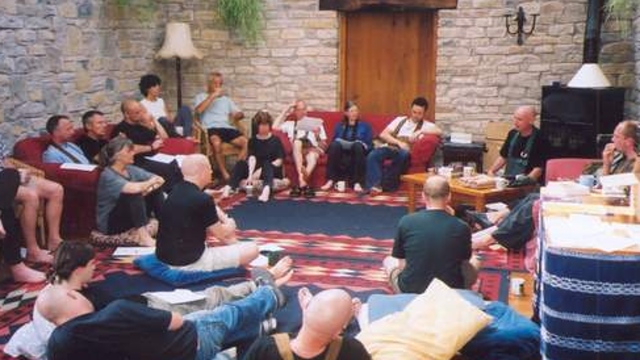
Talks of the series
What the series says (short overview) — About these overviews
Across these five talks, Mike introduces chapters of the Shobogenzo as different views of a reality people already meet in practice, not as a doctrine that could replace that meeting. He says that what Master Dogen does in the Shobogenzo is to describe, across all 97 chapters, one ungraspable something from different viewpoints, and that people experience it all the time; these talks introduce only some of those viewpoints. We are in what is, he says, and we act in what is. Precepts remain, yet a rule followed without its reason can make action rigid, and a changing circumstance cannot always be met by holding an abstract rule. In the reading of Bendowa he gives, Master Dogen’s truth is something in the practice of zazen, not something that one simply knows. The clear explanation he describes as the work of Dogen Sangha helps people see that practice and settle into simple zazen; it does not turn Buddhism into therapy or into a mystery apart from what is actually passed on.
In his account of Genjo-koan, being whole in the action is how we make everything real, and the perfect of One Bright Pearl, as he reads it, is the real situation in which good and bad are mixed, not an ideal in which everything is good. Judged from now, he says, the Soto school did things in the war that were terrible, and he does not mean that therefore nothing was wrong; a book or a retrospective view is not the whole lived situation, the past cannot be changed, and the ethical decisions we can make are here and now. Zazen, and kinhin with it, he presents as a middle without intention: no intention to get anything and no intention to stop getting anything. Real zazen, he says, is always passing through the middle, and we have to try not to try. He holds the Buddhist state to ordinary balance in this moment, not to a euphoric high and not to a picture of the right act held in advance; right and wrong are inside that action, freedom does not mean throwing the rules away to grab the jewels, and life itself cannot be made into zazen. He also says it is absolutely impossible to practice zazen outside zazen and absolutely impossible not to carry its bodily effect into ordinary life, though that effect can be kept or thrown away.
On Uji he reports Master Dogen as not denying the ordinary view of past, present, and future, while saying that in Buddhism time is just this moment; to live that way is almost impossible, he says, but we can move a little towards it. When he is asked whether nature is the face of the truth or one of the faces, he says one of the faces, because reality cannot be held as an image, and he says he has no idea whether he himself is teaching nature. Transmission, as he explains it, is one person teaching another to practice zazen until the practice is their own, not something mysterious. He says Master Dogen says there is no reincarnation; to the suggestion that we are reborn in every moment he answers only “yes in a sense”, and says he has no evidence of it, while reading Gautama Buddha’s “not eternal, not cut off, but in the middle” as denying both an eternal soul and the view that death is simply the end of a body. Sitting remains each person’s choice, a few minutes can become a routine if we can sit at all, and he calls Buddhism itself trial and error, because we do not know where reality is.
Talks in this series
Introductions 1: Rules and Reality
Mike: action follows the situation, not a rule without its reason; Shobogenzo offers many views of one reality
Mike opens the session by arguing that Buddhist traditions and rules need their reasons kept visible, because a rule followed without its reason can make us rigid. In the story of Master Kiso Chijo cutting a dangerous snake, he reads the point not as a licence for carelessness but as being free to act according to the situation. He says precepts remain there, yet an actual changing circumstance cannot always be met by holding an abstract rule. He then introduces the printed chapter summaries as a difficult but useful way into a book whose talks approach Buddhism from many sides.
Introductions 2: Reality in Ordinary Moments
Mike: perfect is no ideal but the real situation, mixed good and bad; ethical decisions are made here and now
Mike presents these chapters as ways of recognising reality in unremarkable moments rather than as an intellectual possession. In his account of Genjo-koan, the “realised universe” is the state in which we make everything real by being whole in what we are doing, without separating ourselves from it. His introduction to One Bright Pearl similarly says that perfect is not an ideal imposed on the world, but the real situation in which good and bad are mixed. He relates this recognition to small moments of acceptance, such as Nick seeing that the robes he had made were already just as they should be.
Introductions 3: A Middle Without Intention
Mike: zazen and kinhin have no intention to get or stop anything; the middle comes by passing through balance
Mike presents zazen, and then kinhin, as a middle state without intention, not as a way of getting something or of deliberately stopping something. Using mu in the sense of “without”, he calls this mu i: in zazen there is no intention to get anything and no intention to stop getting anything. In his account, noticing a thought and stopping it are the same moment, and the same refusal of focus applies to pain, sound, and mental concentration. The difficulty is that talking about this easily becomes a new intention, so zazen is not the purposeful stopping of concentration either.
Introductions 4: Ordinary Balance
Mike ties the Buddhist state to the balance of this moment; right action and time belong to the same moment
Mike holds the Buddhist state to ordinary balance in this moment, not to a special high and not to an abstract picture of how to act. Zazen, as he describes it, is very simple balance: we sway from side to side, and if we do not wobble we crash. Feeling sure that we have grasped everything, or feeling euphoric because we have forced ourselves, is not what he calls the Buddhist state. Zazen, he says, is a steadying influence in ordinary life, but life itself cannot be turned into zazen. On the sentence he reads from Master Dogen, feeling already replete with the truth is what happens when the truth has not yet satisfied body-and-mind. When we wonder whether we have it, he leaves it at “maybe”.
Introductions 5: Clear Explanation for Zazen
Mike: this talk’s Buddhism is an explanation for simple zazen, not therapy or a mystery apart from practice
Mike holds this talk’s Buddhism to a clear explanation that lets people settle into simple zazen, not to therapy and not to a mystery handed on apart from practice. Dogen Sangha, as he tells it, is Nishijima Roshi’s response, after fifty years of study and fifty years of practice, to finding that the Shobogenzo teaches true Buddhism, and the group’s work is to say that clearly in modern words. He says Buddhism is not an intellectual pursuit, but a clear explanation helps them see what zazen is and settle into simple practice with confidence. If someone keeps finding excuses not to sit, he will not supply a method: the choice is theirs, a few minutes can become a routine, and if they cannot sit, they cannot sit. He does not think Buddhism solves personal or social problems as counseling does; to someone depressed he says keep practicing, and that if they do they can cure themselves, and he says it takes years, though a clinically depressed person will not be helped merely by being told to sit. Uncertainty about helping is allowed, and he calls Buddhism itself trial and error, because we do not know where reality is.