Zazen from Four Viewpoints
Mike: zazen is different from thinking, puts the body right, unites body and mind, unites us with the universe
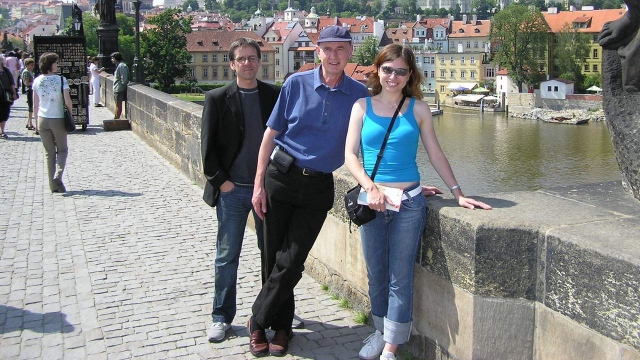
Michael Eido Luetchford
June 2005 — Lotus Centre, Talk 4.
Venue: Lotus Centre, Prague, Czech Republic.
Michael Eido Luetchford · June 2005 — Lotus Centre, Talk 4
Source: audio transcript.
From the retreatPhotosRecordings4Chronicle
Audio
Zazen from 4 Viewpoints.mp3 in the Google Drive folder
What the talk says (short overview) — About these overviews
Mike describes zazen from four viewpoints: as different from thinking, as putting the body right, as oneness of body and mind, and as oneness with the universe. In the questions that follow he keeps coming back to one point, that zazen shows us ourselves as we really are, not a perfect person in a perfect state.
The first viewpoint, tied to the Japanese word hishiryo, is that zazen is different from thinking, although many people believe that thinking is the basis of life and that everything else comes from it. In zazen thoughts keep coming and going, and if we sit for some time they settle, like ash in a glass of water once we take our finger out, but because we are always thinking in everyday life, we keep stirring the water even during zazen, for instance by asking ourselves whether we are thinking. The second viewpoint, putting the body right, Mike explains only physically: the two parts of the nervous system work against each other and can find balance when we sit with the spine naturally straight, whereas an hour of slumping in front of a television or computer squeezes the nerves and changes our physical state. Third, zazen is oneness of body and mind, since Buddhism says we have something that is not separate, and when we stop splitting ourselves into two we are naturally one, in the same state as when we simply act, as in jumping to rescue somebody or playing tennis, where thinking about what we are doing makes us lose. The fourth viewpoint, oneness with the universe, sounds spiritual, but Mike says Master Dogen means something more real: in a balanced zazen we find no barrier between ourselves and the world, and we do not separate ourselves from the cushion, the floor or the wall.
Asked whether growing sensitivity, especially to negative emotions, means the practice is going wrong, Mike says that being sensitive is not necessary, that worrying about the world does not do anything, and that we can act simply, for instance by recycling or giving to charity. In zazen we notice whatever we feel, such as depression we had not recognised or irritability, and anyone expecting a peaceful golden Buddha is dreaming, because in zazen we find ourselves, and noticing that reality is a kind of satisfaction. We always imagine something perfect, and even Mike's own explanation creates such an image, so when our zazen does not look like the beautiful words we think it is wrong, yet that is the real situation. Asked about the four views, he says they can be found, not so clearly, in the early Pali sutras and in Nagarjuna, and that Master Dogen looks at everything from four views, whereas in the West we tend to use two, a spiritual or mental view, similar to idealism, which takes ideas as the basis of existence, and a material or physical view, which takes material things. Buddhism adds a third view, that the basis of existence is our action here and now, since what we do at this moment creates the next, and a fourth, embracing view, in which we wobble between ideas and matter while our present action creates the world, a situation too complicated to describe that we call life, reality or Dharma. As a concrete example he takes zazen itself, where we think our zazen is not good, our legs hurt and we hope the bell will ring soon, yet we still sit from moment to moment and so see ourselves, not the ideal self but a mixture. Asked whether his zazen has changed over twenty years, he says the zazen of twenty years ago is not real, only today's zazen is, although his wife says he has improved, and while he compares cars and the price of food, he does not compare zazen. On children, he says babies might be called Buddhas but are also devils, small children without special disturbance need not practise, older ones have so much energy that sitting still is impossible, and nobody should be made to do what they do not want to, although a seventeen- or eighteen-year-old who wants to practise zazen is fine.
Complete English transcript — About transcripts
Editorial note: This transcript of a spoken talk has been lightly edited to read well as written text, keeping the speaker’s voice and meaning; the wording was adjusted with great care. We recommend listening to the original audio recording too.
This afternoon, I want to talk about zazen from four viewpoints. The first viewpoint is four aspects of viewpoint. No. The first is that zazen is different from thinking. This strange phrase comes from the Japanese hishiryo. Hishiryo. Shiryo means thinking, and hi is very difficult to translate. It means different from, outside of, not, other than. So it has many meanings. So when we say zazen is different from thinking, it's rather difficult to understand. Many people think they are always thinking. So they believe that their thoughts are always moving. They believe that thinking is the basis of life. They believe that everything else comes from thinking.
According to Descartes, the father of philosophy: I think, therefore I exist. But Buddhism has a very strange way of looking at it. It says we live without thinking. Of course, we're always thinking, especially in modern life. But sometimes we're not thinking. But thinking is so strong, even when we're not thinking. So, thinking, not thinking. Thinking, not thinking. So we cover up when we're not thinking. Buddhism says that when we're not thinking, we don't separate the world. For instance, we can think black, grey, different. Different. But if we don't think, we can't tell whether they're different or not. And Buddhism insists that during zazen we experience a state which is different from thinking. Of course, during zazen many thoughts come into our mind, and then they disappear again. Sometimes we don't know where they come from: images, or words, or memories. So we can ignore them in zazen. Then, if we sit for some time, the thoughts coming and going in our mind settle down. A good example: if we have a glass of water, and we put some ash into the glass of water and stir the water, then the ash makes the water cloudy.
If we take our finger out of the glass, the ash settles to the bottom. This is the situation in zazen. But because we are always thinking in our normal life, we like to stir the water. We even think, am I thinking? So we stir the water. Then we take our finger. Then we stir the water again. So this happens during zazen. But the essential state in zazen is not a state of thinking.
The second aspect of zazen is putting the body right, making the body right. The meaning of making the body right we can only explain physically. The human body has a nervous system, and the nervous system controls all the organs in the body. The nervous system has two parts. One is called the sympathetic nervous system. Sympathetic. And the other part is called the parasympathetic. These two parts of the nervous system work against each other. For instance, the sympathetic nervous system makes us aggressive, thinking a lot, and the parasympathetic nervous system makes us passive, concentrating on the physical side of life. So these two parts of the nervous system are always increasing and decreasing in strength. You can read about it in detail in a medical textbook. My explanation is only very rough. When we sit with our spine naturally straight, the nerves come from the spinal cord and come out into the body. And at the top of the spine here,
Jana: Uh-huh, on the back of the thoracic?
Mike: and at the bottom of the spine here, we have parasympathetic nerves. In the middle part, we have the sympathetic. And when we sit naturally straight, the vertebrae— no, the naturally relaxed, not twisted.
So in that situation, the blood flowing to the nerves and the nerve signals to the body can flow naturally, and the two parts of our nervous system can find balance. So we can say zazen actually has a medical, physical effect. If we sit like this, we're bending our backs, the bones are all like this, and the nerves are squeezed. If we sit for five minutes, no problem. If we sit for an hour watching the television or computer, then we experience a change in our physical state. And sometimes, particularly with a computer, like this, we feel tense. I don't know. And so on. So our physical posture directly affects our nervous system.
So when we sit in zazen for half an hour or twenty-five minutes, we can let the back, the spine, relax. If anybody has heard of the Alexander technique, you can find some very useful explanations. The Alexander technique explains that the muscles in the spine, which are connected between the bones, are controlled unconsciously. So in order to relax our back, we need to do some physical practice. So, from the second point, or aspect, we say zazen is putting our body right.
From the third point of view, zazen is oneness between body and mind. We usually think that we have a body and we have a mind, and they're separate. But Buddhism says we have something which is not separate. And when we separate it, we call one side the body, and the other side we call mind or spirit. I don't know in Czech. There is a word for mind and a word for spirit. Is it different or the same?
Jana: Mind and spirit. Mind, it's like thinking, and—
Mike: Okay. Is it the same in English?
Jana: It's the same.
Mike: Same as in English. In French—
Jana: The same problem.
Mike: In French, there is not so much difference, because l'esprit is a mental function. And in Japanese, mind and spirit are the same thing. So in Buddhism, we make no distinction between mental functions and spiritual functions. But when we sit in zazen, when we stop splitting ourselves into two, we are naturally one. So we can feel this state in zazen sometimes. Sometimes we are thinking and we recognise our ideas. Sometimes we are feeling pain, so we recognise our body. But sometimes we are between our mind and our body. This state is the Buddhist state. And it's identical to the state when we're acting, in sport for example, or in our daily life.
The instant that we do something, there is no room for us to think about what we're doing. There's no room to feel what we're doing. We just do. And it's easy to recognise this in very extreme situations, for instance, if we have to jump to rescue somebody. Although we may be thinking, we have to stop thinking to act. And although we know where our body is, we don't need to look to see where it is. We just act. This is also the same in sport, for example tennis. People say, in the zone. Professional tennis.
Jana: I haven't heard this one. In the zone.
Mike: Zone. Okay.
Jana: I don't know what it is. So—
Mike: When you're playing tennis or some game, if you think about what you're doing at the critical time, you lose. If you look to see whether your leg is near the ball, you miss it. So there is some very simple mode of acting which we use all the time, but we don't recognise it. Sometimes we notice it, and we say, oh, I did that without thinking. I just did it. But this is also true of a simple action, picking up something. For one instant, for one instant, in a short time, we stop thinking. We stop looking. We stop feeling. And we do something whole. So this is the meaning of oneness between body and mind. In Buddhism, in Master Dogen's teaching, he calls this action. But it's very difficult to use a word like action. It's very difficult to translate it into Czech and English too. So if we look from another side, we can say a Buddhist state of action. It's the state where we do something whole, not separating into thinking, not separating into perceiving, but doing something fully.
Then the fourth aspect of zazen is oneness with the universe. Oneness with the universe sounds very strange, so many people might think it means some spiritual oneness. But Master Dogen means something more real. When we're acting, when we're practicing zazen and we're in a balanced state, we can't find any barrier between ourselves and the world. So we don't separate ourselves from the cushion, from the floor, from the wall. We don't separate ourselves from anything. So we're one with everything. This is oneness with the universe. And we get the same state in simple actions, for instance in sporting activities and in daily life. So that's zazen from the four aspects. Are there any questions?
Question: I would like to ask: in my first session of zazen today, there was a question in my mind during the meditation. I didn't ask at first, but I still feel it in myself, so I thought I should ask you. Most people start doing something like this to feel, let's say, happier in their lives. At the same time, we become more sensitive towards things in the world around you. From my own experience, I would say I feel the same way, but sometimes I do feel I'm sensitive in maybe a negative way. I do feel more sensitive towards negative emotions than towards positive ones. And I would like to ask: is that normal, or does it mean that the practice is maybe going the wrong way, or that my attitude towards the practice is wrong? What is it?
Mike: Only you can say where your practice is going. But in zazen, it's not necessary to be sensitive. If we're too sensitive, we feel the pain of the world. And sometimes that stops us from acting, stops us living free from worry. For example, if we watch television or read the newspaper, we can see many terrible things happening in all different places throughout the world. Then we can worry. Oh, the world is starving. Oh, the world is coming to an end. The atmosphere is getting worse. There's a war in Iraq. Oh, terrible. But although it's true, our worry doesn't do anything. But especially in modern society, people think that to be concerned, to worry, has some kind of effect. It's not true. But we can act in some simple way. We can have a place in the garden for recycling. We can contribute to a charity, et cetera. But it's not necessary to feel unhappy. If our own life is unhappy, we feel unhappy. It isn't necessary to feel unhappy about somebody else's unhappiness.
But I think, in my opinion, many people may feel this strength. So it's not necessary to become more sensitive. But practicing zazen makes this more realistic. For instance, if we are rather depressed, and we've been depressed for several months, we may not recognise it. Then during zazen, we notice we're depressed. These kinds of situations come up in zazen. If we work too hard and we practice zazen, we may feel very irritable, or very sharp, aggressive. So we can notice our own state. Lots of people think that in zazen we should find some beautiful, peaceful Buddha. But that's only a dream. In zazen, we find ourselves. Irritable self. Negative self. Aggressive self. Sexy self. Whatever we feel, we notice in zazen. This is our state. There's no other state hiding, some beautiful state. We just have to face ourselves. There is nothing else we can do but face our real situation. So zazen helps us to recognise. If we think that zazen will give us some peaceful, beautiful state, like a golden Buddha, we're dreaming. But to notice the reality about ourselves is a kind of satisfaction.
Does that answer? Shall we sing?
Participant: Yes.
Jana: Oh, I don't know.
Mike: Right. Shall we? Why don't—
Participant: Just hold it. Can I have a phone?
Mike: I don't know. Human beings, we love to imagine perfection. So even when practicing zazen, we sometimes seek perfection. But it doesn't exist, only in our mind. So then we feel, oh, I didn't get any perfect, nice state. Maybe I'll stop. I'll stop zazen. We do something else. So all human beings, we always imagine something perfect. Even my explanation creates a kind of image of something perfect.
But in each of our zazen, we can't find anything like those beautiful words. We can't. We can't find anything which looks like the beautiful words our teacher said. So we think, oh, my zazen is wrong, or something. This is the real situation. Any more questions?
Question: Okay, can you maybe tell us something about the four views of looking at the world? I mean, the four philosophies. I've heard it. It's interesting for other people. In Buddhism there is a kind of logic in looking at things from different points of view on the world: Nishijima Roshi calls it the four views of the world, or four philosophies, or rather three philosophies and one reality. And I only— because there were no questions— asked whether Mike could somehow describe something about it to us.
Mike: The four views— we call them the four views— we can find in the early Pali sutras, but not so clearly, because the sutras were written in a different part, a different time. And they include lots of, what's the word, lots of beautiful poetic explanations. But in some of the Pali sutras, we can find the four views. Then, in the second century, a descendant, one of the disciples descended from the Buddha, called Nagarjuna, talked about four views. And Master Dogen, who lived a thousand years later, looks at everything from four views. In Western society, we tend to look at things from two views: a spiritual or mental view, and a material or physical view. The spiritual or mental view, we can say, is, for instance, religions and traditional philosophy. And the physical or material view, we can say, formed the basis of science. So the spiritual or mental view, we could say, is similar to idealism. People who believe in idealism believe that ideas are the basis of existence. People who believe in materialism believe that material things are the basis of existence. So we can find in history many battles between the two groups of people. And the most recent, very clear example is the battle between communism and capitalism, or whatever.
But Buddhism has a third view. But that view is very difficult to explain. It says that what we think is not the basis of our existence. And material things are not the basis of existence either. The basis of our existence is our action, here and now. But this sounds very strange. Our action at this moment creates the next moment. The only place we can act is now. Although we can look at the lessons of history, or we can think about strategies for the future, only what we do at this moment changes the world. So Buddhism says the basis of existence is human action at the present moment.
But this view is so strange that it's difficult to explain. Then the fourth view that Master Dogen uses is an embracing view. It says that sometimes human beings believe that their ideas are real. Ideas are real. And sometimes human beings think that the only reality is matter, material things. But during their life, wobbling backwards and forwards between these two views, their action in the present creates the world. So we have a very complex, complicated situation which we can't describe. We call it our life, or reality, or Dharma. So those are the four views. And Master Dogen uses them to look at things, to look at the subjects he's talking about. That's it. Okay, thank you.
Question: Can you give us a concrete example of what philosophy is? For example, with the connection of position with zazen.
Mike: Yes, our experience in zazen. For example, in zazen we have four views. We're thinking, thinking, thinking. My zazen is not good. I cannot carry on. My legs are hurting. I hope the bell goes quickly. It's impossible. So these are physical and mental views. But still we sit, at this moment, and the next moment. It's amazing! My legs are on fire. But I'm sitting. So we have four views in zazen. We think about things. We think about other things. We feel our perception, feel our body. We exist just at this moment, just at this moment, just at this moment. And that whole situation we repeat again tomorrow. Why?
Question: This state— if a person sits for a week or for twenty years, this state is still the same. What you describe keeps repeating.
Mike: Yes, still the same, but we can notice ourselves. So even though my legs are on fire, just by sitting at this moment, even though I'm thinking lots of thoughts, it doesn't matter. So we get this experience. We can see ourselves. Not the ideal self. Not the dream, some perfect person who I want to be. But this mixture, which is me.
Question: From your point of view, do you find any difference between your zazen, for example, twenty years ago, and your zazen at the present moment? Do you find a difference— or do you think that there is a difference between the zazen of a beginner and the zazen of a long-term practitioner?
Mike: The zazen I did twenty years ago is not real. It's not real. It's not real. It disappeared. It's not here. It's just a memory. So if I remember it, maybe it was worse. Maybe it was better. There it is. So the zazen I do here is the only real zazen. However, my wife says I've become better. So we can see some progress, but not so clearly.
Participant: It's just a human idea to compare things. Yep.
Mike: Yes. It's natural to compare things. But the zazen we have today is the only real zazen. So better than yesterday, or worse than yesterday, I don't know.
Question: Have you stopped comparing things, or do you still?
Mike: Sometimes. No, I stop, yes. I do stop. I compare cars and the price of food, and so— I don't compare zazen. I just do it every day.
Question: Is there any benefit of zazen for children? Or, I mean, someone says, like, children, they don't need to meditate or to practice because they are in this state of mind. They don't have to think yet.
Mike: Yes, I agree. Of course, some children are disturbed.
Question: Children, when they meditate or do zazen, whether there are some advantages for them in it, or whether it is for them, whether it brings them something, whether it is good for them. Because I heard that children at that age in fact don't need to meditate. But again, somewhere there are already courses for children, so that is what I was asking about, what you think about it.
Mike: Let's see. So little babies, we can say, are Buddhas. Of course, it's not true. They're devils. It depends on the day. They don't have a strong interpretation of the world, so they live naturally. So it's important for human society to make them into members of society. Then the problem starts. When children are small, if they haven't had any special disturbance in their life, then they don't need to practice. And when they're older, I think it's, for instance, five, six, seven, eight, nine, ten.
I think children have so much energy that it's impossible to sit still. So they need to explore the world. When they become teenagers, maybe some children can sit as teenagers. But I think it's very, very difficult. So it's not necessary to make people do things which they don't want to do. So if somebody who's seventeen or eighteen wants to practice zazen, that's fine. If they want to go and find boys, that's fine too.
Thank you. Should we stop? Okay. Thank you very much. Thank you.