Effort for Its Own Sake
Mike: we give up the aim only for this moment and keep the long-term one; actions, not plans, make our life
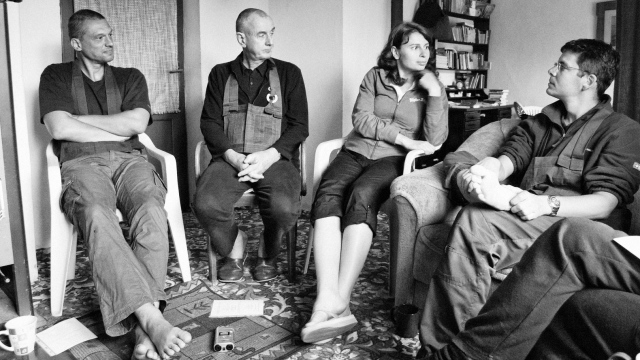
Michael Eido Luetchford
July 2009 — Dibbavana, Talk 3.
Venue: Dibbavana Meditation Centre, Mariánské Lázně, Czech Republic.
Michael Eido Luetchford · July 2009 — Dibbavana, Talk 3
Source: audio transcript.
From the retreatPhotosRecordings4Chronicle
Audio
200907-03-Effort-for-the-sake-of-making-effort.mp3 in the Google Drive folder
What the talk says (short overview) — About these overviews
Mike argues that making effort for the sake of making effort, an attitude he finds very unusual in Europe outside sport or playing music, means giving up our aim just at this moment while keeping our long-term aim. Dogen calls this attitude of concentrating on the present moment action (gyo in Japanese), although Mike is not sure that action is the best English word, and for Dogen zazen is action and the practice of action is the centre of Buddhism.
Mike stresses that he is not talking about giving up the aims of normal life, since a company that gave up the aim of making a product could never sell it or make any profit. When we shop, we can forget our shopping list at the instant we put something in the basket, and when he climbed in the Himalaya after careful preparation, putting one foot in front of the other magically brought the climbers to a different place, so we can move towards our aim by giving up our aim. Sports people know this too, because holding on to the aim strongly disturbs our freedom, and famous footballers say that they are not thinking about winning but just play the match. Everybody's life is full of action, but in our advanced civilisation we cover it up with thoughts about something else, and if we keep worrying about the future or about what others think of us, our life becomes difficult and, in the extreme, full of unhappiness and stress. Human beings therefore need a place where they can act in the present, such as a walk, a game of squash or getting up to make a cup of tea, but there is no teaching that gives value to such simple activity. Because society values the stockbroker above the person cleaning the toilet, Mike says we need a philosophy that says all action is the same, and to understand and practise action is what Dogen calls the great task.
In the discussion he says that when we reach a goal it is always different from what we imagined, as the retreat house near Pilsen turned out to be, and that nobody knows where we are going because the future is not here yet. We choose a direction at every moment, so our plans don't make our life; our actions make our life, a viewpoint he contrasts with the strong bias towards achieving goals and perfection that Christian spiritualism and Greek idealism gave Western civilisation. Dogen's teaching about action, he says, is simple and severe, or dry: it does not tell us whether to get married or whether to become rich, but only says that our life is our action, so we should balance body and mind and act in a balanced way. Asked how Dogen relates action and time, Mike answers that Dogen says they are the same, that in the Uji chapter he gives several views and images of time, and that the only real existence is this moment. What we call time is, in Mike's words, something we construct and share by agreement, which Nagarjuna calls the constructed world.
Complete English transcript — About transcripts
Editorial note: This transcript of a spoken talk has been lightly edited to read well as written text, keeping the speaker’s voice and meaning; the wording was adjusted with great care. We recommend listening to the original audio recording too.
First of all, this afternoon there's free time from two o'clock till four o'clock, as usual. But in the free time this afternoon, I'm going to do a precept ceremony for Robert to receive the rakusu and the Buddhist precepts. The ceremony is about maybe 45 minutes, and we're going to do it in the dojo with a small table and a chair, and me and Robert and two people, Pavel and Andrew, as assistants.
If anybody wants to come and join, they're very welcome. But it's not obligatory; you don't have to. If you want to go for a walk, that's fine. From two o'clock we're going to have just the explanation, to see where to put the table and so on, so I think the ceremony starts at 2:30. So if you want to come at 2:30, please come. You just have to sit and watch. Sorry,
Roman: Oh no.
Mike: I didn't give time.
Jana: Oh, I think they understood.
Mike: You understand? Yeah. Okay, so that's okay, I don't need to. Yes, Kaikyoge. Let's recite Kaikyoge.
[recitation, 00:01:53–00:02:48]
Yesterday I talked about making effort for the sake of making effort. I think, generally speaking, to make effort for the sake of making effort is a very unusual attitude in Europe. I think the main area where this attitude appears is in sport, or other physical activity, or activities like playing a musical instrument, where people get used to making an effort for the sake of making an effort. This attitude is not unusual in Japan, for instance, where people's attitude is simpler in general.
In order to make an effort for the sake of making an effort, we need to throw away our goal. To throw away our goal seems aimless. Civilisation in Europe is so used to pursuing some aim: sometimes a spiritual aim, sometimes a material aim, sometimes a business aim, and so on. And of course it's clear that if we don't pursue an aim in normal society, we can't achieve anything. If we give up the aim of our job, for instance to make a product, then we never make the product.
And therefore we cannot sell the product, so the company cannot make any profit. So I'm not talking about giving up the kind of aim that we hold in our normal life. I'm talking about giving up our aim just at this moment. And in fact, we can give up our aim just at this moment but keep our long-term aim. For instance, in our everyday life we can have an aim to make ourselves healthy. But just at the moment when we're doing the exercise, we can give up our aim to make ourselves healthy.
If we have the aim to go out to the supermarket and buy a list of shopping, then when we actually go to the supermarket, at the instant when we take something from the shelf and put it in the basket, we can forget about our shopping list and just put the product in the basket. So the kind of giving up the aim which I'm talking about applies to our action in this present moment. Another example: if we go for a hike in the mountains and want to get to the top of one mountain, we look at the map and plan which way we're going to go.
Then we set off with our companions towards the mountain. But in every step, we can give up the aim of getting to the top of the mountain. And if we do that, magically we find that we are moving towards the mountain. I did mountaineering for many years, at quite a high level, and this was my real experience. For instance, when we were climbing in the Himalaya, we made very careful preparations, getting special food, special clothing and everything.
But in the actual situation, putting one foot in front of the other, then stopping and looking back, magically we moved to a different place. So we can move towards our aim by giving up our aim. This is very important in sporting activities, because if we hold on to our aim strongly during our sporting activity, the mental effort of focusing on our aim disturbs our freedom. And so many sports people know clearly that during their activity the most important thing is what you're doing now.
If you ask famous footballers about the match which they're just going to play (for instance, a journalist says to them, Do you think you're going to win today?), they often say, I'm not thinking about that. Just play the match. So there is something in the way that we can lead our lives where we give up trying to get somewhere. But that doesn't mean we don't achieve anything. It's an attitude in the present moment, an attitude where we focus on what we're doing now, not where we're going next.
These two attitudes, to focus on what we're doing now and to plan what we want to get, where we want to get to: if we think about them, they seem to be contradictory. But in reality they're not. So we can have both attitudes at the same time. We can plan for the future and forget about the future. Now this attitude of just concentrating on the present moment, giving up our aim and doing something here and now, is called action in Dogen's teaching. Gyo, in Japanese. Gyo. Whether action is the best word in English, I don't know. It covers not only moving or doing something, but also putting ourselves into the present.
So for Dogen, zazen is action. Although we're not moving around, we're giving up our aim, giving up all ideas and focusing on where we are now. So in Dogen's language, this is action. The practice of action is the centre of Buddhism. Action is different from ideas. Action is different from what we think it is. Everybody leads a life which is full of action, but in our advanced civilisation we cover it up. So the person walking along the street towards their office may be thinking about what they're going to do when they get there.
So although they're acting, they're covering it up with their thoughts about something else. And I do this, you do this, everybody does it. However, without the action itself, which is different from thinking, we can't lead a normal life. So if we keep thinking about something else while we're leading our lives (for instance, keep worrying about the future while we're living today, keep worrying about what somebody else thinks about us, keep dreaming of our new boyfriend or girlfriend), our life becomes rather difficult. And in the extreme situation, it becomes full of unhappiness and stress. So human beings need a place where they can act in the present and throw away their thinking, their hopes, their intentions and so on.
And everybody finds this to some extent: to go for a walk in the countryside, to go and play squash, to go to the gym, to play the piano, to get up from the computer and make a cup of tea.
All these are ways where human beings act. But there is no teaching to give value to this very, very simple activity. But Dogen taught that action is the centre of Buddhism, the centre of our lives, the centre of the universe, and the most important thing.
We need the freedom to act, and we need a philosophy that teaches us the value of action. Human beings in our very sophisticated society don't realise the great value of something simple. The person in the stockbroker's office, working on the computer, transferring very large amounts of money by pressing fingers on pieces of plastic, says he is, or she is, a very, very important, valuable person.
But the person three rooms away is cleaning the toilet, and they think they're a very poor and ignorant person. But one is doing this, and one is doing this. So of course, in society we give value to different actions. For this reason, we need a philosophy that says all action is the same. If we have that philosophy, we can give value to all human beings equally and do all activities equally.
So to understand what action is and to practise action is what Dogen calls the great task. And that's the centre of his teaching. The end. Ask me a question.
Participant: That means you are saying that to have a long-term goal is okay, just to forget the goal at the time when you are doing something.
Mike: Yes. When you reach your goal, it will be completely different, and you forget that it's different, so you think you have reached your goal. So actually we never reach our goal, but in our mind we think that we reach our goal.
Roman: Why don't we reach the goal?
Mike: Because our goal is only in our mind, and it's imagination. And when we reach it, the situation is always different.
Participant: How different?
Mike: For instance, I was going to go to the Czech Republic, to a retreat near Pilsen somewhere, in a house which is run by a Theravadan Buddhist, and I imagined a two- or three-storey house with lots of very small rooms, somewhere quite near to Pilsen. But here I am, and it's completely different, and it's not so near Pilsen. So I got to my goal, but my goal is different. That's all. It's different.
Participant: But these are only things that are not so important, I think.
Mike: No, it's not important.
Participant: But your goal is important. Your goal is teaching, for example. You are teaching here now the same way as you were thinking about it before.
Mike: No, no, it's not true.
Participant: Not true.
Mike: I never know what to say.
Participant: Yes, so you didn't prepare your talks beforehand?
Mike: I have some kind of vague shape or colour, and I also always feel a little worried. So, what shall I talk about?
Participant: You give yourself the situation.
Mike: We all do, yes. Of course we reach our goals in our daily life. We do what we want to do, it's true. But from another point of view, what we achieve is always different to what we imagined. So we accept it and we move on, yes. But from one point of view, our goal is always here, but reality is not here yet. That's all.
Participant: From my experience, most of the time we are not even aware that we have a goal. We are doing something, but, you know, when you become so frustrated, that means that somewhere you have a goal, but reality is completely different, and that creates frustration.
Mike: That's true, yes.
Participant: So maybe you do not think to yourself, I have a goal.
Mike: That's true, yes.
Participant: We hide our goals from ourselves sometimes.
Mike: Yes.
Participant: Yes. So it takes a long time to figure it out: why am I not pleased with my life, or with something in my mind? And then it clicks: okay, all the time I was trying to achieve something, but it was an illusion. And I was, as Mike said, covering up simple activity with my thoughts. For example, when I play the guitar, I usually cover it up, so my mind is somewhere else. But I can bring it back because it's activity. This is activity which is simple, and you just give up, give yourself to music. But sometimes, you know, your mind is somewhere else.
Roman: You described the moment, but I think it's important to have some direction in your life. You can live only without direction, or, for me, it's important to have some direction, some direction between something, not...
Mike: I think it's very important to have a direction in your life, and I don't think you denied it.
Participant: No, I agree, it's the same, yes. But not to... to be yourself that you have some goals or some direction, and be frustrated by that.
Participant: It took ten years to figure out that my goal was: I want to be the great guitar player. But I didn't know that I had a goal, and so I was always unsatisfied. I would see some great player, and I was, you know, like in a competition. But I didn't know what the problem was. The problem was that I wanted to achieve something with my playing. It was not enough just to take the guitar and play.
Participant: But at the moment that you know about this, you have the same direction. You can have the same direction, but not criticise yourself that you are not so good. You accept your direction, that you want to play well, not be a famous guitar player.
Participant: Just to pick up the guitar and play. And then put it down and do something else, and forget about the guitar. Then the other day, pick it up and play.
Question: But how do we select the long-term goal? Which one is good, and which one is worthwhile?
Mike: We can choose freely what our goals are, and we can head towards them as fast as we can. It doesn't matter. But actually we don't know where we're going. People who want to know very, very clearly where they're going are usually a little insecure. So they need to have a very clear idea where they're going. It makes them feel more comfortable and gives them confidence. But actually, nobody knows where we're going, because the future is not here yet.
Participant: So we might select anything and just go to Mars.
Mike: So we're selecting our direction at every moment. We think that we are selecting the direction of our life by planning or thinking in our head and by deciding what we want, what we don't want, what we like, what we don't like and so on. But every single moment we are choosing a direction, sometimes consciously, sometimes unconsciously. Every step, every moment, every step, we create the future. Even when we walk along the street and cross over from the right side to the left side, it changes our life. We stop at the traffic light and wait for the green, or we run across the road.
All those decisions make our real life. So we are making our life with our actions, although we believe we are making our life with our plans. To plan is natural and part of human society, and I don't mean don't plan, just move. Crazy. But we can notice that our plans don't make our life; our actions make our life. That's all. Just notice.
Participant: There's some idea that you have some wish, and this wish is very important for you, and you should abandon the wish in the moment, forget it. But some time in life, some years in the future, maybe many, many years, it happens that the wish is...
Mike: It's completed.
Roman: Ah yes, it's true.
Participant: But now you are... yes, that was the wish that I had before, twenty years before.
Mike: Yes, that's true. Sometimes, yes. Sometimes it's not true. There are many different circumstances in life. Sometimes we get what we want. Sometimes we don't get what we want. Sometimes we want what we get. Sometimes we don't want what we get. So, many different circumstances. But what we get depends on our action at every moment. This is a rather unusual way of looking at life, which is not so common in Western countries, in Western civilisation. For thousands of years we have had a Christian background, which is based in part on Greek philosophy, and Christian spiritualism: God is speaking to us.
Christian spiritualism and Greek idealism combined gave Western civilisation a very strong bias towards achieving goals or reaching perfection. And this fact built the whole of our civilisation, and this recorder on the floor. So everything in human society is the result of that way of thinking. So Buddhism introduces another viewpoint. Not that this viewpoint is right and the other viewpoint is wrong. Just another viewpoint.
And this other viewpoint is very simple and very important, because we don't notice it. We don't notice that we change our life at every moment.
Participant: You said that this viewpoint, the philosophy of action, is quite unusual for our society, I mean Europe, America.
Mike: Yeah. But I think that the philosophy of action was taught by Dogen, Nagarjuna and so on, so they must have had the same problem. So, for instance, it's common to the whole of human society.
Yes, so for instance, Nagarjuna had the problem because Indian society was very intellectual, very philosophical, and there were many very philosophical and intellectual traditions in ancient India, which you can see if you read the philosophies of great Indian philosophers and so on. And Dogen had the same difficulty, because he was surrounded by people who were practising many different kinds of Buddhism that came from many different places. And he wanted to teach the philosophy of action in a simple, direct way. So many times he criticised other ways of thinking and so on. Yes, so the problem exists all the time, I guess.
Participant: So it's our nature that we are driven by our thoughts.
Mike: Yes, it's our nature, but it's also a result of the direction of our society. Society can take different directions over hundreds of years, and we can say that sometimes society becomes very idealistic, or sometimes society becomes very materialistic. So our normal attitudes in society and our values change, and we can see different values in societies. Now the world has become much smaller; we can see many different societies that have very different values. For instance, in the 1970s Japan became very important, and everybody wanted to do business with Japan, and everybody wanted to learn about Japanese methods. And people in the West wrote that Japan had some special secret of success; many books were written. And the reason was that they found a whole society doing something from a completely different point of view. No secret, no special power, just they had a different viewpoint. And when the West saw this viewpoint, they couldn't understand it. Businessmen couldn't understand, for example, having meetings with Japanese. And there were lots and lots of thick books written about it. So this was Western culture meeting Japanese culture.
And now I think maybe a similar thing happens with China, to some extent. We don't realise that the Chinese way of doing things is fundamentally different from ours. We tend to think everybody's the same underneath, so really they're like us. So we give reasons to people's actions based on our own social values. But the teaching about action is independent of those things, because it's very simple.
Participant: I think that now the situation is that Buddhism is being created in Europe, finding the ways; it's also mixed with Christianity and tradition in Europe, and then something other comes out.
Mike: I think that if we see the real situation, then we accept the real situation. That's not very clear. Of course, Buddhism has come to the West from different sources: from southern India, from Burma, from Thailand, from Japan, from Korea and so on. And we all have Christian values in the West from many hundreds of years, and sometimes we don't realise they are Christian values. So Buddhism in the West is a kind of mixture, and we're finding our way and finding what Buddhism is about. So it takes a long time. Yes.
Participant: It will not be the same Buddhism as in Thailand, Japan, Korea and so on.
Mike: No, not the same, no. But the same.
Participant: Because the nature of people is different.
Mike: Yes. But the nature of the universe may be the same. Doesn't have to be. Yes.
Participant: I think that's the most important point.
Mike: Although scientists have said there may be parallel universes, there may be many different ones, I think there's only one, actually. So the teaching of Buddhism, Dogen's teaching about action, is rather simple and severe, or dry. It doesn't tell you whether you should get married or not, or how to live your life in society, whether to become rich or poor, and all these kinds of things. It doesn't say anything about them. It just says that our life is our action, and our action makes our life. So balance your body and mind, and then act in a balanced way, and get on with your life, whatever.
Even if you're a Christian, you can practise zazen and lead a balanced life, I hope.
Question: Is that noise the oven? Okay. I thought maybe the universe is humming. In what way does Dogen explain the relationship between action and time? Because it's not clear to me. I read some of his essays in Shobogenzo, and he has very strange, I mean, ideas about time, so that basically the nature of time is not what we experience as time. We experience, like, linear time.
Mike: Linear is linear.
Participant: Linear, yes. Time flows from the past; now is the present; the future. But he says that this is not the nature of time. So could you explain? I think that he says that action and time are connected.
Mike: He says they're the same. In the Uji chapter, actually, he has different views. He says that we think of time flowing like a river, from past to present to future, but our actual experience is now, in which time is existence, or existence is time. So what he's saying is this: in our normal lives we remember the past and think about the future, and that's normal, so we can say that the past and the future are within me now; but the only real existence is this moment.
So in that sense, what we call time is a kind of invention, which we need to function in society, but actually time is now, just now. But he doesn't give only one point of view.
Participant: No, no, I've read it a few times and can figure it out. You know, sometimes he says the present goes to the past. So I thought that he's talking about our psychological states, because in our mind we can move when we want to.
Mike: Yes. And he says, for instance, we usually think of time like a line. The past is like a line going backwards: yesterday, and then the day before yesterday, like a line. But he says we can think of time past like standing on the top of a mountain and looking out over all the other peaks. So there's yesterday, there's tomorrow, there's last year. So he creates lots of images which are different ways to look at time. He has lots of different images in the chapter. And he also says time is just here, just now.
Or in other words, what we think is time, we are constructing and sharing. So you look at your watch, I look at my watch, we say, Oh, another four minutes, and I look at the little hand and it's moving, so I think time is moving. So you agree? No. So if you don't agree, then we don't have time.
We need agreement, so we construct and share time.
And we construct and share the past, and we construct and share the future. So Nagarjuna calls this the constructed world. And there's an excellent American philosopher called John Searle, who has written a very excellent book called The Construction of Social Reality. It's a bit philosophical, but he's talking about how human beings create our world by sharing our thoughts and feelings, and then we believe that world is real.
Participant: What about animals? Or dogs? They live with us.
Mike: I'll ask the cat whether it's the end of the lecture.
Participant: Is it time to stop?
Jana: I don't know.
Participant: No idea what you're thinking.
Participant: The cat is not sharing.
Participant: But it's not there. Yeah, it's not.
Participant: No, I don't think so. Maybe a little bit. Domestic animals share.
Participant: Yes, they do, don't they? We had a little cat, and at eleven o'clock it used to come in and go meow, meow, every day. Yes. So it's sharing.
Participant: Oh my, that's sharing. And it's a reflex.
Participant: Oh, reflex. It's nothing else.
Participant: Oh, no.
Roman: No.
Participant: I thought it was sharing.
Participant: I think you need concepts to create concepts. But it's the subconscious part of our brain. It's not real.
Participant: Maybe it's not really just a reflex.
Participant: They have a very beginning intuition. They intuit your world in some form, I think. Maybe I'm mistaken.
Participant: Yeah, maybe.
Participant: And people who have domestic animals also give something to the life of the domestic animals.
Mike: Yes.
Participant: They construct too.
Mike: They're part of the human family to some extent.
Participant: Yes.
Mike: Yeah. But, you know, this is not part of our family, and wild animals are not part of our family. So we share a different consciousness with most wild animals and birds and fish.
Participant: There's some kind of treating illness by being very close to some animals.
Roman: Oh yes.
Participant: I think it's to abandon our construction and be more relaxed.
Mike: Yes, I think the animals do that, don't they? Yes. People like to have pets because pets have a different value system. For instance, dogs are usually always happy to see you, even when you're in a bad mood, or...
Participant: Compared to women, for example.
Participant: A dog is better than a woman. Sometimes.
Mike: Okay, it's twenty past, I noticed. So let's chant at the end of this talk.
Jana: No.
Mike: I thought we were half hour.
[recitation, 00:56:32–00:57:52]
Mike: That's Japanese, and that's Chinese. Medieval Japanese and medieval Chinese, not modern. So a modern Japanese person can't usually understand.
Participant: Because we chant it after zazen every...
Mike: Yes.
Participant: In zazen, but...
Mike: Yes, you do, yes.
Participant: More... I used to sing it more quickly.
Participant: More quickly?
Participant: Yes. Ah, more quickly. But is it better not so quickly, or...? Negawakuwa kono kudoku o... I guess.
Participant: Okay, yeah. Make a pause. I think we'll get to the fragment.
Mike: The first part doesn't have such a strong rhythm, but the second part does. Yes. So there's no rhythm in the first part: negawakuwa kono kudoku o motte amaneku issai ni oyoboshi.