Enlightenment as a Normal State
Mike rejects enlightenment as a superhuman state won by greater effort: the state we seek is that of zazen
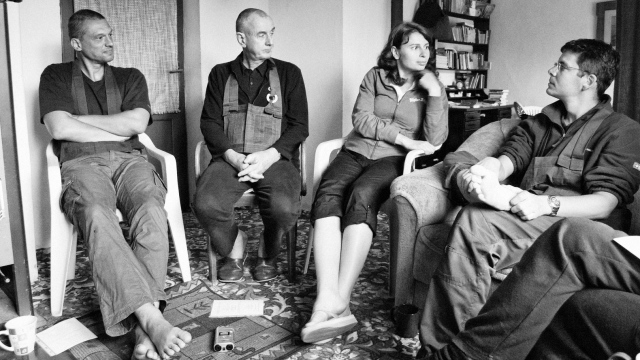
Michael Eido Luetchford
July 2009 — Dibbavana, Talk 2.
Venue: Dibbavana Meditation Centre, Mariánské Lázně, Czech Republic.
Michael Eido Luetchford · July 2009 — Dibbavana, Talk 2
Source: audio transcript.
From the retreatPhotosRecordings4Chronicle
Audio
200907-02-State-called-enlightenment.mp3 in the Google Drive folder
What the talk says (short overview) — About these overviews
Mike says that the idea of enlightenment as a special superhuman state, free of problems and mistakes and reached sooner by ever greater effort, is complete rubbish. Following Master Dogen, he says that the state that we are seeking is just the state in zazen, which even a beginner has, and that the most important thing is to practise every day, because ten minutes every day is better than sixteen hours for two weeks.
Because we start zazen hoping to find something special and find only our confused and chaotic self, many people doubt this, and the wish to become better and better through zazen is very strong. Mike tells the story from the Shobogenzo of Daikan Eno, a labourer at a temple, whose reply poem to the clever head monk's poem said that there is no bright mirror to polish, and who was then secretly given the transmission by the master of the temple. What Daikan Eno realised, Mike says, is that practising zazen is not making an effort to make ourselves better: we do make an effort, but the aim of our effort is just effort, as when we clean the windows just for the purpose of cleaning the windows. So the goal of practising zazen is to have no goal: many beginners want to know what the purpose is, it takes a while to get used to this, and it is puzzling especially for Western people.
Mike then explains the physical side of zazen, which Dogen could not explain in his time because there was no medical science. Sitting upright in a balanced posture lets the muscles between the bones of the spine relax, so the spine becomes a bit longer, the pressure on the nerves to the organs becomes less and the nervous system becomes balanced. Seen like this, zazen is just a standard method of balancing our body, a nice normal state rather than a spiritual one, and teachings about attaining something special, making great efforts or wearing unusual clothes are all a kind of hobby. In the discussion he adds that the effort in zazen is to sit and let the spine lengthen while looking for a balance between too much tension and too little effort, and that a participant's constant wondering whether he is practising rightly is itself a normal attitude. Each of us, he says, can only attain our own normal state, and we are getting it every day. Asked about ego, Mike says that we create a picture of ourselves and then believe it, that we cannot get rid of ego, but that every time we act we let go of it, and when we act sincerely, self and other disappear. He tells people not to try to bring zazen into everyday life, but to practise zazen every day and live their normal life without worrying, because practising zazen changes our physiological state and this change stays in the body for some time. He ends by describing Buddhist belief as a belief that what we are experiencing is real, not an intellectual belief but also a kind of physical one, a belief that comes when we practise zazen on and on.
Complete English transcript — About transcripts
Editorial note: This transcript of a spoken talk has been lightly edited to read well as written text, keeping the speaker’s voice and meaning; the wording was adjusted with great care. We recommend listening to the original audio recording too.
Shall we recite Kaikyoge?
[recitation, 00:00:13–00:01:06]
This afternoon, I'd like to talk about the state called enlightenment, because in the talk this morning I described how many Buddhist groups which have a kind of spiritual structure put enlightenment at the top. And so, to attain enlightenment by constant effort is a common belief in those groups. And so naturally, people think if they make a bigger effort, they get enlightenment quicker. And if they make a superhuman effort, they might get it in one week or two weeks. And this leads to, for instance, some groups having very intensive meditation, many hours a day for several weeks. This attitude, to me, is a waste of time. The most important thing in our practice is to practise every day. Ten minutes every day is better than sixteen hours for two weeks. In Dogen's time, they had long retreats in the summertime. And this was a tradition that came from India.
But in those countries there is a rainy season. And in a rainy season, it rains very hard for several weeks or even months. So to have a retreat during that weather, when it's impossible to work in the fields, is a very nice tradition. But the most important thing is to practise every day. And I want to explain a little bit why.
People think that so-called enlightenment is a special superhuman state where we no longer have any problems. And we no longer feel unhappy. We no longer suffer. We no longer make mistakes. And so on. But this is complete rubbish. And if we look at the teachings of Master Dogen, we can find lots of descriptions by him where he says that the state that we are seeking is just the state in zazen.
And even a beginner has the same state as somebody who's been practising for a long time. But that makes us very puzzled, because when we start to practise zazen, we can't find anything in our state that's special. And we hope to find something special. But all we find is our confused and chaotic self. And that's it. So Dogen says, That's it. But many people doubt it.
The tendency for human beings to want to get better and better, to practise zazen to become better and better, so that our state in zazen gets better and better, is very strong. There's a story in the Shobogenzo which Master Dogen describes, about the life of a Zen master called Daikan Eno. He was the sixth person to receive the transmission after Bodhidharma, who brought the practice of zazen to China from India. And actually, he didn't join the temple as a monk. He worked in the temple outbuilding as a labourer, a worker. And I think his job was to grind corn, to make flour. And in this temple, the chief priest was a very clever intellectual.
And he was very proud of his understanding of Buddhism. So he wrote a poem on a piece of paper and hung it on the wall in the temple corridor. I can't remember the poem exactly, so this is a kind of rough idea. It said something like, Our consciousness is like a bright mirror, and we have to constantly polish it and clean it to get free from dust and dirt. And he wrote this poem and put it on the wall. And I suppose that Daikan Eno must have seen this poem. And he knew the character of the head monk.
So secretly he wrote his own poem in reply. And in his poem he said, There is no bright mirror, so what is the use of cleaning and polishing? And he pinned the poem on the wall. And when the master of the temple saw the poem, he tried to find out who wrote it. And eventually he found that Daikan Eno had written it. So some time later, in the middle of the night, secretly, the head of the temple, the master of the temple, invited Daikan Eno to his room and gave him a transmission of Buddhism and a robe and the bowl and told him, Please leave the temple now, because other people will be jealous.
So, in that simple story, we can see that what Daikan Eno had realised, which the head monk had not realised, is that practising zazen is not making an effort to make ourselves better. Of course, we make an effort in zazen. But the aim of our effort is just effort. To say that our effort is just effort sounds strange. We're used to making effort for an aim.
So if we don't have an aim, sometimes we think there's no point in making an effort. We can see this attitude in many activities. For instance, if we walk around our house, we look and say, Oh, it's not dirty, so I don't need to clean yet. Or, Oh, the windows are not dirty, so I don't need to clean them. But according to Buddhism, we clean the windows for the purpose of cleaning the windows. We clean our room just for the purpose of cleaning our room.
This is a very strange idea to Western people. But in Japan, we can still find this attitude, after hundreds of years of Buddhism. But it's disappearing. So, just to do something for the sake of doing something is what Daikan Eno realised, and the head monk at that temple didn't realise. Just to practise zazen for the sake of practising zazen is what Dogen teaches. And to practise meditation in order to make ourselves more pure, or better people, is not Buddhism. It's some kind of spiritual attainment. Goal. Goal. Goal. But I think this is quite a strange attitude for most people. And for that reason, many people who start to practise zazen want to know what the purpose is, or what should I do, or what should I focus on? The habit of pursuing a goal is very strong in us.
But the goal of practising zazen is to have no goal. It takes a while to get used to that. And it takes a while to realise what that feels like: sitting in zazen, not having any goal, not trying to do anything, not trying to get anywhere. And so this is quite puzzling, especially for Western people, when they first start to practise. In Master Dogen's time, he couldn't explain the physical side of zazen in the same way that we can today, because there was no medical science. People didn't understand the workings of the nervous system until about 1900.
But since 1900, medical science has made great discoveries. And we can now understand how what we do changes our physiological state. What we eat changes our physiological state. And we know about the effects of all kinds of drugs on our physiological state. When we sit in zazen, we are sitting in a physical posture. Physical posture, sorry. Sitting upright in a balanced posture allows the spine to become relaxed, or, in more detail, it allows the strong muscles between the bones in the spine to relax. And so our spine becomes a bit longer. And because our spine becomes a bit longer, the pressure on all the nerves which come through the spine to all the different organs in the body becomes less. So the functioning of the nervous system becomes balanced. If we sit like this for a long time, because our spine is twisted like that and our muscles are tense all along this side, the nervous system is biased towards one side. And this affects the balance in our body.
So we can describe the state in zazen as being the state where our nervous system can be balanced. There are lots of different states where our nervous system can be balanced. For instance, if we keep moving around in all directions, which we do in physical activities and sport, we can make our nervous system balanced, because it's not biased to one side. But if we sit still, then we unbalance our nervous system. Not sitting still, but keeping active, helps to balance our body. Zazen is just this function. But we can do it without going out into the sports field, or running or walking in the rain or hot sun. So zazen became a standard method of balancing our body. People in Dogen's time couldn't explain it like that.
They didn't have the knowledge to explain about the nervous system. And there weren't many activities like there are today, sport and other physical activities and so on. So we can be much clearer about what zazen really is. And if we see it as balancing the body, we can see that it's just having a nice normal state. Not a spiritual state, but a balanced state. And if we practise zazen for several days, like we are now, we can feel settled and contented. So, if people can understand that the function of zazen is very simple, like this, then they can see immediately that all the other teachings, which are about attaining something special, making great efforts, doing strange practices, wearing unusual clothes, making beautiful noises, are all a kind of hobby. But the essence of Buddhism itself is very simple. And that's why we find it so difficult to understand. Thank you. The end.
Roman: I feel that my back is somehow naturally crooked. I feel that I can't reach that upright posture at all, where the muscles can relax. Can that perhaps affect the state of zazen, or can I somehow get to the balanced state even though my spine is not straight? I'd like some comment on that.
Mike: Yes, no problem.
Participant: Okay. But I still feel that during zazen I have some tension there, and that it actually somehow suppresses the effect of zazen that Mike talked about. I mean, you spoke about nerves and the flow of energy, so I think it's this block, and maybe it's suppressing it.
Mike: Maybe, or do you think it is?
Participant: I don't know.
Mike: Can you imagine what it's like if it didn't suppress it?
Participant: No, I haven't had this experience, so maybe… Sometimes maybe I'm more energised and I can get closer to this posture, so then I feel better, but I don't know.
Mike: Yes, so we all have different bodies, differently shaped bodies, and some people have spines which are shaped like this. And some people have very curved necks. My neck is curved. Some people's necks are very straight. So when some people sit in zazen, their back and their shoulders and their neck and their head are beautifully straight. Yours is. But other people, like me, you can see a curve here. So my neck is curved. The bones are curved here. I can't straighten them out. And if I make a very great effort to straighten them, I create tension.
So the effort we make in zazen is to sit and let our spine lengthen. And how to do that exactly, we don't know for our own body, so we try. And sometimes we feel too much tension, too much effort. Sometimes we feel too tired, not enough. And so we're looking for a balance all the time. So that's zazen.
Participant: Yeah. I would like to know about this effort. I don't know what the measure of this effort is, or actually what I have to do during zazen in my mind and in my body, because sometimes I feel I just… I can't focus so much. I just feel sometimes—
Mike: This is why you are such an excellent practitioner. Always—
Participant: Oh my God.
Mike: —you're wondering, Maybe I should be a bit different, this is not quite right. So this attitude is normal. If you think, I'm practising beautifully, this is not so good. So your feeling is just your feeling. Your feeling that maybe this is not good enough, or maybe…, this is just your feeling. What you are actually doing is making yourself into an excellent Buddhist person. Isn't it?
Roman: Yes. You mean the sincere effort?
Mike: Sincere effort.
Roman: That's what Karel has. Sincere effort is important.
Mike: Yes, and sincere effort doesn't know where it's going. This is why new people practise zazen and sometimes they don't know. So Master Dogen says that effort is the effort in zazen, and we get used to it, but we don't lose that feeling.
Participant: I think it's quite natural that we can't see the results of our practice, because I can't see any results. But still, I'm making a constant effort. Even in the physical posture, lengthening the spine and balancing the body on the cushion is the most important.
Mike: The most important thing. So whether we feel unsure or not about what we're doing, or whether we're wondering or not, is just our wondering.
Participant: Which is sometimes puzzling. For example, if you have a friend who doesn't know anything about Buddhism, and you want to explain to him—
Mike: Why am I doing this?
Participant: Yes.
Mike: It's quite—
Participant: Difficult.
Mike: Difficult. Yes. Impossible.
Participant: Isn't it because some people, like Pavel… I think he's such a balanced, realistic, normal person, so he cannot see any difference. So I think it doesn't mean that for him practising zazen is useless, not at all. But with me, for example, I'm often very excited or often very confused or very sad. I see the difference after even five minutes of zazen. So some people are naturally balanced, and they cannot see—
Mike: —a difference, because they are excellent even before practising. Some people are so lousy, like I am, so I can be a little bit better after zazen. Should I agree? What can I say to you?
Participant: So much praise for everyone.
Mike: Can we rewind and play it again?
Roman: But does it make sense?
Mike: We all have our own life. We have our own childhood, our own influences, our own problems, our own way of living. All those things make us. So we can only attain our own normal state. You can't have Pavel's normal state. I can't have your normal state. You can have your normal state. You're getting it every day. That's it. Enjoy it.
Question: So I'd like to ask: apart from the meditation of zazen, the Buddha defined ego as the biggest illusion, which gets in our way and separates us, and he explained how that ego works, put together from those five elements. How can this be connected with what you say about zazen?
Mike: I never tried.
Participant: But how to use it, or whether not to use it, or just to sit zazen and balance?
Mike: I don't think the Buddha talked about ego. He talked about atman and anatman, and self and other. And he talked about not choosing self over other, and that's really talking about ego. And he also explained that we build up a picture of ourself for ourself, our own me. We create a me all the time. And that me is only our creation. It's not an illusion. We really create it, but it doesn't exist anywhere, only in our mind. But there is another self which is real, and that self is moving in the world.
So I think the Buddha was talking about the way we create a self, a me, and then we believe it. So: I am an important Buddhist teacher. People should serve me. They didn't serve me today. This is very bad. So I can make up a self, then I can believe that self. Or you can do the opposite, you know: I'm just a very humble person. I don't understand anything. I can't do anything. My life is miserable. We can make up ourself and then believe it. And the Buddha said this self is not the real self. It's a construction. But I don't think we can get rid of ego.
We cannot get rid of ego. It comes and goes for everybody. Some people have a very external ego, so they're confident and speak loudly. Other people have an internal ego, so they're quiet. But still, they have an ego. It's part of being human. But when we prefer ourself to others, then we believe that the self which we constructed is real. So not to prefer self or other, to balance between inside and outside.
When we balance between inside and outside, we forget which is me, which is you, which is what I want, which is what you want, and so on. I think we couldn't exist in society without an ego, because it's necessary in the society which we created. But it's also necessary to let go of it sometimes. So, having a balanced ego. Though I think people who try to get rid of their ego are just making their ego stronger.
Participant: It's said that by practising zazen and then having a very clean consciousness and so on, you see that ego is a construction. That's what I'm practising for, for example.
Question: Can you see that ego is a construction during zazen?
Participant: Sometimes it helps, yes, of course. It helps that before I was in some construction of myself, or of somebody. So we can drop the construction, leave it. For me, during zazen it's like that. It's very important.
Question: Do you think that our belief in our constructed self, or this ego, can weaken or change, become more balanced, that the belief itself can somehow be let go of?
Mike: Did somebody… I didn't hear the first part.
Participant: The belief in this constructed self or this ego that we create, which may not be balanced, which may be biased towards the inner, can it be let go of or diminished?
Mike: The belief in the ego. I think once we realise that we create a picture of ourself, once we notice that, it has already changed.
Participant: We always need some kind of belief in me, so we always need some kind of construction. We always need—
Mike: We can't stop it. We can't stop—
Roman: Not possible.
Mike: —creating ourself. But when we act, every time we act, we let go of it. So if we act sincerely, then self and other disappear, or ego and the world disappear. So the central thing is action, which I want to talk about tomorrow, because action usually means doing, moving, but in Buddhism it has a wider meaning. So if we think about zazen as balancing, we can say balancing everything. We are balancing inside and outside. We're balancing self and other. We're balancing pure and impure. So, for instance, in zazen, I don't have pure thoughts.
Sometimes there are very impure thoughts, and sometimes neither pure nor impure. So I'm always wobbling like this.
Participant: My experience is that in that posture it's easier to accept yourself and everything, you know, even if you have impure thoughts or pain. I mean, sometimes, not often, but sometimes for a few seconds it's okay. One thought after another, one feeling: I'm not sitting well. But it's not so fixed. Usually in life, you have an idea and you grab it and won't let it go, and there is conflict with other people. But zazen is just opening. So the thought is still here, but for a second it's not so important. And it's not something special. Sometimes it's just so ordinary that it's boring.
Participant: I thought it would be something exciting, you know, some experience. But it's just life.
Mike: Just life, yes.
Participant: Smells.
Mike: Your life, yes.
Participant: And somehow it includes everything. Ideas, feelings, pain, sounds.
Mike: Yes. Me too. But many people say, Oh, I want to bring zazen into my everyday life, or, How can I transfer zazen into my everyday life? And I say to them, You can't, don't. Because if we go into a job... [inaudible, 00:47:35–00:47:46] We can't deal with our problems. So the attitude is: practise zazen to practise balance, then live your life just how you want to. That's very important, because practising zazen changes our physiological state. So this change stays in our body for some time. And this is the benefit of zazen. We don't have to try. So practise zazen every day and live your normal life without worrying, whatever it is.
Participant: I think that every time we are talking about this, we are talking about the conflict, or maybe not the conflict, the difference between our beliefs, or the intellect, or our thoughts, and the experience of reality. For example, there is a whole library of Buddhist words, thousands and thousands of categories of Buddhist theory. If you go to the forest, there is nothing like this. And for me, it's quite difficult to realise this difference between my thoughts, my beliefs, and to realise that it's just my thoughts. Yes, it's very difficult.
Participant: It's a whole library of very complicated teaching, and what you say is a few sentences, very simple. Everything summarised in a few sentences.
Mike: This is very important, to cut through a very complicated explanation. And all the Buddhist teachers, back from Dogen and Nagarjuna, tried to cut through the complicated explanation.
Participant: Yes, I agree with this completely. But it's quite funny that the whole library is totally complicated and that people believe it, and everything is really so simple. In fact, there's nothing to teach.
Participant: What I meant is that, for example, I can believe in reincarnation or whatever, but I don't think it's important in my life. So, in my case, I'm not interested in, you know, studying things about reincarnation and past lives and so on, because I can't see anything of this in my life.
Participant: So I think when we realise what life is like, quite simply, we notice that these other complicated things are not important.
Mike: So if people want to believe them, they can believe them, but it's irrelevant. Which means that it's not so important what I believe in. Is it important or is it not? Well, it may be, for example, your motivation to do things, or not to do things, so somehow it's important, but on the other side it may be different from real life.
Participant: Well, it's very important what you believe in. So we should believe in reality, and reality is what is here and now.
Mike: So Buddhist belief is believing in something which is always changing. So it's very important to believe in this which is always changing, not something else, somewhere else. So it's not a kind of abstract belief like we normally think. For instance, Christian belief: I believe Jesus died to save everybody from their sins, or something. Belief. But Buddhist belief is different from that. It's a belief that what we are experiencing is real, and this is the world, and everything is obvious. Nothing is hidden. So we believe that. And that belief is not intellectual belief. It's also a kind of physical belief.
So if we practise zazen on and on and on, it comes. I don't know where it comes from. I don't know what it is. But some kind of belief. I can say, This is real. Reincarnation is not true. How can I say that? Many sincere people believe in reincarnation, but I feel that it's irrelevant, because I believe in this world.
Shall we stop? Sorry, no more questions. I have to stop you there. Please keep them all for tomorrow. Thank you. We have the chant, Fueko.
[recitation, 00:55:41–00:56:58]