Summer 2004 — Bussho
Series digest
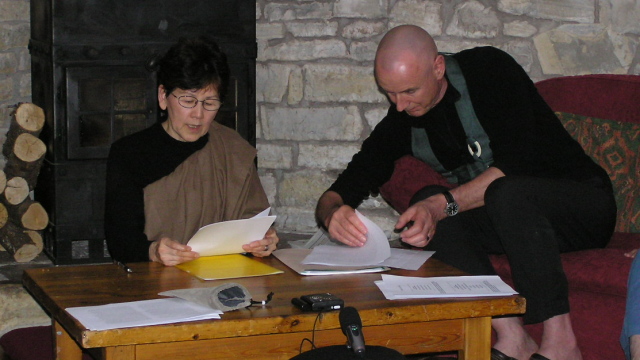
Michael Eido Luetchford
Summer 2004 — Bussho.
Venue: Earth Spirit.
Michael Eido Luetchford · Summer 2004 — Bussho
Editorial note: A digest is a shorter way into the talk: the speaker’s main ideas in their own voice, gathered by theme. It suits a first acquaintance or a reminder; nothing in it is added. The full wording, with all examples and context, is in the full transcript, which remains the authority.
An experimental phrase
I’ve chosen to talk about Bussho, buddha-nature; I haven’t finished my modern interpretation yet. The chapter starts with a poem from Gautama Buddha:[1.1][1.2]
All living beings fully manifest buddha-nature in their existence:
Buddha is always present and does not change.[1.2]
“Fully manifesting existence” is not in the original. It’s a bit of an experiment, to catch something of the Chinese/Japanese meaning; if I can find a better phrase I’m quite happy to change it.[1.2]
Master Dogen is asserting that what the poem says is something fundamental to Buddhism, maintained by practicing Zazen.[1.3][1.4]
He says these words mean a person who cannot be captured in words arrives from somewhere we cannot describe exactly. With our conscious mind we give people a history: I am Michael, I come from Bristol. But the real situation at this moment is beyond description; we can suppose a lion in front of another lion doesn’t think, “seen you before”. It has something to do with just being who we are at the present, beyond interpretation, beyond name. “Living”, “sentient”, “life-form”, “creature” are alternative terms: to live is to fully manifest existence, and that, he says, is the nature of buddha.[1.5][1.6]
For hundreds, even thousands of years buddha-nature has been discussed as a quality that you get after doing this and doing that, going up through the ranks. Master Dogen is destroying that misconception.[1.14]
What it is not
Master Dogen denies that Bodhidharma’s skin, flesh, bones and marrow are an order of value: we all fully manifest our own characters, so to say so-and-so is better is inappropriate. Fully manifesting existence is not a concept like “existence” or “non-existence” either.[1.7][1.8]
… “living beings fully manifesting their existence” is me-and-the-world-unseparated, which does not depend on ability accumulated day by day, does not come from random circumstances, does not depend on following the rule of the Universe, and does not depend on having mystical powers or on practicing to get a result.[1.10][1.11]
We picture oneness as two things welded together, a body and a mind, but Buddhism insists there’s only one thing; the two is what we make of the one. Nor is it some reward for our conduct. We can’t understand what he’s talking about unless we practice Zazen; the real experience that fits those words comes from Zazen.[1.10][1.12]
Question: Does Zazen make you more likely to just slice bread wholly?
We usually think that to become a good buddha we train, and that’s not wrong; Zazen is training ourselves to slice bread. But Master Dogen is saying that fully manifesting existence is not the result of training; it’s a state in the present moment. We need more than one viewpoint, and we have to talk about practice as a process. But the actual experience doesn’t come from anywhere. We’re training to un-train ourselves: dropping it off, then dropping off the habit of dropping it off.[1.17][1.18][1.19]
“Fully manifesting existence” is not to return to an original state of existence that once we had and have now lost, because the present moment includes both the eternal past and the eternal present.[3.1]
Nor is it, he says, something in the future that we’re not good enough to get, a series of moments, beginningless, or new. These are contradictory, the same argument as in Uji and in Master Nagarjuna.[3.1][3.2]
He says buddha-nature is not an enduring “self” like Senika’s eternal soul, nor knowledge built up until we’re enlightened. My “movement of molecules in our brains” is Dogen’s “movement of wind and fire”. A stupid person can be as much of a great buddha as a clever person. For him, realising and knowing are manifested just at the present moment, “beyond movement through time”.[3.3][3.4][3.5][3.6]
Some people think we have to wait until some future time for buddha-nature to manifest itself; he says this kind of person is not a Buddhist.[4.6][4.7]
He calls the metaphor of a seed watered by the rain of Dharma just the romantic thinking of ordinary people: seeds, flowers and fruit all exist as they are at the moment of the present. That seems to deny scientific explanation, and he means to; elsewhere he affirms it. A seed is a seed, is a seed; that’s what he means by fully manifesting existence.[3.16][3.17]
One world, one me
Master Dogen denies another Universe outside this Universe, and another him at the present moment. We talk as though there were two of us, and split ourselves. But there’s only one of me; when I am one, I fully manifest me. We are as we are. That doesn’t mean we can’t change. He says we can’t recognise this intellectually, because our mind is always busy interpreting reality from past experience.[1.13][2.1]
Question: A girl came in with a load of labels; playing Monopoly, it all disappeared.
So we assert ourselves beyond labels, not only in Zazen, but Zazen is our standard. Whenever we act wholly, without a second person, we fully manifest who we are.[1.14]
We can be whole even when we’re ill or unhappy, but if we think we shouldn’t be unhappy, we split ourselves.[1.15]
To fully manifest existence is just to be as we are here and now. He says it is not the objective material world, nor a Universe centred around me. When we don’t make any division between our self-centred world and the external world, we fully manifest existence. When we act, we throw away that division, if only for a second; when we pick up a cup of tea it disappears.[2.1][2.2]
He says it is not easy to see this fact. We want to be a spectator on our lives as well as living. For the heart of the matter I’ve put “freedom in this moment”; I don’t know if that’s the best phrase.[3.2][3.3]
The instant of action
Question: Might we describe Zazen itself as a simple form of action?
Yes.[2.2]
Question: Is it the being? The looking?
We can’t recognise it; this is why Buddhism is so difficult to explain in words. In Zazen we’re sometimes aware of the room, sometimes inward looking, sometimes there’s a balance.[2.2]
To balance you must wobble, and in that movement there’s an instantaneous middle position where we’re not thinking. The same happens whenever we act. We can’t grasp it or properly describe it, but these instants of action are our ground, the basis of our life.[2.3]
Question: If we’re not aware of them, what’s the point?
There isn’t a point to anything; it’s the doing. When we do things with all our effort, there’s no place to notice, to look at ourselves; we just do. Then the busy mind comes back: “should I have done that?” But the instant of action comes billions of times through our day.[2.6]
We can’t imagine mind not conceptualising, but every time we act we drop it all away. We think listening to me talk about Buddhism will teach us Buddhism, but doing or acting is the basis of our life. Master Dogen writes about that, but never managed to finish what he wanted to say.[1.20]
Buddha-nature is clear when there is no division in our mind between things that happen and the time they happen; doing something fully, we have the nature of a buddha.[4.7][4.8]
Question: Can we ever know we’re buddha?
No. “Oh, I’m a buddha now” is a thought, different to the nature of a buddha. You put the spoon in the bowl… We can think back, “I was a buddha then”, but that’s only a thought; if we think “this is the present moment”, that’s a fraction of a billionth of a moment after. When we’re involved in being ourselves in this moment, that’s all there is; we call that “action” in Buddhism. Of course we’re not numb, but there’s no second person.[4.9][4.10]
Question: Is working it out afterwards completely useless?
No. But it’s useless in the sense that understanding what’s gone into the past can’t act in the present; if we look for buddha in the past, it isn’t there. I give up.[4.10][4.11]
Real present time
The Buddha said:
If we want to know the meaning of buddha-nature,
It is just real present time, causes, and circumstances.[4.2]
Master Dogen says wanting to know it is not only intellectual knowing; it also means wanting to practice it, experience it, explain it, and be unaware of it. Each is a present fact. He goes further: drinking the glass of water is the present, explaining buddha-nature is the present.[4.2][4.3]
He creates an image: what is happening and present time are like two mirrors facing each other, with no room to call this moment perfect or imperfect. Then he says this mirroring is not divided into two. This, he says, is real buddha-nature, free of the concept “buddha-nature”, Buddha just being Buddha. “Things as they is.”[4.4][4.5]
Question: This is not unique to buddha-nature; it’s true for eating, laughing, shouting.
Everything, yes.[4.5]
He echoes Uji: viewed from the present moment, there is no process. That sounds bizarre, because we know there’s process, but when we act fully, past and future collapse into the present. That’s the third of the four viewpoints; I find it useful to notice them, not to mark them out.[3.3][3.9]
Question: Is buddha-nature a way of throwing away Uji?
Buddha-nature is Uji. Buddha-nature, Uji, buddha, nirvana are total expression in the present; there is only one fact that he’s trying to explain.[3.18]
Thinking, words and doubt
The mind is always busy; when the mind is not busy, there is no mind. “Intellectually” is maybe superfluous, maybe a carry-over from Nishijima Roshi; I mean thought.[2.4]
To me, saying you had one of those moments five minutes ago is pointless; it’s gone. Maybe that’s just my character; the important thing is to act now. We cannot stop thinking, so we should have thoughts which point us towards the basis of our life. These words are a kind of delusion, but better than “there is a happy land far away”. The basis of our life is outside of these thoughts, which is a real pain![2.4]
A master who told his students not to read sutras was found reading one: “I’m just shading my eyes”. We need to look in the drawer; that’s to be human. The idea that we should somehow be perfect is idealism. Buddhas open drawers.[2.5]
Question: Doesn’t “grasp real knowing” suggest a buddha knowing it’s a buddha?
No, by grasping he means throwing it away, stop thinking. But we can’t get past the words: “you said grasp!”[3.13]
Question: Could you reverse it, so that reality manifests us?
Yes, however, we need both viewpoints. Say something is manifesting me, and lots of people look for the “something”; say “me manifesting something”, and they look for the “me”. So Master Dogen says forget about both; but in words, we can’t.[1.19]
At the very time which I doubt, buddha-nature is just coming back to me.[4.11]
Just my doubting in the present moment is buddha-nature. There’s no “it” to run away.[4.13][4.14]
Thinking and talking most take us away from the present; I don’t mean it as a criticism, I mean it as a fact. But we can inhabit a separate area to such an extent that we believe it’s real, and that’s the source of lots of our suffering, or our problems.[4.11][4.12]
Question: But a process view is good too; without it…
We wouldn’t have any civilisation. Master Dogen has never said that we should get rid of this view.[4.11]
Why we keep explaining
Master Dogen says there wasn’t any Zazen in Japan before him, but there was in China; he introduced pure Zazen, shikantaza, just sitting.[3.8]
Question: Why did Dogen write so much, not just “sit in Zazen, goodnight”?
Why did you go to India?[3.14]
Question: I just went.
That’s why he wrote, he just wrote.[3.14]
Question: Without explanation you’d build weird ideas about Zazen; this knocks them down.
Yes. In Master Dogen’s time people said that chanting the name of Buddha makes you know everything, that standing under a cold waterfall can make you enlightened, that buddhas are superhuman. He denies it all.[3.15]
Question: Why do we keep explaining Zazen when we could just sit?
I can answer that for myself, not for you. What Nishijima Roshi said made sense to me, sometimes, not always, and that made me value Zazen. After 25 years, the only thing I’ve got to teach is how to practice Zazen and what I learned from him about Dogen. So I just do it. The contradiction is real. But the fact that we ask the question is the answer itself; if you don’t need to ask it, there’s no need to be here.[4.15]
When we practice Zazen, we sit in reality, and reality seeps into us; we’re not trapped by ideas so much.[4.16]
I can’t think of any words to write, so I pinch a bit of light off the edge of Master Dogen’s. After this chapter, I want to rely completely on Zazen, not work out how this chapter can work for me. It’s finished; let’s do the next thing.[3.19][3.20]
Master Dogen says the time here and now is the only time there is. And the retreat we’re having here and now is the only retreat there is. He keeps pulling us back, and in Zazen we pull ourselves back, again and again. It isn’t wrong to fly off, but this is the basis of our existence, it’s here.[4.18]
Question: Kodo Sawaki says we shouldn’t take the temperature of our Zazen.
He means we shouldn’t compare. The person who is sitting now is the only me there is now; all the other Zazens are imaginary.[4.19]