Yoko on Sawaki
Yoko reads Kodo Sawaki’s zazen as fully becoming yourself, not as something gained
Eido Yoko Luetchford
Summer 2004 — Yoko Luetchford, standalone talk.
Venue: Earth Spirit.
Eido Yoko Luetchford · Summer 2004 — Yoko Luetchford, standalone talk
From the retreatPhotosSummer 2004 — Bussho4Chronicle
What the talk says (short overview) — About these overviews
Yoko reads her own English translation of Master Kodo Sawaki’s talks and treats zazen as fully becoming yourself, not as a special state you get from it. Where people ask what they can get, she reads his answers “you can get nothing” and “you can become natural”, against the idea that lighting a candle brings satori at once or that satori is the same as intellect. She keeps Master Dogen’s words that shikantaza is not an idea but the fact of just sitting, and that the state of sitting is satori itself, not something that must come before practice or after it.
The posture, in the passage she reads, is the skin, flesh, bones, and marrow of the ancestors, and the old woman’s prostrations at Ryu-unji are what showed Sawaki that this posture reflects the truth of Buddhism. Practicing it, she reads, makes you not push others down and makes you become yourself fully, whether rich or eighty, dropping off mind and body, without comparing yourself to others or to your past life. Belief in zazen is, in the next part, an action like tuning a radio to the wavelength of the Universe: gassho and just sitting, made habitual, make your state the same as Gautama Buddha’s. She reads the rule of Buddhism as pure sake, and people who go from talk to talk adding ideas, from the Rinzai school or elsewhere, as pouring water into that wine. The line she later discusses says practice does not help other human beings but helps you to become a buddha, and that Buddhism is not an ideal heaven or something to remember, but full and sincere conduct here and now. Acting fully, in that reading, is the same in breakfast, cleaning a room, or a moment of sport when winning and losing are not what you are thinking about.
The four bonno she reads — not knowing that your buddha-nature is the same as Gautama Buddha’s, a self-centred view, comparison with others, and love of self — are what Sawaki thought to be the root of human torment, and she reads that understanding them intellectually will not remove them without zazen. When someone asks whether living with a person who sits might still change them, so long as they do their own zazen, she says that is not his meaning: he emphasised just zazen and spoke fiercely, and to the suggestion that he was challenging practice for other people’s souls she answers only that it could be. Mike, whom she introduces as her interpreter, adds glosses and does not take over the talk: it helps you, do it for yourself rather than as a Christian prayer for others, sitting means we are buddhas and can skip being bodhisattvas, and Sawaki is criticising people who collect talks and think they have got something, while lots of people in Japan do that even without zazen. Asked what he did as a professor, she answers that he did not deny real Buddhist talks or the need to study Buddhist theory; his title was professor, but he trained students in zazen and in Master Dogen’s zazen, not only on the intellectual side. In the 1952 NHK interview she then reads, Sawaki says fox-zazen mistakes a muddy delusion for enlightenment, while sincere sitting, without reciting sutras or thinking, is real zazen and being a true buddha, and he goes on to say that zazen is Gautama Buddha’s rule. She ends on his picture of human beings as bits of mildew on the earth, and on zazen as Tenchi ippai, fullness between earth and heaven, itself the most valuable thing in the world.
Complete English transcript — About transcripts
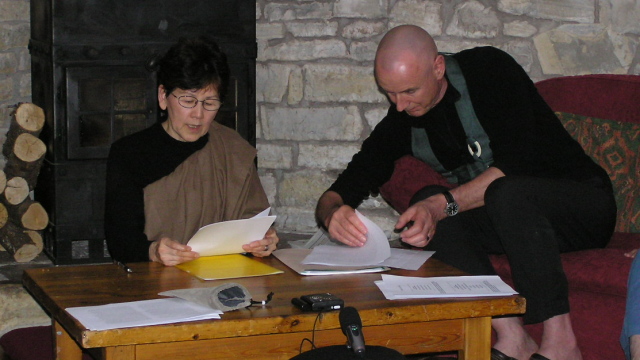
I’m going to read some excerpts which I translated from Master Kodo Sawaki’s book. There are over ten books about Kodo Sawaki’s talks and comments, and many biographies. The book from which I’ve translated these excerpts into English is a collection of his talks given here and there throughout Japan on his travels. I’ve divided it into eight parts, so I’ll read up to the fourth, then if you have questions we can talk about it, and then if my pronunciation is strange and you couldn’t understand, please shout, alright? And my interpreter is that person (Mike).
1 The life of Master Kodo Sawaki
Master Kodo Sawaki was born the fourth child in a family of factory worker, in the west part of Japan in 1880. When he was five years old, his mother died, and three years later his father died. His two sisters and one brother were adopted by relatives, but none of his relatives wanted to adopt him because they said he was a very difficult boy to deal with. Therefore he happened to be adopted by a couple who had no moral sense at all. They lived at the back of a brothel, his adopted father was a swindler, gambler and blackmailer, so that their house was a hotbed for a gang of hooligans, and a lot of gambling took place in their house, day and night. When he was growing up in this most hideous of circumstances, he witnessed the sudden death of a man in the brothel one day. He was very shocked to realise how severe and fragile life was. Since then he kept looking for the chance to run away from his adoptive parents.
When he was seventeen years old, he decided to leave for Eiheiji. After standing at the gate of the temple for two days and nights he was accepted as a temple labourer. However, he said that he found that there are just ordinary people living at Eiheiji, and many young trainee priests were very brazen and were just interested in eating lots of food and drinking lots of saki. And also he found that if a person belonged to a particular group, they would tend to follow the other members of the group. He felt that this attitude would make him senile, because people in Japan were very group minded. Therefore he had a great struggle to find a way to get out of Eiheiji temple. Consequently he did not stay there for a long time.
At the age of eighteen, he left Eiheiji, and went to Soushinji in Kumamoto, which is in the southern part of Japan, and met Master Koho, who later gave him the precepts. He was called up to the armed forces during the war between Japan and Russia at the age of twenty-five. He started giving talks on Buddhism and teaching people how to practice Zazen by travelling through Japan from Kyushu to Hokkaido. Since then, he had lived in Daiiji Zen temple in Kyushu in 1925. At age twenty-six, he was appointed professor at Komazawa University, which is a Soto sect Buddhist college, and also he worried about the tradition of kesa – the robe, dying out, so that he taught how to sew the robe, to many nuns, from time to time. He was a true Buddhist priest, until his death at the age of eighty-five. So this is a rough life history.
And number two:
2 Zazen
There are many misunderstandings about Zazen. Some people believe that when you strike a match to light a candle or incense, then you get satori, enlightenment at once. Or that when you get satori, enlightenment, you can understand everything. This understanding was popular in China over nine hundred years earlier. Some people have the tendency to trust their intellect completely, and those people think that satori or enlightenment is the same as the intellect. Some people asked, if they practiced Zazen, what could they get from it. He replied “you can get nothing”. Those people who expected something special from Zazen looked greatly confused. Then he replied, “you can become natural”. If you try to understand Zazen intellectually, it will make you very confused. Master Dogen said that Shikantaza is not an idea, but the fact of just sitting in Zazen. While he was working as temple boy aged seventeen in Eiheiji temple, he was sent to Ryu-unji temple, where a special hundred day ceremony – Gokoe, was held. He worked under an old woman doing chores there for the ceremony. One day, after the end of the big ceremony, all the priests and temple workers had a one-day holiday, they all went out to town to enjoy themselves. But he stayed at the temple alone, and wanted very much to practice Zazen on his own in the Zazen hall. While he was sitting in Zazen, the old woman who worked with him, happened to enter the Zazen hall and was shocked very much at seeing him sitting in Zazen. She immediately prostrated to him many times to show her respect. He was also shocked to realise that the Zazen posture must be something special, because she was a rather mean person who had always nagged and scolded him while he was working for her. This fact told him that the posture of Zazen reflected something about the truth of Buddhism. Zazen is the skin, flesh, bones, and marrow of the ancient ancestors of Buddhism. Zazen makes you not push others down, and makes each of you live as natural people. You become yourself fully by practicing Zazen. If you are born into a rich family, you should be a rich person fully, if you are an eighty year-old person, you should be an eighty year-old person fully, dropping off mind and body.
The state of Munen Musou (no worldly wants and no delusions) is the state in which you become yourselves fully, without comparing yourselves to others, or to your past life. Number three:
3 Belief in Zazen is a kind of action like just tuning in the radio
You have to tune in to the wavelength of the Universe. This action is gassho – prostration, and just sitting in Zazen. This action puts you on the same wavelength as the limitless wavelength of the Universe. If you put yourself on the wavelength of the Universe as your habitual action, then your state becomes the same state as Gautama Buddha’s. There are no wrongs in the state of satori, enlightenment, in Buddhism. It is not easy for you to practice Zazen, yourself, alone – practicing Zazen with other people, together, is much easier. However, it is very important for you to establish the habit of practicing Zazen. Some priests say that if you get satori, then you should start practicing Zazen, and some priests say that you should practice Zazen until you get satori. Those ideas are utterly wrong, Master Dogen said that the state of sitting in Zazen is satori itself.
4 The rule of Buddhism is like pure Sake (wine)
Some people have the intention to listen to talks in order to add some ideas to their own idea or knowledge or ideas on Buddhism, and then go to listen to other people’s talks, from the Rinzai sect or from something else. What those people are doing is just like adding water into the pure wine or sake. Some people want to improve themselves by listening to Buddhist talks. It is not a good way for you to study Buddhism half-heartedly like that, because if you do it like that, it will lead you into confusion about your life. Practicing Buddhism is not the way to go to some ideal heaven; it is the way to find yourself as you are. It doesn’t help other human beings but it helps you to become a buddha. All you have to do is to practice Zazen and experience yourselves, on and on until you make yourself convinced by doing it. Buddhism is not something to learn intellectually or to remember, Buddhism is just our full and sincere conduct here and now. All sorts of sports are momentary action – people just act momentarily without thinking about winning or losing. This momentary action is oneness of life and death, or winning and losing. This action is the same as every action in our day to day life. Whenever you have breakfast, you just eat fully, whenever you clean your bedroom, you just clean your bedroom thoroughly. It is very important for you just to act fully. We live momentarily at the moment of the present, fully, between the heaven and the earth in the Universe.
5 People in every society are competitive
Master Dogen said “even if you think you are better than others at something, there is no merit in it. If you think about being different from others, then you are not yet awakened”. As Master Kodo Sawaki was from a very poor family, he was not allowed to finish even compulsory education, he put all his efforts into studying Buddhism, in various ways, for a along time. He hated to be a loser; he was very proud that he was the number one priest in Japan, as far as chanting sutras beautifully and loudly was concerned. He taught many priests in Tokyo how to chant sutras beautifully; therefore he had a terrible shock on reading this teaching of Master Dogen’s. Of course, ever since then he stopped comparing himself to others.
6 Four bonno, (Four Worldly Desires)
Master Ryusui composed poems.
“Mind which I am not aware of, I call mind without perceiving.” “Who has named something called mind? The echoes reverberating through the hills are my voice; however who is the person called I?”
However, there is no such thing as enduring mind, spirit, or soul, they are changing at the moment of the present. You seem determined to worry over your achievement or loss, you seem to be eager to want to get back something which you lost in the past.
There are four terms called the four worldly desires in Buddhism, they are gachi, gaken, gaman, and gaai. Ga means “I” in modern terms in Japanese. But in this case, ga means mind or spirit. Therefore these terms are called the four ga, or the four bonno in Japanese.
Gachi means ignorance of self. You don’t know your self, in other words, you don’t know your buddha-nature, you don’t know clearly that your buddha-nature is the same as Gautama Buddha’s nature. When you sit in Zazen, your state is the same state as Gautama Buddha. If you practice Zazen, you are a buddha. If you steal somebody’s belongings, you are a robber.
Gaken means individualistic and self-centred. You have your own opinion and criteria about every single thing. He interpreted it as Dokudan, which means arbitrariness, or the mind of common man. In other words, you are always wearing a pair of coloured glasses.
Gaman means comparing the self; you always compare yourself to other people, so that you are prone to become too proud of yourself, thinking that you are cleverer than the other person. Or on the contrary, you are prone to belittle yourself, and to feel that you are not a worthy person compared to somebody else, because you have an individualistic self-centred view. There are individualistic views among the countries of the world; the cause of wars is based on this fact.
Gaai means love of self or eroticism. You think that you are the most important person on the Earth. For instance, if you see somebody being stung by a wasp, you don’t feel for them, but you a stung buy a wasp, you make a great fuss about it. People who are inclined to live in this fourth state instinctively are called mediocre people. These four terms are used often when training junior priests in temples in Japan. The truth of Buddhism is not satori or enlightenment; it is just to forget everything which you think belongs to you. He thought that the root of the torment and troubles that human beings experience comes from human beings’ tendency towards these four states, although you may understand intellectually what he means, it will be impossible for you to get rid of these four states without practicing Zazen.
Shall I stop here? Did you understand? Do you have any questions?
Question: I think in part four, there was some kind of reference to your Zazen not affecting other people, I can’t remember how it was worded.
So practicing Zazen doesn’t make you compare yourself with other people, something like that. Just that you don’t compare yourself to others.
Question: There was something about not helping other people……..
Yes, it doesn’t help other human beings. So that means Master Kodo Sawaki discriminated in that case – you are practicing Zazen, you are listening to the truth of Buddhism, but other people, this means mediocre people, aren’t helped by your practice.
Mike: It doesn’t help other human beings, but it helps you.
Question: I think maybe in a small way if you live with someone who practices Zazen, it might change, at the end of the day they’ve got to do their own Zazen. Is that the meaning of it?
No, I think he emphasised, just practice Zazen, Zazen, Zazen. So in that case he was quite critical, he had quite a sharp tongue, he talked quite fiercely.
Question: Do you think it may be a comment on other people who practice for others, for their souls or for the lives of others, and he’s challenging that view?
It could be.
Mike: So do it for yourself. So in Christianity people pray for other people, but not that.
Question: But the idea of a bodhisattva is to stay and help others.
A bodhisattva, yes, yes?
Mike: But Master Dogen says if we practice Zazen, we’re buddhas, so we can skip over being bodhisattvas!
Question: Can I ask you, you mentioned that he said something about people listening to talks on Buddhism, and then he became a professor at a university, I’m a bit confused about what he did at university, and also, what about Mike’s talks on Buddhism, should we ignore those talks on Buddhism.
That’s a very good question. He was interviewed by the NHK broadcasting company, NHK is the equivalent to the BBC, and in that interview he was talking about how to practice Zazen. He emphasised that to listen to the real, true Buddhist talk is important. So he didn’t deny studying Buddhist teachings, we need to study Buddhist theory.
Mike: So what he is saying is that some people go around listening to Buddhist talks then they think they’ve got something, then they go off and listen to someone else, then they’ve got some more. So he’s criticising that attitude. Lots of people in Japan do that, without Zazen even.
They just accumulate their own knowledge about Buddhism, so he was criticising that. And he was a professor, his title was Professor, but he trained students in Zazen, and talked about Master Dogen’s Zazen, so he did not teach only the intellectual side of Buddhism.
Question: Did they have exams in Zazen?
I don’t think so.
Question: They would have all passed.
All passed, yes. No pass or fail.
Question: Can I just say that Kodo Sawaki seems to have as you say, a very sharp tongue and, a very strong personality. And also having a difficult childhood, do you think there are certain things that can happen to someone in their life that help them become a Buddhist?
No. He really wanted to become a Buddhist himself when he was very small.
Question: But do you think it had anything to do with him having a difficult life – Master Dogen lost his parents too?
The situation and circumstances between Master Sawaki and Master Dogen are quite different. Master Dogen was born in a very high place, the emperor’s relative, so…..
Mike: But Martin is asking if you have difficulties when you’re young….
Master Kodo Sawaki had much difficulty, yes. He was forced to be a guard at the gate of their house, where gambling was going on.
Question: He was a war hero as well wasn’t he?
Yes, a war hero. But in those days, all priests, if they were called up. Had to do their duty, there was no discrimination between priests and ordinary people. So in his case, he just acted fully, therefore he was a successful soldier, although he was wounded. So I don’t think he was a war hero, but he had a special medal….
Question: Was he a priest before he went to war?
No, during the war he became a priest. He was talking about this part of his life in his interview, shall I read it? I’ll read it and then finish:
7 – NHK interview which was broadcast in 1952
Interviewer: You were wounded in the Russo-Japanese War, you were shot through the mouth, and since then you have had difficulty in speaking, have you recovered completely?
Sawaki: I was not able to speak at all for over six months, and had asked the doctor when I would be able to speak properly. He told me that if I started to talk just like a baby, with all effort, then I might be able to speak again. So I did that for a long time. Now I can say most words with great effort, but it makes me feel rather tired, it seems that my tongue is not functioning properly.
Interviewer: Did you volunteer for the army and were you a priest at that time?
Sawaki: I was a priest then. I was called up to the armed forces at the age of 25. I had heard that priests had the right to refuse to join up, but there was no discrimination between ordinary men and Buddhist priests in Japan. Therefore all Buddhist priests had to go into the army if they were called up. The authorities in Japan in those days did not protect them.
Interviewer: Are you from a Buddhist temple family, what made you become a priest?
Sawaki: No, I was not from a Buddhist temple family. My parents died when I was a little boy, so that I was adopted. I was brought up in a horrible environment, and I experienced the awful, dirty side of human beings day and night. And so I wanted to go to some pure place. When I was 12 or 13 years old, I started visiting a nearby temple secretly, and listened to a Buddhist talk occasionally. Gradually, a longing to devote myself to the truth developed in me.
Interviewer: Did you choose to become a priest voluntarily, or did someone suggest that you do it?
Sawaki: I was wondering how I should live. I kept secretly visiting the temple while I was with my other parents. My mind was struggling between the two sides of my life in day to day life. In one, I was forced to stand guard at the front gate of our house while unlawful gambling was going on. In the other, I was visiting the temple and was moved by listening to Buddhist stories. One of these stories in the Nehan Gyo Sutra was about a young boy named Setuzan Doji who laid down his life in the name of the truth. I decided to run away from home, and to devote myself to the way of the truth. So I did. I ran away to Eiheiji temple, taking two small bags of rice with me. The distance from my house to Eiheiji temple was about 175 miles. It took about 2 days and nights to get there.
Interviewer: How old were you then?
Sawaki: I was seventeen years old. I stood at the gate of the temple for two days and nights. The priest refused to accept me and just said, “go home, go home”. So I said “I have such a strong will to become a priest, if you will not let me, I will kill myself.” The priest said “That’s not good! That would cause a lot of trouble.” Then a priest came out of the gate and let me go into the temple. They gave me some rice gruel.
Interviewer: How did you find life in the Temple for the first time?
Sawaki: I found neither heaven nor enlightenment there. There were just ordinary people in the temple.
Interviewer: What did you do after entering the Buddhist world, with your strong will to become a priest?
Sawaki: I had been worried how I would cope with life in the temple. As you know human beings are very complicated, I did not have a proper education so that I thought I should study something. I read many Buddhist books but apart from physical practice, I just accumulated only Buddhist knowledge, which was one of my problems. Having a lot of knowledge about Buddhism did not help me. If you do not have oneness between mind and body, you cannot solve your problems. I did not stay in Eiheiji Temple for long. However I became a priest and have been practicing Buddhism since then.
Interviewer: When a priest gets older he traditionally gets his own temple. That’s the normal career of a priest. Your case is somehow different from other people in the Buddhist world. Is there any particular reason?
Sawaki: When I was still young, I thought I had to have a temple in the same way as the others. However the more I witnessed the many disputes among priests taking over the top seat of their temples, the more I felt discouraged from following suit. Some brother priests went to court over the succession of their temples or sometimes a junior priest would seize the top seat of a temple from the senior priest by doing something behind the scenes. I decided not to have a temple of my own in my life to avoid long term disturbances over those kinds of problems. And also it was not meaningful for me to have a temple. I am happier without a temple. The main reason for this kind of dispute among priests behind the scenes is that if they can get the top seat of a temple, they feel secure financially. Particularly famous temples have a tendency to have this kind of problem. Some priests feel that they are very successful if they hold a big temple. However, look at what Gautama Buddha did. He threw away his throne for Buddhism! Master Dogen kept away from fame and profit.
Interviewer: Talking about Zazen, what do you think about yakozen, which means the Zazen of a fox? Are people who do yakozen happy? We outsiders cannot understand what is going on with them.
Sawaki: Nothing is misunderstood more than Zazen. Many people who believed that they have got enlightenment (Satori) are actually in the middle of a muddy delusion; they are deluding themselves. I think Zazen or enlightenment is not something that you get by studying for years and years and accumulating a lot of knowledge on Buddhism. Some people think Zazen is a kind of technique, so they cannot grasp the essential aspect of Zazen. In ancient China, questions and answers (Koan stories) between priests was a kind of game involving solving a riddle that was used as a way of getting promotion. That is not right. If you listen to right talks on the truth of Buddhism, and practice right Zazen then you can get into the great state that is the same as Gautama Buddha’s at once. Zazen is the most sacred posture that human beings can ever adopt. If you sit in the posture of Zazen sincerely without reciting sutras or thinking, if you practice Zazen exactly like I explained, that is real Zazen, enlightenment (Satori), and you are a true buddha. On this point my Zazen is very different from other kinds. Zazen is the rule of Gautama Buddha. If you practice Zazen following the rule of Gautama Buddha, your state is the same as Gautama Buddha – that is the character of my Zazen. All you need to do is just practice Zazen, and believe in Zazen. This is the truth of Buddhism and enlightenment. It is very different from other people’s so-called Zazen; it is Master Dogen’s teaching and Bodhidharma’s truth.
The last one is not so long, so I’m going to finish:
8 Human beings are just bits of mildew on the surface of the Earth
Master Kodo Sawaki said that he thought human beings are just bits of mildew on the surface of the Earth. He also said the following:
It is said that “Human beings are created in the image of God” in the Old Testament of the Bible. Buddhism is existentialism and realism. Since ancient times, it has been said “If you do not do the same as Gautama Buddha does, you are ordinary people.” What is the same action as Gautama Buddha? That is Zazen; in other words “Human beings are created in the image of Gautama Buddha.” There is no better world than the Buddhist world, in other words Zazen makes us create the most noble and valuable world. Zazen is itself the most valuable thing in the world. Zazen is Tenchi ippai which means fullness between the Earth and the Heavens.
The end.
Thank you very much.