Shoaku Makusa 2: Not Doing Wrong as a State
Mike reads Dogen on acting fully, on cause and effect, and on not doing wrong as the state of balance
Michael Eido Luetchford
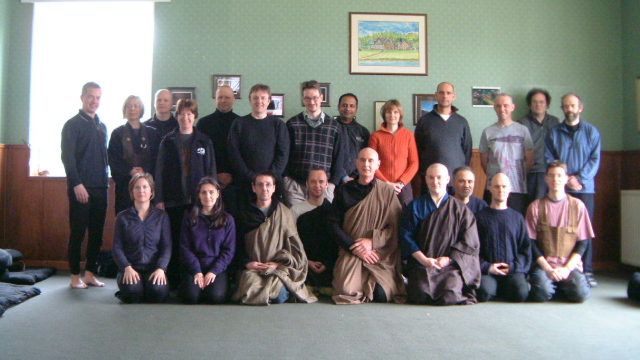
Winter 2006 — Shoaku Makusa, Session 2.
Venue: Rowardennan.
Michael Eido Luetchford · Winter 2006 — Shoaku Makusa, Session 2
From the retreatPhotosChronicle
What the talk says (short overview) — About these overviews
In the second talk on Dogen’s chapter Shoaku Makusa, ‘not doing wrong’, Mike carries on reading and says that, for Dogen, not doing wrong is not an admonition to think of something wrong and then not do it but a momentary state, the natural, balanced state in which we act fully. Mike adds that abstract wrong is just a thought, whereas real wrong is a matter of not doing it, and that what we confirm in zazen is the difference between thinking and doing.
Dogen writes of ‘the ineffable person who is I’ who acts, fully uniting body and mind, and Mike takes this to point to the real experience that when we do something fully there is no ‘I’ to watch ourselves, as when climbing a mountain. Mike explains that Dogen wants to say that in the moment of action there are no separate parts, although in words we can divide reality into many parts, and that the mountains, rivers, earth, sun, moon and stars with which Dogen says we act in oneness suggest the whole of nature. Mike calls it puzzling that Dogen says that ordinary people who become buddhas neither disrupt the state of buddha that has always belonged to them nor destroy their characters as ordinary people, and yet have transcended the state of an ordinary person. Dogen then says that we accept right and wrong and cause and effect in what we do but do not try to change the effect we are causing or to cause a particular effect. Mike says that not trying to cause a particular effect would be complete nonsense as a general statement about life in society: to pass an examination, for instance, we have to study and try. Mike says that Dogen is speaking instead about our action in the moment, in which balanced action has no strong intention, while a strong intention, for example in sport, splits us. Seeing cause and effect clearly in such balanced action is, Mike says, not an intellectual recognition but happens in a kind of flash, as it does for a good cook, and it concerns simple everyday action, not a power to foresee the future.
To a participant who understands practice as a way of becoming better at being in the moment, Mike answers that we practise not to get better, but to give up getting better, and that a master cook or a sportsperson is not trying to get better either. Mike also says that words create illusions and that he misunderstands too when he reads Shobogenzo; after more than twenty years of studying and sitting, he had to reinterpret the words to suit his experience rather than look for experiences that suit the words. Mike tells his listeners that they have to interpret what he says to match their own experience. Mike says that Dogen’s description of the basis of our momentary existence is not an instruction to throw away everything else: trying to stop thinking or to be invisible in the moment at every moment is, Mike says, a recipe for disaster, and we need to live as human beings, follow the rules of society and break them where we think we must. Dogen gives the pine tree in spring, chrysanthemums in autumn, buddhas and the whisk he is holding as examples of things that neither stay the same nor constantly change but are just in the momentary state called not doing wrong, and Mike says that for Dogen everything in its natural state is in the state of not doing wrong. For human beings, Mike says, the natural state Dogen means is the state of balance, and a person in the state of natural balance is, according to Dogen, in the state of not doing wrong, which means that no wrong can be done. Mike adds that the claim that no wrong can be done cannot be verified by intellectual argument and that the only way to find out is to test it. When a participant asks whether wrong is caused by too much conceptual activity, Mike says that one could say so, adds that wrong is also caused by the intention to do right, and says that cats and dogs, who have no concept of right and wrong, can do no right and no wrong. Mike says that he is not very happy with Dogen’s two sentences on causes and conditions, that he cannot explain them more clearly today, and that he thinks he will have to think again about how to put it more simply.
Complete English transcript — About transcripts
We’re half way down the left hand column on page 2. We stopped in the middle of the paragraph.
When we act fully, uniting body and mind, then we see the situation clearly just before the moment of action, and we notice the fact that we have not done wrong in the back of our mind afterwards.
He goes on:
When the ineffable person who is I acts, fully uniting body and mind, the power of all the mental and the physical aspects of reality appears at once.
“The ineffable person who is I acts,” suggests the real experience we have - ‘when we act there is no second person’ is how it’s described in the ancient Chinese stories. In other words, there’s nobody we can call ‘I’. When we do something fully, there is no ‘I’ to watch ourselves. So although I can say ‘I went to Scotland and climbed up Ben Lomond,’ the actual experience of climbing up Ben Lomond, at every moment, is not an experience from a viewpoint of a person called ‘I’. So walking up mountains is an ineffable experience. Anybody who has done a lot of it can recognise that. And the same with all action. In the moment of our complete action there is no person. What was the film about a young boy who was dancing? ... ‘Billy Elliot’? In ‘Billy Elliot’ when he’s being interviewed for the Royal Ballet or some institution, and he has to dance in front of the adjudication panel and they say, ‘How do you feel when you’re dancing?’ and he says, ‘Oh, I just kind of disappear.’ So that’s a kind of real explanation of our real experience. So Master Dogen describes it as “the ineffable person who is I acts, fully uniting body and mind”. And “ineffable” suggests there is no person. Then he goes on more to reinforce his description about being fully united in body and mind.
But there is no separation between these mental and physical aspects of reality and our action. When all these mental and physical aspects of reality combine in action at the present moment, their power in that moment is the fullness of action itself.
He wants to say that although in words we can say that there is a mental side to what we do, a physical side to what we do, there’s an act, there’s a person, there’s an action – we can divide reality into lots of different parts – in the moment of action, in the fullness of action, there are no separate parts, there’s no separation. And again, this is something we all experience momentarily, but often we then dissect our action into parts.
When we act in oneness with the mountains, rivers and the earth, the sun, moon and the stars, then the mountains, rivers and the earth, the sun, moon and the stars also act in oneness with us.
Again, he’s giving two opposite points of view there to suggest a oneness between ... “mountains, rivers and the earth, the sun, moon and the stars” suggests the whole of the external world, or the whole of nature.
This is not just a singe momentary occurrence; it occurs at every moment. So being in the moment, in which we are awake to reality, is the cause of buddhas of all times acting with body-and-mind undivided, being taught by reality, and experiencing the effect of that. But none of the buddhas have ever seen the teaching they receive and the effect they experience as separate from themselves, and neither act, teaching nor experience have ever separated from them.
Again, he’s reinforcing the fact that all descriptions of reality involve concepts, but the momentary experience itself is whole.
So when act, teaching, and experience make buddhas act with body-and-mind undivided, none of the buddhas try to resist, before, during, or after the moment.
In that rather curious sentence he’s describing the natural flow of our activity in the balanced state. So those are quite difficult sentences in the last paragraph or so, because he’s describing the state of oneness, and the state of oneness we can’t catch in words because words separate into parts. But that’s his way of doing it. He goes on further to describe “the state of buddha”.
During the hours of the day and night, as we are sitting, standing, walking, and lying down, we need to reflect on the fact that when ordinary people become buddhas, they do not disrupt the state of buddha that has always belonged to them. And when ordinary people become buddhas, they do not destroy their characters as ordinary people.
In the first sentence he says “we don’t disrupt the state of buddha that’s always belonged to us”. So “the state of buddha,” or the natural balanced state, is something everybody can return to. So we can say we all have it. And the previous chapter that I did last year, “Buddha Nature”, talked about the nature of a buddha in great detail. “And when ordinary people become buddhas, they do not destroy their characters as ordinary people.” People often think that a buddha is some kind of enlightened being with a completely calm, peaceful and enlightened attitude to everything, and different from an ordinary person. But according to Master Dogen that’s not true: a buddha is an ordinary person, or a buddha has the character of an ordinary person.
They do not take anything away from it or add anything to it.
That is, their character as an ordinary person.
But they have transcended the state of an ordinary person.
If we read that and think about it it’s very puzzling. First of all he says buddha, and we know that “the state of buddha” sounds wonderful. Then the buddha’s got the character of an ordinary person - that’s a puzzle, ‘How can they have this wonderful state and still be an ordinary person?’ And “they don’t take anything away from it or add anything to it” but at the same time “they’ve transcended it”. So to read it and think about it is very puzzling - ‘How can we be ordinary and transcend being ordinary at the same time? And what is it to transcend being ordinary?’... Now he comes back to his original theme of right and wrong.
We accept that there are right-and-wrong, cause-and-effect in what we are doing. But we do not try to change the effect we are causing, or try to cause a particular effect.
Right-and-wrong is very much tied up with cause-and-effect. When we try to decide what right action is we often do so depending on what effect that action will have or what effect the action had. But that doesn’t actually make it any easier, because we then have to decide if the effect of our action might have had another effect further on. So every action has an infinite chain of effects – an infinite chain of causes and an infinite chain of effects. So to use thinking about the effect of our action to decide what right action is, is not an easy thing. If we think whether we should say something to somebody because it might hurt them, so we decide not to, and then we find out later that not telling them hurt them. So if we think through the cause-and-effect relationships of our action it doesn’t always make things easier. But if we don’t we’re in trouble. But what Master Dogen is saying, he says “we do not try to change the effect we are causing, or try to cause a particular effect.” Now if we think of that in general terms in society it’s complete nonsense. If we don’t try to do something how do we do it? So if I want to pass an examination I have to study and try to pass it, I can’t pass it by not trying or anything like that. So we have to remember that he’s not talking here about the kind of events, causes and effects that we think about in normal society on a very abstract level. He’s talking about, again, this very primitive, basic, momentary situation that we’re actually always in. We always think ourselves into hypothetical situations in our roles in society, but we don’t think of it as hypothetical. So we think where we’re going to go and what we’re going to do. But Master Dogen’s not talking about that kind of thinking, he’s talking about our action at the moment. And our action in the moment - “we don’t try to cause a particular effect” suggests that we don’t have a strong intention. So balanced action doesn’t have a strong intention. But that makes us think, ‘Well if we don’t intend to do something how can we possibly do it?’ And if we think on a macro-level, ‘If I don’t intend to go to Rowardennan how can I ever arrive there?’ But again, he’s not talking about that kind of decision; he’s talking about a decision in the moment. And in the moment, if we intend to do something, we put an intellectual or abstract layer on top of our action. And if we think of a sport, for example, in sport, in an action while we’re giving some kind of performance, if we have some strong intention in our action it splits us.
And sometimes it is cause-and-effect that makes us act. This state, in which we can see the cause and its effect clearly, is the state called not doing wrong;
So the state in which we can see the cause and its effect clearly is the state called not doing wrong;
it neither appears in this moment, nor is it a constant state. And in this state we are neither denying that effect inescapably follows cause, nor are we trapped in a deterministic view. It is the state in which the division between body and mind falls away.
So these are not so easy sentences. But when we think about action and right-and-wrong - the cause of things and the effects of our action, we give great weight to them. But Master Dogen is suggesting that simple action in the balanced state is somehow not trapped by cause-and-effect.
Question: When he says we can see cause and effect, he doesn’t mean at a conceptual level, he means we can see it sort of simultaneously?
Mike: Yes. So, for instance, when we are very balanced ... When you’re cooking, if you’re a good cook and you’re in a nice state, because you’re skilled, you’re not worried too much about how it’s going to turn out, you’re confident in what you’re doing, you can see what you’re doing and what the effect will be in a kind of flash.
Participant: Yes.
Mike: So you don’t think, you just act, act, act. And it’s the same when we’re an expert or a master in our activity, whatever it is. An expert swimmer, or an expert musician. Each moment we can see where we’re going, but it’s not an intellectual recognition. So that makes it very difficult to describe in words. So what he’s suggesting in a way, both here and in the previous paragraph where he said ‘before and after the moment,’ is some kind of instant recognition of a situation, before-and-after, cause-and-effect, but all at one time.
Participant: Yes, it’s probably where talk of supernatural powers and all that sort of thing comes from – they’re actually not supernatural they’re very, very natural, on the contrary.
Mike: Yes, that’s right. He’s talking about simple things. But because his language is complicated in attempting to describe a very simple thing, we mistakenly interpret it as, ‘I see, so there’s some kind of special Buddhist state where Buddhists can see what’s going to happen before and what’s going to happen afterwards and all these kinds of things, they’re whole and dashing around acting without any intention, and performing miracles.’ No, he doesn’t mean that. He means putting the baked apples into the oven. And doing things in a balanced way confidently. But although we do that from time to time in our life, we also have large portions of our lives in modern times where we’re not so balanced, we’re wound up, we’re heading towards a deadline, we’ve got pressure. And he’s not talking about those situations, he’s talking about the situation where we’re acting fully, confidently, without strong pressure, and we perform. And in performing we actually, from moment to moment, see clearly where we’re going and what’s happening and so on. So, simple everyday action is what he’s talking about, not the power to divine the future of the human race.
Question: Another thing I can’t get my head around ... Would you not consider it a negative aspect to develop your practice to such an extent that you were, in the majority of your time, invisible?
Mike: Yes.
Participant: So in fact there’s a level where you don’t want to become so invisible that you’re so in the moment, because if you’re in the moment all the time then you don’t exist really, you’d be in the same situation as the rocks or the mountains ...
Mike: Right, so let’s all get out of the moment shall we then? Shall I go first?
(Laughter.)
Participant: No, but I still ... I must misunderstand the function of practice because the way I understand it is you practice in order to become better at being in the moment.
Mike: No. No. You don’t practice to become better. And if people practice Zazen to become better they often get disappointed and give up after a few weeks, months or years. So, not to get better, but to give up getting better. And to give up getting better is much better! But it’s very difficult for us to do. However, when somebody is very practiced in their art - and I talked about cooking because Mike’s the cook – if you see somebody who’s a master cook, they’re not trying to get better, they’re not trying to make a better baked apple, they’re doing something else. Of course at another level they may be creating new recipes, but in their action they’re not trying to get better, it’s something else they’re doing. And a sportsperson is not actually trying to get better. They may have said they want to win the race, but somebody who’s pounding along wanting to win the race at every moment won’t win the race.
Question: Could ‘action’ refer to things that we wouldn’t normally think of as action, for instance responding appropriately when someone asks you a question, or...?
Mike: Yes, to catch the meaning of action...
Participant: To catch the moment in a sense...
Mike: Yes.
Question: ... Without seeing but actually just responding appropriately to the situation. Because I used to think of action as just something, you know, physical, like putting something into the oven, but I suppose it’s more than that isn’t it, it’s just about doing what you think needs to be done, but not consciously, just doing it.
Mike: Just doing, yes, is action, yes. So, unfortunately words create for us illusions. And these words are no different. So we misunderstand. So listening to me you misunderstand. When I read Shobogenzo I misunderstand. And it’s only by remembering that what Buddhism is talking about is the real experience we are all having here and now that you can make any sense of it. If you think, for instance, that we’re all trying to disappear, then we can say ‘Well you shouldn’t do that.’ But he doesn’t mean that. He’s grasping to explain in words the real experience in the present where, in acting, we can’t watch ourselves. We can kind of watch ourselves doing some things, and some people think we should be ‘mindful’ of ourselves and watch ourselves. But when we’re really fully acting, and we can notice this in emergency situations, we can’t watch ourselves. So the state in which we can’t watch ourselves is the state where there’s no person. So not a state we haven’t got yet, but a state that you have thousands of times every day. But it goes and comes, it comes and goes. You stand up after this talk and for an instant you can’t watch yourself, and then you start thinking again and you go out the door and you’re thinking, then you hit your toe on the door. But in the moment of action we’re invisible, if you like, but the words and the sentences themselves mislead us into thinking ‘Oh I see, so I’m going to watch that person, when they move, if they disappear or not,’ or whatever. So we’re always creating big intellectual ‘flowers in the sky’ around the sentences which are intended to bring us down to earth. And this is the kind of Buddhist training – we study and then we think ‘Oh I can’t make head nor tail of that, it’s talking about all kinds of weird stuff,’ and then we go and sit on black cushions over there and do something very simple and stupid, and then we come back here and we talk about kind of very esoterical things that don’t make sense. And I did that for more than twenty years and slowly I realised that I had to reinterpret the words to suit my experience, not look for experiences that suited the words. And that’s the best thing to do. So although my words miss the target, in other words they don’t catch reality, you have to interpret what I’m saying to match your own experience. And that’s what Master Dogen means often when he says ‘We should study this in practice again and again,’ and things like that. We should look around to see ‘What can it mean “to disappear”?’ And then we may notice that actually we do in a way – not literally, when we disappear we’re still here – but it’s a way of describing our momentary state.
Question: If you write words after an experience, after an action that you’re in, say poetry for example, that’s after the thing is done. But kind of to recapture the moment and put it into words because you’re moved to do that, would you say that you hadn’t actually been in the moment fully if you can do that after, or...?
Mike: No. Poetry can capture reality very nicely. It’s one of the ways we use to try and grab reality with words. But it doesn’t mean that the poet is thinking about his poem while he’s experiencing what his poem’s about. We somehow have the ability to retain a taste of our own experience. And that taste is unformed, so we try and form it with words, but we can’t find the words. So science does it one way and poets do it a different way, how to make the words fit the experience. But what we do when we read those words as a third party is we try and look for an experience or imagine an experience to fit the words. Which is the wrong way round. So we read about the Buddha who’s this enlightened being who acts fully in moments and we create an image, and that image is not like us, we’ve created it, so we think it’s out there. So, ‘I’m not there yet’, so ‘I want to get there, so I’ve got to do more Zazen.’ But that’s completely wrong. ‘I’m not good enough yet.’ It’s not that at all. It’s seeing how to reflect the meaning back into our own real experience. That’s all we’ve got, all of us. All we’ve got is our own real experience, moment to moment.
Question: Can I ask you about this sentence here, third paragraph down, “This state, in which we can see the cause and its effect clearly, is the state called not doing wrong; it neither appears in this moment, nor is it a constant state”?
Mike: Yes. Master Dogen often uses this phrase to suggest that our actual experience, our momentary experience, doesn’t seem to come and go, but neither does it seem to stay. It’s just here. So, our actual experience of being here is we’re just here. We’re always here. We’re always here. So it’s a kind of contradiction, and he tries to describe that state often by saying it neither appears in the moment nor does it continue. In scientific terms we could say it’s not discrete and it’s not continuous. It’s not digital and it’s not analogue. So that’s the way he does it. It’s a bit tricky really, the phrase.
Question: I have a question on your response to, I think it was Mike’s question on balanced action, seeing cause and effect clearly. All the examples were in fields that require practice, cooking, sports, dance and so on. And that seems to suggest that balanced action or the state of seeing cause and effect clearly, requires practice.
Mike: Yes.
Question: That’s what you mean?
Mike: Yes.
Question: So, outside of a particular specialism, a particular field of practice, you cannot act in that way?
Mike: Yes we can. Yes we can and we do. But if we pursue a practice, whatever it is, it has a kind of purity about it. That’s why we revere people who pursue practices ... I mean, I think I’ve used this example before – holding a piece of metal and hitting it with a hammer for fifty years making shapes in stone is a very, very simple operation, and yet we revere sculptors because they have a practice. We revere potters, we revere musicians, sportspeople. If we have a practice and we follow it, it has some kind of simplicity to it. But if we take jobs in society, teachers, engineers or whatever, it’s more difficult to see that pure pursuit.
Participant: We can see it in children, for example.
Mike: Yes, in children. Yes we have it as children, but then we have to get jobs, or study and go to school and become members of society.
Question: So we don’t need to practice as children?
Mike: Yes.
Participant: That was my point – children don’t need to practice.
Mike: No, they don’t. So later on Master Dogen says babies are buddhas, a few pages down the line.
Participant: They just need to be left to it.
Mike: Yes. Not to be too disturbed. Supported but not disturbed, yes. So sometimes our efforts to educate children to fit in society actually disturb them.
Question: Does Master Dogen refer to Zazen as ‘stepping backwards’?
Mike: Yes.
Participant: I think I read it somewhere and that’s what I interpreted it as, as a way of stepping backwards from where you came from in a way.
Mike: Yes, we can say so, yes. Anti-social (Laughs.) But then, without rejecting society. So it’s not ... his descriptions of the basis of our momentary existence on this planet is not an instruction to throw away everything else. It’s just another view, if you like. So we don’t need to try and stop thinking, pursue pure practices, be invisible in the moment at every moment. That’s a recipe for disaster. We need to live as human beings, follow the rules of society, break them where we think we must, and so on. ... Shall I carry on? So he goes from talking about right and wrong, to talking about a state, and talking about buddhas, and talking about acting fully, and then he comes back to right and wrong, and so on. And in this next paragraph he’s back to talking about the first line of the poem, which is “Not doing wrong”.
If we study in this way, we realise that wrong is simply a matter of not doing wrong. And helped by this realisation, we can see clearly that the word wrong always means not doing!
If we talk about wrong without talking about doing or not doing, in his mind, in his opinion, it’s abstract. And abstract wrong is just a thought. He’s concerned with real right and real wrong. And real right and real wrong are inseparable from doing or not doing, from action. So if we study in the way that he’s suggesting, we realise that wrong means not doing wrong. It doesn’t mean there is something called wrong floating around somewhere which we mustn’t put into practice. It simply means ‘Don’t do! Don’t do! Don’t do!’ So action itself. So he says the word wrong always means not doing. Now this is a strange thing to say. But what he’s trying to say is that wrong in the abstract is completely different to real wrong. And real wrong is a question of not doing it. We can say from morning to night what we think is wrong. But what we think is wrong is completely different from doing wrong or not doing wrong. So this is quite difficult to talk about really.
We confirm this absolutely in the practice of Zazen.
What we confirm in the practice of Zazen is the basis of simple action. Or the difference between thinking and doing. Or the difference between our thoughts and reality. So in society, wrong and right are abstract concepts. And although they’re very deeply embedded in society, so that we can discuss what’s right and wrong between us, what we’re discussing is abstract. And even although we may reach firm conclusions, it’s completely different from whether somebody does wrong or does right. Doing wrong is completely different from thinking about wrong, deciding what is wrong, and so on.
In realising that wrong is always just a matter of not doing wrong, just at the moment of the present, there are no causes or conditions that produce wrong, or that cause wrong to disappear; it is just a matter of not doing wrong.
There’s nothing that produces the wrong or causes wrong to disappear, it’s just a matter of not doing wrong.
If or view of wrong is balanced, all things are balanced. People who understand that wrong arises out of causes and circumstances, but do not see that the circumstances, the causes and they themselves are all in the momentary state of not doing wrong are to be pitied! It is said that the nature of buddhahood arises from the circumstances, but equally the circumstances arise from the nature of buddhahood.
So again in these difficult sentences he’s talking about the relationship between causes ... ‘Causes and conditions’ is a phrase that was used very much in Buddhism in China. In theories of how the world arises, how reality arises, the phrase ‘causes and conditions’ is used a lot, and that’s why it appears here. So what he’s suggesting is, at the moment of the present, in acting in the present moment, the ‘causes and conditions’ that produce wrong are inappropriate or don’t have any place. ... On reading these two sentences I’m not so happy with them, so I think I’ll have to think again on an easier way to put this.
Question: In the previous sentence he said there are no causes and conditions that create wrong?
Mike: That’s what he says, yes.
Participant: So there’s a contradiction there.
Mike: No. Em, I can taste what to say but I can’t say it! And the sentences are not clear enough. “In realising that wrong is always just a matter of not doing wrong,” means to notice the only important thing is not doing it. And to notice that the only important thing is not doing it is to realise that our action at the moment is important. To realise that our action at the moment is important is to throw away thoughts about what causes action or what my circumstances are, or ‘What can I do to not do wrong?’, all those intellectual ... or all those thoughts are inappropriate. I still can’t get any nearer to it! Because what he’s talking about is simple action.
Question: So buddha nature is free from causes and conditions, so that it affects circumstances and circumstances affect buddha nature, they both simultaneously manifest, affecting one another reciprocally?
Mike: Yes. But what he wants to say is, when we are balanced and acting fully in the moment there is no separation between the person who’s acting and the situation, the circumstances, the causes, and so on. There’s just something happening. That’s what he wants to say.
Question: Not doing wrong, in the case of a buddha?
Mike: ‘Not doing wrong in the case of a buddha’ is our normal action. That’s the best I can do today! They’re rather difficult sentences there and I can’t find a better way to put them at the moment, but I’ll work on it. So let’s just pass over that on to the next paragraph.
It is not true to say that wrong does not exist; it is just a matter of not doing wrong. It is not true to say that wrong exists; it is just a matter of not doing wrong. Wrong is not only an abstract concept; it is just a matter of not doing wrong. Wrong is not only a concrete event; it is just a matter of not doing wrong. And this doesn’t mean the idea of “not doing wrong”; it means really not doing wrong!
So in those sentences in that paragraph he’s trying to emphasise something which is very difficult to emphasise in words, and that is ‘What I’m talking about is not thoughts, not ideas, not words. What I’m talking about is not what I’m talking about!’ So he’s talking about not doing wrong. And not doing wrong is different from the words ‘not doing wrong’. So that’s the way he does it.
Question: In the earlier paragraph, is he saying that not doing wrong might have circumstances and causes, and circumstances might cause it, but when we’re not doing wrong then we’re just not doing wrong.
Mike: Yes, you can say so, yes. So then he gives some examples.
An example is the pine tree in the spring; neither staying the same nor constantly changing, it is just in the momentary state called not doing wrong. Another example is chrysanthemums in the autumn; neither staying the same nor constantly changing, they are just in the momentary state called not doing wrong. Buddhas also are neither staying the same nor constantly changing, they are just in the momentary state called not doing wrong. Things like those pillars outside, that stone lantern over there, this whisk I am holding, that staff you are holding, are neither staying the same nor constantly changing, they are all just in the momentary state called not doing wrong. I am neither staying the same nor constantly changing, I am just in the momentary state called not doing wrong.
So here he very clearly identifies what he means by not doing wrong. To him, not doing wrong is not some kind of admonition to think something that is wrong and then not do it; it’s a state. It’s the state of a pine tree. What is the state of a pine tree? Well it’s just there, isn’t it? It’s the state of chrysanthemums in autumn. What’s the state of chrysanthemums in autumn? They’re just fully chrysanthemums in autumn. So a natural, normal, balanced state, he defines as the meaning of not doing wrong. So everything in its natural state is in the state of not doing wrong. The table’s not doing wrong.
Participant: Human beings are a bit more complicated than tables.
Mike: Yes they are.
Participant: So a table can’t do anything. A table can’t act. And if you proceed up the evolutionary tree - a pine tree, don’t know; a cat, maybe; and you get to humans and it gets rather complicated.
Mike: Yes. So he doesn’t say there’s no such thing as wrong. He says things in their natural state are not doing wrong. Human beings in their natural state are not doing wrong. What’s the natural state that he means? He means the state of buddha. What’s the state of buddha that he means? He means the state of balance. So his definition of not doing wrong is to be in the state of balance. But if we think about it, we can think ‘Well yes but, you know, somebody in the state of balance could then go and blah blah blah blah ...’ So those kinds of thoughts are very persuasive. But if you’re in the state of natural balance, according to Master Dogen, you’re in the state of not doing wrong. So no wrong can be done. So there’s only one way to find out and that’s to test it. We can’t verify that by intellectual argument.
Question: He also means that in only an instantaneous and momentary sense, doesn’t he? So, for instance, practically, if you kind of sit Zazen and then go and drink eighteen pints of lager you wouldn’t be in a balanced state.
Mike: No. That’s true. So the momentary state of balance is the state of not doing wrong.
Question: That suggests to me, I mean I might be wrong, that the creation of wrong is also intellectual?
Mike: Yes.
Question: And in the balanced state you’re actually not employing too much conceptual workings of the mind?
Mike: Yes.
Question: So is that fair to say, then, that wrong is caused by too much conceptual activity?
Mike: We could say so, yes. And wrong is also caused by intention to do right. So we can say that human beings created wrong and right, and by pursuing right they create wrong. But cats and dogs don’t have any concept of right and wrong. So the actor, the person or the entity who’s acting, without any concept of right and wrong can do no right or wrong. But human beings have concepts of right and wrong. So not only do we do right, we try to avoid wrong.
Question: But does that mean that the balanced state precludes any kind of intellectual activity?
Mike: Yes.
Question: It does mean that?
Mike: Yes. But, as Mike said, what he’s talking about is a momentary state. So we take hold of the words and kind of spread them out. So we then imagine this person who’s kind of always balanced and so never does anything wrong, and then we define that wrong in our own terms, so we’re trying to imagine somebody who never does anything wrong. But actually we don’t know what is right and wrong. Because right and wrong are always changing. But then if I say that we start thinking, ‘Well that’s not true. There’s lots of things we can say are wrong.’ But although we can say they are wrong, what Master Dogen is interested in is not doing them. So not doing them is different from discussing them.
Participant: Reality is one thing, but it’s quite a dangerous concept.
Mike: Yes.
Participant: For someone to take on board that conceptually without practice could result in problems, because there’s a kind of absolution in it, isn’t there, ...
Mike: Well it sounds like there’s an absolution.
Participant: ... for the sort of spiritual mind, you know.
Participant: That’s how they train soldiers, isn’t it, to live in the moment, so that when they are in a particular situation they’re able to fire, they don’t think about where the bullet’s going or what it’s going to do, they just have to respond.
Mike: Yes. It’s true. And we can judge the soldiers actions.
Participant: And if the soldier doesn’t fire then he can be judged for not firing.
Mike: Yes. So in recent times society likes to judge the actions of soldiers almost before they’ve finished acting. We have journalists on the battlefield and the soldiers are not free to act because we’re judging whether their actions are right and wrong from a distant place according to our own judgment and our own societies and so on. Yes, that’s modern warfare. ‘Stop that soldier, he’s doing wrong!’ We’re overlooking the whole of the world and making sure nothing goes wrong, from remote places. And we insist on our opinions about what those individuals are doing in their remote places.
(Bell rings.)
Sorry, that was a bit confusing there today at the end, but it’s the best I can get out of it at the moment. That paragraph is rather difficult. It gets a bit better (Laughs.)