Shoaku Makusa 4: Doing Right Without a Doer
Mike reads Dogen on doing right, then answers questions about thinking, karma and the balanced state
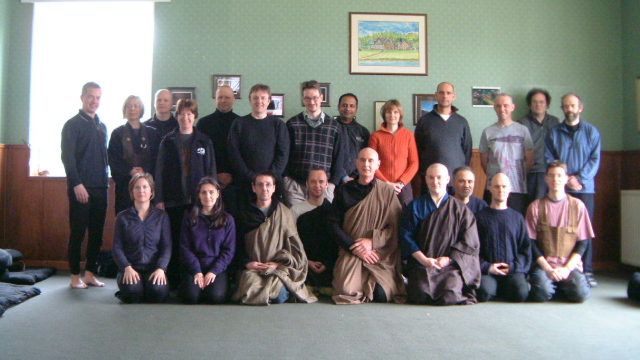
Michael Eido Luetchford
Winter 2006 — Shoaku Makusa, Session 4.
Venue: Rowardennan.
Michael Eido Luetchford · Winter 2006 — Shoaku Makusa, Session 4
From the retreatPhotosChronicle
What the talk says (short overview) — About these overviews
In the fourth talk on Dogen’s chapter Shoaku Makusa, ‘not doing wrong’, Mike reads Dogen on ‘doing right’ and says that, for Dogen, our concepts and examples of right are not real, that there’s nothing called ‘right’ that’s waiting to be done, and that there is something called right action. Mike says that, in this passage, Dogen describes concrete right action as momentary action and that action in the moment doesn’t have a doer; in the moment of acting there is no self, no person doing the acting and no world being acted upon, but a wholeness in the present moment.
Mike says that Dogen describes all the forms of rightness that we can think of as pulled into the place where right is being done as if by a magnet, and, asked whether they had magnets in the thirteenth century, he says that he thinks Dogen did not actually say ‘magnet’ but ‘vairambhaka wind’, though it could be a kind of magnet, and that people in those days did have magnets, just without knowing it. Mike says that buddhas of all ages teach the truth in the form in which it manifests itself in their time, but that the truth they teach is momentary, beyond time and beyond intellectual recognition. Mike says that the ‘right’ of a person who pursues the truth through intellectual study and belief might be an abstract ‘right’, while the ‘right’ of a person who pursues it through action is more concrete, and as an example he imagines watching soldiers fighting on television in some foreign place, like Iraq: we might judge their actions as right or wrong, but the actual soldier’s judgment about his action in that moment is completely different, and judging the world through the powers of our mind causes a conflict. Mike explains that the sravaka, the intellectual buddhist, thinks it essential that the precepts must never be broken, whereas a bodhisattva has a more realistic opinion, that in a certain situation we have to act according to the situation and that if we break the precepts we shouldn’t worry, and he adds that Dogen says in another chapter that it is better to act right and break the precepts than to keep them. Mike says that Dogen denies here that right action comes out of the circumstances we are in or has a cause, though not completely; the difficult thing about Dogen’s writings, Mike says, is that he will deny something in one place and affirm it somewhere else, depending on the view he is taking. Mike says that by ‘the unclouded perception of Buddhists is like looking at the sun or the moon’ Dogen means a very simple state, in which we might step outside tonight, if the sky is clear, and look up at the moon, a whole state, whereas intellectual views separate into me and the world. Mike says that we have a concept of right but that when we actually do right we make right real, and that our concept of right and actual right are not separate; he adds that, according to Dogen, rightness does not arise in the moment for the first time and does not stay in the doer, and that we can do right but cannot become good and stay good.
Asked what Dogen’s statement that thinking based on unclouded perception is not the same as other kinds of thinking means, Mike says that he hasn’t a clue, and then that Dogen means that when we are in the balanced state we have a clear view; he adds that science tells us the brain is always working and that we could say there is some kind of thinking, but not the usual kind. Asked whether Dogen’s word is as narrow as ‘thinking’, Mike says that he does not have the original Japanese and that the area has not been clarified – ‘mind’ in Chinese and Japanese is shin, which means ‘heart-mind’, and ‘thinking’ in Japanese means ‘thinking-feeling’ – and to the suggestion that there can be thoughts without a thinker he answers that we can never be sure; when we look for thinking we are always thinking, and if we stop thinking there is no one to look for it. Asked whether we can act without thinking, Mike answers ‘Oh yes’ and says that nobody yet knows what is meant by ‘thinking’, and to the remark that an organism couldn’t act without some kind of instructions from the brain he answers that this seems to be correct and that we could suppose that Dogen, in the thirteenth century, was guessing that something is always going on between the brain and the nerves, though he had no basis for that. Mike says that ‘causes and circumstances’ was a kind of standard buddhist phrase in Chinese Buddhism for the things around that have an effect on what is happening, that Dogen is saying that they are unrelated to action, and that when we are not acting we can create a virtual world and think that we are living in it, but when we act we make the world real. Asked whether what Dogen says is more sophisticated than a simple notion of karma, Mike answers that it is beyond a notion of karma, that Dogen says that karma is absolute – we can never escape the results of our actions – and also that in the real moment in which we act karma does not have any bearing, that Dogen believes both, and that the contradiction exists in our minds, not in reality. Asked whether Dogen is saying that the end doesn’t justify the means, Mike answers ‘No’ and says that Dogen is saying that if something starts right, it ends right, and that Dogen would not say to take wrong steps to achieve a good end but would say ‘act right now’; Mike cannot ask him, but he is sure that Dogen would refute ‘the means justifies the end’. Mike says that by ‘right action’ Dogen does not mean doing something which is ‘right’; if we think so, we are back in our trap; but when we do one real right action from all the ideas we might hold about what right action is, everything is made real, and in Dogen’s teaching to act is to make the world and ourselves real. When participants remark that ‘the balanced state’ sounds like a concrete state and that it is rather ‘a dyne’, Mike replies ‘a balanced dyne’ and says that we always think that everything is something that exists that we have got to get into, that we imagine something which is not and then try to get there, and that we imagine a balanced state that we should try to get into, forgetting that we have just been sitting in it. Mike says that we have to convince ourselves about the very simple things, such as that this is the only life we have and that there is something very simple that we all do all the time called acting, and he thinks that sport teaches people the simple nature of action; asked why we don’t just come and sit, he says that there is some kind of basic need to convince ourselves, to discuss and to make clear, until we can believe it, or not.
Complete English transcript — About transcripts
This morning we got to the bottom of page 3, right hand column:
Doing right.
Master Dogen’s moved on to the second line in the poem, “Doing right”.
Rightness is one of the three conceptual properties: wrong, right, and neither-right-nor-wrong. The concept of rightness covers many concrete right actions, but this does not mean that the right action already exists somewhere waiting for someone to come and do it. However, the very moment when someone does right contains all the many concepts of rightness. All the many forms of rightness that we can think of are pulled into the place where right is being done as if by a magnet. Nothing on Earth can stop this merging of the many forms of rightness and right action itself.
So he wants to say that our concepts of right, our examples of right, are all examples, they’re not real. But when something right actually occurs our descriptions of right all merge in with that right action - “as if pulled in by a magnet,” he says.
Question: Did they have magnets in the thirteenth century?
Mike: No, he didn’t actually say “magnet”. I think he said “vairambhaka wind”. But it could be a kind of magnet. They did have magnets in those days, yes, just they didn’t know. There were magnetic materials around. They hadn’t named it so they didn’t know it.
On the other hand, as with wrong, what we recognise as right varies between different societies and cultures. Just as buddhas of the past, present and future teach the truth in the form that they see it, what we see as right we call right. But although they teach the truth of their own times in the world as they see it, since their existence too is momentary, they all teach the truth that is beyond intellectual discrimination.
So he wants to say that, in terms of his examples, buddhas – all buddhas of all ages – teach the truth in the form that it manifests itself in their time; but that the truth that they teach is momentary, and so it’s beyond time. And beyond intellectual recognition.
So even though there is only one kind of right, the “right” of a person who pursues the truth through intellectual study and belief, and the “right” of a person who pursues the truth through action are very different.
“The ‘right’ of a person who pursues the truth through intellectual study and belief” might be an abstract ‘right’. They might say, “This kind of thing is right.” But “the ‘right’ of a person who pursues the truth through action” is more concrete. So in a concrete situation, what we see as right is different to what we think of as right. So a good example might be if we sit and watch the television and we see films of soldiers fighting in some foreign place, like Iraq, and we might judge their actions as being right or wrong, but to the actual soldier on the battlefield his judgment about his action in that moment is completely different. He’s not saying that one is right and the other’s wrong, he’s just saying that they’re different. So, to judge the world through the powers of our mind produces a different kind of right to the right action in a concrete place. It causes a conflict.
For example, the way that intellectual buddhists observe the precepts breaks the precepts as they are observed by buddhists who pursue the truth in their everyday lives.
“Intellectual buddhists” in the original is sravaka. And sravaka is a name for people who study Buddhism through scriptures and intellectual study. And “buddhists who pursue the truth in their everyday lives” is a bodhisattva. So bodhisattvas pursue the truth in the world as they experience it, not through the scriptures. So he says that the observance of the precepts by the two groups is different. So, for example, if we read the precepts and it says, “Don’t do this, don’t do that,” then to the sravaka, or intellectual buddhist, it’s essential that you must never do it. But a bodhisattva has a more realistic opinion – although something may be against the precepts, in a certain situation we have to act according to the situation. And in that situation, if we break the precepts, then we shouldn’t worry. So Master Dogen says, not in this chapter but in another chapter, that it’s better to act right and break the precepts than to keep the precepts.
Concrete right actions do not arise out of causes and circumstances, neither are they made to vanish by causes and circumstances.
He used exactly the same phrase about “not doing wrong”. And in this sentence he is denying that right action comes out of the circumstances that we’re in, or has a cause. He doesn’t deny it completely, and this is, as some of you know, the difficult thing about Master Dogen’s writings - he’ll deny something somewhere and then affirm it somewhere else, depending on the view he’s taking. But in this particular place he wants to describe concrete right action as momentary action. And in momentary action there is no room, or there is no relevance for a cause or the circumstances. Just action at the moment of the present.
Concrete right actions are real events, but not all real events are concrete right action.
So he wants to make the point that lots of things happen, but they’re not all concrete right action.
One similarity between causes and circumstances arising and vanishing and concrete right actions is that if they start right, they end right.
In his description, concrete right action has a right beginning and a right end.
Concrete right action is what is meant by doing right. But it is not done by the self, and cannot be recognised by the self; neither is it done by or recognised by the world.
That’s a strange sentence! He wants to take the subject out of doing right. Although we can talk about “doing right,” he wants to say that there’s nobody doing the doing. And that’s one characteristic of his description of the present moment: action in the moment doesn’t have a doer. It’s also a big theme in Nagarjuna’s writing too. So, to separate what happens, to separate an event into an action and an actor, is to split reality into two parts. But in the moment of acting, he wants to say that there is no self, there’s no person who’s doing the acting, and there’s no world being acted upon. Or in other words, there’s a wholeness in the present moment.
In intellectual views that are based on self and the world being separate, perception is also based on separation of self and the world. But the unclouded perception of Buddhists is like looking at the sun or the moon; that is doing right.
By “the unclouded perception of Buddhists is like looking at the sun or the moon,” he means a very simple state where we might step outside the door tonight, if the sky’s clear, and look up at the moon. A whole state. But intellectual views separate into me and the world. But “the unclouded perception of Buddhists,” according to Master Dogen, is not separate, and that kind of perception is doing right.
At the moment when right is done, we make rightness real.
We have a concept of right, but when we actually do right then we make right real, we give real meaning to the word. So our concept of right and actual right are not separate.
But this real rightness does not arise in that moment for the first time, neither does it stay there in the doer. So we cannot call it our original conduct.
He wants to completely eliminate the possibility that there is something called ‘right’ that comes into an action or that exists permanently. Spiritual religions and spiritual societies usually think that there’s something called ‘good’ or ‘right’. Or maybe they personify it and call it ‘God’, who they believe exists. And that good existence exists and puts goodness into things and people and events. But Master Dogen says that “rightness does not arise in the moment for the first time, neither does it stay there in the doer.” So we can do right, but we can’t keep right. We can’t retain it in ourselves. We can’t become good and stay good.
Participant: Unless we’re the moon.
Mike: Can the moon stay good?
Participant: Or chrysanthemums in autumn.
Mike: Yes, I suppose so. But you’d have to keep asking them to make sure they were still good. No, in the momentary view of the universe, nothing is permanent but at the same time nothing is created. Again, these themes are also present in Nagarjuna’s writing.
Right action is doing right, but we should not understand it intellectually. Doing right in the present is unclouded perception, but we should not understand it intellectually. Our unclouded perception does not appear so that we can think about it intellectually. Thinking based on unclouded perception is not the same as other kinds of thinking.
Question: What does that mean, Michael?
Mike: I haven’t a clue!
(Laughter.)
Don’t ask me, I don’t know! I can’t understand it at all!
Question: Does it mean thinking after unclouded perception? What does it mean “thinking based on unclouded perception”?
Mike: Well, he means that when we’re in the balanced state we have clear view. That means that simple, clear, acceptance of everything. But in that state we can’t say our brain is not working, because science tells us the brain is always working. For instance, just to maintain the basic tension in our muscles, and so on. So we could say there is some kind of thinking, but it’s not the usual kind of thinking.
Question: So is he saying that thinking is going on in the moment of unclouded perception?
Mike: Is he?
Participant: I don’t know. He says “based on”.
Mike: No, the thinking that goes on when we’re in the balanced state is not the same as ordinary thinking... We’d better think about it! But should we think about it with ordinary thinking or with a different kind of thinking? That’s the thought.
Participant: One tends not to think of... If one thinks about being in an unclouded state...
Mike: The clouds come in!
Participant: Half a pint of red bull and vodka tends to make things a bit cloudy!
(Laughter.)
Question: Is the word that Master Dogen uses as narrow as ‘thinking’? Does he just mean mental activity?
Mike: I don’t have the original Japanese, but in the book it’s “thinking”, so in the original I’m sure it was “thinking”. But what is thinking? We’re not quite sure yet, are we?
Participant: I suppose the way that we use it, it’s like it’s a cognitive activity. So we wouldn’t think of, for instance, dreaming as being thinking, or some kind of trauma or something as being thinking. But all of these things would occur in our consciousness, so they could be [inaudible] mental activity. So that was really why I asked.
Mike: Yes. It’s a problem that hasn’t been solved yet. Because, for instance, in Chinese and Japanese ‘mind’ is shin. But shin doesn’t mean ‘mind’, it means ‘heart-mind’. So in Japanese, ‘thinking’ doesn’t mean ‘cognitive thinking’, it means ‘thinking-feeling’.
Participant: There’s a book called “Thought Without A Thinker”, which I think is a good title for a book. I didn’t really understand it, to be honest, but I think that’s the problem. I think you can have thoughts but because there’s the state of the wholeness of our existence, when you don’t have this split of subject and object perhaps you can have thoughts without there being a thinker.
Mike: But we can never be sure, because as soon as we think about it we’re thinking. So there have been people who say that there’s always thinking in Zazen. And with one such person, who was very insistent about it, I wrote to him and said if you look for thinking in Zazen you will always find it. So when we look for thinking we are always thinking. And if we stop thinking there’s no-one to look for it. So we can’t see ourselves when we’re not thinking.
Question: Can we act without thinking?
Mike: Yes.
Question: Can we? You see, I mean, direct perception...
Mike: Well, the problem’s not clear, because nobody knows what they mean by ‘thinking’. There’s some kind of mass of processes that go on in consciousness; but which of those produce which results, people don’t know yet, do they?
Participant: No, but I was just, I mean I was just thinking...
(Laughter.)
Participant: ... You know, here he’s obviously referring to a different kind of thinking, whatever that might be. But I would have thought an organism couldn’t act without some kind of instructions from the brain.
Mike: That seems to be correct, doesn’t it? It would be difficult for us to believe otherwise. So we could suppose that when he says “different kind of thinking,” in the thirteenth century, he was guessing that although we may not be making cognitive calculations there’s something always going on between the brain and the nerves and so on. But he had no basis for that. We have a lot of basis to say that now, don’t we? It’s almost impossible to believe that our brain can actually stop and then we can still move.
Question: Is it not like intuitive thinking? Just sort of doing something intuitively, that you’re not sort of thinking over all the things, you’re just going and doing it because something...
Mike: Is that thinking?
Participant: I don’t know, I’m asking.
Mike: Yes, I thought it [inaudible]... The area has not been clarified. And even between different cultures, the words we use in different cultures suggest different borders between what’s thinking, what’s feeling, what’s intuitive, what’s rational, and so on. There’s this whole area which is not clear to any of the investigators yet. Though it may become clear.
Question: Do animals think?
Mike: I suppose they can think, I suppose so.
Participant: Because I was thinking, we discussed in “Bussho” whether a dog has buddha nature or not. So if you took the basis that animals don’t think, they just act instinctively, but we do think, that’s what separates us from animals. That’s arguable, I know – but in trying to get into the balanced state, where we act without thinking, we’re trying to get rid of the thinking aspects that makes us human beings. But it’s a bit of a paradox, in a way, that we can talk about Buddhism and try and get to become natural in our actions, but then we have to think to go through the process of understanding what action is.
Mike: Yes, but if we think rationally and logically while we’re acting, I don’t think things work so easily.
Participant: No it doesn’t work.
Mike: I think we can generally accept that. However, if Buddhism were to say that human beings should stop thinking, it’s ridiculous isn’t it.
Participant: It says in the book, “Consideration by vigorous eyes is never the same as consideration by other things.”
Mike: “Consideration”?
Participant: Yes. I mean, it doesn’t change what’s been said, just for the record.
Mike: Right, yeah. “Vigorous eyes” is a metaphor for somebody who can see clearly, and therefore a metaphor for somebody in the Buddhist state.
Question: There’s sometimes a contradiction between eyes and ears, so one means kind of intellectual, the other means intuitive. But I can’t remember which is which. I wonder if eyes is intuitive and ears is...?
Mike: Is it?
Participant: He seems to use that.
Mike: Hmm. I don’t remember any places like that... He sometimes says we should see with our ears and hear with our eyes. And that suggests the fact that although we think that vision and hearing are separate faculties, actually they may not be.
It is not a matter of whether concrete right action exists or does not exist, or whether it originates from the physical or mental side; it is just doing right. Right action is – in all places and at all times without exception – real. Doing right is always a concrete action. Action makes things real, and the arising and vanishing of causes and circumstances are unrelated to it.
The reason the phrase “causes and circumstances” comes up so much is because it was a kind of standard buddhist phrase in Chinese Buddhism, to include things around that have an effect on what’s happening. So he’s saying that the things around that have an effect on what’s happening are unrelated to action. And that “doing right is always concrete action.” And in acting we make things real. When we’re not acting we can create a virtual world. And we can think that we’re living in that virtual world. But when we act we make the world real.
Participant: “Causes and circumstances” is a confluence of two views, as well, of reality – one cause-and-effect, and another instantaneous. And action is free of both, but actually reciprocally creates and is created by the instant in which it’s enacted.
Mike: OK! Yes.
Question: I thought... It might be slightly off the subject but “causes and circumstances” or “causes and conditions” is often related to karma as well, isn’t it?
Mike: That’s right, that’s where it comes from.
Question: A simple notion of karma – I don’t know, this is very simple and probably wrong...
Mike: Wrong? Or right?
(Laughter.)
Question: ... is that there is a sort of rightness in the karma, as it were, but the karma has to be activated. Anyway, I don’t know, I just suddenly thought that’s somehow related to that. What he’s saying seems to be more sophisticated than a simple notion of karma, is that right?
Mike: It’s beyond a notion of karma. He actually doesn’t talk in terms of lots of schools talk about, which are very heavy on karma, which is cause-and-effect. He says that we can never escape cause-and-effect. So we can never escape the results of our actions. Never, under any circumstances, can we ever escape the results of our actions. So you could say, ‘karma is absolute’. But at the same time he says when we act in the moment of the present, all that is real is this moment, and in this moment there is no past action or future result, so karma is inappropriate. So in the real moment in which we act karma does not have any bearing. But that’s not to deny karma. So he has two contradictory views. One is that karma is absolute, and the other one is that karma doesn’t have an effect. And he believes both of them.
Participant: Well it makes a lot of sense to me, you know. I mean, karma in a simple sense of it being enacted, you know, is almost the Christian view of right and wrong, if you take it too simply.
Mike: Master Dogen’s karma is identical with cause-and-effect that is the basis of scientific belief. So if something happens, that’s a cause and there’s an effect. Everything that happens has an effect, and that effect becomes a cause and that cause has an effect. And that’s the way the world moves on. But in his belief, to say ‘the world moves on’ is a linear view of time, which is one view of reality. But our actual experience of reality is not like our view of reality. Our actual experience of reality is always here, always in the present. So there is a contradiction at the basis of the whole caboodle. And that contradiction is reflected in what he writes. But the contradiction exists in our minds, not in reality. So just because we can be free of karma in the moment, and yet karma is absolute, doesn’t mean that the stones, rocks and houses are jumping up and down saying, ‘Wait a minute, this doesn’t make sense!’ It’s only us, in our minds. The contradiction is only in here (points to head). Reality doesn’t contain any contradiction; but there is a contradiction, and it’s in his writings because it’s in the way that we have views that we use to conceive of reality.
Participant: It gets more complex by the minute doesn’t it!
(Laughter.)
Question: The earlier sentence, “One similarity between causes and circumstances arising and vanishing and concrete right actions is that if they start right, they end right.” Is he saying that the end doesn’t justify the means?
Mike: No, he’s saying if something starts right, it ends right.
Question: So the means to the end, the means has to be right or the end won’t be right?
Mike: Um...
Question: Is he saying if you start to do an action and you’re in the balanced state, then the finish of the action will actually be right, right action?
Question: Is it not instantaneous?
Mike: Well, it’s not instantaneous in our mind.
Participant: [inaudible] because the whole point of the phrase ‘the means justifies the end’ means we...
Mike: I don’t know whether he knew that phrase.
Participant: Well I don’t know, but a common argument is that if the end is conceived to be good then you might have to take wrong steps to achieve a good end. But he’s saying that...
Mike: No, he wouldn’t say to take wrong steps to achieve a good end. He would say act right now. So the end doesn’t matter, act right now. So, I can’t ask him but I’m sure he would refute ‘the means justifies the end’.
Participant: Also the phrase ‘the means justifies the end’ comes out of a codified system of morality. You’ve got to know the difference between right and wrong, you must have some set of sort of preceptual ideas, in order to talk in those terms.
Mike: Yes. It’s a minefield, isn’t it!
(Laughter.)
[inaudible comments]
Action is like this through-and-through. When we do one real right action from among the many conceived “right actions,” this real state makes everything real.
We shouldn’t think that when Master Dogen says “right action” he means doing something which is ‘right’. Because if we do we’re back in our trap. He says that there’s nothing called ‘right’ that can be done. There’s nothing called ‘right’ that’s waiting to be done. But there is something called right action. And when we do one real right action from all the ideas that we might hold about what right action is, then everything is made real. In Master Dogen’s teaching, to act is to make the world and ourselves real. Or to stop thinking and to enter reality.
Question: Mike, could we say the balanced state, in doing itself, wouldn’t interrupt, distract or obstruct itself?
Mike: Yes.
Question: Therefore, right is done?
Mike: Yes. You can say exactly that. Go with the flow.
Participant: When you talk about the balanced state it sounds very concrete. You know, it sounds like a state, and I’m kind of used to understanding the balanced state through kind of what isn’t rather than through what is. You know, some philosophies will say, you know, it’s not this and it’s not this and it’s not this. But talking about ‘the’ balanced state makes it sound like, you know, it’s a kind of something that, I don’t know...
Mike: Something that exists, that we have to find and do it, and get into it.
Participant: But that’s not what he means, obviously.
Mike: No, no.
Participant: It’s not a state, it’s a dyne!
(Laughter.)
Mike: Yes, a balanced dyne. We always think that everything is something that exists that we’ve got to get into. We think that Buddha is something that exists that we’ve got to become. We think that the image we have of ourselves a little bit better than we are now is something that exists somewhere, that we have to get hold of it and become it. So this is the way human beings imagine the world. We imagine something which is not and then try to get there. So we imagine there’s a balanced state and we should try and get into it, forgetting that we’ve just been sitting in it - forgetting that all of Master Dogen’s writings say is, ‘Practice Zazen. Practice Zazen. Practice Zazen. Practice Zazen. If you practice Zazen you’re a buddha. If you practice Zazen you’re a buddha. Practice Zazen, you’re in the balanced state.’ All that goes out the window and we think, ‘Balanced state? Ah, I wish I could get it!’ You know, ‘My Zazen is, you know, it’s not quite good enough. I just want to tweak it.’
Participant: Make it more balanced.
Mike: Make it more balanced, yes.
Participant: Extra-balanced!
(Laughter.)
Mike: So that’s what he means by good existing somewhere and wanting to do it. We call it wanting to become better. And a desire to become better is very, very deeply ingrained in our psyches, I think. But Master Dogen wants to reverse that. He wants us to take off the things that pull us out of reality.
Question: That’s right, it’s just that... ‘To take off’ you say, but when you use the term ‘balanced state’ it sounds like ‘putting something on’. But actually it’s more about dropping things off?
Mike: Yes. So if I open my mouth, I make a mistake. So should we say anything or should we keep quiet?
Participant: I don’t know.
Mike: Nor do I (laughs). This is what it’s like to be a human being.
Question: Are we discussing all this because we’re human beings, rather than just sitting? I mean, is that not the whole thing, that now we’re thinking and...
Mike: Yes. We have to convince ourselves about the very simplest things. Because we’re so sophisticated we can readily believe very sophisticated ideas very, very quickly. But we have to convince ourselves about the very simple things.
Question: Do we?
Mike: Yes. We do. Like, for instance, ‘Oh, my life is OK. This is my life. This is it. This is the only one I’ve got and so I’d better get on with it.’ But we have to keep saying that to ourselves to convince ourselves. Otherwise we’re off on a track thinking, ‘I’ve got to change, I’m no good,’ and all this kind of thing. Born in original sin. Or, for instance, talking about action. We have to study and read and discuss, on and on and on about action before we realise that there is something very simple that we all do all the time called acting. And one way to study it is through sport. And I think that the growth of sport in the modern world has had far more effect than all the religions of the world. Because it’s teaching people the simple nature of action.
Participant: The availability of creativity as well. Music and art and...
Mike: Yes. They’re all sports!
(Laughter.)
Participant: They’re all mountaineering of one sort or another.
Mike: Yes, that’s right! But especially sport, which has spread so widely and so quickly, I think that is amazingly wonderful.
Participant: And, I mean, what he’s saying here in this chapter is very, very, very simple, very fundamental indeed.
Mike: Yes.
Participant: And, you know, we’ve spent hours and hours already trying to convince ourselves of it.
Mike: Yes, we have to convince ourselves, yes.
Question: Why? Why don’t we just come and sit?
Participant: Because we don’t know it.
Mike: Because you’re sitting there. If you all weren’t sitting there I would say, ‘Well, maybe people don’t need to convince themselves after all, it’s just me.’ But you’re all sitting there. And then if I wasn’t here you’d go and probably find someone else. So there’s some kind of basic need we have to convince ourselves, to discuss, to make clear, until we can believe it, or not. That’s it, I can’t answer why.
Participant: There’s something about Dogen as well, where you’re continually confronted with truths that become instantly self-evident. So you recognise them and wonder why you hadn’t recognised them ten minutes before you did recognise them, because it’s so blindingly obvious.
Mike: Yes, he had a very unusual ability to do that. Unfortunately none of us have ever known him as a person. I mean, he’s a vague historical figure that we know through writing, through his writings. But he does seem to have been very unusual, and a very great man... How’s the time?
Participant: We’ve got another twelve minutes.
Mike: Twelve minutes... Time for twelve right actions...
Participant: If we get on to page five we might finish it tomorrow.
Mike: Page five, right.
The cause and the effect of this doing right are also real right action.
So the cause, if we think that there’s a cause for our acting right at this moment, then that cause itself is also a right action. And if our acting right at this moment has an effect, then that effect is also right action. So he’s suggesting that action in the balanced state gives rise to balance, balanced action. So there’s some kind of flow of balance.
We shouldn’t always...
(Recording finished before end of talk due to recorder batteries going flat.)