A Buddhist Teacher Without a Plan
Mike followed his life as it unfolded and cannot guess whether what he teaches is useful to others
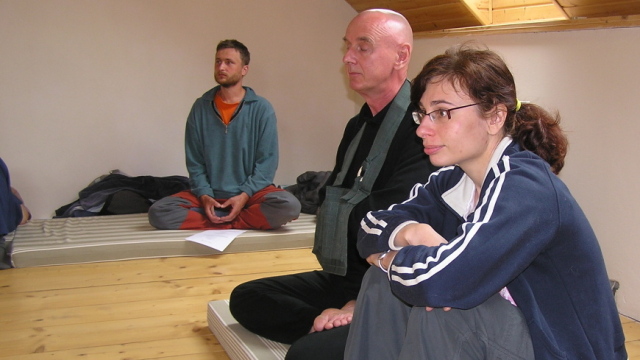
Michael Eido Luetchford
June 2007 — Padmafarma, Talk 4.
Venue: Padmafarma, Bělá u Jevíčka, Czech Republic.
Michael Eido Luetchford · June 2007 — Padmafarma, Talk 4
Source: audio transcript.
From the retreatPhotosRecordings3Chronicle
Audio
Padma Farm 2007 - Talk 4.mp3 in the Google Drive folder
What the talk says (short overview) — About these overviews
Mike says that he became a Buddhist teacher without a plan, by following his life as it unfolded, and that he cannot guess whether what he teaches is useful to others. Looking back, his life seems to have had a direction that it never told him, and besides the decisions we make by thinking and planning, he recommends that we practise zazen every day if we can, or whenever we can, and follow the stream of our life.
He says that when we teach we to some extent teach ourselves, that he cannot guess when what he says is useful, and that the audience teaches him too, since without them he could not talk or learn. He tells how in nineteen seventy-seven he went to a seminar on Zen with a little Japanese monk, who became his teacher, and, without knowing why, kept going every week for about fifteen years, and how he took the precepts without knowing what they were. He helped his teacher to translate and publish books about Master Dogen, and slowly found that he understood them. Before returning to the UK he asked his teacher whether he could talk about Dogen there, was told that if we do not start we can never learn to teach, and went through the Dharma transmission ceremony, though a year later he realised that he had nothing. Back in the UK, when he talked about Shobogenzo to the AZI group in Bristol, its leaders objected after eleven months, and he told them that he could not follow their way blindly. Then two dojo leaders invited him to talk to their groups, which left AZI and joined him. A young man from the Czech Republic, Pavel, who had asked Nishijima Roshi about zazen at a session in Brussels, later asked him to come, and Mike says that how he got from Tokyo in nineteen seventy-seven to here is a kind of puzzle: he made choices, but he did not have a plan.
He says that in normal life we decide by thinking and talking, but that underneath, his life is flowing forward and he is following it without knowing where it is going, and he compares this to throwing soft mud at a wall, where most slides off but a little stays and builds up, which is how he learned Buddhism. The Buddhist way comes from balance rather than from getting knowledge or talking and learning, he says, although those things are important too, and if we practise zazen and balance body and mind, the very small choices we make subconsciously sometimes lead our life, although we cannot see clearly what we chose. Because Buddhism came together with different cultures, he says, it is puzzling what is culture and what is Buddhism, and each of us has to find out by comparing what is taught with our own life, since nobody knows the result. He adds that people who have never been to Japan dream of spiritual societies in Asia, that in his view Europe is more spiritual than Japan, and that his teacher says that Buddhism can now survive only in the West. When a participant objected that letting anybody start teaching seemed to go against the precept not to sell the wine of delusion, Mike answered that his teacher meant that if we wait until we feel ready it is too late, that people are free to start teaching, and that those who listen can decide whether they want to hear them. He adds that when he teaches he opens himself so that everybody can look at him, and that if he does not feel confident that he is telling the truth, he cannot continue. He thinks that people who want to become famous teachers may hide their dishonesty by becoming grand, but that we can see what such people are really like. It will take some years, maybe decades, he says, for Buddhism to become established in the West, and such efforts will not be so successful, though he stresses that this is only his guess. He also says that he has another job which he can do at home, and he mentions a student, Mr. Ida, the president of a large cosmetics company, who offered to pay everything for Mike's teacher so that he could just teach Buddhism.
Complete English transcript — About transcripts
Editorial note: This transcript of a spoken talk has been lightly edited to read well as written text, keeping the speaker’s voice and meaning; the wording was adjusted with great care. We recommend listening to the original audio recording too.
So we chant. Come on.
[recitation, 00:00:06–00:00:51]
Before I came to the Czech Republic last week, I asked Roman by email, Do you have any suggestions about talks, what I can talk about? And he made some suggestions. And the last one was how to become a Buddhist teacher. So I'd like to talk about that. First you fill in an application form, together with the hundred thousand krona, and you send it to me. And you can become a Buddhist teacher. But seriously, it's a very strange situation to teach something to somebody else. I'm sure some of you are teachers already.
And you know that when you're teaching something, to some extent you're teaching yourself. So you prepare the lesson you're going to teach. You make it your own. And then you teach. And sometimes when you teach, it seems to go very smoothly, and you feel very happy with what you explained to yourself. Sometimes you feel puzzled. Ah, I couldn't explain it. Something didn't feel smooth. But I found in teaching Buddhism that it's impossible for me to guess when what I talk about is useful, and when it's not useful. Sometimes I gave a talk and afterwards I felt, Oh. Then somebody comes and says, Oh, this is a very good talk. Thank you very much. How do I say, Oh, this is good, isn't it?
So it's a very strange situation. Talking about something, teaching myself. But I can't guess whether I'm teaching you. On the other hand, you're teaching me. Because if you're not here, I can't talk. Well, I can talk, yeah. If I can't talk, I can't hear myself. And I can't learn. So it's a very strange situation. But there are lots of Buddhist teachers in the West now. Some of them are very great persons. Their lives have been very great. They've given all their energy to teaching. But I don't know any of them, so I can't guess what it's like for them. I hear about the different teachers, but I don't know what teaching is like for them.
Even people in my own group in Japan. For instance, Brad Warner in the States, who wrote a well-known book about Buddhism and teaches Buddhism in the States. Although I studied with him in Japan for more than eight years, I can't guess what it's like for him. So I can't tell you in general. But I can tell you my experience. In nineteen seventy-seven I went to Japan. I suppose I was searching for something, but I didn't know what I was searching for. And then at the weekend, I had free time from my work, so I went to a seminar on Zen with this little Japanese monk. And I listened to him talking. And that was the start for me, in nineteen seventy-seven. Ah, thirty years. You think about thirty years. And I don't really know why. I listened to this little Japanese monk, but I couldn't understand sometimes what he was saying. But something made me continue. And I continued every week, going to practise zazen and then listening to talks.
And I continued for about fifteen years, every week. Sometimes I felt, This is very interesting. Yes, I'm beginning to understand. And sometimes I felt, What am I doing? I can do something else. I can go swimming, or go outside from Tokyo. So what was it that made me continue? Sometimes understanding. Sometimes not understanding. Sometimes I disliked this little man. He had a very sharp voice. And if you disagreed with him, he'd become very loud. Blah blah blah blah. And I kept going every week, every week. And then I started to help him with the translating and publishing of the books about Master Dogen. I didn't know who Master Dogen was. What are these books about? But I still continued. Then one day, two American students who came before me were talking to each other. This weekend we have this ceremony and... What time are you going? So I thought, Hmm, something is happening. So I rang up my teacher, and I said, Would you tell me what's happening this weekend? He said, Oh yes, we're having a Buddhist precept ceremony. Would you like to take the precepts? So I said, Oh yes. And I went and took the precepts, and became a Buddhist without knowing what the precepts were, or what the meaning is. And I feel that this kind of strange situation continued for thirty years. If I look back, it's as if my life has a direction. But my life didn't tell me the direction. So I'm going somewhere, but I have to wait, and then I can look and see, Ah, I see, I'm going there. Do you have that experience? Where am I going? I see, I'm going this way. So, luckily, I didn't have a strong ambition to have some particular job or to be some particular person. So I could follow where I'm going. And I continued helping my teacher with translating and editing and publishing books about Dogen. I'd like to check through the words, to make the English smoother. So I continued doing it for more than fifteen years, in my spare time. And slowly I discovered, Oh, I can understand. But I didn't feel I studied. I checked it, and put in a stop and a comma, and made the sentences a little bit more beautiful. So I was quite surprised after several years. Ah, yes, I understand the meaning. So when I understood the meaning, I felt quite happy, but I didn't have the chance to do anything, because I was living in Japan. So my teacher is very vigorous in his teaching. For many reasons, I decided to return to the UK. But when I say I, I mean we, with my wife. So when I decided to return to the UK, I thought maybe I could talk about Dogen in the UK. I said to my teacher, Do you think I can talk about Dogen in the UK when I return? And he said, Yes. If we don't start talking, we can never learn to teach. So even if we don't feel ready, we can start. So I said, Okay, thank you. And I said to him, There's something called a transmission. In Buddhism, there's something called transmission of Dharma. So I said to him, Can you tell me if it's important? So he said, Oh yes. Do you like it? Yes, okay, yes.
So then, after one or two months of preparation, I took the ceremony to transmit the Dharma. And actually, at the time, I wondered if I would get something, something transmitted to me. But after the ceremony finished, and about one year passed, I realised I didn't have anything, just like in the ceremony. So then, back in the UK, I thought I could talk about Dogen. So I joined the AZI group in Bristol, because one of their members had come to Japan several years before. So I made friends with him, and I went to visit the group. And I sat zazen with them two or three times a week. And I said to them, Can I talk about Shobogenzo? And they said, Okay. So I started to talk about Shobogenzo. And because I understood what Shobogenzo is talking about, I could speak with confidence. But I noticed that members of AZI didn't like my confidence, because I'm a new person. I came from outside. And I was wearing a robe. So this was unusual for them. They had a rather clear organisation. So I jumped in, and I continued talking for about eleven months. And after eleven months, the leaders of the groups in England said, We're not happy about the talks. And you don't seem to be so exact with ceremony like we are. So we'd like you to come to a meeting. So then I attended the meeting, with maybe fifteen people. I saw a monk from France called Jean-Paul, and the people who were heads of the dojos in many parts of England. And they said, I think it's better if you follow our ceremony, our way. And when you follow our way for one year, maybe you can give some talks again. They said to me, What do you think? Can you agree?
So inside myself I had two feelings. Shall I agree with them? And I can cooperate, which is rather nice. I can sit together with other people. Or shall I tell them some criticism about them, which is against the Buddhist precepts? And I suddenly decided I'm going to tell them my real feeling. So I told them some things which I found difficult. I said I can't just follow your way blindly. And in any case, I don't like the way your group is talking during zazen. And other things.
So I thought, Okay, now it's finished. Then after the meeting finished, two of the dojo leaders came to me. And they said, Would you come and talk to our groups? So I was very surprised. I thought I'd thrown everything away. But something came back, which I couldn't guess at all. And I went to talk to these groups. And then they left AZI and joined together with me. And we now have those groups in the UK. So then I started to hold a sitting in a room in my house. And one person came. And then another person came. And then Andrew was living in London. And I met him in Japan a couple of years before. So he came from London. Then another person came. I don't know where these people came from. Slowly we had a group. Then the people in London said, It's too far. Will you come to London? So I went to London. Then we had a group in London. Then Nishijima Roshi came. My teacher came from Japan to Brussels. So I went to meet him. And we had the session, yeah. And during the session, there was a young man from the Czech Republic who asked Nishijima Roshi about zazen. So he explained to this young man how to practise zazen. And then I got an email, and his name was Pavel. So then you came to England? From the Czech Republic. And I was very surprised. And he came again. And he came three or four times. Then he said to me, Would you come and check your product? I said, Okay. And I came to Lotus Centre three years ago. And then the next year we did the same thing: we came here. And now I come again. And Pavel says he would like to make some more permanent meeting in the Czech Republic, sometime in the future. So, to me, how I got here from Tokyo in nineteen seventy-seven is a kind of puzzle. Of course I made choices, but I didn't have a plan.
I received a ceremony from my teacher called Dharma transmission. But I didn't get anything. And then some people say to me, You're a Zen master. But it doesn't feel like that at all. It feels like I'm following my life. My life is going somewhere. If I watch carefully, I can keep up with myself. So that's how I became a Buddhist teacher. And I think everyone who practises zazen recognises something similar. The word I use is unfolding. In our normal life, we have to plan for the future. We want to move to a new house.
We decide to live with our partner. We decide to have children. We decide to change our job. All these decisions are important. And these decisions we make by thinking and talking. The Buddhist way is somehow beneath, or simpler, or more profound. Of course I make my decisions, like everybody does. I'm thinking about my life, thinking how to live, how to do my job.
But underneath, my life is somehow flowing forward and I'm following it. But I don't know where it's going. But it came here today. That's my experience as a Buddhist teacher. I think if you have a wall, and you have some very soft mud, and you throw the mud at the wall, most of it slides off. But a little bit stays.
So if you keep throwing, (splat) something builds on the wall. I think this is how I learned Buddhism.
So, although I should not make a recommendation to other people, I would like to do so. Besides the decisions and thinking and planning that you make in your normal life, practise zazen. Every day if you can, or whenever you can. And then you can follow the stream of your life, and find out where you're going. Like a mystery ride. People talk about the Buddhist way. But the Buddhist way is not some kind of path which you find and then you follow it by getting knowledge, or talking and learning. Although, of course, those things are important. The Buddhist way comes from balance. When we practise balance, instead of choosing between this way or this way, we can find the middle way. We don't know what it is, but we do. So if we practise zazen and balance our body and mind, all the very small choices which we make subconsciously sometimes lead our life. But we can't see clearly what we chose. But the problem is that Buddhism came together with different cultures. So it's puzzling, which is culture and which is Buddhism. I practised Buddhism that came from Japan. So it has a certain cultural tradition. Is that important or not important? Some groups think that it's very important. So they like to follow Japanese custom, or wear Japanese clothes, or Tibetan clothes. But whether it's important or not, we have to find out for ourselves. We have to separate between what is the cultural custom and what original Buddhism is saying. And it's a very difficult job. Everywhere in the West now there are different Buddhist groups, different Buddhist books, different coloured Buddhist robes, different kinds of bowing, different kinds of prostrating, different coloured cushions. What's important? What's not important? This is a very difficult problem, which we are trying to solve now. So the people who solved this problem are me and you. We say, Okay, I try zazen. Or I'm going to go to a Theravada group. Or I'm going to read this book. And then we compare with our life. And we say, No. Or, Yes, oh yes. So everybody's choosing, based on whether they think what is being taught is real. Whether it makes sense to them. Whether it makes sense to you in your life. So we can't know the result.
There might be very realistic groups in Tibetan Buddhism. I don't know. And many people are going in that direction. And maybe people think that, for instance, Dogen's teachings that I'm teaching are not so interesting, so nobody goes this way. So I can't decide. Everybody decides this way or this way. So ordinary people decide what is realistic by listening and reading and practising, and then we can see which way, for instance, the Buddhist tradition is going. But nobody knows. We have to watch the situation.
Participant: In Asia, there are some wonderful flowers growing which you can pick as they come and enjoy them.
Mike: Flowers. That's very true. But I don't think there are so wonderful flowers in Asia. People who've never been to Japan, for example, they… I believe that Japan is a very spiritual place. There are temples in the mountains. The roof. Pine trees. The monk is walking. There must be wonderful spiritual culture. But it's a complete dream. Europe is more spiritual than Japan, I find. But we want to dream that they are spiritual societies. My teacher says that Buddhism can only survive in the West now. And maybe it comes back to Japan and China afterward. Because people are interested to find out and compare. But in Asia, people are not interested. It became a kind of dead tradition in other countries. So it's up to us.
Question: Anybody can, or I don't know if I understood well, that people can start to teach Buddhism. I think there was no restriction in this, what you said.
Mike: Yes.
Participant: I think it's too general, no? I mean, there is a precept not to sell the wine of delusion, and I think it's going against this precept.
Mike: I didn't say that precept.
Participant: Yeah, but... I mean, it's one of...
Mike: No, yes, I understand. No, what my teacher said to me was...
Participant: I don't know whether I understood it well, but that his teacher said that Buddhism can be read, as it were, by anyone, and thereby actually to teach, right? And my remark to that was that there is a precept which says not to sell the wine of delusion, which is like not to interpret wrongly, or somehow... Well, simply somehow not to pass on the teaching distorted.
Mike: What my teacher said to me was, If you want to teach, you have to start, even if you don't feel ready. So he didn't mean anybody who wants to teach should start teaching. He meant if we wait until we feel ready, it's too late. And it's true. If we start now, we can learn. However, I think there may be people who want to teach, and they are free to start teaching. But people who are listening to them can decide whether they want to hear them or not. I don't think ordinary people are stupid. So if I want to teach about Buddhism, I feel I'm opening myself, so everybody can look at me. If I don't feel confident that I'm telling the truth, I can't continue.
If there are people who want to become famous teachers, for example, they can decide to talk about Buddhism. And if they feel that they're not being honest, they can hide it. And usually people hide it by becoming very grand, and making their authority very strong. But I think if we look at those people, we can see what they're really like. Well, I think Darwin's theory of evolution applies even to Buddhism. So of course it will take some years, maybe even decades, for Buddhism to become established in the West.
At the moment, although there are lots of different groups, we haven't got to the heart of Buddhism yet. So people have to visit lots of different groups, trying to make sense of everything. So I think that situation will continue for a long time. But eventually, I think people generally will understand what Buddhism is about. And then if there are people who are teaching Buddhism to become famous or important, or because they want to build a big organisation, it won't be so successful. But it's only my guess. So I think, another ten, twenty, thirty years, the situation will slowly change.
Question: Do you teach Buddhism full time, or do you have another job?
Mike: I have another job. But fortunately, my other job is that I can work at home, and I can do the work on my computer. I can choose the schedule. So I can choose when to work, in the morning or afternoon or evening. Or I can work today, or not tomorrow. So it's a very fortunate situation for me. But I need the money. His first student was the president of a large cosmetics company. And so he said to my teacher, I will pay everything for you. When you finish your job, you can come and work in my company. But your job will be just to teach Buddhism. I will give you an office. I will pay to publish all your books. And I will pay to have sessions in the temple. But he continued to do that for more than forty years. His name is Mr. Ida.
And he is a very great man, because, thanks to his benevolence, I could also attend the session. And he paid my train fare. And so on. But it's a very unusual situation. So let's finish now by chanting Fueko.
[recitation, 00:56:38–00:57:23]