Western Buddhism and Hierarchy
Mike sees a hidden crisis: Buddhist groups easily grow into hierarchies of ceremony and special robes
Michael Eido Luetchford
February 2009 — Cholín, Talk 1.
Venue: Cholín, Czech Republic.
Michael Eido Luetchford · February 2009 — Cholín, Talk 1
Source: audio transcript.
From the retreatPhotosRecordings5Chronicle
Audio
1Talk-BuddhismInTheWest.mp3 in the Google Drive folder
What the talk says (short overview) — About these overviews
Mike argues that behind the popularity of Buddhism in the West there is a hidden crisis: people find teachings with very little in common, and many groups grow into hierarchies with special ceremonies and clothing that support the teacher at the top. Original Buddhism, he says, is about losing things and returning to our simple, normal state through zazen, so in Buddhism we should resist building hierarchies and find our own way.
He doubts the common view that everybody in Buddhism believes the same thing, and says that before we can have a useful dialogue about Buddhism we need to know what it is. Some people believe it is a religion in which Gautama Buddha became a god after his death and we become more and more perfect over many lives, but Mike cannot believe in that kind of Buddhism and prefers the very simple one he learned for thirty years, twenty years in Japan. In large Western groups a hierarchy forms with the original teacher at the top, and a special transmission from the top, ceremonies, robes and special colours support that structure, as they do in Christian Europe. Although creating hierarchies is almost natural human behaviour, he calls it a very big barrier to finding out what reality is, because we look to the people higher up to give us something. To see what is real we need to lose all the things with which we cover up reality, and our normal state is similar to when we were children: open, cooperative, honest and simple. Life in society is severe and makes us think in complicated ways, so we desperately need space to become simple, even stupid, for a short time, and by practising zazen simply every day we can let ourselves come back to reality. This, he says, is the centre of Buddhism, which Gautama Buddha taught after sitting in zazen, and he thinks the Buddha might have walked back into the forest had he seen the huge religious movement built after his death. He recalls that after Japan opened its borders in 1860, people ashamed of a simple religion for farmers tried to destroy original Buddhism and introduced more spiritual and hierarchical groups, while a few teachers kept its original nature, which led to Shunryu Suzuki in the United States and to Deshimaru, a student of Kodo Sawaki, in France. In both cases the organisations grew hierarchical after the teachers died, and Mike says he does not feel at the head of an organisation, because when he teaches he is teaching himself.
In the discussion he says there is nothing wrong with dressing like a Japanese or a Tibetan monk, but it does not give us anything of religion: the small piece of cloth he wears is comforting but cannot teach him how to live, and robes, incense and beautiful chants are decoration, like singing the national song before a football match. A participant describes four years in a traditional Zen community in Europe where learning the rules and ceremonies cost her integrity, and Mike agrees that such discipline has value but that it is easy to lose sight of one's own integrity, so people in Europe should look at what Buddhism is about and find their own way rather than somebody else's. When Roman tells how the community around the teacher he started with has shrunk to a few people, Mike replies that he thinks we should not do anything, neither encourage anybody to come nor stop anybody from leaving, and that we should accept this sad, or sometimes happy, fact.
Complete English transcript — About transcripts
Editorial note: This transcript of a spoken talk has been lightly edited to read well as written text, keeping the speaker’s voice and meaning; the wording was adjusted with great care. We recommend listening to the original audio recording too.
Traditionally, before the talk, we chant a verse called Kaikyoge, and after the talk, we chant another verse called Fueko. Some of you will be familiar with Fueko because it's part of the chants in the service in Master Deshimaru's group, I think. So before we start, let's chant Kaikyoge. It's a very slow rhythm: one, two, three, four.
[recitation, 00:03:00–00:03:45]
As many of you know, I don't like to give a long talk with nobody participating. So it's nice if I can talk about something for ten or fifteen minutes, and if you have a question, please ask it when you have the question, because questions are a very important way to clarify Buddhist philosophy. And the simple, stupid questions are the most important. Very sophisticated, complicated questions are too difficult for me to answer. So you may hesitate, but please overcome your hesitation. And you don't have to ask questions in English, because Roman is an excellent interpreter. If you disagree with his interpretation, please correct him.
I think in the UK people ask questions in this situation maybe more easily, sometimes too much. People who are not from the UK, please join in; I want to hear your opinions, not only questions. If you disagree with something, it's fine to say so. I think, as any of you who are scientists or work in the scientific area know, understanding develops best by dialogue, even sometimes by disagreement, but not by some kind of reverence. So I don't like reverence.
If any of you have questions about zazen, please ask me at any time during the retreat, and we can come into the dojo and try to find a solution. Or if it's a more philosophical question about zazen, please ask it. Even if we're talking about some different subject, you can ask a question on a different subject. It doesn't matter.
So this morning I want to talk about the state of Buddhism in the West. In Western countries Buddhism has now become very popular, so it would seem that Buddhism is becoming stronger, and Christianity and traditional religion are becoming a bit weaker. So the situation sounds very encouraging. But I have a different opinion. I think that in the West, in Buddhism, there is a hidden crisis.
I meet many people who are interested in Buddhism. But if they read different books about Buddhism, or go to groups who practise Buddhism, they find very little in common, sometimes nothing in common. And so it's very confusing for people. So usually people decide: this group suits me, or I like that group, the way they do things. And so we have a situation where there are lots of different teachings about Buddhism, but very little in common.
There must be many people who would disagree with me strongly. They would say, Oh no, everybody has the same thing in Buddhism. We are all one. We all believe in the Four Noble Truths, we all do meditation, and we all revere the Buddha. But I think that the tendency in the modern world to believe that we all believe the same thing is misleading.
People like to cooperate, and this is very useful. In the small city in the UK where I live, I often get letters from other religious groups: Christian, Hindu, Muslim. And the two large universities in the city have formed inter-religious groups, and these inter-religious groups have funding from the university or the government to encourage inter-religious activity and discussion between different religions. I don't mean that that is not useful. Of course it's very useful. But I think that within the area of Buddhism we don't yet know what Buddhism is. So before we can have a useful dialogue about Buddhism, we need to know what it is.
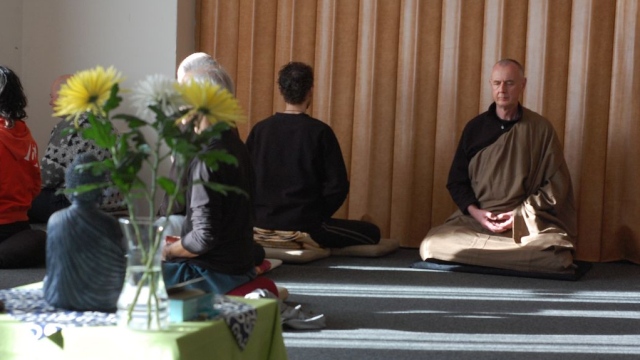
Some people believe that Buddhism is a religion, and that Gautama Buddha, whose statue is by the flowers, is a kind of spiritual being or a god. This happened soon after Gautama Buddha died, two thousand years ago. They made him into a god. And they said that after he died, he entered a special enlightened place called Nirvana. This belief is still very strong. In some groups of Buddhism they believe that we go on to another life after this life, and then even another life after that next life. All the time we are becoming more and more perfect, until we attain some godlike state. But I can't believe in that kind of Buddhism at all. So I like to tell people about the very simple kind of Buddhism which I learned for 30 years, 20 years in Japan. And it's so different from some of the other Buddhist teachings that I wonder if it's the same thing or not.
Some of the people who are teaching Buddhism in the West like to build up very large groups, so they're very diligent in getting new people to join them. And then, when they have joined the group, the group has many, many different activities. And then there is a hierarchy within the larger group. The original teacher is at the top, and all the people underneath hold him up, or her, and gently push them into heaven. Unfortunately, these leaders are not familiar with heaven. Sometimes they do very embarrassing things. Their followers...
Roman: Hide the facts.
Mike: Yeah. So this kind of activity has been very common in human societies for thousands of years. We can see it in all religious groups, in the groups in Europe that for thousands of years have mainly been Christian groups. And we can find this behaviour in Christian groups everywhere.
The person at the top has a direct telephone line, or maybe broadband. Oh, God. And this special transmission goes from the top person to other people, then to the lower people, and then to the very lowest people. Then it's necessary to introduce ceremonies and even clothing to support that structure. This is very familiar in Christian Europe, and it's also very common in Buddhist groups now. In the Christian hierarchy, the person at the top wears very special clothes, with a hat and very beautiful robes, and they have many people going round helping them and so on.
And I've seen the same thing in Buddhist groups. For instance, in some Buddhist groups the robe which Buddhists wear has a very special significance. Or the colour is very special: a certain colour means something special. But unfortunately, although this kind of activity of creating hierarchies, and organisations which support a hierarchy, is very common, almost, we can say, natural human behaviour, in Buddhism it's a very big barrier to finding out what reality is. We look to the people higher up the hierarchy to give us something. And then if we get something, we feel happy, and if we don't get anything, we feel disappointed.
But original Buddhism is about losing things. We can say it's about losing everything. This doesn't mean we should take off all our clothes, give away our money, our car, and have nothing. It means that in order to see what is real in life, we need to lose all the things with which we cover up reality. There's a very well-known quotation from the Bible, the Christian Bible, where Jesus says that to enter heaven you have to become like children. Actually, I don't know what he meant, but I feel that it contains some kind of truth.
In Buddhism we try to return to our normal state, and we can say that our normal state is something similar to when we were children. That doesn't mean to behave childishly. It means to be open and cooperative and honest, and simple. And all of these qualities we can lose very easily. I frequently lose those qualities: in daily life, in working, in becoming stressed, in dealing with life's problems. Sometimes we stop being open; it's too painful. Or we start to think in very complicated ways, because being simple doesn't seem to work.
So, of course, to return to some simple natural state like a child is a kind of dream or a kind of ideal. However, life in society is very severe. More and more, we need to use our brains to deal with things in society: to make choices about our bank details, our work, where we're going for a holiday, what we're doing in our job. So we desperately need some space in our life, to become simple for a short time, to become stupid for a short time. And if we practise zazen simply, every day, we can let ourselves come back to reality.
This is the centre of Buddhism. This is what Gautama Buddha taught after he sat in zazen for, I think, forty days or some period. But after he died, people were very diligent in creating some huge religious movement, with gods and kings and chief priests and assistant priests and monks and nuns and ordinary people and so on. I think Gautama Buddha might have walked back into the forest if he had seen it. It's not necessary. Of course, human society can't help these things.
When we work in society, there are many organisations with hierarchies, and that kind of structure always appears. But in Buddhism we should resist it, because if we don't resist it, it will grow, and grow and grow. And we'll have very, very hierarchical Buddhist organisations which are worshipping themselves and have lost the ability to be simple. So this is my feeling recently about Buddhism in Europe.
In 1860, Japan opened up its borders after 300 years of isolation. And for the next forty years the government brought in many, many Western ideas and Western systems. At that time they saw very spiritual, hierarchical religions in Europe, and they looked at the very simple Buddhism which existed in Japan and felt a bit ashamed that their religion was for farmers, only for some peasants. So they tried to destroy original Buddhism in Japan. They burned the temples, and they sacked the priests. And they created new Buddhist groups which were more spiritual, more hierarchical, and introduced those into Japan. And so the simple nature of Buddhism was almost lost.
But there were a few teachers who taught their students the original nature of Buddhism. One monk was called Nishiari Bokusan, and he taught a Buddhist teacher who taught, for instance, Shunryu Suzuki. Shunryu Suzuki went to the United States in the 1960s and taught very simple Buddhism, and he told his students, Don't go back to Japan. And in Europe there was Master Deshimaru, who was taught by a Japanese monk who studied original Buddhism. That monk's name was Kodo Sawaki. And Deshimaru came to France and started to teach original Buddhism. But in both cases, after they died, the organisations grew and grew and became hierarchical.
So we should resist this. This is my feeling. We should resist building hierarchies, because it makes simple Buddhism into something spiritual and something complicated. Of course, it's necessary to have a teacher if we want to learn something. But I don't feel, for instance, that I am at the head of an organisation, because when I'm teaching, I'm teaching myself, or reminding myself. So I'm very thankful that people come and listen. If nobody comes to listen, I will stop. This is my attitude.
So I'd like to have a discussion in the next 20 minutes, if you have comments or questions from your own experience. So please speak if you'd like to. If it's silent for a while, it's more difficult to speak; it becomes more and more difficult. So we have to cough and move around.
Question: Are there groups in Japan that are operating in the same way that you teach? Or are you suggesting that they've come more to Europe now?
Mike: They've come to Europe and the States, and there are very few groups in Japan. This is why Shunryu Suzuki said to his students, Don't go back to Japan. And Deshimaru said to his students, Don't make contact with Japan. Actually, both groups made contact with Japan after their masters died, because they felt lonely, lost.
Participant: It must be very difficult for them, since it derived from Japan, such a big religious group, to just cut off contact with the roots of where it started.
Mike: It might seem difficult, but only if we believe there's something very special to get. If we believe there's something to get, then we have to find somewhere to get it from. But the teaching of Buddhism is not like that. Many people believe that if we dress like a Japanese, for example, or like a Tibetan, then we've got something about religion. But actually, it's not true. Of course, there's nothing wrong with dressing like a Japanese monk or like a Tibetan monk. There's nothing wrong with dressing like a footballer, or like whatever. Everybody has uniforms.
And I'm wearing this little piece of cloth, and other people are wearing the same, so it's kind of comforting. When I wear this, I feel, Oh, I'm Buddhist. But it can't teach me how to live. This cloth can't teach me how to live. But I can find out how to live by getting rid of all those extra things and looking at life simply. But we like to have lots of things, a ceremony, for example. So people from the States who went back to Japan wanted to become more Japanese, I guess. Maybe they believed that it was more Buddhist or more enlightened. Unfortunately, it's not true.
Even if we have very beautiful robes and dress, and even if we can hold a stick of incense in a special way, and even if we can chant a very beautiful chant, we are far from any enlightened state. But to wear a uniform, to put incense into the bowl nicely and to have a nice aroma in the room is nice. It's decoration. It's like singing the national song before the start of the football match, with the children. It's human society's ceremony. And I want to talk more about ceremony, maybe tomorrow.
Participant: Just to comment a little bit on what you were saying: I found all of it very, how shall I say, illuminating, and confirming the little experience I have in the field. From my own experience, just to say, I spent four years in a fairly traditional community in Europe, a Zen Buddhist community. I arrived hoping it would be like you described, what you do: a tradition where you discuss with people, where you learn by asking questions. And I found I was buried in all the things I had to learn to succeed in this world, in...
Mike: This community.
Participant: Yeah, I mean in this particular community. So my mind, my energy was taken up with learning how to put the incense, with wanting to do it right, with being stressed about not doing it right. You know, just the whole set of rules and ceremonies. So in the end, when I came away, I realised that I had lost more and more of my integrity and my authenticity.
Mike: Yes. Everything has value, so even training in that way has some value. We can get benefit from learning discipline, from following somebody else's instructions, doing something in a certain way, by somebody else's instructions. But as you say, it's easy to lose sight of your own integrity.
Participant: I think, from what you said just now, I'm beginning to appreciate that aspect of my training there, and I did when I was there. Because I think being at the bottom of the pile in middle age, when in ordinary society I had already got a little bit higher in the pile, at the bottom of this particular community, I was right at the bottom. And in my life before, at the school, I was a senior teacher. What I experience now as positive, what I see now as positive: I learned not to mind very much about my image, what I presented to people, what people thought of me. That had been very important to me before, I think. So I think something opened up there.
Mike: In my talk I don't mean to appear critical of all other Buddhist groups or anything like that. But I feel it's important that in Europe people start to look at what Buddhism is about, not to hide themselves in learning lots of ceremonies, but to find their own way, not somebody else's way. I don't want anybody to follow my way. My way has been like this. Everybody can follow their own way.
Participant: So I was just thinking: you've only been coming here for four or five years, and I was wondering how you felt the culture of the Czech Republic, the cultural environment, looked for the establishment of some sort of original Buddhism.
Mike: I think it's very nice here. In my small experience, you people here in the Czech Republic have some kind of pragmatism, which is maybe missing in the UK. And you are more straightforward.
Roman: So, it's nice. Well, I feel, when Mike was talking about the crisis in Buddhism... When I started to practise twelve years ago with Master Grégoire Debailly, there were about forty people at the summer session. And now there are only three or five people. It's a little bit sad for us. I think that in this frenzied modern world there are few people who would still stick to pure Zen. A lot of people are interested in Zen art, Zen philosophy, calligraphy, ikebana and different things, but most people leave pure meditation. When Grégoire Debailly started to teach here, most of his students were, like, university students. Over time, as they started their own families and careers, the community began to shrink.
Mike: Thank you. Yes, I just have to reply quickly. I think we should not do anything. If our group gets smaller, we can teach one person or two people. If there is nobody, we can stop. People should decide freely. I never want to encourage somebody to come or stop them from leaving. Everybody makes up their own mind. This is a sad fact, or sometimes a happy fact. So we have to accept it. Thank you. Okay. So at the end we chant Fueko. The first three lines are a little faster, and the last four lines are slower.
[recitation, 01:01:16–01:02:15]
Mike: I'm sorry, it's the first four lines, the last three lines.