No Hierarchy of Enlightenment
Mike contrasts hierarchical Buddhist centres with Dogen’s teaching that all who practise zazen are Buddhas
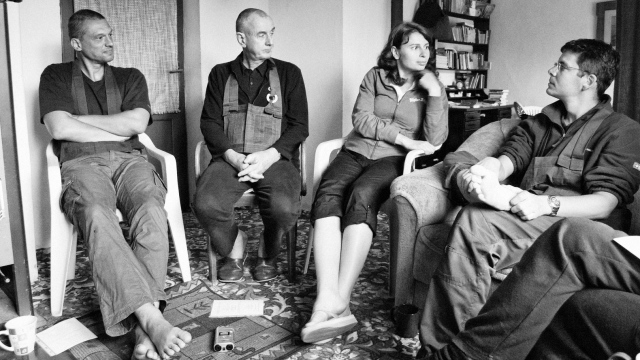
Michael Eido Luetchford
July 2009 — Dibbavana, Talk 1.
Venue: Dibbavana Meditation Centre, Mariánské Lázně, Czech Republic.
Michael Eido Luetchford · July 2009 — Dibbavana, Talk 1
Source: audio transcript.
From the retreatPhotosRecordings4Chronicle
Audio
200907-01-Teachings-of-master-Dogen-vs-other-buddhists-groups.mp3 in the Google Drive folder
What the talk says (short overview) — About these overviews
Mike contrasts the Buddhist centres that are flourishing in Europe, which build communities around a hierarchy with an enlightened person at the top, with Dogen's teaching, which has no hierarchy of wisdom or enlightenment. That hierarchy, he says, is an illusion, and Dogen's Buddhism rests instead on the belief that everybody who practises zazen is a Buddha, whether new or old.
He describes groups, especially those set up by Tibetan groups, that buy large houses, offer activities for adults and children and do a lot of good work, and he links their success to the community of the church, which some people miss now that Christianity has become weaker and church communities have largely disappeared. Dogen also founded a temple and wrote very detailed rules, but Mike explains them by the needs of men from many villages living together in a very unhygienic thirteenth-century Japan, calls the effort to live by those rules today misguided and, while granting that the rules may sometimes be Buddhism, warns that believing very strongly that they are may lead in the wrong direction. A large centre needs rules and a structure, but whereas a business needs its structure to fulfil its purpose, the purpose of these centres' structure is a hierarchy in which the person at the top is supposed to know everything, be enlightened and never lose their temper, while the new people at the bottom know nothing. Dogen's rules, by contrast, were not a hierarchy of wisdom, his group functioned in a reasonably democratic way, and Mike's own teacher, though stubborn and powerful, never imposed such a structure and was open to anyone who wanted to talk to him. Since nobody simply knows the truth, and some people we call stupid are wise while some we call wise are stupid, Mike says we need our freedom to find the truth, and he prefers his group's open, somewhat chaotic style to a conveyor belt moving upwards to eternal bliss, something he has never experienced. Big structured groups are okay to some extent, but in the modern world we no longer need to leave our families in order to practise, so he favours lots of small gatherings and practising zazen at home.
Asked how spreading Zen fits with a hierarchy that at some point stops working, he says to let it break up but to continue to practise and keep in contact, since it is not necessary to get large numbers of people, and he himself has never tried to build a group. He notes that Dogen too had a very small group and founded Eiheiji because a very rich sponsor encouraged him, and he gives a basic Buddhist rule: be very careful where you put your foot now, but don't worry where you're going. Asked why the Theravada and Tibetan schools teach levels of enlightenment while Dogen's Buddha was simple and realistic, he answers that human beings like to be important and try to live according to what they believe, so if they believe that a person can become perfect, they want to be like that. The Pali sutras mix very spiritual ideas with profound and simple ones, he says, and levels of enlightenment already existed in the yogic tradition with which the Buddha practised until, after eight years, he walked out of the forest and sat down again in the same posture, having by then given up trying to become superhuman. The Buddha then noticed he was human, and Mike adds that being normal and human is okay, that what matters is not understanding why people go different ways but choosing which way we go, and that becoming simple, giving up a very strong intellectual aim so that we can follow reality more easily, is the aim of Dogen's teachings. He also grants that other Buddhist activities have value and can help lonely people make friends, though he thinks it almost impossible for them to find out what Buddhism is that way.
Complete English transcript — About transcripts
Editorial note: This transcript of a spoken talk has been lightly edited to read well as written text, keeping the speaker’s voice and meaning; the wording was adjusted with great care. We recommend listening to the original audio recording too.
At the start of the talk, let us recite Kaikyoge, the verse to open sutras. This chant is all written in Chinese, so even when Japanese people chant it, it's not easy to understand the meaning. And every word has the same length, so we chant it with the same equal length. But the chant which we do after the talk, Fueko: the first three lines are Japanese.
Sorry, the first four lines are Japanese. And so they have a slightly different rhythm. I think a lot of you know that chant already. The last three lines are again Chinese, so they're slower and equal. So even Japanese people chant a mixture of Chinese and Japanese. But it sounds nice. So let's chant Kaikyoge.
[recitation, 00:02:05–00:02:57]
I'd like to talk about the difference between Zen Master Dogen's teachings and what seemed to me to be the teachings of other Buddhist groups. Of course, I don't have so much experience of other Buddhist groups, so I may be mistaken sometimes, or make some wrong comments. But at least I know about Master Dogen's teachings, so I won't make a mistake there. No.
There are lots of Buddhist groups in the town where I live, and in different parts of England. And I noticed in the last ten years, since I came back from Japan, that some of them are very successful and vigorous. Especially the groups which have been set up by Tibetan groups seem to be very successful, and they do a lot of good work. Often these groups are able to buy a large house and make it into a Buddhist centre, and there are two very close to my house.
There's also one in Glasgow, which I visit often, because the Glasgow Zen group practise Master Dogen's Buddhism in one room in their centre. They are very successful at building communities. And I think in Europe, since Christianity became weaker, some people miss the community of the church. For thousands of years, churches built small communities here and there. When I was a child in the country in Somerset, we went to church two times a day, and also Sunday school for children, and everybody knew everybody else.
They were friendly and visited each other's homes and so on. So these were an important part of life. But these days those communities have largely disappeared, at least in England, because people stopped going to church. My parents stopped going to church, but I never asked them why. So the role of community which religious groups can build is very important. And these groups, successful communities built around Buddhist groups, have lots of activities, for adults and for children.
They have a celebration for the birthday of Buddha, and they have activities for celebrating other important dates. One particular group that's popular in the UK holds camping weekends where you can also learn to meditate. So these kinds of groups are very popular. People are happy to join them and make new friends, and happy to join in the activities. However, looking from the viewpoint of Buddhism, from Dogen's teaching, we can find some differences. Although Dogen himself founded a temple, and he wrote very detailed instructions for people on how to live in the temple. I think these were only men, no women.
And the people who came to live in Dogen's temple must have come from many different villages and small towns, mainly in the countryside, in the thirteenth century. And they came to live together in a monastery, a temple. If you read Dogen's instructions for living in a temple, there are many, many rules. Some of these rules are for basic hygiene: hygiene when washing your body, going to the toilet, washing your clothes or robes, and also preparing food.
And all these rules were very important because Japan in the 13th century was a very unhygienic place. The men coming to stay in the temple with Master Dogen would probably not be used to living together with other men. Some of them would have been quite stubborn and tough; others would have been quite gentle. So without the kind of rules which Dogen wrote down, it would have been difficult to make some kind of successful community. I heard that there are some temples in Europe, for instance in France, where they tried to live using the rules which Dogen wrote eight hundred years ago.
But I think that kind of effort is misguided, because in the modern world the situation is different. Almost everybody cleans their teeth at least once a day. We can have a shower or a bath whenever we like. We have doctors and hospitals. We don't need to have the same kind of rules that Dogen made.
But some people think that the rules that Dogen made somehow are Buddhism. And they may be, sometimes. But if you think very strongly that the rules which Dogen wrote down for living are Buddhism, you may go in the wrong direction. If we go back to these communities in Europe which I'm talking about, they also have many rules. And it's necessary, if you have a large centre, to have rules, to have a structure. And if you have a structure, you have to have somebody at the top. We know this is true in normal business. So in a business organisation we have managers, executives at the top, and then managers underneath, and then workers underneath, and then maybe freelance people underneath. Because without a structure you can't fulfil the purpose of the business. However, the Buddhist centres which are forming in Europe don't have the same purpose as a business. So their structure has a slightly different purpose. The purpose of their structure is to set up a hierarchy. And if you have a hierarchy, the person who's at the top should know everything, and people going down from the top know less and less, until the new people at the bottom know nothing.
This is a structure which is introduced into many Buddhist centres. And from the Buddhist teachings over the thousands of years, they have put into this structure a kind of power base, a base of power. The person at the top is in charge, is wise, is enlightened, has no problem, is always peaceful, never loses their temper, never has sexual desire, always treats everybody equally. Generally, is a wonderful person.
This is quite a common situation. But it's all an illusion. And this illusion creates misunderstandings about Buddhism. A very enlightened person at the top, other people who've been hanging around for a long time and are almost there, and then so on, down to the new people who look around like this: What should I do? And so on. And I think those new people are very important. They are sincere and they have no immediate aim. Master Dogen's teachings don't have that hierarchical structure. Of course, as I said, he had a very strict set of rules.
But those rules were not a hierarchy of wisdom, or a hierarchy of enlightenment. His group were not like that. And so they functioned in a reasonably democratic way. Dogen's descendants: I don't know the early people, they were dead before I was born. But I heard about Kodo Sawaki from my teacher. And my teacher himself didn't have any hierarchy of power. Of course, my teacher is a very stubborn and powerful man, but he never imposed that kind of structure on our group. If you wanted to talk to him, you could just go and talk to him.
If you wanted to visit his house, you could call him and go and visit his house. So he was very open, and unstructured. So the Buddhism I learned as Dogen's Buddhism doesn't have a hierarchy of wisdom. Some people are wise, and some people are not so wise. Some people we call stupid are wise. Some people we call wise are stupid. Some people are wise today, stupid tomorrow, and so on. So the structure of our group reflected that real situation: listening to somebody today, disagreeing with them tomorrow. Anybody who has followed the internet blogs centred around my teacher for the last few years can see this open situation.
It looks a bit chaotic. But after noticing the nature of the structured centres in Europe, I prefer our style. What is the truth? We don't know. Now I know, now I've forgotten. So, in order to find the truth, we need our freedom. If we join a group where there is somebody who knows the truth and other people who don't, then we join a kind of conveyor belt, moving upwards to eternal bliss.
I can't say whether that's true or not, but I never had any experience like that in my life. So, from my observations, I think that to have a big structured group is okay to some extent. But the need to have big structured groups is not so strong in the modern world. In Dogen's time, you needed to leave your family in order to have some freedom to practise zazen.
If you stayed at home, you had to join in the family life, producing food. Days were quite long. There was not much leisure time. But in modern times we can take Thursday, Friday, Saturday, Sunday, yes, and practise Buddhism. So the function of these Buddhist centres, to create a community, may be nice, because many people in modern cities and towns are lonely. So to join a big club which is founded on compassion and loving kindness sounds wonderful.
But I think, for me, they seem almost exactly like the church I used to go to when I was a child. The group I studied with, Dogen Sangha, and the people in it: I think we are interested to teach people how to practise zazen, for people who want to, and to find a way to do that. The best way seems to be to make lots of small gatherings: different people coming at different times, practising zazen at home, exchanging our experiences. So this is my idea of how to spread Dogen's Buddhism.
It is founded on the central belief that everybody who practises zazen is a Buddha, and new or old is not important. This is what Dogen says. So that's what I wanted to say this morning, and we can have a talk about it now, if you like.
Mike: Did I make you all go to sleep?
Question: Is it Kaisen's way, to make the structure?
Mike: What is it?
Participant: And I think he does it in order to create as many disciples as possible, so that Zen spreads among more people. But at a certain moment it seems to me that it then starts to slow down or to fall apart, not to work, on that hierarchical structure. So it's a very good example.
Mike: Oh.
Question: How to put it together?
Mike: Let it break up. But continue to practise, and continue to keep in contact. And I think that it's not necessary to get large numbers of people. So I never tried to get anybody. But once, when somebody who had come for four or five years said they didn't want to come anymore, I was very sad, so I rang them up and said, ‘I'm sorry, something's not good enough for you.’ But besides that, if people don't come, I don't mind.
If they come, I don't mind. So I never tried to make a group. Pavel kept coming, and I couldn't stop him. So I realised after ten years… That way seems to be kind of too easy-going. But it's not. However, I don't do anything from an idea to build something.
Partly because I'm not so good at organising. If I start to organise something, I can't guess the chaos. So I just let things develop naturally. Or not. Actually, in Bristol, where I live, we have a group, and maybe six or seven years ago we had fifteen people coming. Recently only four. So I don't try to increase it. Even if one person learns how to practise zazen every day, it's great.
Participant: He gives those people a feeling of merit for how many disciples they will have or gather. So that is a great merit.
Mike: He gives students merit for… disciples and new students. He gives them merit?
Participant: Feeling of merit. This is very important. This is the most important of all.
Mike: I see. Yes.
Participant: You should abandon yourself, and your power, your… all… everywhere.
Mike: I see. The more people you bring, the better you are, or so. I see. No. And I think Dogen didn't like to do that, so he had a very small group. He even lost his temple for some years and lived in a small cottage. And he founded Eiheiji because a very rich sponsor encouraged him to build it.
And then suddenly a lot of monks from another group came to him. But I didn't do any evangelical… yeah, getting others. My teacher had four of us for maybe fifteen years. Then we left and some other people came, but those few people are now in different countries, and something's happening. But whether it's successful or not doesn't matter. There's a basic rule in Buddhism, which I can talk about more later.
Be very careful where you put your foot now, but don't worry where you're going. Or, as the famous Buddhist author Brad Warner wrote in his book, if you're firing an arrow, be very careful how you aim, but don't worry where your arrow goes. So this is a very important Buddhist attitude. It sounds quite stupid in the modern world.
Roman: These Theravada and Tibetan schools constantly talk and teach about a huge number of different levels of enlightenment and purity of mind, and they keep emphasising it. And also about a hierarchy of beings, from some kind of worms up to heavenly beings.
Mike: Superhuman… really? So if you believe that, then you…
Roman: No. I don't understand it: they keep claiming this is what Buddha taught, and keep quoting what Buddha said, that if you do this, you will get to that level. And it looks as if there were two Buddhas in history: one who practised zazen and didn't try to reach any levels, and the other one who led to these Theravada and Tibetan schools.
Participant: I guess there seem to be two Buddhas: one that is very idealistic and encourages people to try to attain higher and higher levels and try not to be reborn as worms or cows, and that is the basis for Theravada or Tibetan Buddhism. And then there is Dogen Zen, which teaches about a Buddha who was very simple and very practical and realistic and didn't teach about any hierarchy or any levels. So how come there is such a huge difference between these two schools?
Mike: You can notice that we human beings like to be important. So if we become important and then we believe that we are important, then we live like we are important. Then we start believing that there are very important people and not so important people. And this is one result of the spiritual development of civilisation. So it's a characteristic of human beings to believe things. And once we believe something, we try to live according to that belief. So if we believe that human beings can become some special perfect being, then we want to be like that.
Participant: Yeah, but they claim this is what Buddha taught, the levels of enlightenment, the levels of peacefulness. They keep saying this was Buddha's teaching.
Mike: Well, unfortunately, the Pali sutras, which are the only record of the Buddha's teachings, are quite mixed: lots of very spiritual ideas and also very profound and simple ideas, all mixed together. So I suppose people see things in different ways. Some people wrote down what they thought the Buddha said, and other people wrote down what they thought the Buddha said, but those people had a different understanding. So, for instance, levels of enlightenment in meditation already existed before Buddhism. It was what the Buddha practised with the yogic tradition.
And you can read in Indian philosophical texts about the nine levels of consciousness of the yoga teachers, and so on. But it's clear from the stories of the Buddha that he spent eight years in the forest trying to reach the highest level of consciousness, sitting in the lotus posture. And to do that, the yogins taught that you shouldn't have too much to eat, you should deny physical things, in order to become a superhuman being. But after eight years, the Buddha walked out of the forest, and then he sat down in the same posture. By this time he'd already given up trying to become superhuman.
So then he noticed he was human. And to be normal and human is okay. So I think it doesn't even matter if we can't understand why some people go this way and why some people go that way. If you want to study it, it's fine. But the most important thing is: which way do you go? Scholars can make very detailed studies and help us understand, but without understanding we still have to choose. We don't need to understand in order to choose. Many people go to lots of different Buddhist groups, and then they're thinking which one to join. That's a slow way. You can just say, ‘Oh, I'll do that.’
So the Buddha's story of coming out of the forest is a story of somebody throwing away his hope to become perfect, superhuman, and becoming simple. And this is the aim of Dogen's teachings. So to become simple, we need to give up a very strong intellectual aim. And then we can follow reality more easily.
Roman: That's something.
Mike: I think it's taken a long time for the West to play with Buddhism: to try it, to write about it, experience it, go and live in Japan, go and live in Southeast Asia, try wearing these clothes, try wearing different clothes, try having this kind of bell, try having that kind of bell. But in the end, we have to find out what Buddhism is about without the bells and clothes.
Anyway, cheer up. It'll soon be lunchtime.
Roman: I agree.
Mike: I don't think the other kinds of Buddhist activities are without value. Everything has some kind of value. So the Buddhist centre at the bottom of my road sells very nice zafus, for example, and they have a very big hall. So that's nice for me. But also people who are lonely in modern life can join the large organisation, make friends and so on. But I think it's almost impossible for them to find out what Buddhism is.
Question: Do you live alone?
Mike: I live alone, yes.
Question: Yes. You have children, or?
Mike: I have two children.
Question: And have good contact with them?
Mike: Yes, I stayed with my daughter in Australia, where she lives, for a month, just before.
Question: And they understand you?
Mike: I don't know. Do they understand me? Do I understand myself?
Participant: Well, it's not a philosophical question.
Mike: They know what I'm doing, yes.
Participant: Yes, yes. But they are… in agreement, somehow,
Mike: They agree with you in a way, or?
Participant: In some way, some, not all.
Mike: No, I don't think so. They're not against it. But they know what I'm doing, and they're happy for me to do it. But, for instance, when my daughter comes to stay, she doesn't practise zazen.
Question: And do you have no problem with this?
Mike: No, I don't mind.
Question: And before?
Mike: Before?
Question: Before, ten years ago, for example, didn't you have any problem that your daughter doesn't do zazen?
Mike: No, no, never. But if she practises, it’s nice. She practised zazen once, when she stayed with me, and I thought, ‘Ah, that’s nice.’
Question: Because before, we talked about this question, and I remember that Buddha’s son, they gave him the name Rahula.
Mike: Yes.
Question: For this… attachment. It means attachment.
Mike: Right. You mean attachment to my family, from me, is that your question?
Question: Maybe, yes. How far is this attachment to children, for example, in your spiritual life or Buddhist life, or…
Mike: I have one daughter in Australia, so we are very close, but I don’t see her so often. But we talk on the telephone. And I have one stepson in Japan, and I don’t see him very often, and he’s a very busy doctor. And I’m single now, because my wife wanted to become divorced. So I don’t have any attachment. But I ring her up every week, and we have a nice chat, a conversation. So my situation is difficult to understand.
Shall we stop? More questions? Comments?
Okay, let's turn the echo off.
[recitation, 00:56:29–00:57:32]
Mike: Thank you very much.
Participant: Thank you.