Karma, Cause and Effect
Mike on Dogen: action is free in this moment, yet we never escape cause and effect
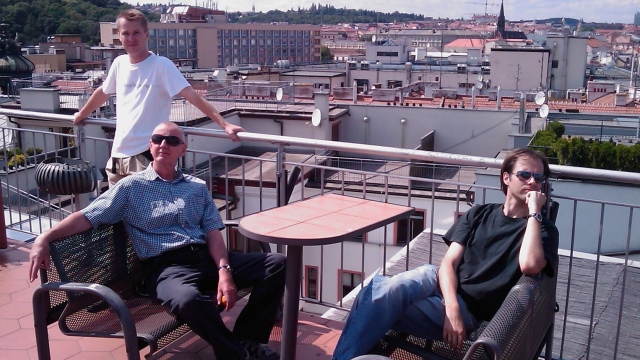
Michael Eido Luetchford
July 2009 — Brno, Talk 3.
Venue: Brno, Czech Republic.
Michael Eido Luetchford · July 2009 — Brno, Talk 3
Source: audio transcript.
From the retreatPhotosRecordings3Chronicle
Audio
2009-07-Brno-03-Cause-and-effect-Karma.mp3 in the Google Drive folder
What the talk says (short overview) — About these overviews
Mike explains that karma originally means simply action, and that Dogen holds two views of cause and effect that do not fit together: in this moment our action can be free, yet we never escape from cause and effect. He suggests that cause and effect is a powerful explanation based on process, a kind of belief that works almost all of the time, while reality itself goes from one moment to the next in an unknown way.
In Buddhism, he says, karma came to mean the result of our action, and mixed with other religions it is often taken as a destiny from past lives or as fatalism, which is confusing when we look at Dogen. According to Mike, Dogen does not believe in karma from past lives or as determinism and teaches that only this moment is real, but he also wrote that when we act there is always an effect, which we notice straight away, after a while, or cannot find at all. In our mind we link cause and effect with linear time, so if the past is gone and the future is not here, we cannot explain how the past reaches the present or how our action now affects the future; Dogen's two views do not fit together, Mike says, because life is also a puzzle. Science studies cause and effect in ever smaller steps, as with the sugar in his tea, yet at the smallest steps atomic physics cannot say how one event leads to the next, which Mike calls a mystery. This does not make cause and effect an illusion, he says, but what we take as cause and effect is a kind of belief in process, and since reality moves on in an unknown way, in each moment we have freedom.
Mike adds that whatever a whole society believes absolutely becomes real for it, as when medieval people believed that God saved Brno from the Swedes, and that today we believe absolutely in scientific explanation. When a participant says that we function only in a process-based view and cannot understand an immediate one, Mike answers that we are nevertheless living immediately, that living so without thinking clearly about process feels like having no direction, and that the process-based view also causes all our unhappiness. He says that dependent origination, as Tibetan Buddhism interprets it, means that everything is connected, which is true, but he does not think we need it to see this, and if Buddhism taught only that, science would be better, he thinks, so there is more to Buddhism than that. Asked about scientists who believe in God, he says that he cannot believe in somebody outside the universe controlling everything, since there would have to be another universe for God to live in, created in turn by another one, which he calls Nagarjuna's argument. In the discussion of belief and experience, he explains that belief affects our actions and what we notice, depends on whether we lean towards the spiritual or the material side, and grows as our evaluation and our belief reinforce each other until we become dogmatic. If we practise zazen and evaluate our experience from many different perspectives over the years, he says, we form a belief on which we can quietly insist, and this is what happened to Dogen.
Complete English transcript — About transcripts
Editorial note: This transcript of a spoken talk has been lightly edited to read well as written text, keeping the speaker’s voice and meaning; the wording was adjusted with great care. We recommend listening to the original audio recording too.
Shall we recite Kaikyoge?
[recitation, 00:00:07–00:00:46]
I don't have a subject to talk about today, so please introduce a subject, somebody. It doesn't have to be true.
Participant: Oh.
Mike: It would be nice if it was.
Question: Well, I would actually be interested if you could say something about action and effect, I mean cause and effect, because it seems that all Buddhism, popular Buddhism, is based on this kind of theory, and karma and so on. But I think that your point of view, or Dogen's point of view, is a little bit different. So I would like to… I heard it from you actually, but it's still quite puzzling for me, so if you could say a few words about the link between cause and effect, action and effect, and karma.
Mike: The word karma in Sanskrit, the original meaning, or the simple meaning, is action. But in Buddhism, it came to have the meaning of the result of action.
This is quite often the case. If you look in a big Sanskrit dictionary, you can find the meaning of a word, and then underneath it says, in Buddhism, and gives a different meaning. So in simple Sanskrit the meaning is action, but in a Buddhist context it has come to mean the result of our action. And more than that, because Buddhist writings have become mixed with many other thoughts from other primitive religions.
For instance, Brahmanism. Karma is often taken to mean some kind of destiny, which is the result of our past lives, or some kind of accumulation of all our actions over many, many years, as a kind of burden. It's also taken to mean some kind of fatalism. For instance, something happens to me and I say, Oh, it's due to my karma. So I think that's quite confusing when you look at Dogen's writing and thinking.
Dogen says that we don't live again after we die. He says that we can be free in the present moment, but he also says that we always receive the results of our actions. So clearly, Dogen doesn't believe in the idea of karma from past lives, or karma as some kind of determinism.
The centre of his teachings is that in this moment our action can be free. Only this moment is real. All our memories of the past and all the effects of the past are now in this moment. The actual events which happened in the past have gone; the results of our actions in the past are here now. The future has not arrived yet, but our thoughts and feelings about the future exist in the present. So for Dogen, the present contains infinity, or eternity. However, he also wrote two or three chapters where he says, We never escape from cause and effect. When we do some action, there is a result or an effect. Sometimes we notice that effect straight away. Sometimes we notice it after a short while.
Sometimes we notice the effect after a long while. And sometimes we can't find where the result is, but it's there somewhere. It's impossible to break cause and effect.
When we think in our mind, cause and effect is a link between the past and the present. For instance, I drank some tea, so I feel full. I had an argument with my partner, so I feel angry. In our mind, we link cause and effect with linear time. To reconcile those different views is impossible. Reconcile means to put together the parts.
If the past is gone, why does the result of our action in the past come into the present? If the future is not here, why does our action now have an effect in the future? So Dogen's two points of view don't fit together, and the reason for this is that life is also a puzzle. In actual reality, for instance, scientists are studying the cause between one event and another event.
A very simple example: I can put sugar in my tea, then I can stir it, then I can taste it. Not enough sugar. Then I put a bit more sugar in, then I stir it, then I taste it. Ah, that's better. So if I'm a scientist, I can study that cause and effect. I can look at the composition of sugar and the composition of tea, and the chemistry which happens when I put sugar in tea, and what happens when the tea goes onto my tongue. And I can study it in more and more detail. Because I put sugar in the tea, the tea changes into something a little different. And when that different tea touches my tongue, the signal that goes to my brain is a little different, a little stronger. So in that way, science can study cause and effect in very small, detailed steps.
So we believe in cause and effect. All around us, science has made clear the causes and the effects of many different things. If you drink dirty water, you become ill. If you wash your hands after travelling on the bus, you don't catch a cold. And they can tell us the reason: there are very small germs on our hands, and they come onto the places on the bus, and then we put our hands to our mouth, and so the germs go into our body. So we can believe it absolutely. Science explained cause and effect.
But if we look very, very closely at science, for instance at atomic physics, scientists are trying to look at the smallest pieces of matter, called atoms and electrons, and quarks and neutrons, and so on. And the amazing thing is, when they look at cause and effect in these very, very, very small steps, they don't know how reality gets from one cause to one effect. This is the state of modern atomic physics. They realised that the step from one event to another event is a mystery.
This is very important, because we can notice that, although cause and effect explained by science is very powerful for us… It's powerful because it breaks processes into steps, and then breaks a step into smaller steps, and then breaks a step into smaller steps, and then breaks a smaller step into smaller steps. But at the smallest steps that human beings can see…
They can't explain how something causes an effect. This doesn't mean that cause and effect is some kind of illusion, but it does mean that what we take as cause and effect is a kind of belief in process. So it's a way to understand the world which works almost all of the time. But we don't know how we come from the last moment to the present moment. We don't know how we go from the present moment to the next moment. It's a mystery.
Mystery is disturbing, so we use science to explain it. So in that way, Dogen is saying that our explanation called cause and effect, which is based on process, describes reality. However, reality itself goes from one moment to the next in an unknown way. So in this moment we have freedom; in the next moment we have freedom. That's his point of view. There are two ways to look at it. Does that make sense?
Participant: Yes, but it's very difficult to understand.
Mike: Yes. Yes. It's understanding. So understanding reality is impossible. But we make lots of models and lots of explanations, and some of them are very powerful. The most powerful is science. Two hundred, three hundred years ago, the religious explanation was very powerful. They said, Oh, you have a red patch on your arm, it's a result of sin.
Or, the citizens of Brno have all got a disease and they're dying, it's the judgment of God. Everybody believed this completely. Now we have science, which explains things with a very powerful method. It's stronger than religious explanation. We can say, No, this is not from sin, this is because you have an allergy. If you stop eating so many biscuits, this disappears. But even though science is strong, many people still believe in religious explanation.
But they call it New Age spiritualism. Well, I would say more New Age spiritualism.
So although science is very, very strong, and we must believe it because it works, there is nothing in reality called process. There is only now. But it's impossible to understand that there is only now. So in our brain we think about the past, the present and the future, and things going through a process. And this way of thinking works very well, so we believe it almost absolutely. But in two hundred years' time, things may be different.
If the whole of society believes something absolutely, it becomes real for them. In medieval society, people believed in the power of God absolutely. So they all believed absolutely that God saved Brno from the Swedes. It was not just, Yes, I believe it, he doesn't believe it, maybe. Everybody believed it was true. Everybody believed that sin is the result of doing bad. A kind of punishment from God. We can't believe that anymore, but we believe absolutely in scientific explanation.
We can't imagine another situation. So it's difficult to understand.
Participant: It's very difficult to understand. I think that there are two points of view: process-based and immediate, if I call it like this. So I think for all of us, we function only in the process-based view, and we can't recognise or understand the immediate point of view.
Mike: No. But we are living immediate. But if we live immediate without thinking clearly about the process, we feel something without direction. Just doing one thing, just doing one thing, just doing one thing. We don't like that feeling, or we worry about that feeling.
Participant: I can understand, but the process-based view also causes a lot of trouble for humans.
Mike: Yes, it does. Although it's very strong and powerful, it also causes all our unhappiness. Yes, in very simple ways.
Participant: It seems to me that most popularised Buddhism is based on a process-based view. It doesn't talk about the immediate.
Mike: No.
Participant: Which is strange.
Mike: Yes.
Participant: Maybe you just didn't understand Buddhism at all.
Mike: I think so, yes. For instance, Tibetan Buddhism interprets the famous phrase… that famous phrase… Yeah, that's it: dependent origination. Dependent origination means everything is connected together. And it's true, and especially in modern times we feel it's true. We discover that the Shell Oil Company burning oil in Africa creates clouds of pollution in Estonia.
We discover that everything in the world is linked together, so we're very worried about human civilisation destroying the world. But I don't think we need to believe in dependent origination at all to reach that point. If Buddhism is only teaching that, science is better, I think. Science can clarify very clearly the connection between our conduct here and the result there. So there is more to Buddhism than that.
Question: What is your opinion of current modern scientists, mathematicians or physicists who still believe in God? For example, my headmaster is a mathematician. I think he's an extremely intelligent person. He's Catholic; he believes in God. And he says that science doesn't deny God because, for example, nobody knows what was before the Big Bang. Or astronomers?
Participant: Astronomers, yeah. There is a famous Czech astronomer, an astrophysicist actually. He's very popular, and he also believes in God. And he says, We know what happened a tiny little fragment of time after the Big Bang, or science can find out, but we can never find out what happened at exactly the moment of the Big Bang.
Question: And he believes in God. So you must have come across some modern scientists who claim they believe in God.
Mike: Yes, I have heard a lot about it, and it depends what they mean, really. If you believe in somebody outside the universe who is controlling everything, I think it's impossible to believe that.
Actually, I think that the Big Bang theory is ridiculous, because nobody can explain what came before. If they can't explain what came before, I think the theory is ridiculous. So I guess after another fifty years we will have another theory. But if people believe that this world is so wonderful, and so complicated, and so complex, that it's a mystery…
They can call it God if they like. But in that case, God has to contain everything bad as well as everything good, everything evil as well as everything good. So that's all right.
Question: But why is it not possible to believe that something outside the universe exists?
Mike: It's not possible for me to believe it, because in that case there must be another universe which God lives in. And then something must have created the universe which God lives in, so there must be another universe outside God's universe which created God's universe. And then there must be another universe which created the universe which God lives in. And this is Nagarjuna's argument, in the second century. So to believe in something outside of this universe is impossible for me.
Participant: I think it matters, or it is important, how you define this universe. If you define it as three or four dimensions, then this is the universe. I don't know how physicists calculate this, but they insist there are more dimensions, maybe.
Mike: They say that from their equations there are more dimensions. So their equations come from their heads. But I'm waiting for one of them to poke their finger into another universe. Then I'll believe it. Our senses can reach only these three or four dimensions. There will not be anybody… Then the scientists with ten dimensions can keep their dimensions inside their heads.
Participant: I think we are back to my question that I asked you last weekend about the connection between belief and experience, because I've been quite obsessed with this problem recently. I don't know why, but it seems contradictory to me. I can believe in many things, but I wonder whether it helps me to experience reality in a different way. And I like what your teacher says, that the universe is God and God is the universe. Somehow it fits with my… I'd like to add: the universe is the devil, the devil is the universe. Not to replace it, but to add. So somehow, in my mind, I made a model: I separate these two things, belief and experience.
Mike: Belief is a very strange thing, because we believe many things at different levels. But at a kind of primitive level, belief affects our actions. So if I believe that fruit with purple skin is bad for you, I don't eat plums. If I believe that my hands can transmit energy into other people, I can put a bed in a room and have patients and put my hands above them, and if they believe that too, they will pay me money to do it.
So it depends on our experience, on what we do and the result. But what we believe also changes what we notice. If we are a little bit unbalanced towards the spiritual side, like this, then if somebody says, You have an aura around your head, and there is a gap in your aura, I can fix it for you, we believe it. So then we will pay some money or go to some place to have it fixed. But if our state is a little bit towards the materialistic side, we can't believe things like that. We can't believe anything which is not physical. So different people have a different balance between the mental and the physical in their characters.
And so they see their experiences in slightly different ways, and then they say, Yes, I believe that, that really worked. And if it continues like that, they believe it. And if the belief gets stronger, it goes into our body, not only our mind. So we become dogmatic; our belief becomes much stronger.
So our belief depends on our state, whether we're a spiritual person or a material person, because this determines how we evaluate what happens to us. And then that evaluation strengthens our belief. But if we're not fixed too spiritually or too materially, but wobbling here, we evaluate what's in front of us differently today, tomorrow maybe, this morning, this afternoon. This morning we think, Yes, yes, zazen is the truth, and it's making me perfectly balanced. And then this afternoon we sit, our legs are aching and our back is aching, and we think, Ah, let's get out. So this is very helpful for us, to evaluate our experiences in different ways. But many people like to fix their experience on one side, their evaluation on one side. And then that creates belief, and belief creates the evaluation, and evaluation creates belief.
So it becomes stronger and stronger. For somebody who practises zazen, it becomes stronger in us to notice, Oh, my mood is different, I see things differently. I see. I'd better believe in that. I'd better not believe my feelings too strongly, I'd better not believe my thoughts too strongly.
So, let's carry on. If we believe in that, we're believing in reality, and that belief becomes stronger in us.
Participant: There are people who practise zazen and believe in God.
Mike: Yes. So if they continue to practise zazen, I hope they keep evaluating their belief.
Participant: You can believe in God like some kind of universe which is helping us, or you can believe in God like somebody who is
Mike: giving you messages about how to live. So many different cases.
Participant: It seems like a message again. I was in a fog.
Question: Do you think that belief is just a thought?
Mike: No, it comes into our body and mind. But what it is, I don't know. In the beginning it's just a thought, something that comes from what we're doing. If this thought fits our experience, then we can… Not only thought. So a child can believe that their father is perfect, just because they're evaluating the experience of being with their father, who seems to be big and strong and capable. So they have some kind of belief. And then when they become a teenager, they realise, No, he's not, he's a shit.
Participant: Or, I believe Mike feels balanced now. No, it is not just a thought; it's based on how I feel, you know.
Mike: You keep your beliefs to yourself. I know.
Participant: It's based on what I see, how you sound, how you look, right? It's not just, I believe this, and maybe it's completely out of reality.
Mike: Yes. So in Buddhism, to believe that practising zazen makes us balanced is a belief. But when we first practise zazen, we can't believe it. So we practise, and we hear somebody say, You're a buddha. But if we continue day after day after day after day after day after day after day after day after day practising zazen, after a long time, evaluating from many different perspectives, evaluating when we feel happy, evaluating when we feel miserable, evaluating when we feel excited, evaluating when we feel depressed, evaluating when we feel desire, evaluating when we feel hungry, evaluating when we feel drunk, over the years we form a belief. Then we can insist on our belief quietly. This is what happened to Dogen.
That's the best I can do. Time to finish: the last sitting, and then prostration and closing. Then we come back and have lunch. Okay.
[recitation, 00:57:41–00:58:47]
Participant: Thank you very much.
Mike: Thank you.