Opposites and Being Upright
Mike: opposites form one whole; Buddhism makes no effort to be good or stop being bad, but to be upright
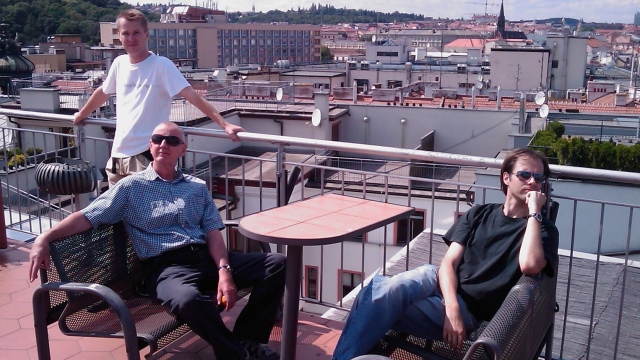
Michael Eido Luetchford
July 2009 — Brno, Talk 2.
Venue: Brno, Czech Republic.
Michael Eido Luetchford · July 2009 — Brno, Talk 2
Source: audio transcript.
From the retreatPhotosRecordings3Chronicle
Audio
2009-07-Brno-02-Two-sides2.mp3 in the Google Drive folder
What the talk says (short overview) — About these overviews
Mike argues that the opposites we name with words, such as big and small or good and bad, are relative and form part of one continuous whole, and that Buddhism therefore makes no effort to be good or to stop being bad but makes an effort to be upright, the middle way between them. This effort, he says, is made just for the sake of making effort, a teaching he calls almost unknown in Western civilisation, which has been idealistic for more than two thousand years and makes an effort to attain its ideas.
To show that opposites are relative he notes that a small room in the Czech Republic may be a big room in Japan, and he prefers a model like a stick moved between two extremes, which lets us ask how much love or how much hate rather than use fixed words. Spiritual religions, in his view, are one-sided, because they insist that we should be good and get rid of the bad, while Buddhism says neither good nor bad but in the middle, since our real actions are very complex and we do not know all their results. This is why, he says, Dogen tells us not to make an effort to become Buddha, which would mean becoming some good person, so that not making that effort is to be upright, and to be upright is Buddha. Dogen as a young monk asked why we need to make so much effort if we are all Buddha, and eventually realised that we make effort just for the sake of making effort. After a participant's story about a master who keeps telling a student at the top of a tree to climb higher, Mike recalls Dogen's metaphor that to act in the present moment is to step from the top of a hundred-foot pole, since each moment is separate and the next one is unknown. When a participant objects that effort for its own sake is possible only in zazen, sport or free time, he replies that we do it many times every day, for instance when we open our mouth and just make a word without first thinking what to say. Because of the very strong teaching of idealism we do not notice the value of such actions and call them stupid, while Buddhism said they are okay.
In the discussion he explains greed, anger and ignorance as states we should avoid, which produce a physical reaction and change the physiological state of our body, so that Buddhism calls them poisons, though he admits that the real meaning of ignorance is not so clear. Asked whether zazen is enough to cure very strong desire, he says it depends on each circumstance, since practising zazen helped two of his students who used to be alcoholics, while for others the physical state may be almost impossible to recover. Once you are angry, he agrees, it is too late, and he calls Nishijima's advice to just stop it a kind of hope, because he has seen Nishijima when he did not catch himself. Some people are naturally balanced and others unbalanced, as Mike was when young, until rock climbing gave him an opposite to thinking and worry, so Buddhism is not the only way to balance but a way to practise it and understand how important it is. This is why it can appeal to unbalanced people who feel the opposite pull between the physical and the mental, and Mike recalls that Nishijima once said he might be a terrible person if he did not practise zazen. He concludes that Buddhism can affirm for everybody that making an effort is important, that we can just act and move into the future without worrying too much, and that we can accept good and bad together, free from religion.
Complete English transcript — About transcripts
Editorial note: This transcript of a spoken talk has been lightly edited to read well as written text, keeping the speaker’s voice and meaning; the wording was adjusted with great care. We recommend listening to the original audio recording too.
Shall we recite Kaikyoge before the talk?
[recitation, 00:00:13–00:00:57]
This afternoon I want to talk more about two sides: everything has two sides. But this time in terms of opposites. We have lots of words for opposite things or opposite states. Big, small, high, low, far, near. Right, wrong. Good, bad. Love, hate. These are very common words for opposite things. And because we use language to give words to opposite things, sometimes we make the mistake of thinking that something called big or small really exists. But it's easy to see, for instance, that big and small are relative. A small room in the Czech Republic may be a big room in Japan. A tall person in Japan may be a short person in England. So these opposites are relative. Hot and cold. Of course, we can use scientific measurements to make the measurement objective. So, for instance, 40 degrees centigrade is hot.
Ten degrees centigrade is cold. But still, these terms are relative. The temperature of the sun is very, very hot. So when we notice that the opposite words we use for states are relative, we can make a different model to help us understand reality. Instead of having fixed words, for instance love or hate: how much love? How much hate? We can notice that in reality these states, which we call opposite, form part of a continuous whole.
A continuous whole.
Roman: Can you try to say it one more time?
Mike: They form part of a continuous variation. So, in order to illustrate it, I like to use a model like a stick, which we can move from this extreme to this extreme. I like this model, but it's only a model. But using this model, I can say, I love you very, very much. Something's a little bit big. Something's a little bit small. So I like this scale because, for me, it's nearer to reality.
The reason I'm talking about this model is that it helps me to understand good and bad. Good is here. Bad is here. They are part of something. We all contain bad and good. A little bit good, a little bit bad. However, spiritual religions insist that good is what we should be. Bad is what we should get rid of. God is good. The devil is bad. Heaven is good. Hell is bad. So they want to get rid of all the bad side and just have the good side.
So I think spiritual religions are one-sided, basically. And if you try very hard to be one-sided, after some time you feel much better. So we can find examples of very good people who like to be bad sometimes. We can find examples especially in Christianity. Buddhism says neither good nor bad, but in the middle. To be balanced in the middle is to be good and bad at the same time. Or to stop separating the world into good and bad. Of course, sometimes we do something which we think is good.
Sometimes we do something we think is bad. But our real actions are very complex. We do not know all the results of one action. So if we say we should only do good actions and we shouldn't do bad actions, then we are trying to be only on this side. So Buddhism doesn't try to be good, and doesn't try to be bad. It doesn't make any effort to be good. It doesn't make an effort to stop being bad. But it makes an effort to be right. Right: in English we can say upright. Can you say it in English? To be upright is the best we can be.
Not worrying about good and bad. This sounds irresponsible to some people, but in fact it's the middle way between good and bad. And if we follow the middle way, we can act upright. This is the reason that, for instance, Dogen says, don't make an effort to become Buddha. To become Buddha means to become some good person. So for Dogen, not to make an effort to become Buddha is to be upright. And to be upright is Buddha. So it's a strange kind of contradiction. We make an effort, but we don't make an effort to be good. We make an effort to be upright. That's it.
So please say something.
Participant: I don't know if it's a koan or just a normal story about a master and his student. The master asked his student to climb a tree, to the top, to the very top.
Roman: And he asked him: Continue, continue. He did not know how, and so he made one step, but then it was not possible any more, and he asked him again. So does it agree with your understanding of zazen, or... I don't know.
Mike: I don't know the story.
Participant: The master says, Climb higher, higher, and the student says, I can't, and the master says, Just higher. That's the whole story.
Mike: I don't understand that story. What did the student say next?
Participant: He doesn't know how to.
Mike: No.
I haven't heard this story before. If I were the student, I'd like to climb down and stand by the master on the ground. So this is the highest state. But I wasn't there.
Roman: Is it related to the story about jumping off a hundred-foot pole? Maybe you remember it: jumping off a hundred-foot pole.
Mike: That's an expression which Dogen uses in Shobogenzo as a metaphor.
Participant: When I was practising with Grégoire, he told us about this koan during zazen, and he explained that it means that we should try to sit as upright as possible and keep pushing ourselves up and up. As if it was a physical explanation. See?
Mike: Yes.
Participant: That was his explanation.
Mike: Yes, this is what I did. I used to be only one metre fifty. That's rubbish. What was Dogen's interpretation? He said that to act in the present moment is to step from the top of a hundred-foot pole.
So every human being, at every moment, is stepping from a hundred-foot pole, because the next moment is unknown, and each moment is separate. So the hundred-foot pole represents this moment: very short and very high. And then we step.
It's important to make an effort. So I don't mean we don't need to make any effort. Dogen, as a young man, as a young monk, had this question: If we are all Buddha, why do we need to make so much effort? In the temple where he lived, they made lots of effort to clean the floors, to read sutras and study. Nobody could answer his question. But eventually he realised that we make effort just for the sake of making effort. This teaching is almost unknown in Europe, in Western civilisation. For more than 2,000 years Western civilisation has been idealistic.
To be idealistic is to follow our idea. So we make an effort to attain our idea, and the result has been wonderful. Making an effort to follow our ideas produced this wonderful recorder. But the Buddha's teaching is different. Buddhist teaching is: make an effort just to make an effort. Do something just for doing it. This is a very unusual teaching, which we can only find in sport. And even in sport it becomes covered up by ambition and many other factors.
Participant: Effort just for the sake of making an effort is something you can do practically only in zazen, and maybe in sport or in your free time, but not generally in life.
Mike: No, you can make an effort just for making an effort many, many times, in different situations. If you open your mouth to say something and don't worry what comes out of your mouth, but just make a word, you are making an effort for the sake of making an effort. If you think about what to say first and then try to make a noise which matches your thinking, this is the normal Western way: I must think about it carefully.
And then I must speak. So, many, many situations: every day you are making an effort just for making an effort. But because of the very strong teaching of idealism in Western civilisation, we don't notice the value of it. So, for instance, we think that if I say something without thinking about it, it's stupid. If I clean the windows but the windows aren't dirty, it's crazy. If I lead my life without thinking where I'm going, that's stupid. But Buddhism said all those stupid things are okay.
Question: Does it put the same value on both things, also on the other one, where there is thinking? The same value, or...?
Mike: You know, Buddhism puts value on action. It says that what we do creates our life. What we do at every moment creates the future. So it encourages us not to worry, but to act.
Question: But by acting, they don't mean thinking, in this sense?
Mike: No. So the problem for us in the Western countries is: how can we do that and also continue our complicated idealistic lives? How can we act without worrying where we're going, and at the same time think about where we're going? So we have to try, and we find it's possible.
Participant: I like the idea you mentioned at the previous retreat: that you might have a long-term goal, for example to be successful at work, but just forget it in the present moment. This may be the right way.
Mike: Yes, yes.
Participant: Because actually, in my opinion, it's the answer to what Karel asked: his claim was that it doesn't work in normal life, but I think it works like this: you can have the goal you want to achieve, but at that moment you forget it and just act. In fact, I thought about it for a very long time, because for me there was quite a contradiction between not having goals and just acting, and this might be the solution.
Mike: We can't find a solution in our own brain. We can't find a solution in our brain and then do the solution.
Participant: But we might select some direction and then try to go in that direction, but at the same time just forget it in the present moment, and maybe we will reach the destination or not, but it's not so important.
Participant: But this is the main thing.
Mike: And what is this?
Participant: Also a direction, but we only act in the present. Basically, we always forget it: now, when we're cutting the vegetables, I don't have to think that we want to get somewhere, but it can be something in the background. But as I'm cutting vegetables,
Roman: Don't remember the direction.
Mike: Yes.
Roman: For example, when cooking a meal, he is focused on cutting vegetables, but all of a sudden he has an idea: now I will grab a cucumber.
Mike: Yeah.
Participant: So you... That's a Buddhist idea, isn't it?
Mike: But it doesn't come from... So it should still be the idea.
Participant: It surprised me: is it something Buddhist?
Mike: It's a Buddhist cucumber.
Participant: If it comes from intuition, then it would be a kind of Buddhist approach. I don't know what will come then.
Roman: There is an idea: I will do this and that. And then I'm doing something, acting, acting, and then I have an idea: I'll do this.
Mike: Yeah, yeah. That's not a question, no. It's wonder.
Participant: Thinking aloud.
Question: I'd like to ask if there is any difference between balance and ignorance, and what the difference is.
Mike: Balance and ignorance, in English?
Question: No, in Buddhist theory.
Mike: Balance is only an idea. Ignorance is only an idea. But the idea of balance refers to some kind of state which is between opposite sides. This is the usual meaning of balance. If I balance this on the floor, like that. Ignorance usually means lack of knowledge. But in Buddhism it's sometimes used as a translation of avidya. There are three categories in Buddhism: greed, anger and ignorance. And those refer to states which we should avoid. Avoid getting angry. Avoid desiring too much, which is greed. And avoid ignorance, which means purposely not finding out. So we should avoid being purposely ignorant.
Roman: And this is because in Czech we also have two kinds of translation. Ignorance is, as you said, not knowing enough or not having enough knowledge, but in Czech we also understand it as being cynical: I don't care.
Mike: Okay, yes, that's what it says.
Roman: The source of problems is not caring or not knowing, in Buddhism. Does it mean we don't care enough, so that causes problems, or we don't study enough and that causes problems?
Mike: I think, for instance, the three categories which I mentioned, greed, anger and ignorance, refer to states which produce a physical reaction in our bodies. So, for instance, greed, to desire too much or to be greedy, is a physical feeling. To be angry is a physical feeling. And to purposely deny our intelligence is a physical action. And so they change the physiological state in our body. So they last for some time.
So in Buddhism they're called poisons, because they produce some kind of poison in our body, which we can now understand more with endomorphins and so on. That's the best I can do.
Roman: Can you give an example of ignorance changing the physical state?
Mike: Don't keep asking me questions. I don't want to talk about it. I just want to sit here. Oh, that's... it's the remote. Oh, don't call me. Don't talk to me. Give me a beer. I want a beer. I don't want to talk to you.
Participant: I want to drink beer.
Roman: So it means not caring: I don't care.
Mike: I suppose so. It's not actually so clear, the real meaning. So we have to find a meaning. But I think the three categories, the three poisons, mean poisons. So we can understand anger, because when we get really angry, not politically angry, but really angry, we feel it in our body, even after ten minutes, or even after ten hours. And if we get angry constantly, we change the physical state of our... And with greed, when we desire too much, very strong desire, we change our feeling. Very strong sexual desire. Very strong desire for material things. Very strong desire for drink, alcohol. We change the state of our body. So we need to look for some meaning for ignorance which matches those two.
Question: I wonder, in this extreme case, when your desire is too strong and so on, as you said: do you think that zazen, practising zazen, is enough to cure this? Because if you have such strong feelings...
Mike: You mean if somebody has very strong feelings?
Question: Yes. And if he sits,
Mike: Yes.
Question: whether it would be too strong to solve the problems by sitting.
Mike: So it depends on each circumstance. If somebody leads a life very, very strongly based on desire for a long time, I mean extreme, it may be impossible for them to recover their normal state. But, for instance, I know two students of mine who used to be alcoholics, and practising zazen helped them to return to their normal self. But there may be other alcoholics who have been drinking too much for too long, so their physical state is almost impossible to recover.
Roman: About saying stop being angry or greedy or ignorant: as I understand it, you can only change the circumstances that are leading to this situation, but at the moment you cannot change the fact that you are angry.
Mike: Once you're angry, you're angry, yes. Once you're angry, it's too late.
Participant: Yes. I remember a video with Nishijima. I don't understand it exactly, but it was about anger, and
Mike: Anger.
Participant: Anger, yes. The student asked something about anger: What to do when you are already angry? And Nishijima said, Just stop it. And the student asked, But how to stop it? And Nishijima said, Just stop it. I don't remember it quite exactly. And I think Brad Warner also wrote something similar, not that I am a jiujitsu practitioner, about anger: Kill your anger was the title of the chapter. At first I didn't understand it completely. I don't understand completely how to do it.
Mike: Nor do I. Nor does Nishijima. Well, I think what he says is a kind of hope. So if we can catch ourselves, we can stop sometimes. But I've seen Nishijima when he didn't catch himself. So it's a kind of hope, or a kind of effort.
Question: But there are people who have been ignorant their whole life.
Mike: Yes.
Question: Do they feel comfortable?
Participant: I don't know. They are still healthy, they feel comfortable.
Question: No, they have stayed ignorant and they feel okay, comfortable, so this poison doesn't affect them in a bad way.
Mike: If they feel comfortable, they're not ignorant.
Question: So then they are balanced, not ignorant.
Mike: I don't know which.
Question: My husband, for example: he doesn't care about so many things, and she just comes: So, Daddy, let's speak about death. Oh, come on, I don't care about it. But he's okay, he's completely okay.
Mike: So we all have our own situations. Some people are naturally fairly balanced people. Other people are fairly unbalanced people. When I was young, I was rather unbalanced. So I used to think a lot and worry a lot. And then I started to go rock climbing, and I found rock climbing and mountaineering gave an opposite to thinking and worry. So people naturally try to find balance in their lives. But there are many different situations: how we are brought up by our parents, and so on. So we shouldn't think that only Buddhists are balanced. But Buddhism is a way to practise balance and understand how important it is. It doesn't mean that you get it and no one else gets it.
So, for instance, if you like to be an artist, you can go to art school, and you can learn how to paint and how to draw and so on. But it doesn't mean that other people can't paint or draw. So to follow the Buddhist way is to concentrate on living a life of balance.
So sometimes it's very appealing to unbalanced people, like me. My teacher, Nishijima, said once that if he didn't practise zazen, maybe he would be a terrible person. No comment. But it's true: if in our own life we can feel the opposite pull between the physical and the mental, then sometimes that kind of person is interested in finding the balance between the two. So they may be interested in Buddhism. So, in a way, Buddhism can affirm the valuable things about human life.
And not only for Buddhists, but for everybody. They can affirm that to make an effort is important. Not to be clever or not to be stupid, but just to act. Not to worry too much, but just to move into the future. Not to try to be very good, but to accept the good and bad together. Free from religion. And this is a contribution that Buddhism can make. Very simple. Can we stop now? Thank you very much.
Participant: Let us recite Fueko.
[recitation, 00:57:22–00:58:31]
Mike: I like your socks. I just saw them now. Wow. Life and death.