Just to Be Alive Is Enough
Mike reads stories about Shunryu Suzuki and says that a terrible experience made Suzuki very wise
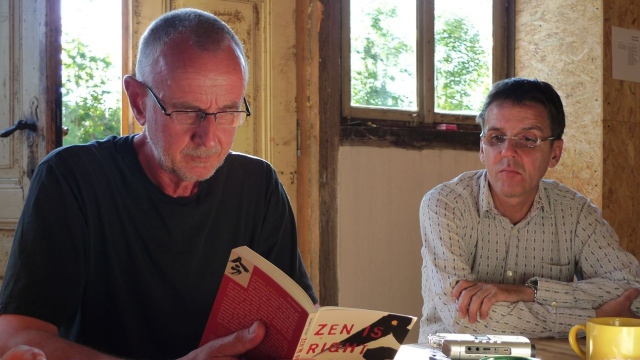
Michael Eido Luetchford
August 2011 — Dibbavana, Talk 2.
Venue: Dibbavana, Mariánské Lázně, Czech Republic.
Michael Eido Luetchford · August 2011 — Dibbavana, Talk 2
Source: audio transcript.
From the retreatPhotosRecordings5Chronicle
Audio
2011-09-Talk-2-Shunryu-Suzuki.mp3 in the Google Drive folder
What the talk says (short overview) — About these overviews
Mike reads little stories about the Japanese Zen teacher Shunryu Suzuki, which one of Suzuki's oldest students collected from his fellow students for a book, and in the first of them Suzuki says that just to be alive is enough, which Mike calls a very profound thing to say. We usually think that we are alive for a reason, to do something or to help others, and Mike admits that sometimes being alive does not feel enough, but says that there is a state where we can feel that just being alive is enough, and sometimes we can catch it.
Suzuki also said that we should practise zazen like someone who is dying, for whom there is nothing to rely on; Boris describes this as no hope, no future, just this moment, and Mike says that it is very difficult to live like that, but it is a very true way. To a student who asked why there is so much suffering, Suzuki replied that there is no reason, and Mike adds that suffering is one part of life, so the point is not to get rid of suffering but to overcome or transcend it. Suzuki said that enlightenment is not a complete solution to all our problems, that a Zen master suffers in the same way as his students, and that hell is not punishment but training. On the fourth day of a sesshin, when his students were sitting with painful legs, he told them that the problems they were experiencing would continue for the rest of their lives, and Mike comments that without problems there is no life: problems are the water we swim in. Mike calls these answers very humorous but also true, and he points out that Suzuki paid no attention to whether his students were following the precepts but noticed how they were with each other. He then explains Suzuki's background: a simple temple priest who always wanted to teach zazen, Suzuki accepted a strange young man into his temple after the Second World War against his wife's wishes, and after a couple of years the young man killed his wife. Mike thinks that at that moment Suzuki lost everything and that this terrible situation made him very wise, so when he came to America in 1959 he had nothing to get and could see through things which deluded other people. He believes that a very severe experience can be a great teacher: we do not want it, but sometimes we get it, and it helps us to see reality.
Asked to compare Suzuki with Kodo Sawaki, Mike says that Sawaki taught in Japan before the Second World War, when people followed group ideas very strongly, and strongly criticised this tendency, while Suzuki came to a young, idealistic American society and wanted to burst the balloons of its strange ideas about enlightenment: different characters, different societies, different teachings. He adds that if we practise zazen for many years we can get a simple balanced feeling, so we can notice when the society we live in becomes abnormal, as he thinks Sawaki did. Asked about the situation today, Mike says that societies are slowly moving forwards and becoming freer, but that all religions are lagging behind: Christianity and Islam believe in a God outside the universe, which conflicts with scientific knowledge, and Buddhism is also stuck in the past. He says that he does not mean we should never study old knowledge; it is simply that if we do not bring the ancient ideas and the modern knowledge together, we have some kind of religion which is stuck in the past. When Boris asks whether the teaching about prajñā is old-fashioned too, Mike answers that just saying the word prajñā is old-fashioned, but trying to understand it in our modern life, perhaps as something that happens before our conscious thinking, is understanding it in a modern sense. Finally, recalling that the Lotus Sutra says the Buddha's teachings are written on stones and trees, he says that the true teachings are everywhere: if we know what they are, we can see them everywhere, and if we do not, we spend our lives looking for them in Buddhist books.
Complete English transcript — About transcripts
Editorial note: This transcript of a spoken talk has been lightly edited to read well as written text, keeping the speaker’s voice and meaning; the wording was adjusted with great care. We recommend listening to the original audio recording too.
In 1959, a Japanese monk went to America, and he died there in 1971. During that time, he set up a big Zen centre and had a hundred students. His name is Shunryu Suzuki. He never wrote any books, but his students published five books. This is the latest one I found, from 2007. I think he's a very unusual teacher. I never met him, but one of my friends who comes to the London group, Patrick, studied with him.
I suppose if you read books about somebody, they make the person sound wonderful. But he seemed to have some special quality in the way that he taught. So one of his oldest students collected small stories from all the students whom Shunryu Suzuki taught. He asked lots of students, please tell me a story about your experience with Shunryu Suzuki. And then he published them in this book. It's a rare book. It's called Zen Is Right Here. And you can understand the meaning. So I want to read you some of the little stories, because they're very nice.
One day a student was in the hall at Sokoji. Suzuki Roshi approached her. Sokoji is the name of the temple which he built. Just to be alive is enough, Suzuki said. And with that, he turned around and walked away. So, just to be alive is enough is a very profound thing to say.
Because we always think that we are alive for a reason. Our life has some reason. We are here to do something, or we're here to help others. Even one of the Buddhist vows says, We are here to help everybody else, save everybody else. But Suzuki says, just to be alive is enough. Of course, sometimes it's not. We're alive, but we don't feel satisfied. But there is a state where we can feel that just being alive is enough. Sometimes we can catch that state.
That's the first one. Next one. One day in a talk, Suzuki Roshi said, We should practise zazen like someone who is dying. For someone who is dying, there's nothing to rely on. When you reach this kind of understanding, you will not be fooled by anything.
Practise like someone who is dying. What is it for someone who is dying? Practise like...
Boris: Everyone is dying.
Mike: Oh.
Participant: Every moment.
Mike: Every moment. Yeah. But what did he mean, practise like someone who is dying?
Boris: No hope. No hope, no future. Just this moment.
Mike: Good.
Boris: No projections into the future.
Mike: Okay. Nothing to get. Just now. I think it's very difficult to live like that, don't you? Sometimes you can live like it for half an hour. Then the future comes. But it's a very true way.
They say that if somebody finds that they can't live very long because they have some disease, and if they accept that situation, they become very peaceful. I saw a documentary once which showed a person in that situation.
Participant: I know someone in that situation now.
Mike: Do you?
Participant: She has accepted it, and she's very peaceful. Very peaceful. She's going to die.
Mike: Maybe we all have to die then. Next one.
A student is filled with emotion and crying. Why is there so much suffering? Suzuki Roshi replied, No reason. Yeah, no reason. Some types of Buddhism say we should get rid of suffering. Some teachings say we should get rid of suffering by getting rid of our desire. I think suffering is one part of life. So not to get rid of suffering, but to overcome suffering, or transcend suffering.
This is a story somebody wrote about Suzuki. I was driving Suzuki Roshi and another student back to the temple from another place. My friend, who was sitting in the back of the car, had his packet of cigarettes in his pocket, and he asked Suzuki a question. Zen is hard, Suzuki said. It's at least as hard as giving up smoking.
Participant: [inaudible]
Mike: I don't know.
Participant: [inaudible]
Mike: Yes, the pancreas. Pancreatic. Yeah, cancer, yeah.
Participant: Deshimaru also.
Mike: Did he? Really? Wow. Same age, same generation. Maybe something in the diet or something. Deshimaru smoked.
A student asked him, Is enlightenment a complete solution to all our problems? Suzuki Roshi replied, No.
A student asked him, Does a Zen master suffer in a different way from the way his students suffer? No, in the same way. If not, I don't think he's good enough.
They are very humorous answers, but also true answers. One morning in his zendo, a group was sitting around the breakfast table drinking coffee. A student asked Suzuki Roshi, What is hell? Hell is having to read aloud in English, he answered.
Once in a lecture, Suzuki Roshi said, Hell is not punishment, it's training.
About the sesshin here. On the fourth day of the sesshin, we sat with painful legs and aching backs and with hopes and doubts about whether it was worth it. Suzuki Roshi started his talk by saying slowly, The problems you are now experiencing... We were sure he was going to say... will continue for the rest of your life.
Of course. We think problems are something to get rid of, but without problems there's no life. So problems are the water we swim in.
One day during the tea break, a student who was standing next to Suzuki Roshi asked, So what do you think about all of us crazy Zen students? Suzuki Roshi said, I think you're all enlightened. Until you open your mouth.
So the whole book is full of these little stories. Suzuki Roshi arrived at the meeting place of the Cambridge Buddhist Society when he visited the east coast of America. When he arrived, everyone was cleaning the inside to prepare for his visit. They were surprised to see him because he had said he would arrive the following day. But he tied back the sleeves of his robe and said he wanted to join in the preparations for the grand day of his arrival.
A student asked Suzuki Roshi if he kept an eye on his students, if he watched his students, to see if they were following the precepts. I don't pay any attention to whether you're following the precepts or not, he answered. I just notice how you are with each other.
During a lecture, Suzuki Roshi said that life was impossible. [inaudible]
A student felt lethargic and discouraged about life and practising Zen. This is good, Suzuki said. All practice has these moments.
Can you get an idea of the man's character?
Boris: There is a video on YouTube where he teaches, of him speaking, yeah.
Mike: Really? Yeah. Is it good?
Boris: Not yet, but it's good. There is a blog where they publish all his talks.
Mike: Really?
Boris: Audio and also transcripts.
Mike: He was a simple temple master in Japan, but he always wanted to teach Buddhism abroad. He was married with three children, and in the temple that he was in charge of, he conducted funeral ceremonies for local people, and special ceremonies to remember people who died three years ago, and five years ago, and seven years ago. These are the main duties of a Japanese priest. But he always wanted to teach zazen. But for many, many years in Japan, ordinary people were not interested in zazen.
And he had a terrible experience, because there was a strange young man who wanted to study with him. This was just after the Second World War. So there were many young men who came back from the war, and they had many mental problems, especially because Japan lost the war. Before the war, Japanese people thought that Japanese morals were the best. So as long as they followed their moral code, everything would be fine. They had very strong confidence in following the rules of society and the moral code which they were taught at school. So when Japan lost the war, it was a huge shock for ordinary people, as if they had lost their god. So they lost all sense of what is clearly right and wrong. But of course their habits kept society reasonably good.
This young man wanted to live in Suzuki's temple and help him. But Suzuki's wife felt this young man was very strange, so she didn't want him to live there. Suzuki did not listen to his wife, because he felt Buddhist priests should be open to everybody, accepting everybody, even if they're strange. They must have some problem, and we should be compassionate. So he insisted that the young man could live at the temple. However, after a couple of years, the young man attacked his wife and killed her.
I think at that moment, of course, Suzuki was devastated, and felt that it was his fault. But I think at that moment he lost everything. That terrible situation made him very wise. So when he came to America, he didn't have anything to get. He just wanted to be himself and teach Buddhism. And he could see through things which other people are deluded by, because of his very severe experience. So I think a very severe experience can be a great teacher. Of course, we don't want it, but sometimes we get it. It can be a great teacher, and it helps us to see reality, which is severe.
So I think the reason behind Suzuki's wisdom was a very sad reason. But I think he is a very great teacher. His new wife, as I read, the wife he had in America, said about him, I think my husband is a great Zen teacher, but not a very good husband. I think she felt he spent a lot of time with the students and didn't speak to her as much as she wanted. Maybe.
I have to think of something to say. Where are the biscuits? Okay.
Boris: We have found a beautiful place for swimming today.
Mike: Did you?
Boris: Yeah. The other two cars gave up. They thought it was too terrible.
Participant: We found such a beautiful place for swimming.
Participant: And there were some other monks who came from Japan to the U.S. in the early sixties?
Mike: Yeah, before him, in the fifties.
Participant: In the fifties. Because he's probably the best known, no?
Mike: I guess so, yes. There were a couple of people before him. I forget their names, but one of them is quite well known. He had an American woman student called Ruth Fuller, Ruth Sasaki Fuller.
Participant: Sasaki? Sasaki Roshi?
Mike: Maybe, yes. She wrote a book about him. Okay. Yeah.
Participant: Do you think, when we compare the teaching, the style of Shunryu Suzuki and Kodo Sawaki, another famous Zen master in Japan, they seem to be very different people, or to have a different approach? Sawaki is very critical of all kinds of foolish things people do, very critical, and Shunryu Suzuki seems to be very kind and tolerant. But they teach essentially the same thing. Do you think so?
Mike: Well, Kodo Sawaki taught in Japan before the war. Between the two wars, Japan had a war with China, and then came the Second World War. So Kodo Sawaki taught between those two wars. During that time, Japanese society was very strange, and people were following group ideas very strongly. So he very strongly criticised Japanese people's tendency to be group-minded.
Participant: Yes.
Mike: And he was right, I guess.
He thought Japanese ordinary people were sometimes very foolish because they followed the group. Instead of following their own intuition, they always followed other people. And this situation led to the Second World War. So he criticised it very strongly. He must have felt a very strange feeling in Japanese society.
If we practise zazen for many years, we can get a kind of balanced feeling in ourselves. I don't mean some special peaceful state, just simple balance, not extreme. So we can notice what is ordinary, what is normal, and what is not so normal. So if the society in which we live becomes abnormal, we can notice it. I think he noticed it, and it disturbed him.
On the other hand, Shunryu Suzuki moved to America, and American society was very idealistic and young and interesting and energetic. People were searching for new ideas, new ways to live. So he tried to tell people what was sensible and what was silly. America had many strange ideas about enlightenment and things like that. So he wanted to burst the balloons which they were blowing up. So: different characters, different societies, different teachings.
Boris: What is your opinion about the situation today?
Mike: Today?
Boris: Yes, today. Europe or the whole world?
Mike: In the whole world? Oh, just let me think a minute.
Boris: You can see the situation, let's say, in Bristol and in Sedliště. You can see the movement in the situation in society and then in teaching and so on, and maybe you can see the situation of today, this period.
Mike: I think in many modern societies people are becoming more free, and women are becoming stronger and freer, which is a very big force behind society. So both men and women can find more freedom, generally speaking. So society is slowly moving forwards, positively. But sometimes a little bit this way, sometimes a little bit that way. Maybe ten years this way, fifteen years that way, twenty years this way.
Human understanding is developing very fast. People are finding the value of action, of physical movement. And because we have more free time, we can pursue physical activity.
The big problem is that all religions are lagging behind. Religions like Christianity and Islam are old-fashioned, because, for instance, they believe that everything is controlled by a God which is outside the universe, which conflicts with scientific knowledge. And Buddhism is also stuck in the past, because people want to learn about the five skandhas. They want to practise old traditional practices without trying to see whether they're valuable or not. So those religions, including Buddhism, are all out of date.
We can find more realistic thinking in all fields of society. Artists and craftspeople, scientists, doctors and so on are all making progress, and the knowledge in different fields is coming together. But generally speaking, religions are holding society back.
Participant: I don't agree. It's not about religion. It's about the church. It's different. It's not the same, because without the church, religion can naturally move on.
Mike: Move on.
Participant: But the church is a structure, and the structure is dead.
Mike: Okay.
Boris: I disagree.
Participant: Why?
Boris: I think that the problematic ideas are part of the religion, very often part of the teachings. Can you help me to separate faith and religion?
Mike: Faith and religion?
Boris: Yeah. Where is the difference?
Mike: It depends. Religion is faith in some being. But if we have faith in life, we don't call it religion. So I believe this table is real, and I'm living here. But that doesn't make me religious. But I believe that God is in heaven and is looking at us: that makes a religion.
Boris: I think it's difficult. Different people define religion differently. Your teacher Nishijima had an interesting definition of religion. I don't know exactly what it was. As Kodo Sawaki also said, it's a kind of balance or something. Zen teachers usually define religion in a very unorthodox, a very alternative way.
Participant: Or maybe facing God may be somehow part of human character, of the psychological system.
Mike: Yeah. I'm not human then. Yeah, it seems to be.
Boris: You said that religion, maybe Buddhism, is too much combined with old techniques, that everybody should know what karma is, and so on. But you translated a sutra from the second century, and you are very intelligent about these kinds of words, what they mean, and you search back in history to find out what is true. But for me it's the same if you teach the Prajnaparamita or something. It remains in the teaching for a long time, no?
Mike: Oh yes.
Boris: But why, for example, the skandhas? Were the skandhas wrong, or how?
Mike: It's not wrong. Old-fashioned.
Boris: Old-fashioned, yes. The teaching about prajñā is old-fashioned too, or?
Mike: It depends. If you say prajñā and only say prajñā, then it's old-fashioned. But if you say prajñā is something we can try to understand in our modern life, so maybe we can say something happens before our conscious thinking, then we are trying to understand it in a modern sense. Yeah.
Participant: I think, first, Mike wanted to say that we just shouldn't follow something that is already written in stone. We have to understand it in our current way of living, and transform it and update it.
Mike: But I'm saying very general things, only very general things. Well, there are many examples of ancient things which are interesting, many examples of old-fashioned knowledge which is important. So I don't mean we shouldn't ever study old-fashioned knowledge. It's simply that I think if we don't bring the ancient ideas and the modern knowledge together, then we have some kind of religion which is stuck in the past. That's all.
Like in Islam: Muslim extremists think they have to convert the whole world to Islam, and then they can go to heaven, based on ancient teachings. But it's obvious they can never convert the whole world to some ancient teachings. But they can't give it up. So they fight.
Participant: So, to you religion is denial.
Mike: Oh, no, they can't. We can't go back and get rid of the TV or media, go backwards. No, no, we can't. Which is what Islam, radical Islam, is trying to do.
Participant: I think everything could be used, really used. It can be useful. But from just Buddhism, which is teaching us everything: each book, each commercial, everything, you can learn something from it and use it.
Mike: Yes. Even in the Lotus Sutra, it says that the Buddha's teachings are written on stones and trees and everywhere. So it means that the true teachings are everywhere. So the question is, what are the true teachings? If we know what they are, we can see them everywhere. If we don't know what they are, we spend our life looking in Buddhist books, trying to find them.
Participant: Gary Snyder. I think he wrote it. He imitated it. It was his poem, in fact. It's from a part of Shobogenzo, about mountains and rivers. And he uses it in a strange way, because he wrote that the mountains and rivers live in us, and it's about us when we go to the supermarket and when we ride in the car and when we're sitting on the toilet and everywhere, and they're like that. I found that most of the students of Suzuki Roshi, like Philip Whalen, and I think Saylor too, have some podcasts, messages from the teaching, but they do it in a strange way, in a very, very American or European way, and I like it. The point is, I want to say that Suzuki Roshi and Kodo Sawaki are somehow in a more philosophical context, because they are both very silent, and maybe because I like that, because I like the Buddhist way in a very simple way, just like a Japanese way. You understood?
Mike: Maybe yes. Yeah. Okay, it's time to stop now. Thank you very much.
Participant: Thank you, thank you. Okay.