Kodo Sawaki and Concrete Teaching
Mike reads Kodo Sawaki's sayings, then contrasts the concrete koans with modern intellectualising
Michael Eido Luetchford
August 2011 — Dibbavana, Talk 4.
Venue: Dibbavana, Mariánské Lázně, Czech Republic.
Michael Eido Luetchford · August 2011 — Dibbavana, Talk 4
Source: audio transcript.
From the retreatPhotosRecordings5Chronicle
Audio
2011-09-Talk-4-Kodo-Sawaki.mp3 in the Google Drive folder
What the talk says (short overview) — About these overviews
Mike talks about the severe life and some of the sayings of the Japanese Buddhist teacher Kodo Sawaki, and then contrasts the concrete teaching of the old koans with the way we intellectualise in modern times. He says that the koans of 10th- and 11th-century Chinese teachers present one concrete situation after another without abstract theory, while he thinks that modern society takes the theory out of a concrete situation very quickly; it is not that we should never intellectualise, but we need to know how to cut through it when necessary, because the real situation is on the other side of intellectualising.
Sawaki was born in 1880, lost his parents as a child and from the age of seven grew up in a kind of brothel with a professional gambler who had adopted him, so he saw the worst side of human beings. In the Russo-Japanese War he became a hero because he was very brave, and Mike says that he was brave because he acted on his own, while Japanese society has a very strong tendency to act in a group; because of his character he acted on his own, and he saw the very bad effect of group psychology on Japanese society. Mike supposes that if we practise zazen for a long time we find a kind of middle position in society, but if society moves to an extreme we feel that abnormality, and he says that Sawaki felt it in Japan in the years leading up to the Second World War. Mike's teacher Nishijima studied with Sawaki at nineteen, perhaps a few years before that war, when Japanese society was divided between a very strong right wing and a very strong left wing, and he was shocked when Sawaki said that right is wrong and left is wrong. Mike explains that Sawaki meant something like a middle way and that this was a brave thing to say in Japan at that time. Among the sayings Mike reads are that to study Buddhism is to study losing and that a thought is nothing but a made-up story while the Buddha Dharma is everything before we make up stories, which Mike calls the world before thinking. He explains the saying that the more sober you are, the smaller you see yourself: when we are intoxicated we think we have become important, but when we are sober we see that we are just one small person. Mike says that in some of the sayings we can see a rather severe view of life from a man who had a rather severe life, but since we did not grow up in a brothel or have to fight in a war, we can be cheerful and accept that he was grumpy: he was a man in his time, and everybody is in their time. Some people criticise Sawaki for saying during the Second World War that Japanese soldiers should fight fully, but Mike thinks that they do not understand the man, because Sawaki was talking about a personal attitude from his own experience of war, not making a comment about politics.
As an example of a koan, Mike tells of a student who asks his master what the most important thing in Buddhism is; the master asks whether he has finished eating and then tells him to go and wash his bowl, so he does not say anything abstract, and the concrete stories are teachings themselves. Mike thinks that modern society intellectualises very quickly, as when commentators turn a concrete event into a theoretical discussion and often learn lessons from it even before it has ended. He finds the question "What kind of relationship do you want?" strange, because a relationship is concrete, not something we can think up in theory and then look for; we can never find what is in our mind, and usually we forget it when the concrete situation happens. We do not realise how different the teaching styles of the past were, he says, and we think that people of the past thought in the same way we did. When a participant tells how a trip to Venice solved many problems with his girlfriend, Mike points out that sometimes we can also avoid solving problems by doing things, so it depends on the situation: sometimes we need to stop and sometimes we need to go. Finally, a participant describes how as a child she often fell into a state where there was nothing while playing the violin, and how her teacher criticised her when she came back and had lost her place. Mike says that he does not think children need to meditate, agrees with Boris that they do it naturally, and adds that when a teacher tells them to look at the music they lose that natural state, which, he says, is called education.
Complete English transcript — About transcripts
Editorial note: This transcript of a spoken talk has been lightly edited to read well as written text, keeping the speaker’s voice and meaning; the wording was adjusted with great care. We recommend listening to the original audio recording too.
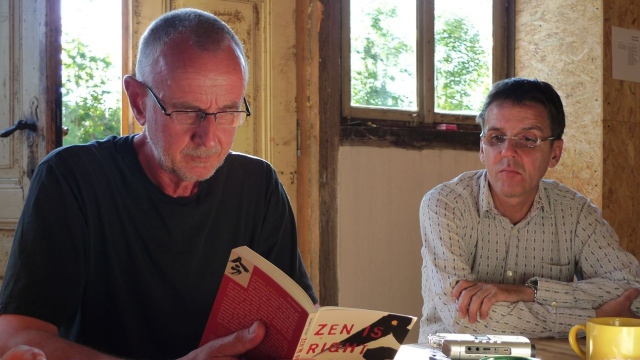
Shunryu Suzuki and his character. And then this morning we talked about the character of teachers, and I thought this afternoon I would talk about Kodo Sawaki. This is the only book I know in English about Kodo Sawaki, and this is a rare copy. I had one copy at home and it disappeared. And then Stuart found another copy in a second-hand shop in Bristol. Amazing.
That's it. Okay, that's the end of the talk. (laughter)
He was called Homeless, Homeless Kodo. Kodo was his monk's name. He was called homeless because he never had a fixed temple. Although in later life he settled at Antaiji temple, he didn't stay there. He moved around the countryside giving talks and holding sesshin. The photograph... anyway, I don't remember when he died.
Participant: Sixty-five.
Mike: Yeah. He was born in 1880, and he had a very severe childhood. His mother died when he was four. His father died when he was seven. He was adopted by an uncle, who died very soon afterwards. Then he was adopted by a professional gambler. So from the age of seven, he grew up in a kind of brothel. So he saw the foolishness of men, and he saw the worst side of human beings.
He wanted to become a monk, and when he was 17, he became a monk and practised for two years. Then when he was 19, he practised again with another master for one year. When he was 20, he was drafted into the Japanese army, in 1900. Four years later he was sent to the Russo-Japanese War. He was wounded and came back to Japan to recover, and then he went back again. He came back to Japan in 1906, so six years in the army, and two years in the war. In the war he became a hero, because he was very brave. He wasn't timid. He was a very brave person. And he received some kind of medal for bravery.
When he came back to Japan in 1906, he was 26 years old. He began to study Buddhism, and he went to various places in the next few years. He moved into a small temple alone for two years, just practising zazen on his own. After those two years, he became a kind of lecturer at the Buddhist University. From that time he moved to different places and lived in houses which people lent to him, and began travelling around Japan, leading sesshin and giving talks. Then in 1935, when he was fifty-five, he became a professor at the Buddhist University, which he continued for about five or six years. [inaudible], which is quite famous, because he lived there as he got older. Antaiji is now run by a German monk. And I think they have a website you can read. Have you seen it?
Participant: Yeah.
Mike: So that's his life. He had a very rough childhood, and he had a brave time in the army. When he started teaching Buddhism, people knew about his bravery, so they revered him for that kind of character. And because of his childhood, seeing the worst side of human nature, he had some kind of anger, I guess, at society. Maybe anger is too strong, but some kind of feeling to speak out against stupid people.
When he was in the army, he was brave because he acted on his own. The group of soldiers he was with was trapped in some kind of place. But without asking the others, he broke out on his own to take the Russian soldiers. So he realised that if you act on your own, it sometimes has a good result. But Japanese society has a very strong tendency to act in a group. So, shall we go? Shall we go? There we go. So it's frozen. But because of his character, he acted on his own, and he saw the very bad effect of group psychology on Japanese society.
So people said he always looked grumpy. Do you know grumpy? There's a picture somewhere here. He looks very grumpy. People say he looked like that a lot, so I guess he was. Maybe you can see it there a little bit. That kind of face.
And I suppose, as I said yesterday, if you practise zazen for a long time, you find a kind of middle position in society. But if society moves to an extreme, you feel that abnormality. So he felt that abnormality in Japan leading up to the Second World War.
My teacher, Nishijima, studied with him when he was 19 years old. That was maybe before the Second World War, maybe two, three or four years before. At that time in Japan, before the Second World War, there were two different opinions in society. There was a military force and the imperial family, the emperor's family, which were very right wing. And of course the military were manipulating the emperor to control Japanese society. On the other hand, there was some communist influence from China, from Mao Zedong; that very big revolution, the Red Army, was happening. And there were strong undercover communist cells which were stirring up society. So a very strong right wing and a very strong left wing.
When my teacher Nishijima Roshi went to Kodo Sawaki's talks, he was a young man of nineteen, and he had been thinking: Which is right? Which is right, right wing or left wing? Which is the best way? Which is the right idea? And he said that Kodo Sawaki said, Right is wrong and left is wrong. Both are wrong. This shocked my teacher as a young man. So what is right? Of course, Kodo Sawaki meant something about a middle way, a balance between left and right. But as a young man, my teacher didn't understand what he meant. But he was just very shocked at this very grumpy man saying both sides are wrong, which was a brave thing to say in Japan before the Second World War.
So I'll tell you some of the things that Kodo Sawaki said.
Human beings are strange creatures. They're groping in the dark, groping, with an intelligent look. They are only striving to avoid being bored. Lots of things in this world attract you, but once you do them or get them, they're worthless. Some people never find their own way of living. If you have no money, you're in trouble. But it's good to know there are more important things than money. If you have no sexual desire, something is wrong. But it's good to know there are more important things than sexual desire. To wander from place to place in this transitory world is to pursue name.
I don't understand that.
A person is born naked. But then he's given a name, which is registered, and he's covered with clothes, and a nipple is stuffed into his mouth, and so on. When he grows up, you can say, Oh, he's great, or strong, or clever, or rich. But these are only comforting words. In fact, everyone is naked.
Shall I go on? I'm not going to read it all. This is... Here's a good one.
Stop crying. Because you are timid, you think you are worthless and other people are great. You cry and worry about little things. And then, from time to time, things go well, and you feel overjoyed.
To study Buddhism is to study losing. Shakyamuni Buddha is a good example. He left his kingdom, his beautiful wife, his lovely child and his splendid clothes, and became a monk with bare feet and a shabby robe. All the Buddhas and ancestors intentionally suffer loss. It's a very big mistake if a Buddhist monk wants to rise in the world. We monks are all beggars from top to bottom.
All sentient beings are deluded. They think unhappy affairs are happy and happy affairs are unhappy, and they're always kicking and screaming. When you give a piece of candy to a kid who is crying, he grins with his eyes full of tears. That's the happiness that people talk about.
People often say they are busy. Busy with what? They are only busy earning their living. Chickens are busy themselves eating food. But they eat food only to be eaten by human beings. It is a mistake to climb up to a place from which sooner or later you have to fall. The life of a monk or a nun is no falling.
That reminds me of a story in the book from Shunryu Suzuki, where a woman said to Shunryu Suzuki, I'm making very great efforts to progress in Buddhism. It's like climbing a ladder. I go up three or four steps and then I slip back two steps. And Shunryu Suzuki said, Oh, in Buddhism there's no ladder. Everything happens on the ground.
A spiritual teacher may say, I will remain celibate all my life. There are many kinds of masks.
Life is full of inconsistencies. One person will criticise another person, saying, Look what he did. But it's exactly what the person who criticises wants to do.
The more sober you are, the smaller you see yourself.
The more sober you are, the smaller you see yourself. It means that if you're intoxicated, you think you've become important. But if you're sober, the opposite of intoxicated, then you see that actually you're just one small person.
What's the use of doing zazen? There's no use in doing zazen. Until this penetrates your thick skull, and you are really doing zazen that is of no use, it is really no use.
A thought is nothing but a made-up story. The Buddha Dharma is everything before we make up stories.
In other words, the world before thinking.
One reason that Dogen Zenji is so fascinating is that he understood that the Buddha Dharma was talking about him. Not some fairy tale for mediocre people.
As far as you can see, there is only you and there is nothing else but you. You can't ask someone else to share your weariness, or to bear your pain for you.
Okay, that'll do. Yes. In some of his sayings you can see a rather severe view of life, from a man who had a rather severe life. I guess we all have our own problems with our families and childhoods and so on. But we didn't grow up in a brothel with a stranger, and we didn't have to fight in a war. So we can be cheerful, and we can accept that he was grumpy. So there's a man in his time. So everybody is in their time.
Some people criticise Kodo Sawaki for some things he said during the Second World War. But I think those people don't understand the man. I haven't read the Japanese, but I've read a translation. He was quoted in an article in which he said, Japanese soldiers should fight fully, completely and utterly. So people thought that he was a supporter of Japan's war. But I think he was talking about a personal attitude, from his own experience. From his own experience, he knew that if you're in the army, in the war, you need to act fully, and live or die. That was his own experience. It wasn't a comment about politics. But he's been criticised for saying those things.
Participant: Which war?
Mike: I don't know. Generally, people don't say what they were doing during the Second World War in Japan. Well, it says that in 1940 he established Tengyo Zenen. So I suppose he was teaching zazen. But it doesn't say in detail. There are many books about his life in Japanese, and Yoko translated some once. But I don't have the translation now. Do you? Here? I don't. I have it somewhere.
So many different characters, many different ways of teaching, many different ways of writing, and so on. If you go back to China in the 10th and 11th centuries, you can read many koan stories about the teachings of masters. Some of them were very rough. Generally speaking, they didn't talk about abstract theory.
I think in modern times we are used to taking a situation and taking the theory out of the situation. In other words, we intellectualise. For instance, if something happens in the world, many commentators sit down and discuss it. And although what happened is a concrete event, for instance, a bomb exploded in Syria and students fought against the army, commentators will take a theoretical discussion from the concrete situation. They will generalise about people in general attacking their government, and about what society should do in general, and so on. And they will talk about lessons which we can learn from the situation. Often, even before the situation has ended, the commentators are learning lessons. So modern society is based on intellectualising from concrete situations very quickly. But I think this is a modern phenomenon.
If you read the koans of 10th- and 11th-century Buddhist teachers, you can see that they just present the concrete situation. And then another concrete situation, another koan. Another concrete situation, another koan. So if you study these koans, or hear these koans one after the other, you can understand something abstract, some general principle.
For instance, one koan says a student is eating his supper, and he asks his master, What is the most important thing in Buddhism? The master says, Have you finished eating? The student says yes. So he says, Go and wash your bowl.
So the master doesn't say something abstract. He doesn't say, The most important thing in Buddhism is not asking theoretical questions. He says something direct. So if we read these concrete stories, we can't find any theoretical teachings in them. But they are teachings themselves: concrete teaching, concrete teaching, concrete teaching, concrete teaching. That's how they thought in those days.
But these days, in modern times, we're always thinking about... for instance, relationships. So at the moment, in my mind... people say, you know, What kind of relationship do you want? To me that's a strange question, because can I think up a theoretical relationship and then look around? To me that sounds crazy, because it's concrete, isn't it? If you see something concrete, you can see it. But in modern times we think, okay, what kind of person do I want? Was it 192... 184 centimetres? No, no, 160 centimetres. Sorry. So we live like this. We think in our mind, what do I want? And then we look for it. But we can never find what's in our mind. So sometimes, if we hold on to what's in our mind, we'll be disappointed. But usually we forget what's in our mind when the concrete situation happens.
Okay. So, many different teaching styles, and they're very, very different sometimes. We don't realise. We think that people of the past thought in the same way we did.
Roman: Yeah, I think. They were also... those monks looking for the truth also tended to think abstractly. That they had to be corrected by...
Participant: That's interesting, that is, some koans, because reading them is very difficult. I find it very difficult to understand anything in them, because I was looking for the meaning. What does the bowl mean? Looking for what you usually look for in a text, you know, the signs and signifiers and metaphors and things. What does the bowl mean? Very, very difficult. I think it's more helpful to look at it as, you know, what's the simplest situation that can work here, almost like a dramatist: how could this conversation make sense? How could it be a real, meaningful exchange?
Roman: I think that most people don't want to be concrete in the situation, because they are afraid. If you are too concrete... ordinary people, but we have the experience: if you are too concrete, too direct, it's disturbing. Then you switch.
Participant: People are afraid to throw away the mask. They'd rather stay with the theoretical.
Mike: Yes. And of course, sometimes we need to do that. But it's a kind of common attitude in modern society. So it's not that we should never intellectualise, or never think about things, or never be general. But we need to know how to cut through it when necessary, because the real situation is on the other side of intellectualising.
You look very happy, Thomas.
Participant: I remember, I just can't stop thinking about it. This aspect you mentioned is such a great discovery. I had such a long, tiring, frustrating talk with my girlfriend a month ago about... and we couldn't solve anything. And I said, Let's go to Venice. We went to Venice, and it solved so many problems, because we were busy going there, buying pizza on the way. Are we getting the point? (laughter) I'm not sure it's necessary to go to such a beautiful place, but it was exactly that: stop, let's go to Venice.
Roman: She was fine for one month after this.
Mike: On the other hand, sometimes we can substitute doing things, without noticing that there is something we have to reflect on. So we can avoid solving some problems by saying, Let's go to Venice. Okay, let's go to the cinema. Okay, let's go here, let's go there. So it depends on the situation. Sometimes we need to stop. Sometimes we need to go. And don't look at the traffic lights.
Participant: Escape from prison.
Boris: I have a very, very good memory of how I walked across the whole of Bratislava, because I had given my wife the car. Once we went to the movies with my wife, and she needed the car to drive the kid, so I didn't have the car. I should have taken a taxi or a bus, but I just decided to walk. I had to walk a long way through the whole city of Bratislava, and it was a great chance to see the city in a new way, like never before. I had lived there for five years.
Participant: But these talks from Kodo... I remember one thing my grandfather was always saying, and it's a little bit similar: if you have nothing, you have a problem. If you have something, you have a big problem.
Participant: I'd like to ask about the natural ability to meditate from childhood. I have this experience, and I think maybe every one of you experiences it: those states when a person sits and, as people here call it, stares into space. You stare with your eyes wide open and you are actually absent, nowhere. Then you come back. As a child I experienced it very often, much more often than now. And it was a problem. It was a problem for the people around me: don't sit, don't stare, go and do something; they always pulled me out of it. For me it was a state where there was nothing. At that time I couldn't define it. I was most aware of it in violin lessons, when I had the sheet music and was playing an étude, and I don't know why, but very often, almost in every lesson, I got into that state, in which my mind worked on some kind of system, so that I played perfectly, but actually I was nowhere. Then I came back and had lost my place on the page. The teacher said: You're just stupid, how come you don't know where we're playing? You were playing it, you played it well. And I was silent; I didn't know how to define where I had been, because it was like... there was nothing. Only later did I learn to handle it: I noticed the moment when I came back, I knew where my eyes were in the music, and I could carry on, and nobody noticed. I learned to come back to the playing, to the moment on the music sheet, but it led to mistakes. It wasn't that natural anymore. It's normal stuff, maybe. I think that children can meditate, but it isn't supported in them.
Participant: I think the children were not corrupted by the meanings. They are pure, we can say.
Mike: We hope so. But not for very long. But yes, I agree. But I don't think children need to meditate.
Boris: They do it naturally.
Mike: They do it naturally.
Boris: Yeah, I can remember sitting in the woods at our weekend house, like a small child, just sitting doing nothing for hours.
Mike: Yes, if you want to call it meditating, that's fine.
Boris: Well, I don't want to call it meditating. Just a kind of natural, peaceful state of mind that slowly disappears while growing up.
Mike: Yes. Or when your teacher tells you to look at the music, you lose the natural state. So this is called education.
Participant: When I see my daughter doing this, I tell everyone: don't disturb her, let her be. She's eight.
Boris: That would be Dharma. When I spoke about going back to that state: I remember, a few years ago, that you can go back to the state you were in as a child, looking at the world like a child. It's not a big problem, but it's only about believing in it. For me it's very important to have it. I had a Vietnamese student at high school, a very talented, very bright girl. She told me that her parents are Buddhists, that they have very deep faith in Buddhism, as is usual in Vietnam. She asked me what I practise. I said, This is called zazen, and she wanted to try it, so I showed her the posture. A few days later she told me that she had done it at home, and her parents told her, What are you doing? Go and do some work. Don't waste your time sitting doing nothing. It's quite paradoxical.
Mike: Time to stop. Thank you.