Actions always have results and we live only in the present: two truths Buddhism teaches, realised through zazen
Michael Eido Luetchford
May 2014 — Banská Štiavnica, standalone talk.
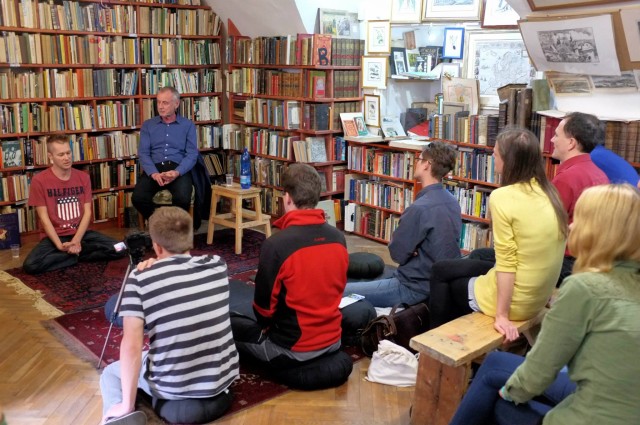
Venue: Bookshop, Banská Štiavnica.
Michael Eido Luetchford · May 2014 — Banská Štiavnica, standalone talk
Source: video transcript.
From the public talkPhotosRecordings1Chronicle
Video

What the talk says (short overview) — About these overviews
Mike says that Buddhism offers the modern world two simple truths, which he says belong to everybody and not only to Buddhism: what we do always has a result, and we live only in the present. Buddhism adds, in his view, that people who called themselves Buddhists have taught these truths for many years, and that it also has a simple physical practice, zazen, through which we can start to realise them. Mike adds that understanding this is easy and living it is very difficult.
The first truth is cause and effect: whatever we do has some result, which is the basis of science, and Buddhism has stated it since ancient times without knowing the findings of science. Even in the modern world, he says, people sometimes like to forget that what they do has a result. The second truth is that reality is only now: the past is gone and the future is not here yet, although we can imagine it in our heads. Mike says we live much of our lives in our heads, and that modern society shares a belief in past, present and future as a line we travel along, which Buddhism calls a belief. Thinking about the future is fine, he says, but it is only activity inside the brain. Living in the present could help modern people stop worrying about the future and stop being trapped by the past. He calls this a kind of dream, because we can imagine being happy in the present, but living that way is very difficult. He finds the same truth outside Buddhism, in athletes being in the zone. Zazen, a simple physical practice of sitting, is the Buddhist way of coming into the present, and he demonstrates its posture. He says it is not easy, but no different from learning a sport, and many people who come to Buddhist meetings excited then look for something easier.
In the discussion he says that life is unfortunately not fair, although we can make society fair, and that the teachings of Buddhism stay the same while imported clothes and ceremonies slowly disappear. Asked about merging religions, he says that Buddhism teaches a middle way and compromise instead of fighting for one's belief. Asked what the present is, he answers that it is simply to be here and now, not trapped by thinking, which is very simple and therefore very difficult.
Complete English transcript — About transcripts
First of all, thank you very much for allowing us to have the talk here. I feel this very nice space. Thank you very much. Maybe the shape, I don't know, but it's a very nice feeling.
Interpreter: Very interesting to be surrounded by books. And I think especially with the old books, because the old books have some...
Mike: Old books. The smell. [unclear, 00:00:43–00:00:44: “I smell bread.” / “The smell better than smell.”] Anyway, it's good to be surrounded by books, especially as what I want to talk about is... That the world we live in is not inside books. I think the title of my talk today is about the present. Buddhism is a very ancient teaching, as many of you know. And it has many ancient traditions and rituals. And if you visit Buddhist groups in different parts of the world, you can see many different rituals, many different types of clothing.
Robes. And incense. And bells. And of course all these rituals are, they do have value. But I've always been interested in what the Buddhist teaching is really about. So that's what I want to talk about. The strange thing is, when many human beings live together, they create a group which we call society. And society creates its own structure. So many different societies have many different structures. We tend to believe in this structure.
We believe in those structures. And we think that the structure we live in has some truth. But if we meet another society with another structure, sometimes we find that the truths which we believed are different in another society, another structure. And often this leads to arguments, disagreements, misunderstandings. So, who is right? Which society's truths are right? Are the truths of a Christian society right?
Are the truths of an Islamic society right? Are the truths of a Buddhist society right? Are the truths of a materialistic society right? These are the kind of questions that we have to find answers to in the modern world. We are finding answers by living. But it's a huge trial and error process. We can see if we look at history, the huge mistakes and the huge changes as many societies become integrated. I've been watching a television series about the First World War. Which was explaining about the situation with the Austro-Hungarian Empire. And the other great powers in the world.
And how they, different empires had to integrate in Europe. And all the difficulties and problems. But strangely, things are moving slowly. Towards some kind of integration. I didn't come here to talk about history. But Banská Štiavnica was a very historical place. So I always remember when I come here that Europe was many separate little places. With separate societies. Separate structures. Separate rules. But now I can come from England. And it's not so different. Things are the same, more or less.
So what can Buddhism offer this modern world? It seems to be based on science. The materialistic concepts and science. And money. An economy. And yet Buddhism is a very ancient teaching. Of course, it can offer a kind of group. We can join a group and feel a member of a group. And we can learn how to dress up as a Buddhist. Or even pretend to be a Japanese Zen Buddhist. Or a Tibetan Buddhist.
Or a Sri Lankan Buddhist. But Buddhism has two very essential things which can contribute to the modern world. Welcome. Come in, sit anywhere. The first is something that we already know about. It's a principle in life. Cause and effect. Cause and effect is the basis of science. Whatever we do, there is some result. And this is the basis of scientific investigation. So, constantly finding out when we do something, what is the result. What is the mechanism? In ancient times, people maybe they believed if we drank hot water on a hot day. It would make us ill. Or if we drank some special potion when we were ill it would make us well. Yeah. And some of these beliefs are true. But there were also many beliefs which were, at the time, believed, but later we found them not true. So one belief which is very strong in Christian Europe. If you sin. You will go to hell. And many people in the modern world found that's not true. I don't know whether it's true. But it doesn't seem to be. In the sense that I've committed many sins. But I can't believe I'm going to go to hell. So science is gradually changing our beliefs. To explain, when we do something, what is the result? If we drink too much alcohol, we will get bad liver. Now, Buddhism also, since ancient times. Without realising the findings of science. Stated that whatever we do, there is a result without exception. We can never escape the result of our action. But even in the modern world, where we know cause and effect very clearly, people like to forget sometimes that what they do has a result. Without exception.
But Buddhism, the Buddhist teachings state very clearly there is always a result of our actions. We can never escape the... That's the first principle, which is not so unusual. But the second principle is very difficult for us to realize. It says, Buddhist teachings say, life, reality is just now, at this moment. The past is gone. We can never go back to the past. It's absolutely impossible. The future is not here yet. We can imagine the future in our heads, but we can never go into the future. Sounds simple.
Of course, people say... But in fact, we live a lot of our lives in our heads. Either in the past, thinking or feeling about what happened to us, or what happened to other people. Or thinking in our, or feeling in our heads about the future. Anticipating the future. Or worrying about the future. And almost all of us live like this. We live in a world where the past and the future and the present exist as a kind of process line inside our mind. So we believe it absolutely and completely. Tomorrow is so-and-so is happening, I have to go so-and-so. Yesterday I was in Bratislava. The day before yesterday I was in England. Ah, I didn't. I forgot to do so-and-so in English. Oh, so I have to do it when I get back. So it's impossible to live in any different way. Because our modern society, our civilization, created this shared belief. So we believe it. So in our mind, in our consciousness, we believe past, present, future. We are travelling through. And we need to in order to exist in society. So we can call it the shared belief. So we believe it's true. Buddhism says, actually, it's a belief. And the truth is, we're only here.
To think about the future, of course, is fine. But it's only thinking. We can think about wonderful things that we are going to do. Or are we going to become? Or aims that we want to reach. But they're only activity inside our brain.
And the only thing that's real is what we are doing now. And of course it says the past. We worry about what we did, or we remember what we did. But what we did is gone. And we can never change it. So we can understand that explanation in our mind. Okay, I got it. Past is finished. Future hasn't come. Just we're here. But to realize it, and to live like that. Very, very difficult. But if we can live in the present, it can help modern people very much. We can stop worrying about the future. We can stop regretting, or being trapped by our past. This is what Buddhism says. But of course, this doesn't belong to Buddhism. Doesn't belong to Buddhism.
Although it was taught by people, ancient people who taught, who told them, who said that they were Buddhists. We can find this teaching in many different areas. For instance, if you are an athlete training for some kind of event, it's very important to be in the present. I think to forget the past. Because you just did something, you just fell over, or you just didn't jump over the... Not to think about the future. But just to perform now. Sports people call it being in the zone. Zone. Does that make sense? So. Z-O-N-E.
Interpreter: Don't they say flow?
Mike: Okay, being in the flow. Yeah.
Interpreter: I thought flow. In the flow.
Mike: Yes. So, sports psychologists and sports people. Or believing in Buddhism. In the sense that they are trying to concentrate on what they are, their own behaviour or performance now. And through their real experience, they know. That this helps them a lot. And another example. We know that many people have many experiences in the past, affect their present life. And psychologists and psychotherapists. Try to help people look at their past and free themselves from. To be free from the past. And to be free from the future.
It's just the second principle of Buddhist teaching. So there are Buddhists everywhere. So actually, I don't like to use the word Buddhist. These two truths. The truth that our action always has a result. And the truth that we only live in the present don't belong to any religion. They belong to everybody. And different people sometimes realize these things through their own lives. So, what's different about Buddhism? Well, to me, the difference is that people who called themselves Buddhists. Have taught these two truths. For many years.
And now in the 21st century we find they're true. Science is showing us that the cause always has an effect. And more and more we can understand the results of our behaviour. Results of our diet. Results of our way of life. Are becoming clearer and clearer. On the other hand, in modern life we can start to realize. Through our own experience with, for instance, sport. That to concentrate on the present. is the most effective way to live.
So these two things have always been taught by Buddhism. But they don't belong to Buddhism. But there's one more thing. Since ancient times. Buddhists have had a very simple practice. Which people call meditation. In Japan they call it zazen. Zazen, which means sitting meditation. And it's an actual practice. It's not an intellectual study. It's a simple physical practice. And by meditating or practicing zazen. For some time, regularly. We can notice that we just live now. We can realize that what Buddhism says is true.
And we can sit peacefully in the present. It's a very, very stupid activity. Because it's not thinking. It's not doing some kind of special sport. It's just sitting. But by this very simple practice of sitting. After a few years. We can start to realize the truths of Buddhism. They're true of every human being.
Every human being is living now. If we live now. We don't need to worry about the future. We don't need to think about the past. And this attitude can make us happier in the present. However, what I've just told you. It's a kind of dream. Because we can imagine being in the present and being very happy. Not worrying about the future. Being free from the past. But it's very, very difficult to do. But although it's very difficult to do. If we have some activity that makes us come into the present. For instance, meditation. And not only meditation. Sport. Somehow we feel free.
If you have a busy day or a busy week at work, and you go for a swim. [unclear, 00:31:53–00:31:55: “But afterwards you feel.” / “afterwards you feel you”] don't have to walk in the woods. You get rid of your frustration. You let go of the past. So all these are the truths that Buddhism has been teaching. And that we are finding out in the modern world. Which is great because we need it. We are always in touch with somebody who is not here, thinking about tomorrow. Thinking about the past.
So if we put our phone away and sit in meditation. or leave our phone at home and go to the sports club. We can be free. Don't take your phone. That's all I'd like to say. I'm happy to talk about any questions. And I would like to demonstrate the simple posture of meditation. So should we do that first? So Boris is going to sit. And then afterwards, you can ask any questions or make any comments. So it's not necessary to have a black cushion. You can have a red cushion. You can have a blanket, you can have a box. So you need a place which is a little bit quiet. Not too hot and not too cold. The traditional posture is crossing the legs. And some people are very flexible. They can cross, like, lotus posture. Which is very nice and comfortable if you can do. But we have to work with our own body. It's no good imagining that we can do something. So if you can't get your foot like Boris. You have to get it like this. Then we put our hands together with the thumbs touching. And rest our shoulders down. And rest our hands here. If you are touching your thumbs, you can notice when you are thinking a lot. If you are thinking about many things, you start usually going like this. Our spine should be naturally straight. And everybody's spine has slightly different shape.
Boris has very nice shape on his back. My back is more stiff down here, so not such a nice curve. Then relaxing your weight down onto your cushion, as if your spine bones are a pile of stones. And you're balancing. So people say that meditation is a position of balance. To balance the body is to balance the mind. So not stiff. Backwards and forwards. Find the position of balance. And the same with the head on top of the shoulders. Not stiff. Not like this. But nicely loose in balance. In this posture, we have many deep tensions in our body. Which we are not conscious of. If we sit in this posture for some time. 20 minutes. 30 minutes, somebody who's experienced, maybe 45 minutes. Slowly these tensions will drop away.
In the shoulders, in the arms. So on. The mouth is closed naturally. If we close our eyes, sometimes we go to sleep. So we keep the eyes open. Naturally. And if we notice that we're thinking something, then we can adjust our posture. Which stops our train of thought. And then maybe a few minutes later, we're thinking something again. So we straighten our posture again. And then slowly, if we sit for maybe 30 minutes. We stop having this train of thought. Of course, we can't stop all things coming into our head because our brain is working. But we're not thinking a train of thought or a story. To sit like this is the whole of zazen. Very simple. But not so easy to do. We look at Boris, he's been sitting for twenty years.
And we think, ah yes, I'm going to do it when I get home. After ten minutes. Twenty minutes. So it's not so easy to do. But it's no different from learning a sport. If you want to start running. You can get very excited, buy some new running shoes. And running trousers. [unclear, 00:41:22–00:41:28: “Colourful. Go running. They had.” / “California top. if you're running, it's hell.”] But if we continue. Day after day, just a little. We learn how to run. It's the same. Many people come to Buddhist meetings. And they get very excited. Yes, I will. So this is for me. I read many books. Yes. And then they try to sit. Oh no, no. I need something easier. There is nothing easier in life. Life is not easy. So that's what I have to say. Thank you, guys.
Participant: Nice to sit.
Mike: Nice to sit. But we have to train ourselves to do anything.
Participant: I was the lucky man here.
Mike: Yeah, yeah. We want to play tennis, we have to train ourselves. In our heads, we become very excited. And our body is not so quick to learn. So if anybody has any comments or questions, please. In Czech or in Slovak. English? Or German. Okay.
Participant: I have something. I think maybe the action and reaction thing, you know, some people believe it's something like justice, and I think it's a big difference between, you know, because your reaction, what you get, don't, or isn't like justice. It don't work like this, you know what I mean?
Mike: Ah, yes, we think there's justice in the world.
Participant: Yeah, yeah, yeah. But it's not true. It's not true.
Mike: No.
Participant: You know, if you just grab the stone, it falls to the ground.
Mike: Yes.
Participant: But it's no justice in that, you know, not moral or not something.
Mike: Ah, yes, yes.
Participant: So I think this... It has nothing to do with morals.
Mike: Yes, of course. We can say there's right things to do and wrong things to do, but... We don't understand how the person who lives in the next street. He's becoming very rich because he doesn't pay any taxes. And what is the dynamic? It seems to have a very happy life. And the person lives in our street. It is rather poor and miserable. But never does anything wrong. Life doesn't seem fair. Yeah. So life is, unfortunately, life is not fair. But we can make society fair.
Interpreter: And Mike didn't explain us why tomorrow will be never come, because tomorrow we have sesshin.
Mike: Oh, okay. Robert said we should put a notice. Oh no, you said in a pub there is a notice.
Interpreter: I just translated.
Mike: Yeah, yeah, yeah. And the notice says, free drinks tomorrow. So you can put the notice here. Free beers tomorrow. And leave it there every day. So tomorrow, this sounds very strange thing to say. Tomorrow is an idea which we cannot live without. There is only now. But without ideas, human society can't live. But if we look at animals. Dogs or cats? Of course, we cannot guess what they really, what their life is like. Yeah, but it would seem that dogs and cats are not worrying about tomorrow. They seem to live in the present. They don't seem to worry. But we can't live as dogs or cats. We cannot live as dogs or cats. But we can remember that actually, we don't need to worry. Yesterday I was in Bratislava. With my English friend Rory and his car looking for somewhere to park. And everybody, I'm sure everybody knows, if you're looking for somewhere to park. You get some kind of tension. So Rory said, Don't worry, the parking god will look after us. And so we're just driving around. Of course, it's kind of a joke. But there's a difference between, you know, can I get... And just relaxing about it.
Question (Slovak): Väčšinové svetové náboženstvá v súčasnosti sledujeme, že zaznamenávajú určitý vývoj.
Question: We recognize that the biggest religions in the world, there is some progress. Where is Buddhism in this progress?
Question (Slovak): Áno, hovorí, že to je progres, ale že sa to zmení.
Question (Slovak): Ako sa buddhizmus mení?
Question: Do big religions change themselves, and how? If the Buddhism is changing in the present time, or how it changes?
Mike: Yes, very interesting question. Buddhism is new to the West. And Buddhism, which is imported into the West. comes from, for instance, Tibet. Or Japan, or India. And so on. And it comes in with many traditions from those societies. So you can see people in Buddhist groups dressed in strange clothes. So slowly, Buddhism is changing. When people realise that dressing as a Buddhist is not what it's about. I lived in Japan for 25 years. Studying Buddhism. And I don't like to wear Japanese clothes.
People who didn't go to Japan. They like to dress up as Japanese monks. I think it's very amusing. So I like to say that the teachings of Buddhism are the same. But all the extra things slowly are disappearing. But it's quite a new situation in Europe. So still many people want to study Buddhism as a kind of special religion. With many special ceremonies and so on. But it has to integrate with Western society. In a different way. We can see in Christianity there were many very special rituals. In the old times. Or even fairly recent times. But now there are more modern forms of Christianity. Where they realise that understanding the teaching. And living the teaching. Yeah, it's fine. It doesn't matter what you wear. If you want to be a Buddhist, it doesn't matter what you wear. It doesn't matter if you sit on a round black cushion, or a red blanket. That's not the point. Is that answer?
Question: ... týkal sa športu a korešpondencie športu s budhizmom. Desiatky rokov som prežil v karate. A významných majstrov som stretol Japoncov. A nikdy od nich som nepočul niečo podobné. Prečo? Tá filozofia a to konanie bolo v súlade s buddhizmom. Ich filozofia nejako súvisela s buddhizmom, alebo správanie? Ale nikdy nehovorili o buddhizme.
Mike: Yes.
Question: The question is why?
Mike: They were teaching karate. They weren't teaching Buddhism. But also, it's interesting, in Japan. There are many deep Buddhist customs for hundreds of years. But people don't notice. So if you say to a Japanese person about sitting in zazen. They think, Oh no, I don't like that, painful. But actually, their behaviour is something based on the Buddhist. But if you say your behaviour is based on Buddhist teaching. They say, oh, really? Just what I learned. So I agree with what you said, yes. The ability to focus on action. Without explanation. Just do it, it's some custom from Buddhism.
Question (Slovak): Posledná otázka. A náš slovenský Dan Brown, Jozef Banáš.
Question: It's called Josef Banáš, some Slovak author which is similar to Dan Brown, which is writing similar books. Dan Brown is an author, which is written in English, very popular. You know, in Slovakia there is another one which writes books with similar content. And he is saying in one of his books...
Question (Slovak): Ide asi o tom, že ten pokoj a kľud vo svete je splynutie náboženstiev do jedného. Je šanca z jeho pohľadu, aby takéto niečo nastalo a buddhizmus bol pritom?
Question: Yeah, that's the peace and peacefulness in the world. Is someway result of merging of the all major religions. If you think that if is a chance that this merge of this major relationship will happen, and if the Buddhism will be some way integrated.
Mike: Ah, yes, yes, I agree with him. Two partners are arguing, fighting. But if they continue, they can integrate and merge and have peaceful situations. No. When they realize that to stop arguing is to be peaceful. If one country stops fighting, it might help. I think Buddhism has teaching of balance between opposites. This person thinks they are right. This person thinks they are right. This country thinks they're right. This country thinks they're right. Buddhism says they're both wrong. So they should find a middle way. But we believe there is right and wrong very clearly. So we fight for our belief. Buddhism says, don't fight for your belief. So Buddhism believes that not to fight for your belief. But to compromise. But we hate to compromise. We hate it. We feel if we compromise, we lose our self. So we continue arguing. But I think the world slowly will realize. And one factor is that it's more difficult for soldiers to fight. Now there are television cameras watching the soldiers fighting. And many people sitting in their armchairs. Making some kind of judgment. Oh, I shouldn't do that. And so on. So that sounds a very strange thing. But slowly it has an effect on society. So it becomes more difficult to engage in fighting. But I think it takes a long time. For instance, Islamic world and the humanistic world. Or the Christian world.
But to find a common ground. I hope they find it. I think they will find. So Islamic people, for instance, who've come to live in Western society interpret Islam in a more humanistic way. That is a more helpful way. In resolving the differences between the religions.
Participant: Yeah, Mike, but one thing I cannot agree with you.
Mike: Yes.
Participant: I was there last week and there is no parking on the Bratislava. Yeah, I really was there last week and ...
Interpreter: It's a parking god was not with you.
Mike: Oh yeah. Yeah, of course, it's only a story. Yeah. My friend says it to make himself feel relaxed. Don't worry. Okay.
Participant: Can I ask you something?
Mike: Yes.
Participant: What's the point, so what's the point of this Buddhism speak to us? You said me stay balance or sit in balance, but what's the point of meditation? Some another feeling or what? Because I don't know. I really try to be in balance, but it's not so easy. So could you tell me some trick to better...
Mike: Yes. Continue.
Participant: Thanks a lot.
Mike: It's not easy. But living is not easy. And the point of zazen is just sitting in the present. But to keep ourselves in the present. Keep our mind in the present is very difficult.
Question: Yeah, I know it, because what's the present? It's one second past, one second is future, so what's the present? This second? It's the continuity. It's the flow of time. We can handle it. How we can handle it with this meditation? What's the effect of this meditation? Because everything is in flow, it's continuing. So where is the present?
Mike: Now. Yeah. Here. And now. So not to be trapped by our thinking. A simple state. Where we are here. That's all. But this simple state is very, very difficult for us. Our mind is jumping, jumping to different places all the time.
Participant: Yeah, that's my problem. That's correcting my problem.
Mike: So the answer is... We'll continue.
Participant: Okay, thank you very much. And may I ask another question? What's the reward of this meditation? What kind of feeling?
Mike: The result.
Participant: Yes.
Mike: Oh, you can be here. So not trapped by the thinking.
Participant: No.
Mike: Oh, sorry. Here. So it's, that's the result. To be here, that's the result. Because here is the only place to be. But human beings like to be somewhere else, here with their body. They love it. We can invent wonderful places to live.
Question: Is it not astral travelling?
Mike: We can stop astral travelling. If we want to be here.
Participant: Yeah. Okay, thanks a lot.
Mike: It's very, very simple. That's why we find it so difficult.
Participant: Okay, thank you.
Mike: Right, thank you very much.