Right Action from Balance
Mike on Dogen: right does not wait as an idea but exists in what we do and follows our state of body and mind
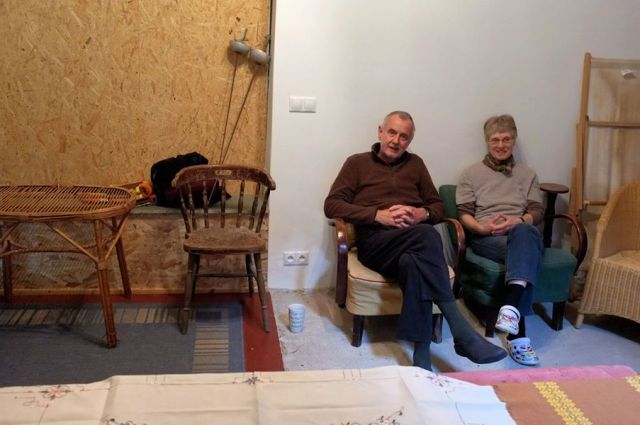
Michael Eido Luetchford
August 2014 — Banský Studenec, Talk 1.
Venue: Banský Studenec.
Michael Eido Luetchford · August 2014 — Banský Studenec, Talk 1
Source: video transcript.
From the retreatPhotosChronicle
Video

Video chapters
Video: Tomáš David- 0:00 Thinking and doing
- 2:21 Dogen's story about doing right
- 8:32 The gap between words and deeds today
- 11:21 Right does not exist beforehand
- 15:24 Action follows our state of body and mind
- 19:45 Balanced body and mind, and zazen
- 22:08 A teaching foreign to modern society
- 24:38 Noticing the real situation
- 25:59 Right is not an abstraction
What the talk says (short overview) — About these overviews
Mike points out the complete difference between ideas and action, and explains that in Master Dogen's teaching the way we act is not governed by the idea of being right. Right does not exist beforehand as an idea that waits for somebody to do it; it exists in what we do. Our action follows from our state of body and mind, and it is right when our body and mind are balanced, which is why we practise zazen.
He starts from the observation that in modern society it is very easy to build wonderful structures of ideas in our mind, in books and on the internet, and to communicate them anywhere in the world, yet human beings still find it difficult to do what they want. To illustrate the difference he reads a story from Dogen's chapter about doing right and not doing wrong, in which the official Haku Kyoi asks Master Choka Dorin what the great intention of the Buddha Dharma is. Dorin answers: not to commit wrong, and to do the many kinds of right. Kyoi, a governor and literary man who expected a more academic answer, says that even a child of three can say that, and Dorin replies that a child of three can speak the truth but an old man of eighty cannot practise it. Mike takes this as pointing to the difference between what we say, think and write and what we do, which is becoming very difficult to notice in modern society, where we make plans, follow the news and form opinions. For example, after watching a programme about a place we never visited we may talk about it as if we had been there, forgetting that we only watched pieces of coloured glass, and he adds that this is not wrong but should be noticed.
He calls Dogen's statement that no kind of right exists beforehand and then waits for somebody to do it very shocking, and says we are educated to believe that first we think what is right and then make ourselves do it. We are often disappointed because real situations are always completely different from what we think, and what we do will always differ from it. So instead of a stronger will or a clearer idea, Dogen says our state is the most important thing, and Mike adds that zazen is the simplest standard way of balancing body and mind, although many activities bring balance, and that this may be better than thinking a lot about what the right decision is. He admits that this teaching is very difficult, perhaps impossible, to accept and is quite foreign to modern society, which believes that thoughts and ideas are the most important thing and that, if we cannot make them reality, we should force them into reality; he notes that forcing very strong ideas or beliefs into reality might end in fighting. Mike does not think society can stop thinking or that we can have blank minds; what matters is to notice the real situation and the gap between the world of ideas and our actual actions, not to make ourselves into some special Buddhist but to notice that we are ordinary people. He closes by saying that in Dogen's teaching right is not an abstraction, whereas in Christian cultures and modern society we abstract what we think is right and then measure our action against it.
Complete English transcript — About transcripts
Editorial note: This transcript of a spoken talk has been lightly edited to read well as written text, keeping the speaker’s voice and meaning; the wording was adjusted with great care. We recommend watching the original video recording too.
Participant: It's a bit comfortable chair.
Mike: That's the end of my talk. This morning I want to talk about the difference between thinking and doing, or even talking and doing. Because in modern society it's very easy to construct wonderful structures in our mind, in books, on the internet. And these structures are structures of ideas. But Buddhism emphasizes the complete difference between ideas and action, or doing. And because communication in modern society is so good,
we can communicate our ideas at any time, anywhere across the world. But still, human beings find it difficult to do what they want. In the Shobogenzo, Master Dogen wrote a chapter about doing right, not doing wrong. And in that chapter, he quotes a story, a koan story from ancient China. So I'd like just to read it.
Haku Kyoi of Tang China was a lay disciple, an ordinary person, a disciple of Zen Master Bukko. He was governor of a district in China, so an important man. And he practised zazen. And Master Choka Dorin is quite a famous master. In the story, Kyoi, the official, asks:
‘What is the great intention of the Buddha Dharma?’ So he wants to know, what is Buddhism about? What is the purpose of Buddhism? What do we do Buddhism for? And Master Dorin replies, ‘Not to commit wrong. To do the many kinds of right.’ So, Kyoi, you must have been surprised. He was expecting a more academic answer. So he replied, ‘If it is so, even a child of three can say it.’ And Master Dorin replied, ‘A child of three can speak the truth. But an old man of eighty cannot practise it.’ And Kyoi prostrated to Master Dorin to thank him.
And left. Now, Kyoi was, in addition to being a governor of a district in China, a very literary man and a poet. He wrote lots of poetry and lots of books. So when he heard Master Dorin say that Buddhism is about not doing wrong, doing right, rather than giving a complicated answer, he was very surprised. Even a child can see that. It's too easy. But Master Dorin said, even the child can say, but even this old man of eighty can't do.
So he was pointing out the difference between what we say and what we think and what we write, and what we do. And I know this difference very clearly.
Participant: You're not eighty.
Mike: No, I'm only seventy. So I don't know it as clearly as Master Dorin. I'm still learning, in a sense. But in the modern world, this difference is becoming very difficult to notice. Very often in modern society, we are involved in making plans, saying what we think should be, what we think people should do, what we think people shouldn't do.
We listen to the news, and in the news today, sometimes we even hear straight from the war zones what the soldiers did or what soldiers didn't do. Then we have an opinion. So we get used to making judgments based on our ideas. I don't mean that we shouldn't, but we should notice the fact. Often, if we watch a programme on the television about some place we never visited,
we may then talk to a friend about that place as if we had visited it. We forget that we didn't go there. We just watched pieces of coloured glass. Of course, I don't mean it's wrong or we shouldn't do it, just to notice the difference between what we speak, what we hear, what we think, and what we do. In this chapter, Master Dogen is concentrating on right action. He says in one part of the chapter, there has never been any kind of right that is realised beforehand,
and then waits for somebody to do it. That's a very shocking statement. Our society, our civilisations, have developed codes, codes of conduct, moral codes, ethical points of view, which we feel we should follow. And of course, we live in society, so we do our best to follow them. But Dogen is saying, what is right doesn't exist in our head,
it exists in what we do. So we can't have an idea of what is right, and then that idea is waiting for us to do it.
That's a very surprising thing, and quite difficult to accept, because we all think and we are all educated to believe that first we think what is best or what is right, and then we make ourselves do it. So Dogen's view is a little different.
He says, the right is not there until we do it. But that seems very strange. It points out a big difference between what we think, what we believe, and how we act. So in Master Dogen's teaching, he says that the way we act is not governed by the idea of being right. How we act doesn't follow on from what we think we should do. But it follows from our state of body and mind. We're not used to thinking of the state of body and mind. The state of body and mind is something whole. But we're used to thinking about ideas,
followed by physical movement. But Dogen is saying both together, when we act, makes our action right. Often we get disappointed because in our life we can't do what we want, or things are not as we thought they would be. For instance, we might have had an idea about this session before we came. But the real situation is completely different. And all real situations are always completely different,
to what we think. But we don't notice the fact. When we want to do something and our action doesn't match what we want to do in our mind, we often feel disappointed. So we might think that we should be more strong-willed, or that our idea should be much clearer. But what Dogen is saying is, our state is the most important thing. What we do will always be different from what we think,
but to act right, we need to focus on our state. And the state, he says, is the state of right: when our body and mind are balanced. And as you know, this is the reason we practise zazen. So, following on from that, we get the teaching that as long as we practise zazen and balance our body and mind, then our action is right.
That's very difficult to accept. It may be impossible to accept. But that's the teaching that Buddhism has for us. Of course, not only practising zazen. Of course, zazen is the standard way, the simplest standard way of balancing our body and mind, but many activities bring us into balance. So if we want to act in a way that is right,
rather than thinking a lot about how to act right and what is the right decision, it may be better to balance our body and mind. This teaching is quite foreign to modern society, where we still, even more in modern society, believe that our thoughts and ideas are the most important thing. And if we can't make our thoughts and ideas into reality, we should force them into reality. If we have very strong thoughts, ideas or beliefs which we want to force into reality, we might end up fighting. So I just want to point out today the difference between our ideal world
which is huge in modern society. It's vast. It's spread everywhere. And what we actually do, which is sometimes completely different to what we want. I don't think society can stop thinking. I don't think we can stop having ideas. I don't think we can have blank minds, practise zazen and then do things. But to notice the real situation is very important:
not to make ourselves different, but to notice how we are. Not to make ourselves into some kind of special Buddhist, but to notice we are ordinary people. And to notice how big the gap is between the world of ideas, thoughts, the internet, and our actual actions.
So that's all I want to say this morning. I'm sorry, my energy is a little low. That might be a good thing. We can't abstract right from the real situation. But we do that ourselves all the time in our society.
We abstract what we think is right, and then we want to do that right. And he says it's not true. There is no right waiting for somebody to do it. In his teaching, right is not an abstraction. But for us, in Christian cultures, in modern society, right is an abstraction, and then we measure our action against the abstract.