Nishijima’s Four Main Points
Will to the truth, cause and effect, instantaneousness, zazen: Mike on Nishijima’s central points of the path
Michael Eido Luetchford
September 2015 — Banský Studenec, Talk 2.
Venue: Banský Studenec.
Michael Eido Luetchford · September 2015 — Banský Studenec, Talk 2
Source: video transcript.
From the retreatPhotosChronicle
Video



Video chapters 1/5
Video: Tomáš DavidVideo chapters 2/5
Video chapters 3/5
Video chapters 4/5
What the talk says (short overview) — About these overviews
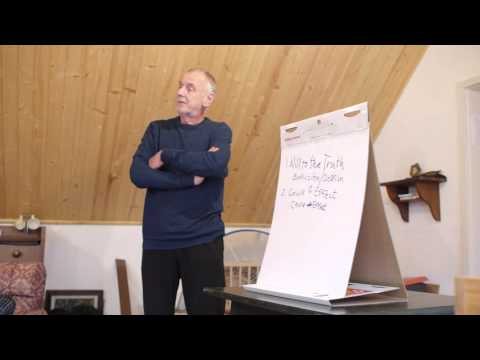
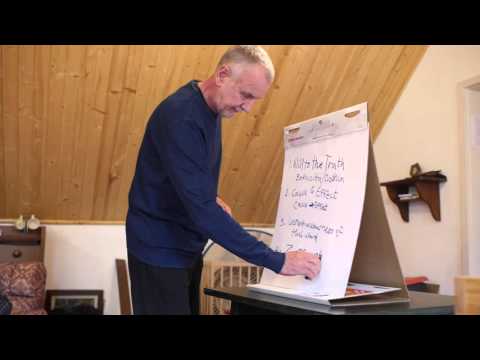
Mike presents what he calls Nishijima Roshi's four main beliefs, the central points of the Buddhist path: will to the truth, cause and effect, instantaneousness, or the present moment, and zazen. The first, will to the truth, is the search for the truth that human beings share, and in Buddhism, Mike says, we search for it in an unusual direction: right here.
Mike says that Nishijima translated the Sanskrit bodhicitta as will to the truth because he wanted to explain the very subtle desire that human beings have to discover what is true, a desire we can see most clearly in the curiosity of children. Adults search in many different places, such as music, sport, business or food, and he says that even someone who searches through money finds fragments of the truth, while someone who searches through art may find big pieces. When a participant asks whether will to the truth is Nishijima's interpretation of bodhicitta, since the direct translation is a little different, Mike answers that bodhi originally means wisdom, and that Nishijima interpreted the word as the will, or curiosity, that human beings have, not only Buddhists. Buddhist philosophy does not contain the truth but points to it, he says, and instead of a finger pointing at the moon he would say it is a finger pointing at the ground, because the truth is here. He adds that the truth does not belong to Buddhists: in the Lotus Sutra story a boy writes the truth on the trees, the rocks, the ground and the sky before telling a demon that it can eat him, and gathering in a group, with special clothes and the Hannya Shingyo, does not mean that we own the truth. The second point is cause and effect, which Mike says Buddhism believes in, teaches and supports, and which is the same rule as in science: every cause produces an effect without any exception, so everything we do has an effect. He finds it very comforting that our efforts have a result even when we can't see it, so in Buddhism we can make an effort without worrying about the result. When Boris says that billions of causes make it impossible to understand logically what is going on, and Robert says that we should think about the effect that years of hard work may have on our health, Mike replies that we can think and try, that curiosity about the cause of an effect is a search for the truth, that it is stupid to say that nothing matters except here and now, but that if we look for the reason of everything all the time we can't move.
The third point is instantaneousness: Mike says that we can only act, only be happy, hungry or sad, and only have the will to the truth now, so that now is the only reality, it is not an idea, and it is always changing. Because the world is instantaneous, we can be free from our past and from our future, but at the same time we are bound by cause and effect, so we are free and not free: you are never free from cause and effect, he says, but you are completely free at this moment. After Roman gives an example of feeling free from what people think of him, Mike says that freedom is more simple: it does not mean we can do what we want, since even in prison we are free to be happy or angry, to stand up or sit down. The fourth point is zazen, which, Mike says, does not seem to fit among beliefs because it is a practice; he says that Dogen said that if we practice balance our actions are balanced, which means doing the best we can, and that he himself says not only zazen but other balance, although Nishijima would become very angry at that: zazen is the only method. Asked whether Nishijima did not teach about sport, Mike says that he did, but that zazen was very precious to him and his whole life was teaching zazen, and that he was proud that sport and zazen had some connection, as with a famous Japanese marathon runner who used to sit with them. Mike describes Nishijima as a Japanese monk who wanted to establish real Buddhism in a Japan where most priests were drinking beer, making money from funeral ceremonies and forgetting about zazen, and so was very combative. Answering Boris, he says that we have the will to the truth naturally, but if we try very hard to find the truth we cover it up, and that if we stop trying we see that we are here. He closes by saying that when to talk and when to listen is very important: people who come to learn about Buddhism bring a cup that is already full, so we need an empty mind and just listen, and when Pavel briefly asks whether it is the same as the three philosophies and one reality, Mike says that it is the same, in different words, and that everything is connected because words are not reality.
Complete English transcript — About transcripts
Editorial note: This transcript of a spoken talk has been lightly edited to read well as written text, keeping the speaker’s voice and meaning; the wording was adjusted with great care. We recommend watching the original video recording too.
Belief. One. Will to the truth. Will to the truth is Sanskrit bodhicitta. Most people translate bodhicitta as Buddha mind. Doshin, or mind of the way. But Nishijima always translated it will to the truth, because he wanted to explain the very subtle desire we human beings have. Subtle, subtle. Yeah.
Jitka: Yes, good. Delicate.
Mike: Okay. To discover what is true. He said, we can see most clearly in children. We call it curiosity, searching for something interesting. So a child will play, searching for something. Nishijima explained that this is searching for the truth. When we become older, we search in different places, in many places. We may search in music, to discover the truth of music. In sport. In business. In food. So adults search for the truth in many different places. Bodhicitta, or doshin, means searching for the truth in the Buddhist path.
If we search for the truth in fame, we may never find it. If we search for the truth in money, for instance, many people believe that if they become very rich, they will find happiness. But they never find it. I had a friend who was very, very rich, but he was always worried about his money. Sometimes he said, I wish I had no money. But he was searching for the truth. In that way, all human beings search for the truth, but some people search in the wrong direction. For instance, where is my computer?
If I search here, I never find it. But still I might search. However, even somebody who is searching for the truth through money finds pieces of the truth, fragments of the truth. Somebody who searches for the truth through art, painting, may find big pieces of the truth. This big. This big. So the will to the truth is fundamental. But in Buddhism, we search for the truth in an unusual direction. We search for the truth right here. That's very unusual. Sounds very stupid.
In Western philosophy, the truth is abstract. So we search for the truth in the mental area. We think the truth must be some mental understanding. But searching for the truth in Buddhism is searching for the truth right here. In my book, Between Heaven and Earth, I put a poem by an English poet, which is very beautiful. T. S. Eliot. He's a rather famous English poet. Light. That's better. My eyesight is getting worse. This is a poem.
We shall not cease from exploring. Exploration. And the end of all our exploring will be to arrive where we started and know the place for the first time.
So he is expressing, we shall not cease from exploring, means everybody is searching. And we all choose where we're going to search. And on our journey, we all find pieces of the truth. And then when we return to this place, we discover this place is the truth. Bodhicitta. Will to the truth. Any questions?
Boris: Do you want to sit down? Shall I bring a chair for you?
Mike: No, I quite... it's quite nice standing up.
Boris: Okay.
Mike: Thank you. Unlike you, I like standing up.
Jitka: In the Buddhist philosophy, correct me if I'm wrong, the Buddhist philosophy contains the truth. But is it also that we contain the truth, the conscious, in our sense? Is there truth in us?
Pavel: That's right.
Mike: Yes. Buddhist philosophy doesn't contain the truth. It contains the pointing to the truth, because the truth is here. In Western civilization we find the word truth difficult. So we can say reality, or peace of mind, or satisfaction.
Jitka: So we can discover the truth through Buddhism, but also through some different parts of our life, or no?
Mike: Yeah, both. We are searching for the truth. Where is it? And then some Buddhist teacher says, Oh, just a minute, it's here. Oh, here. No, no, no, I'm looking here. No, no, no, it's here. Oh, here? No, no, I think it's over here. No, the truth is here. Oh, here? No, no, I think it's over here. And so after many years, we think, Oh, maybe it's me. But we find it everywhere. So in the Lotus Sutra, there is a story about a little boy who met a demon. And the demon wanted to eat the little boy. The little boy said, I don't want you to eat me. I will let you eat part of me if you let me do one thing. So the demon said, Okay, you can do one thing.
So the boy went around and wrote the truth on the trees and the rocks and the ground and the sky, and then he said, Okay, you can eat me. So the story is a metaphor for the truth being everywhere. It doesn't belong to Buddhists. This is very important. If we get together in a group, and we put on special clothes, and we sit in a special room, and we chant the Hannya Shingyo, we mustn't believe that we have the truth, nobody else. We don't own the truth. But when we sit in the room in zazen, we are sitting here. So after many years, we realize, ah, I'm just sitting. So this is the truth here. Very, very simple. Very boring. But really, really real. So all that Buddhism does is just say, yeah, yeah, maybe you can find out there, but it's here.
So Buddhist philosophy is, people say, a finger pointing at the moon. But I would like to say it's a finger pointing at the ground.
Participant: Okay, technical question.
Mike: Yes.
Participant: Is it Master Nishijima's interpretation of the word bodhicitta, will to the truth?
Mike: Yes, it is.
Participant: Because the direct translation is a little bit different. Citta is the mind, and bodhi is awakened mind.
Mike: No. Bodhi is wisdom.
Participant: Okay, so will to the truth is something a little bit different, I would say. Is he just pointing to explain what this kind of curiosity or...
Mike: He's interpreting the meaning. Bodhi means originally wisdom, so wisdom mind. But people interpret it as the mind, the true mind, or something. So doshin, do means way or truth.
Participant: Substance. Substance.
Mike: Shin means mind, so mind of the truth, or mind of the way. So, a little different between Japanese and Sanskrit, and then a difference between the Japanese and Nishijima's interpretation.
Boris: Buddha essence? No, the translation of bodhicitta, the essence of Buddha, they have everybody inside?
Mike: No, that's...
Boris: Because for me it's, I read it like this, bodhicitta. The essence of Buddha means...
Mike: No, essence of Buddha is...
Boris: Substance of Buddha.
Mike: Buddha nature.
Boris: Oh, Buddha nature.
Mike: Yeah.
Boris: Is bodhicitta Buddha nature also?
Mike: No, citta is mind.
Boris: Citta is mind.
Mike: So mental faculty. So the mental faculty which contains Buddhist wisdom. So we need to interpret it. So Nishijima Roshi said, it's the will we have, it's mental, the curiosity we have to find the truth. Human beings have it, not only Buddhists. The difference is, Buddhists say, I know where it is. It's here. And then we forget. And then we come back to reality. And then we forget. So, not something permanent. So this is his understanding. Number two.
Participant: Because yesterday I saw it on the board, the establishment of the will of the truth. It was written, establishing of will to the truth.
Mike: Okay.
Participant: But it was maybe different with Nishijima, because there was another aspect he spoke about, or...
Mike: Do you know another aspect he talked about?
Participant: I don't know. It was written establishing of the will of the truth.
Mike: Yeah. I'm writing will to the truth.
Participant: Okay.
Mike: Establishment means you've got it.
Participant: Okay. I was asking just if we have to somehow focus on it, or not.
Mike: If you had to focus on it, I would have written it. Because I didn't write it, you don't need to worry about it.
Participant: Okay.
Mike: Number two. Cause and effect. Buddhism believes in, teaches and supports the rule of cause and effect. The rule of cause and effect is the same rule as in science. Every cause produces an effect, without any exception. Cause, effect. This is absolute. Buddhism says absolute. Everything we do has an effect, or result.
Everything in the world that happens has a result. Science searches for that connection, and slowly, slowly develops the rules. Buddhist understanding of cause and effect is maybe more simple because it didn't have science, and maybe more general. For example, if you become very excited, then later you become depressed. If you go up, you must come down. If you go down, you must come up. If you go to bed late, you will be tired in the morning. If you say angry words to somebody, you get a bad result.
These are very simple rules, and there are many exceptions, of course. But one important thing about the rule of cause and effect in Buddhism, which is very comforting, is that everything we do has an effect. Often we make great efforts in our life. We think, oh, I made all this effort and... I worked hard for many years. What do I get? I spent five years in the bank setting up the system, and a new man comes and destroys it. Buddhism says, there is a result from your effort.
Just, you can't see it. But it will be there. It is there. So I find that comforting. So in Buddhism, we can make an effort without worrying about the result, which I think is quite good.
Boris: I want to look at this cause and effect from the other side.
Mike: Come over here.
Boris: Because we still want to understand what is going on. Then we follow the causes. We want to see the causes, what happened maybe before, that this house is here, and that cause that Robert came here, and you, and so on. And then there are a million of causes. We want to see, but it's impossible.
Participant: Oh, we can try.
Boris: Yes, but there are so many things happening, you know, you can't see. And you tell it this word, pratitya. Pratitya samutpada. That means that billions of causes are happening now for this moment to happen. Then we can't realize what is going on somehow logically.
Mike: Yeah, but we can think, we can try. We think about why, why do I feel like this this morning? What happened yesterday? You know, we can think, but we can't find 100 percent. I feel ill today. Maybe some food I ate yesterday. Maybe I'm worried. Then we have a lot of reasons, but we can't decide exactly.
Jitka: Is it important to find the cause in everything that happens?
Boris: No.
Roman: Maybe.
Boris: I only wanted to point to the part of our brain, as Robert has, maybe more finding everything logically, and then we are in thousands of information, and then we are lost because it's...
Mike: Not always lost, because, for instance, science has made huge progress over hundreds of years to find that if you do one thing, this happens. Medicine also, you know.
Boris: Okay, but I wanted to know: if we see the reality whole in this moment, then is it important to look for causes?
Mike: No. But there are causes. Yes, but we... What did I do? We don't say, Oh, my shoulder is stiff. Well, my shoulder is stiff. We stop, we think.
Boris: But if you live in this moment, then you maybe can do it. Oh, my shoulder is okay, not always. Okay.
Mike: Yeah, we can.
Robert: I have just one remark, because you said, cause and effect, so we don't need to worry. For example, we work hard for many years, there will be an effect, and this somehow implies that there will be a good effect, but there might also be a bad effect, like broken health. I worked hard for long years, so now my health is broken. So I would say, at least in part, we should think about what the effect will be, because the effect might be broken health, and we could maybe avoid it.
Mike: Yes, very good point. So we are learning that if we have too much stress, maybe we develop illness. So then we, from our thinking... I think from my point of view, these two points are interconnected. So I see the curiosity in wanting to know what the cause of this effect is. Yes, we are searching for the truth in cause and effect.
I find it quite stupid to say, well, I'm a Zen Buddhist, so nothing is important, only here and now, and I don't want to know what...
If we say, nothing, it doesn't matter, it's stupid. But if we say, Oh, I have to find out the reason, all the time, you know. Oh, my toe hurts, I have to find the reason. Oh, my stomach hurts, I have to find the reason. We can't move. Ah, maybe I said something. Maybe what I said had a bad effect.
Participant: And that's connected with points three and four, I think.
Mike: Yes, it's true. Okay. Point three. It's exciting, isn't it? Instantaneousness of this world. Only now. We can only act now. We can only have the will to the truth now. We can only investigate cause and effect now. We can only be happy now. We can only be hungry now. We can only be sad now. So now is the only reality. And now is not an idea. And it's always changing. Number three. So because the world is instantaneous.
We can be free from our past. And we can be free from our future. So, in the present, we are free. But at the same time, we are bound by cause and effect. So we're free, and we're not free.
Participant: Isn't the point now the point when the cause becomes effect?
Mike: Nobody knows.
Participant: Because at this moment I can decide: something brought me here, and at this moment I can decide what I will do. So actually the effect turns into... That is freedom. That is a free decision, what I will do. He has taken the whole thing the other way around: that the effect turns into the cause.
Participant: I don't know how to translate this, sorry.
Mike: Don't worry. Something brought me here, and now I can decide what will be next. So I'm free to decide. The fact that I am here is the effect, but now I can decide freely what will be next. Yeah, but
Jitka: Do you always see the effect here?
Mike: you're never free from cause and effect, right? But you are completely free at this moment. Contradiction. Oh, contradiction!
Roman: Can I give an example of what I sometimes experience in my life?
Boris: Feel free.
Roman: Sure. To give you an example, when I experience this, the moment when I feel that it's both cause and effect, and my freedom in this present moment: when I practice zazen for a while, for 20 minutes or one hour in the morning, and I go to work, I feel that I'm free from... I don't care so much what people think about me, or what happened yesterday, what will happen tomorrow. But I know that people know who I am and what my past is. So people see me as somebody who has all kinds of past, but I don't have to worry about it. I just open the door.
Participant: So, a kind of freedom?
Mike: No, it's more simple freedom. Just we are free.
Participant: Yeah.
Mike: Of course, it doesn't mean we can do what we want. If you are in prison, you are not free in the normal sense. At the moment of being in prison, you are free to be happy, or to be angry, or to stand up, or sit down. So, a very simple freedom. Not, you know, so it doesn't matter what I do. This is kind of imagining.
Roman: I probably didn't express myself. I feel that simple freedom like it doesn't really... maybe.
Mike: Okay, that's fine if you feel it. Good. Instantaneousness, or the present moment, of course this links with everything. They all link together. Number four, these are Buddhist beliefs. Buddhist zazen, number four, which doesn't seem to fit, because zazen is a practice. But for Nishijima, zazen includes... So this is his four main beliefs, or main center points of the Buddhist path. To be a Buddhist means to want to find out what is true; to realize everything we do has effect, good or bad; to understand, to feel free in the present, to be ourselves. And the practice. That's it. So, please discuss.
Boris: Can I ask, if you are sitting zazen, then you see both sides. You are in the present moment. After you stand up, still you, it's clear, you know, you stand up, and so on. And then you are doing something, and after that you are lost in this doing. And after you see, I'm lost. And come back. That's all.
Mike: So, leaving reality, coming back to reality. Leaving reality.
Boris: Leaving is in action? Leaving is in this...
Mike: Coming back is action.
Boris: Coming back is action.
Mike: Yeah.
Boris: And doing this and forget everything. It's what?
Mike: Coming back to reality.
Boris: This is coming action, to see after coming back, to be whole.
Mike: It doesn't matter if you see or not. It's a fact.
We want to be Buddha, or we want to be good, or we want to be like God, and we want to know that we are good or Buddha. But it's not important to know. But human beings want to know. Did I do right? When I said something, was it okay? Was it bad or was it good?
Boris: Are you worried about this? Are you worried? No, I'm asking if you are doing okay, I said.
Mike: Dogen said, if we practice balance, then our actions are balanced. That means we are doing the best we can do as human beings. Not perfect, beyond good and bad, just we make the best effort. Sometimes good, sometimes bad. But the best we can do. So just we can be free if we practice balance. Not only zazen, other balance. So I put zazen.
In fact, at that, Nishijima Roshi would become very angry. And zazen is the only method.
Participant: So he didn't teach the thing about the sports and...
Mike: He did, he did, but zazen was very, very precious to him. His whole life was teaching zazen. So if somebody said you can do something else instead, immediately he's... But, for instance, a famous Japanese marathon runner, called Seiko, in the 1980s used to come and sit with us. Nishijima Roshi was very proud that there's something in sport and zazen had some connection.
Roman: It's like Clara Spilkova, the best Czech golfer, coming to practice zazen with me. I'm like, yes.
Mike: Yes. So there we are. Now you can go to sleep.
Boris: Try to convince Mr. Messner to start practising zazen, because he has already been to all peaks all around the world.
Mike: It would be interesting to. It's up to him. But Adrian runs up and down mountains all the time. So you can ask him.
Nishijima Roshi was a Japanese monk. He grew up in Japan. He lived in Japan all his life. So his focus was to establish real Buddhism, in a land, Japan, where most priests are drinking beer, making lots of money from funeral ceremonies, and forgetting about zazen. So he was very combative, to fight for zazen. So, that was his character. Now I'm going to sit down.
Boris: Where from? Or how it could happen? Because
Mike: The main points in Buddhist life. So you have the will to the truth naturally, but if you try to find the truth very, very hard, you cover up the will to the truth. If you try very, very hard to find the truth, but the truth is here, you... how can you try hard to be here? Here, I'm here. I'm here. I'm here. I'm here. I'm here. Doesn't work. But if you stop trying, oh, I see, I'm here.
Jitka: It is interesting that sometimes, when someone starts to say the same things and then tells the other to do it, and at the same time thinks it's only my opinion, and the other person hears, as it were in quotation marks, the truth, he gets angry. So on the one hand we look for it, and on the other hand, when someone tells it to us, we are unhappy or we don't want to accept it.
Participant: Perhaps it depends on how he says it to him.
Pavel: Yes, definitely.
Roman: When somebody keeps talking about the truth, and we expect them to show it or to express it, and they don't, we become angry.
Mike: Yes. You are angry?
Jitka: No.
Mike: Yes, it's true. You promised you'd show me the truth, but you didn't. So this is what we do. I want a teacher, so I'm going to look for a teacher. My teacher is a very beautiful teacher, and she practices zazen. She's always happy, and she knows the truth. Please tell me truth, teacher. Please tell me, tell me. Ah, you are wonderful. I come and see you, and please tell me, tell me, tell me. You didn't tell me the truth. You didn't tell me the truth. You are not my teacher. This is what we do.
Jitka: I meant it from the other side.
Mike: In the opposite way, the other way around.
Jitka: …about their problems, and when I tell that person, here is the problem, sort this one out, or, I know it may be only my opinion, but I can see it, and he is actually angry that I have discovered the problem, because he probably doesn't want to move on, or it somehow offends him.
Participant: I'm not able to. Sorry, I can't translate.
Robert: Someone speaks about some problem, and then Jitka says she now sees the solution and explains the solution to the man, and the man becomes angry. So she said, maybe someone speaks about a problem but doesn't really want to hear the solution, because it may be hurting.
Mike: Yes.
Jitka: It seems strange that we look for the truth, but when someone comes along, even if it is only his opinion, but there is something to it, and tells us the truth, as it were in quotation marks, we actually cannot accept it, because we are probably not yet at the level where we can accept it, or I don't know.
Robert: She basically said, in other words, that someone speaks about a problem and doesn't really want to hear the solution, so maybe he is not ready yet or doesn't want to hear it. He just wants to be in the problem, but doesn't want to do something about the problem.
Mike: Yes, so you can listen to somebody. You don't give any answer.
Participant: I think this is typical of women, because they only want to speak about their problems, but they don't really want to solve it or help them.
Mike: Can you understand that? It's very simple. Just you have to listen.
Participant: Yes, I understand, but it's very difficult for me to do, not to say anything.
Mike: So this is your lesson. You have to learn.
Participant: Yes, I have noticed already.
Boris: This is sesshin, and this situation is also sesshin. Then you are always in sesshin. It's not so easy.
Participant: If you speak English, I don't understand you. I don't understand even in Slovak, but in English it's too difficult.
Mike: When to talk and when to listen is very important. I meet many people who come, they want to learn about Buddhism. So they bring their cup to learn about Buddhism. Please put Buddhism in here. So it's already full. So you need an empty mind to learn something. If you think, oh, okay, I know, I read many books, then this man is saying, No, this doesn't fit. No, it doesn't fit with my idea. No, it doesn't fit with my idea. No, no, it doesn't fit with my idea. This happens many times.
So, just listen.
Participant: I remember when I met you, I was exactly in that situation because I thought you would confirm everything I read before and everything I learned, that you would just say, Yes, it's all what I teach. But instead you said, Forget everything and start learning from scratch.
Mike: Did I?
Participant: Yes, really. And I appreciate it. And it took me a while to be willing to empty all the things, and then I started slowly.
Pavel: We should stop now, I think.
Participant: Yes, that's the end of the talk.
Pavel: End of the talk. Just very brief. Is it the same as the three philosophies and one reality?
Mike: Yes, the same. Same, but different words.
Pavel: Same pattern, I would say.
Mike: Same pattern. Everything is connected because words are not reality. So you can put, instead of will to the truth, you can put mental...