Zen Without Spirituality
Mike: zazen is a very simple practice; after taking the right posture the body returns to balance by itself
Michael Eido Luetchford
September 2015 — Banský Studenec, Talk 1.
Venue: Banský Studenec.
Michael Eido Luetchford · September 2015 — Banský Studenec, Talk 1
Source: video transcript.
From the retreatPhotosChronicle
Video


Video chapters 1/4
Video: Tomáš DavidVideo chapters 2/4
Video chapters 3/4
Video chapters 4/4
- 0:00 Question: relaxing when running and in zazen
- 3:31 What we might be doing wrong
- 5:11 Zazen is not a spiritual practice
- 7:02 Sitting: cushion, legs, head, hands
- 11:09 Dogen: zazen is not a fixed posture
- 12:07 Thumbs, hands and tension
- 15:13 Strong feelings: move first
- 17:57 Hard to find balance in zazen
- 18:50 Robert: what about thinking?
- 21:22 Thinking about thinking, and logic
What the talk says (short overview) — About these overviews
Mike says that zazen is a very simple practice in which we take the right posture, wait, and let the body return to its natural state of balance, and he regrets that Zen has a reputation for spirituality. He explains that when European and American people look at Japanese Zen they are looking for something missing in their own, the spirituality of Christianity, which used to be very strong and is now becoming weaker, whereas after 25 or 30 years in Japan he can say with confidence that Japan is not a spiritual country, while Europe is a spiritual place. His teacher Nishijima, who lived to be 94, said many times in his later years that Buddhism is just balance of the autonomic nervous system, and Mike shows a paper whose authors conclude that posture has a striking, significant influence on breathing, hormones, spinal pain, headaches, mood, blood pressure, pulse and lung capacity, although most doctors do not check people's posture.
Looking at the human body and its skeleton, he points out that the vertebrae in the middle carry the whole weight of the upper body and the head, that the spine is not straight but curved a little, and that trying to be straight in zazen is therefore useless, although we can be naturally straight. Small, very strong muscles between the bones control our posture and the pressure on the cartilage, and the nerves of the autonomic nervous system, which control our mood, breathing and health, come through that cartilage. When we are tense or stressed these small muscles become shorter, our back becomes shorter, the pressure on the nerves grows and our mood, breathing and health are affected, yet we cannot consciously make ourselves relax. If we take the right posture, however, we can allow the relaxation to happen, so zazen is to have no intention, because trying to get rid of stress or thinking only makes us tenser. We just sit and wait, our body slowly adjusts, the back becomes longer and the autonomic nervous system more balanced, and in Japanese this is called shikantaza, just sitting. Sport does the same by moving, since dancing, walking, running or swimming relaxes our muscles and gives the deeper ones a chance to return to normal, which is why Mike says zazen is a very simple sport, one in which we sit and wait instead of moving. He adds that sport has many other layers, such as learning skill and determination to win, which sometimes cover up its basic factor, returning to normal so that we can function well, and that in the same way, if we practise zazen and look after our underlying normal state, which he calls balance, we can put the other layers on top of it and live how we want to.
Over more than two thousand years the explanations of the ancient Buddhist teachers became very complicated, so when the Buddha said that the fine and peaceful state is when you are not thinking and not feeling, people thought it must be wonderful, like heaven, and wanted to get it. Mike says that the Buddha was talking about the state we have when we are acting, when thoughts and feelings are all mixed together, for instance in the instant when we stand up and reach for a cup, a state that we all experience thousands of times a day. People project their imagination onto this wonderful person and want to get what he has, but even Kodo Sawaki said, You can't get anything. In the discussion, a participant says that she understands how running relaxes her but not how this works in zazen, because she cannot find her correct posture and feels she is supposed to concentrate, and Mike replies that some people tell him zazen seems to do nothing, while a run or a swim leaves them relaxed. He says that we can never relax if we think zazen is a spiritual practice, and that our body already has habits, so we sit on a cushion with the pelvis in a good position, look for the balance of the head and the hands, and remember that Dogen said zazen is not a fixed posture. Some tension is normal, so zazen is a kind of training, and if we have very strong feelings or thoughts it is better first to go for a run, a walk or a swim, while anyone who has tried this for several weeks can stop, Mike does not mind, and they can go swimming instead. To a participant who says that we should also try to stop thinking, he answers that we need not care about the flow, but that if we notice a story we can stop it. When the participant objects that there are thousands of persons inside, each controlling the next, Mike answers that the participant is very clever and very logical, and that the Buddhist way is to find a place beyond logic, without throwing logic away, and to trust what looks like crazy chaos, which is very difficult.
Complete English transcript — About transcripts
Editorial note: This transcript of a spoken talk has been lightly edited to read well as written text, keeping the speaker’s voice and meaning; the wording was adjusted with great care. We recommend watching the original video recording too.
Sporting, because they realise that in the centre of their practice of their physical activity they can find a state of balance. And the state of balance is a very, very nice state. And so several researchers have been looking at the similarity between physical activity in sport and meditation. So I want to explain a bit more the physical aspects of zazen. I think this is very important because, unfortunately, Zen has a reputation for spirituality. People think that Japan or Korea or China are very spiritual countries, and that therefore Zen contains some kind of mysterious spiritual truth.
But in my 25, 30 years' experience living in Japan and being with the Japanese people, I can say with confidence that Japan is not a spiritual country. And Korea and China are probably not spiritual countries. But Europe is a spiritual place. So when European people or American people look at Japanese Zen, they are looking for something missing in their own: the spirituality of Christianity, which used to be very strong and is now becoming weaker. So they think that Zen is spiritual.
However, my teacher Nishijima, who lived until he was 94, studied and taught the teachings of Dogen for seventy years. At the end of his life, he would say, Buddhism is just balance of the autonomic nervous system. He said it many, many times in his later years. There is more and more evidence in the modern world now to suggest that he has some truth in what he says. For instance, this is in English, I'm sorry. It's not easy to understand, but it says posture and breathing affects autonomic function. It says in this part, this part here.
Although there is a lot of evidence that posture affects our physiology, most doctors, most physicians do not talk about this. And they don't check people's posture. And they don't evaluate people's posture as part of their physical diagnosis. But the people who wrote this paper concluded that there is a striking, significant influence on everything from function, breathing, production of hormones, spinal pain, headaches, mood, blood pressure. Pulse and lung capacity are all affected by posture.
And the regulation of autonomic nervous system is affected by posture. So, this is also this lordosis. Okay. I don't understand lordosis.
Boris: Lordosis means this is spine, it's here, so, and inside. And here, opposite. This is the normal posture. So this... of spine.
Mike: Optimal, the best adult human posture includes the lordosis, so you can— what's that word in... So, of course, this is quite difficult to understand. But there are several parts which are saying posture is very important, but doctors did not realise. And posture affects the autonomic nervous system. That's what my teacher said. So I was very happy to read this paper. Okay. Finish. Now, one moment, please. This is Australia in the background.
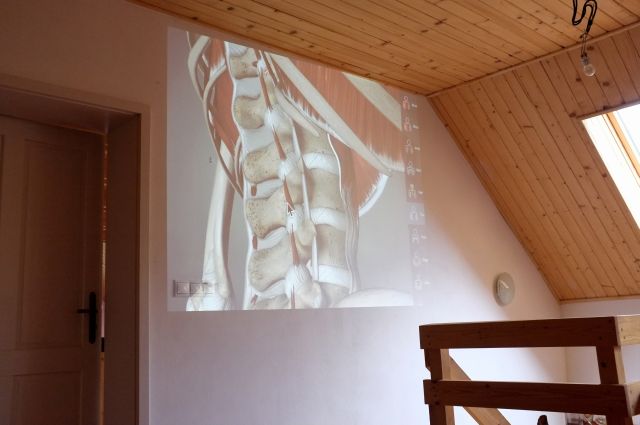
And this is the human body. Here we are. Here's the human body. Turn around. Thank you. Now, look at the human body. The human body is marvellous because we can balance on our legs. And people who are trying to make robots have great difficulty to make the robot stand and balance. And it's the most difficult problem to get the robot who can walk and run without falling over. So balance is at the centre of our movement. Now if you look at the human skeleton.
You can see, in the middle, in this part here, there's nothing except these vertebrae. One, two, three, four, five. Nothing else. So this part is carrying the whole weight of our upper body and our head. At the same time, our head is carried by a very small set of bones here. So this part here, the lumbar vertebrae, and this part here, the thoracic vertebrae, are very important in keeping upright. They are structurally the centre of our body. But of course, we have muscles.
Here we are. Lordosis. You can see the spine is not straight. So if, when you're practising zazen, you're trying to be straight, it's useless. But you can be naturally straight, so that these bones can function as a structure to carry our weight. And these bones need to be curved a little, like that. Now, let's look at this part here.
They are connected together, of course, with some tissues. Very strong ligaments, so that we don't fall into pieces. And then these ligaments also have some muscles on the top.
And you can see the muscles here, between the bones. These muscles are very small, but they control our posture. They also control the— sorry, I'm not so clever to operate— the space between the bones. The space between the bones is cartilage.
I don't know how to make cartilage show here. There we are. Now, these muscles are very small but very strong. But we cannot control them consciously. They are controlled by an autonomic nervous system. Autonomic nervous system controls whether we are tense or relaxed, whether we have a headache, whether we have strong sexual feelings, whether we feel aggressive. And the nerves in the autonomic nervous system come through the cartilage. And there's one, there's one, there's one. Oops, no, there's one. So we have the nerves which control our mood, our breathing, our health. They are coming here, from here. And they are coming through this cartilage, and these muscles are controlling the pressure on the cartilage. When we are tense, the muscles, these small autonomic muscles, become shorter. Our back becomes shorter. When we are tense, we become shorter. When we are stressed, our back becomes shorter. The pressure on these nerves is more, so our mood is affected, our breathing is affected, our health is affected. But we can't relax these. I'm going to relax my back. But we can't do it. We can do it very slowly if we let it happen. So the strange thing about our body is that at the core, at the centre, we cannot consciously make ourselves relax.
But if we take the right posture, we can let ourselves relax. We can allow the relaxation to happen. This is the centre of zazen. We don't try to get rid of our stress. We don't try to get rid of our thinking. Because if we try something, we become tenser. In English, intention, in tension. So what is zazen? Zazen is to have no intention. We just sit stupidly, with these bones in the right position, not bending to one side, or bending to the other side. So we sit and we wait.
And slowly, our body adjusts itself: these muscles and these muscles, and the muscles at the front. Then our back becomes longer, and then our autonomic nervous system is more balanced. So, from that point of view, zazen is a very simple practice. We sit and we wait to return to our natural state. In Japanese, shikantaza means just sitting. We don't try to have intention. We just wait to return to our natural state.
So how about sport? We have many muscles on top of these muscles, many bigger muscles on top of the smaller muscles. All these muscles become tense. If we sit like this with the computer all day, our muscles become a little bit fixed like this. If we sit like this with our legs crossed, our muscles become a little bit twisted. And so it's impossible for us to feel, to allow these muscles inside to relax, because the big muscles are tense. So we do movement. We get rid of the tension. Dancing, dancing, lovely. Walking, running, swimming relaxes all our muscles, makes them balanced. Then the deeper muscles can have a chance to return to normal. So, what's the difference between zazen and sport? In zazen, we sit and wait to return to normal. In sport, we move to return to normal. So I say zazen is a very simple sport, because I think sport returns us to normal. But of course, sport has many other layers: learning skill, moving body in a certain way, having determination to win. So all these factors in sport sometimes cover up the basic factor in sport. The basic factor in sport is when we return to normal, we can function well.
Breathing, eyesight, hearing, heart rate, everything. When our body returns to normal, we can perform most efficiently. Then we can put the other layers, like learning special sports or winning or competing and so on. In the same way, if we practise zazen and allow ourselves to return to normal, then we can put the other layers on top of working and planning and hating and loving and eating and having sex— underlying normality. So if we look after our underlying normal state, which I call balance state, then we can live how we want to. We don't need to worry. But this sounds very simple.
And over more than two thousand years, the explanations which the ancient Buddhist teachers gave became very complicated. They could not explain this. So, for instance, the Buddha said in one of his talks that the fine and peaceful state is when you are not thinking and you are not feeling. So the state without thinking and feeling. So people think, Oh, I want to get that state. So it must be wonderful because the Buddha is wonderful. So it must be like heaven. I want to get it.
But he was talking about the state that we have when we're acting. We're not thinking logically. We're not feeling strongly. Because our thoughts and feelings are all mixed together. So we're thinking, feeling, acting. And we all experience this state thousands of times every day. But it's instantaneous when you stand up and reach to pick up the cup. In the instant of acting, our thoughts and feelings are stopped to be separate.
And we become whole. And we sit down, and we become separate. We do this thousands and hundreds of thousands of times a day. This is the Buddha's meaning of the state without thinking and feeling. But of course people wanted to believe there is something they can get. They want to get something which this wonderful person has. So they project their imagination onto the wonderful person. This wonderful person is wonderful. They are perfect. I want to get it.
So even Kodo Sawaki said, You can't get anything. So I'll stop there, and we can have a discussion.
Jitka: Because I can understand that when I go for a run, the body relaxes, and I am not thinking about it, and I can get out of that stressed state into some calming. I calm down that body of mine by it; that I understand.
Mike: Yeah, I understand that if I go running, I can relax and change my originally stressful feelings, that stress I can transform into some peace. I understand that.
Jitka: But I don't understand how that works in zazen, because, for example, I notice that I do certain things and it affects my posture in zazen. For example, recently I have changed the way I think a bit, but some blocks are still there inside me. And in zazen it seems to me that if I did not concentrate on the position at all, I would relax too much and I would be, for example, hunched, right?
Mike: So in zazen it seems, if I do not try at all and just relax, my posture will be, for example, hunched or curved too much, and if I do not—
Jitka: I can't find out what the correct posture is, based on what is inside me, because I have some habits. And I know that you can't tell me what my correct posture is, because only I know it.
Mike: And I understand you can't tell me what my correct posture is, because only I know it.
Jitka: So I don't understand it in zazen, because in sport I don't correct myself, one just relaxes there. But in zazen I actually have this position. I'm supposed to be concentrated, right?
Mike: Because in sport, it seems to me that it's natural how we relax and the posture is natural. But in zazen, I know I should concentrate. I don't know how it works in zazen.
Jitka: I don't know how to find it in zazen. I understand how it works in sport, but how to find it in zazen?
Mike: Yes, that's a good question. And some people have said to me recently, and also in the past, they can't find— zazen doesn't seem to do anything. They can go for a run or a walk or a swim, and they feel relaxed afterwards. But when they do zazen, they can't feel something like that. And so after some time maybe they feel, maybe zazen's not so interesting for me. Or maybe they feel, I want to find out what am I doing wrong. So let's talk about what we can be doing wrong. First of all, if we don't understand what zazen is, if we think zazen is some spiritual practice, then we can never relax. If we don't understand what relax means, then we can't sit in a nice posture. And if we don't understand that zazen is about balancing ourselves, we can't find a balanced posture. Even if we can understand those things, our body already has habits. You know, our body has habits. So, first of all, we sit on the cushion so that our pelvis is in a nice position, so that our spine can sit nicely. If we sit on the floor, we have to lean forward. We can't get our spine so straight. So we sit on the cushion. We can sit on the cushion high or low, according to how comfortable. We want to feel solid. So if our legs are like this, we don't feel so solid. So if our legs are like this, we put a higher cushion. If we put a higher cushion, our legs go down. Then after some time, our ligaments become more relaxed. The masters in Japan and so on said, sit in the lotus posture.
If it's comfortable for you, fine, but most people in the West can't do that. And I can't do it anymore, because my hips don't twist. So that's the bottom. That's the base. Wait, there you are, sit on the tripod and you can feel yourself. No, no, no. Too far back, too far. Okay, maybe there.
Like balancing. Then the head on our shoulders: if we sit like this, we have tension. We often sit like this. So most people have a kind of habit. So we can try to make ourselves straight. You can move your head. Maybe there. Maybe here. Maybe there. Then what shall I do with my hands? If I put them there, I can't feel the balance anymore.
So I put them here. If I put them there, I can't feel balance anymore. So I move them here. So Dogen said, put your thumbs by your navel. No, it hurts. I don't like it. But if you put down there, you can't feel the balance. So this is zazen, just sitting. So Dogen said, zazen is not a fixed posture. We cannot balance if we're fixed. So people who teach that you should sit like this don't understand what zazen is.
Boris: Samurai.
Mike: Then we can have a stick to hit people. So, if you sit like this.
Jitka: Can I have my hands like that?
Mike: Yeah.
Jitka: I can, because when it's there like this, I have to hold.
Mike: Actually, if you sit with your thumbs touching, you can feel if you're thinking. When you're thinking, sometimes.
Jitka: And can I have the palms ...
Mike: You can sit like that, or you can make a kind of place for your clothes there, like that. So try not to touch here, and then feel. Just sit like you're balancing. You're learning to walk on a rope. And you can do this the whole time through zazen if you like.
Jitka: So I shouldn't feel the tension. If I feel tension, I should look for the nice
Mike: state. Of course, we always feel tension sometimes. So it's a kind of training. So when I say relax, don't try to get rid of the tension. I don't mean relax. Relax. So there is some effort, but not too much effort. But our muscles are like we have habits. So when we sit straight, our muscles say, No, no, I like this is better. So it's training. In our mind, we have lots of rubbish. So Kodo Sawaki said, like going to the toilet. In zazen, everything's coming out.
But if somebody's looking at you, they can't see anything coming out. So it's only in your mind. I'm having such a terrible time. Oh, my head is breaking. Can you see anything? No. But if we have very, very strong feelings or thoughts, it's better to go for a run, or to go for a walk, or go swimming. Then when we got the frustration finished, it's easier to sit. If we say, okay, I'm going to sit, even though I have terrible pain in my mind, I'm going to sit. This is no good. So go and do something else, then come back. Then try sitting like this.
So if we understand that zazen is something simple, then we can be more simple. And if you feel balanced, this is the state of Buddha. What? No, no, no. Buddha is wonderful. It's perfect. I'm not Buddha. So try not touching here. Just try it, and then like this, and learn to balance.
And if you do like this for several weeks and you think... then you can stop. I don't mind. You can go swimming instead.
Jitka: I have some blocks, I know about the blocks, so I go for a massage or a workout. So for me it's simply hard to find that feeling of harmony, or of balancing myself... it's just difficult for me.
Mike: For me it's difficult in zazen to find balance.
Jitka: Because to me zazen seems to be in tension.
Mike: Because naturally I am tense. Can you sit like this? And can you move like this? This is balance. Everything else is not important. Just this is balanced. Balanced.
Robert: But Mike, how about the thinking? Because we should also try some way to stop the thinking.
Mike: You told me this morning, I don't care what's in people's minds.
Robert: But I care what is in mine.
Mike: You do care. Okay. You care what's in your mind. I don't care what's in your mind.
Boris: Stop the translation, please.
Mike: Sorry.
Robert: I was asked— he was saying that, without intention, without purpose, basically we should also do something about the thinking in zazen, so to speak, that in some way at least we interrupt it, or so. And Mike said— this morning you told me that it doesn't matter what thoughts people have, and now you say that it matters to you what... I said I don't care what other people think, but I care what is in my mind.
Robert: But you said that zazen is only the balance, not the sitting. But there is, as I usually said, that we should also stop the flow of the thinking and try to stop some way.
Mike: Yeah. So if you're thinking, you can go like this. Then when you go like this, you come back here.
Robert: So if I'm sitting straight, I don't need to care about the flow?
Mike: No. But if you notice there's a story, okay, you have a story, then you can stop the story when you notice.
Robert: But sometimes I feel that maybe the story is going for fifteen minutes
Mike: Yeah, me too.
Robert: So this is no problem.
Mike: No.
Robert: Something needs to be done in thinking, and Mike said that when I realise that a story is running in my head, I can stop it and I can balance. And I said that I'm not entirely sure whether it doesn't matter that the story runs for fifteen minutes.
Boris: Whether it's enough just to realise it?
Mike: You are thinking about your thinking, and you're worried about your thinking.
Participant: Double worry.
Boris: Second.
Robert: Yes, but there are thousands of... there is no one person inside, but thousands. So the one is controlling the second, the third is controlling the... turtles all the way.
Mike: You're a very clever person, so you have a very active mind.
Boris: He's not a human being, he's a...
Mike: Robot.
Boris: A computer.
Mike: So if I say something which goes against logic, or goes against reason, you don't like it, because you're a very logical person. So unfortunately, the Buddhist way is to find a place beyond logic. Not to throw away logic, but you can say, Now I have logic. Now I don't need logic. And that's difficult for you. I understand. Because if there's no logic and there's no reason, you think, What is there? Just kind of crazy chaos? Yes! So you have to trust the crazy chaos, which is very difficult. So you don't want to do it. Now you're thinking...
Boris: [inaudible]
Mike: Yeah?
Boris: To make perfect, we should have no chaos. Because to believe this is all like this is, it's not so easy.
Mike: Finished.