Summer 2006 — Ikka-no-myoju
Digest of sessions 1–4
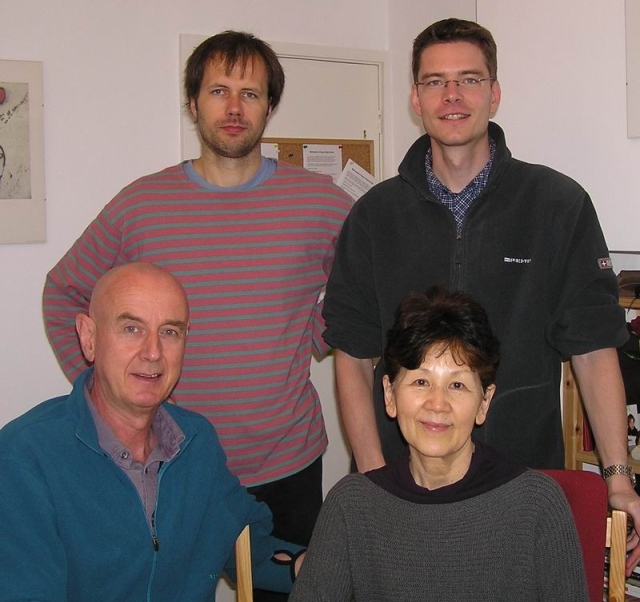
Michael Eido Luetchford
Summer 2006 — Ikka-no-myoju.
Venue: Earth Spirit.
Michael Eido Luetchford · Summer 2006 — Ikka-no-myoju
What sessions 1–4 say (short overview)
In these four sessions on Dogen’s Ikka-no-myoju, Mike reads “one bright pearl” as the undivided, uninterpreted reality in which we are, right at this moment. He starts from the small, simple things of practice, such as washing a mug after tea, and says that if a text still talks about something completely different after our effort to understand it, his advice is to throw it away, because it is not Buddhism. Master Gensa had taken a teaching to mean that his body was not real until, in great pain from a stubbed toe, he realised, “This is real!”; Mike says that Gensa realised something about the realistic nature of Buddhist teaching, and offers only as one interpretation that it was Gensa himself who had been deceiving himself. For Mike, a teacher’s truth has to be made our own: a monk who only repeats Gensa’s words back has understood them but not realised what they mean, and we can realise something only through our own experience, not from somebody else telling us.
Dogen says that Gensa’s expression is meant to get beyond categorisation, yet, as Mike reads him, he insists that daily life, including the social reality of pin numbers and bank accounts that we invent, is the Universe itself, with no other perfect state hiding behind it. Reality, for Mike, is the meeting of me and the world here and now, and that reality does not stop with me but is a common reality. He asks people to notice when the mind is elsewhere, calling this a description of reality rather than a criticism or an instruction. He keeps a contradiction that he finds throughout Dogen’s writings: thoughts are different from reality, yet thoughts are real and are the Universe.
Although the monk seems caught up in his intellectual habits, Dogen says that in asking his question he is fulfilling the essential function of the Universe, and Mike takes fulfilling our function to mean fulfilling our place in the Universe. In the discussion of regret, Mike says that the past is gone and that future action depends on our physical and mental state rather than on our intention, so he suggests reflecting in a lighter sense and practising balance. He does not present this view as invalidating other viewpoints such as therapy or talking with somebody else, and his own example of hitting a partner still ends with going to try and sort it out. Mike says that the perfection of reality is the different, real life we actually lead, not a perfect self, partner, holiday or retreat, and even our efforts to evade that truth take place within it. Real things put into words become concepts, which Mike calls very poor pictures of reality. When a participant is still not clear why Master Yakusan’s answer about the weather comes after the cave, Mike says that he is not clear either. In the recorded part of the fourth session, Mike says that the universe and all the things in it teach us, from the realisations of ancestors to a late bedtime, a dog or a forest. A pearl hidden in a garment suggests that we receive wisdom unexpectedly through an encounter and may not recognise it until later.
Editorial note: A condensed version of the talk in the speaker’s own voice. Repetitions, digressions and tangled exchanges were left out and related passages were brought together; nothing was added. The full transcript remains the authority.
What matters is small and simple
The rather strange thing about Buddhist practice is that the important things are the very small, simple things, and the large things are not so important. So if we don’t understand a word of what I said at the end of this talk, it’s alright, go and have a cup of tea. But after you’ve had a cup of tea, wash your mug up. All the sometimes rather abstract, difficult-to-understand Buddhist scriptures are saying that.
In a lot of koan stories, the answer to “What is the most important thing in Buddhism?” is something like, “Get up and do the washing-up.” And it’s not a joke — well, it is a joke, but it’s very serious! Because just leading our life simply and practically is the aim of Buddhism. If we make our effort to understand what we read and it’s still talking about something completely different, my advice is throw it away, it’s not Buddhism. Often we read something and it sounds completely different, but when we think, “This is written by somebody in a different culture in a different time, so let me try and grasp what they must have been trying to say in normal terms,” then we can sometimes find the meaning. Some of these koan stories sound very strange when you first read them, but if you imagine these two medieval Chinese people out in a rice field talking to each other, then it can make sense.
Bringing that into what we’re doing here, the simple things we’re doing are the most important. And if there’s a big calamity, we just have to accept it and let it go, as lightly as we can.
Gensa’s stubbed toe
The chapter I want to talk about this weekend is Ikka-no-myoju, “One Bright Pearl”, which Master Dogen wrote in 1238. It’s based on a quotation by one of his ancestors, Master Gensa Shibi, who said that the whole Universe is one bright pearl.
Gensa was a fisherman because he loved fishing. But he wasn’t trying to catch the legendary fish with the golden scales. Then he left secular society to study Buddhism, having realised how fragile its foundations are.
One day he set off to visit other masters. He stubbed his toe on a stone. He’d heard the teaching that this physical body isn’t real and thought it meant that our real bodies are not real, like people today who say that “there is no self”. So, “If there is no self, why is my toe hurting?” could be another way of putting it. In great pain, he suddenly realised something: “This is real!” And that realisation made him go back to the temple. His master said to him, “Hey, you hard little man. What are you doing?”
Gensa replied, “I have realised that it is not others who deceive me.”
That’s a very simple little phrase, but it’s very profound. In hitting his toe on a stone, he realised something about the realistic nature of Buddhist teaching, not theoretical or spiritual. We can interpret that in lots of different ways; but we can say maybe he realised that Master Seppo was trying to teach him something true, and it was he himself who was deceiving himself.
Asked about his trip, Gensa said, “Bodhidharma didn’t plan to come to China, just as our second ancestor didn’t plan to go to India.” Bodhidharma did come to China, and the second ancestor stayed where he was; both just followed events. Gensa is suggesting that he didn’t have a plan to turn back. Just he turned back. A lot of our actions in our life are like that: we’re not always thinking our way through our lives, we’re living our way through our lives. We can imagine that he went off to find something, and stubbing his toe he found something. So he had some kind of intellectual intention in going, and the reality his toe faced him with broke through his intellectual intention, so he just turned around and came back, naturally.
Gensa was just a fisherman, a very simple and sincere young man, not pursuing some idealistic thing. But he had a will to find out what the truth is.
Making it our own
But he did gain the power to make the truth of his master’s teaching his own.
If we study Buddhism with a teacher, we find out whether what the teacher is teaching is true, and we make it our own. In that sense, we don’t learn something which we didn’t know and then, once we’ve got it, take it away with us. We realise something that’s true as the basis of everybody’s life.
Gensa taught this truth with the words that the whole Universe which extends in all directions is one bright pearl. “The whole Universe” is not only the physical universe, but the Universe of all things and phenomena, including everything, and nothing; all our mental universe, too.
One day a monk asked Master Gensa, “… How should we, your students, understand this?”
Master Gensa replied, “… How could it be useful to understand these words intellectually?”
Several days later, Master Gensa put the same question back to the monk … The monk replied, “… How could it be useful to understand these words intellectually?”
The second time, Gensa doesn’t mean, “Give me an intellectual explanation.” He just means, “Give me something back.” But the monk replied with exactly the same words; he was just imitating his master. So Gensa told him that he was “struggling with a demon in a cave on a black mountain”: some kind of intellectual wrestling going on inside our brain. The monk didn’t express anything real in his own understanding. He could have said, “Well, it’s not much of a pearl today! Look, it’s peeing down with rain.”
He understood what the master had said, but he didn’t realise what that phrase meant. In English “understand” usually means intellectual understanding; “realise” suggests something more profound.
Question: Realise by your own experience.
Yes. That’s right. Which is the only way we can realise anything. We can’t realise it from somebody else telling us. We can only realise it when it hits us on the toe and makes our toe bleed.
Koan stories were real conversations. The tradition of saying the same thing back, I think, is not part of real Buddhism. In one direction the koan tradition became stylised, and we’re not interested in that kind of stiff game-play. In your mind you can separate two things, getting the same reply back and seeing a real person in front of you; but there’s no such situation in reality. In reality, a reply is given in a real situation by a real human being. Master Gensa heard his reply and saw his attitude, all together.
Question: Isn’t the monk’s reply a bit cheeky?
Yes, could be cheeky. But we could also imagine a very sincere student who’s been grappling with what Master Gensa said, day after day. Told that he can’t understand it, he repeats the fact that he can’t understand it, but doesn’t express his own view. Master Dogen says the monk needs to reflect in zazen. That doesn’t mean that he’s got to practise zazen and think about it; simply, sitting in zazen we reflect ourselves, we reflect the world, so we can experience reality. Then he can maybe realise that understanding is not always the point.
Beyond categories, inside daily life
Master Gensa is saying something about reality which is not something you can think about and understand, but just a simple description of reality. Master Dogen is saying that Gensa’s expression is intended to get beyond categorisation: the Universe, the whole of reality, is beyond our powers to express, in its totality. We do describe it, but in the end we’re lost for words.
Dogen says the Universe is beyond our usual interpretations of “living and dying, coming and going”, a metaphor for our ordinary life. We all share a social reality, and that social reality is invented by us. Only human beings understand what’s meant by a pin number; it’s useless to try to explain it to a cat. It’s real, and we share it, but the Universe doesn’t care about pin numbers. But then he goes on to say:
Living and dying, coming and going are the Universe itself.
In other words, our daily life is reality. Master Dogen insists that the daily round, our daily life, with pin numbers and bank accounts, is the same thing as the Universe. There isn’t another perfect state hiding behind the life that we lead. In Buddhism, Heaven and Earth are the same.
Then Master Dogen asks whether the Universe is only an accumulation of particles or something indivisible and whole, exactly the problem of atomic physics. Of course it doesn’t matter, because we can’t change it. But it does matter to people who are seeking for the basis of existence. It doesn’t matter to me.
The meeting of me and the world
In the end, the whole of reality [the whole Universe] is just endlessly realising that I exist right here in this world, and realising that the world exists right here with me.
Although we imagine a Universe, the only real experience we have of reality is what is here now. So we can say that reality, for me, is the meeting of me and the world here and now: “I exist right here in this world” from my subjective side, “the world exists right here with me” from the objective side.
Yoko and I often move about between Japan and England, and we both feel that when we’re in one place, the other place disappears. It’s impossible for us to experience anything other than what is here and now. That doesn’t mean that the world’s stopped; it’s something to do with the nature of our experience itself. A phone call or the news takes us out of being with what we’re doing. I don’t mean that we should stop it, just that fact itself. Notice it. We don’t have to go around keeping on noticing it.
Question: When I’m gardening I’m only gardening, but I didn’t realise that before. But then when I realise that, it goes!
To notice that fact is to notice how human beings are. Many people hear Buddhist teachings and think, “I have to get there.” But the point is just to notice how I am. Sometimes, although I’m doing something, my mind is elsewhere. That’s not a criticism, it’s just a description of reality. And sometimes in work we have to split ourselves. But to notice it clearly is important. Nowhere is there any instruction that we shouldn’t do this and we should do that.
Question: Reality is still a personal thing, though, isn’t it?
Me meeting the world is reality. That reality doesn’t stop with me, it extends to everything, because you’re here. When we think about it, we make it personal with our thoughts and feelings; but it means a common reality, which in Buddhism is the Universe, or Dharma. When we stop thinking, in zazen, or gardening, or doing something sincerely, there’s no edge to what is included in our consciousness.
When we stop thinking, there aren’t any objects. Carrying a cup of tea, you don’t name things or interpret them; you’re just acting, just being. Early Buddhism calls that “empty”, the state where we don’t discriminate or analyse. We all have that state, or we couldn’t live. But if we don’t give ourselves enough time without our busy minds going round, we get stressed. So the answer to stress is just to train ourselves to sit in the gap between our thoughts. Master Dogen doesn’t say, “When I’m here I know what the Universe is.” He says, “When I’m here, I am the Universe.”
Thoughts are real
… our emotions and our thoughts, just like turning our head or changing our facial expression, are momentary actions to take things in, and as such they are the Universe itself.
This is a very strange statement! Our thoughts take place in reality, so they’re the Universe itself. But it’s a contradiction. Thoughts are different to reality. Master Dogen says that all the way through his writings: “Yes, thoughts are different from reality; but thoughts are the Universe, thoughts are reality.” And we don’t like contradictions, so we get stuck: “But, but, but…”
Thinking is when we create an image in our head and think about it. We can think about something before, during or after doing it, but doing it is different from thinking about it. And you can’t garden unconsciously: “Oh, good gracious! All the gardening’s been done!” Our thoughts are not real, because we think about things that don’t exist; but our thoughts themselves are real things. If we strap bits on our head, we can see little blips on the graph.
The word prajñā commonly means “wisdom”, but it actually means what we experience before we interpret the world — pre-thinking. Buddhism insists that before our conceptualisation there is something and we’re in it, so there is some experience; it’s real. That may be different from the modern meaning of “experience” and, as Harry says, we should talk about it in detail some time.
One bright pearl
… the whole Universe is one bright pearl. Not that grass out there, or those trees over there, not just the mountains and rivers all around us, but one bright pearl.
“One bright pearl” suggests something whole and undivided, some undivided state of experience that exists here and now before we start to analyse here and now. We’re all in it. We are it. That’s what is expressed by “one bright pearl”: that undivided, uninterpreted reality in which we are, right at this moment. The phrase is a metaphor for something we can’t put into words.
What Master Dogen is talking about here is difficult to talk about. That’s why he uses metaphor and why his description contains contradictions. And we shouldn’t be surprised, because reality contains contradictions when we think about it.
Question: Difficult to talk about, but not difficult to experience.
No, we’re experiencing it all the time.
What Master Dogen is saying in this chapter is we all lead a great life. We’re all pearls.
England is a name, France is a name. We can’t be in a name. In our heads we can be in a name, but actually we’re just here and now. One bright pearl. There are no boundaries, no borders. And even when it’s miserable, it’s wonderful. Master Gensa said, “It is not others who deceive me.”
But we can still assert that the whole Universe which extends in all directions is one bright pearl — not two pearls or three pearls.
“Not two pearls or three pearls” means something whole, not made up of parts.
Fulfilling our function
Although the monk here seems just to be caught up in his intellectual habits, in asking his question, he is fulfilling the essential function of the Universe.
A wave contains exactly its amount of water, and our daily conduct must mirror this.
Master Dogen is putting into words the fact that we all have to be as we are. If we’re asking an intellectual question, or sitting quietly without asking a question, that’s fulfilling our function. Fulfilling our function is just to be who we are without thinking about it. But we’re all different, and every moment is different. So to fulfil our function means to fulfil our place in the Universe. What we’re trying to describe is the experience of being completely whole in this moment.
Question: Why is Master Dogen pointing that out then?
Because we always doubt. If we realise that what we’re doing is part of the Universe, then we can have confidence in what we’re doing, however silly it might seem, or embarrassing, or great, or small.
Question: There is a link, though, to “not doing wrong”, isn’t there?
That is exactly not doing wrong. In Master Dogen’s teachings, not doing wrong is not obeying an abstract moral law but finding the morality in the situation. And the morality in the situation is to be who we are.
Master Dogen is saying that Master Gensa’s phrase expresses the perfectness of reality; but that perfectness is not the perfectness we create in our brain: perfect me, perfect partner, perfect holiday, perfect retreat. Our life is different, and it’s that different real life that is perfect. The truth passed on from teacher to student is passed on not only by discussing facts like the perfection of reality, but by our actual practice of balancing body and mind. And in balancing body and mind we notice that the reality in front of us is just as it is, perfect, and that includes all our conduct, whether we’re asking intellectual questions, being too aggressive, being upset, and whatever.
It is this truth that Gensa passes on to himself.
Master Dogen’s suggesting that we teach ourselves. And as there’s nobody else to teach us, I suppose we do.
… even when we are trying to evade this truth, all of the efforts we are making to evade it are made in the one bright pearl of this present moment.
We can’t escape from reality, because we’re always in it. Although that sounds like a self-justifying statement, it’s also a true fact. And if we notice that, we can accept the situation and ourselves — not in a passive way, but simply by realising the fact.
Regret, reflection and balance
Question: So what happens if you are hitting your child? … I move on to another space which is regretting it.
The past is gone. So although you might regret it, you did it, and your conduct now is what is important. The only thing we can do is something now. You can regret it, but regretting it is just you.
Question: When we did it, that was the best. So just, how can I say it?
We’re doing our best.
I’ve got a rather peculiar viewpoint on learning from the past. I wonder whether we learn in the way that we say. When we reflect, we put our thoughts in order. But in the future, how we act doesn’t depend on that sorting out in our mind; it depends on our physical and mental state at the moment when we act. So whether or not we do it again doesn’t depend on our intention, but on our state. A very strong intention not to do something sometimes works against us: no cigarettes for three weeks, and then two packets. But if we reflect in a lighter sense, not as a plan for action, then we’re free to act in the future. And if we practise balance, we will act in a balanced way the best we can.
Maybe to go for a long walk, or to do something physical, might have a better effect than a mental process of regretting and promising to ourselves. To me it always is; but I hesitate to say it always is for everybody.
I can’t work out the effects of what I do so clearly. Sometimes I think I can, but it’s only from my perspective, so it’s not a big picture. It’s just one-sided. If we look back, we can get some kind of picture of the effect of our conduct, but for me it’s only in retrospect.
Question: It’s important to be talking with somebody else about it too.
The viewpoint of Buddhism on this doesn’t mean that all other viewpoints are invalid, or that if we do something it’s gone, so we can do anything we like and don’t need to plan. That sounds like chaos. In the middle of the therapeutic processes in use these days, those of us who practise balance can realise that we’re doing our best at every moment. Simply, “I did my best and I hit my partner, but I should go and try and sort that out.” And then sorting it out becomes another instance of doing your best.
Concepts and names
This is like a man riding a robber’s horse to chase the robber!
That’s a rather curious expression; it also occurs in Nagarjuna’s writings. I can’t explain it any more than it’s written there. What Nick said makes the most sense to me: adopting the same method as somebody else.
Tentatively we can say that real things and events that are teachings and practice, when put into words, all become conceptual in nature.
Real things, when we put them into words, become concepts. Then we tend to discuss the concepts, argue about them, and forget that they represent reality itself. So all our concepts are actually very poor pictures of reality, but we tend to believe the pictures and forget what’s behind them. Either the robber or the good guy, we’re all using the same concepts and languages to try and understand reality, but we can’t. We’re chasing round and round on the same horse.
In medieval China, when monks were asked their name, they would say, “It’s a very nice time of year, isn’t it?” I don’t know why. Maybe it’s something to do with the fact that our name is a concept, and we ourselves are beyond our name. We can all recognise that sometimes we don’t really know who we are. But, beyond that, I think asking ourselves “Who am I?” is a load of rubbish. The koans are just pointing to the fact that we are not the name that’s given to us, just like the Universe is not what is described by the word “Universe”.
Master Yakusan didn’t complain how hot it was that June; he just said, “It’s very nice!” He followed the norm. I get the impression from reading the story that in fact June is a very hot time and not so nice, but customarily a monk would say, “It’s nice.” It’s a way of avoiding saying your name. It’s like “Good morning!”, isn’t it?
Question: So we say “Good morning” to somebody, which is customary, but at the same time it’s something from our self.
Question: I’m still not clear why all that lot comes after the cave bit.
Ah, nor am I. Well, you never know with Dogen, do you?
The universe teaches us
… the whole Universe is perfectly rounded, and roundly it rolls along.
So we end the talk, give the chant, practise zazen, have lunch. The Universe, or reality, rolls along, and our duty is to roll along with it.
Master Reiun Shigon realised what reality was when he was looking at plum blossoms: that reality is just here and now. Master Kyogen Shikan is said to have realised what reality is on hearing a pebble hit a bamboo. Master Dogen is saying that these ancestors realised the truth because the universe is one bright pearl. But if we try and explain that in terms of “Therefore this happened, therefore that happened”, we can’t find a logical connection.
So people in the past, the present and the future can realise what the truth is. We can take the Lotus Sutra’s image of Buddhas appearing as meaning reality is all around us: the universe and all the things in it teach us. It can be a person or a dog or a plant in the garden, an incident, a sound. Not some kind of mystical “This is reality”, but just, “Ah, I see. If I keep going to bed late, I can’t get up in the morning.” So we can say those things or people or beings that teach us reality are buddhas.
The Lotus Sutra’s bodhisattva appearing in the body of all different kinds of people is the symbolic way of the Lotus Sutra. But in fact we can say that all of the universe is teaching us what reality is, because it’s all real. So we may learn from our children, or from our dog, or from trees what reality is. We can be wound up by our work, our busy mind whirling round, and we go for a walk through a forest, and the rustling leaves tell us, “Here we are.”
A pearl in the garment
In the Lotus Sutra, a drunk friend sobers up and finds that his friend has hidden a pearl in his clothing, and then gone. Pearl means some kind of wisdom or true teaching of the truth. We meet somebody and we realise something about reality through the encounter, and then they’re gone. But often we don’t find the pearl until afterwards. Under the black dragon’s chin is hidden a pearl; I think that’s a legend, but I don’t know that in detail. What’s under its chin?
Participant: A carrot.
Participant: A lime.
It … is often hidden beneath a garment, and we shouldn’t expect to find it displayed prominently.
So, if we receive a pearl of wisdom from somebody, we shouldn’t expect it to be obvious necessarily. We may receive it and not recognise it.
It is often hidden in a topknot or under a chin, but we shouldn’t go searching for it there.
That suggests that we receive the wisdom of the universe unexpectedly. If we say, “The universe has got wisdom, right, I’m off to look for it,” we don’t find it. We stumble on it accidentally. The universe as it is is full of the truth, and we get little bits of the truth as pearls, and often we don’t recognise them, we don’t find them till later.
[audio recording likely incomplete]