The Four Views
Talk digest
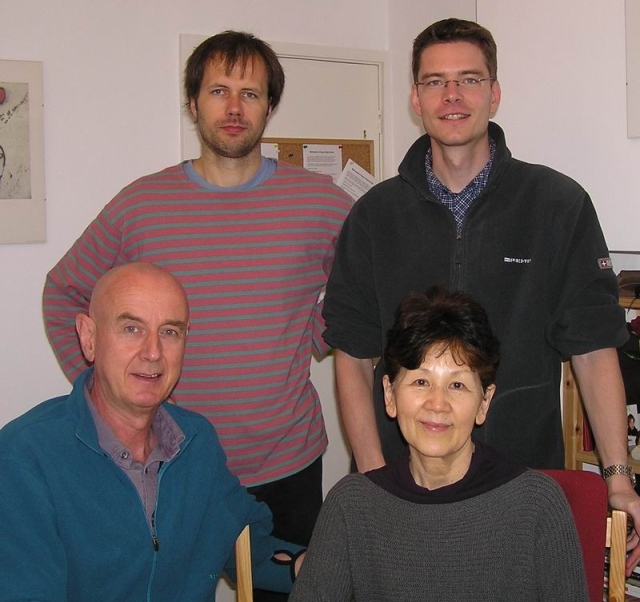
Michael Eido Luetchford
Summer 2006 — Ikka-no-myoju, standalone talk.
Venue: Earth Spirit.
Michael Eido Luetchford · Summer 2006 — Ikka-no-myoju, standalone talk
Editorial note: A condensed version of the talk in the speaker’s own voice. Repetitions, digressions and tangled exchanges were left out and related passages were brought together; nothing was added. The full transcript remains the authority.
Reconciling Buddhism with normal life
I always feel, when I talk about a chapter in the Shobogenzo, Master Dogen writes in such a strange way, puts everything together, and you feel sometimes, ‘Ah, yes.’ But when we go out into the world, the world doesn’t feel very ‘Ah, yes’ at all. If we go away from this weekend saying, ‘Everything is a bright pearl!’, and somebody at work says, ‘What about that deadline?’, and you say, ‘No deadline. Lifeline, living line, yes’ — it’s fine for us, but nobody else really gets the point. Buddhist teachings about the immediacy of our real experience, about the perfection of the real world we live in, warts and all, about the difference between our thoughts and reality, are very exact; but they don’t seem to fit in with politics, daily life, the pressures of business. And I feel that to try and create a Buddhist world in this world is a big mistake. Personally, I have no desire to build up any kind of Buddhist community that lives in a nice peaceful, happy state, because it’s a kind of dream. You can do it; but, for me, I’m more interested in how we reconcile Buddhism with normal life. And Master Dogen reconciles it with normal life — of course, normal life for him was very different — by using four viewpoints.
Look where we’re stepping
The teachings of Buddhism make us look at the here-and-now. We could make the story about Gensa stubbing his toe a kind of metaphor for society. We’re all walking along this path, looking hard at the end of it and hurrying along, and we keep stubbing our toes. A few of us stop and try to help the people with bleeding feet; but we don’t notice that what is creating that situation is how we’re moving forward. Without some kind of aim or ideal we never move forward. So we shouldn’t stop our busy lives, we shouldn’t stop having our ideals and moving towards them, we shouldn’t stop trying to help people who’ve stubbed their toes; but we should learn how to look where we’re stepping as we’re moving towards our ideals.
I think this is the contribution that the peculiar Buddhist view can make towards modern society. Not to say, ‘Stop working for companies and making profits!’, or ‘We shouldn’t have armies, Buddhism is peaceful!’ That’s really, in a way, unrealistic, at least at this time. But we can say, ‘As you’re rushing along, just watch where you’re going. Concentrate on putting one foot in front of the other, because that’s what gets us to our aim.’ I learnt this as a mountaineer. When I started, we were all young people, very driven to get to the top of the mountain, and those of us who didn’t look to see where we were going fell down crevasses. It might be heroic and wonderful to watch, but it hurts! In order to watch where we’re going, we need to understand that this one step is moving us towards our aim. So we concentrate stupidly on this one step and, magically, half an hour later we’re up there. It’s a kind of miracle, and what’s done that is this peculiar action called walking. So we can say the Buddhist contribution says, ‘Look where you’re stepping now and then you can move more realistically towards the goal.’
Four ways of being
Formally, in Buddhist philosophy, this is explained as four views, or four fundamentals, or four ways of being. The first is the ideal: we need to think and plan and see where we want to go. The second is the physical: unless we keep our body healthy and keep within our physical limits, we won’t get there. It’s no good having a strong will without having a strong body.
The third is the immediate: looking where we’re putting our feet at this moment, doing something now, rather than trying to do something now while our mind is thinking about something else. We often have to multitask; but if we only multitask, and never just concentrate on what we’re doing now, we become so stressed we can’t carry on. This is the Buddhist view: acting in the present, which, we can say, saves us from our physical difficulties and our intellectual difficulties.
Then the last viewpoint is an all-embracing one: the intellectual, idealistic area, the physical area and the area of action in the present are all intermixed. So we’re all idealists at the same time as being materialists at the same time as acting.
We can apply the four views to Gensa walking along the path: his ideal, his physical body, his action in the moment. Putting those together to get a total overall view, we see that, because his intention was so strong, he didn’t look where he was going and he stubbed his toe, and that made him realise the situation.
Question: The fourth fundamental seems to bring the first three together. Why has Dogen added it?
Because we have that ability. It’s indisputable that we think, that we have a physical body, that we act, and the only place we act is now; and it’s also indisputable that we can take a kind of intuitive overview of our situation. If we do it from only one viewpoint, it’s unbalanced.
Question: Is that prescriptive or is it descriptive?
Both. More descriptive than prescriptive, actually, because even though we might want to be balanced, it’s beyond our ability to know quite what to do. We can do it, but to know what we should do is difficult.
The value of action
But in Western civilisation the third viewpoint is rather weak. Idealism and materialism are highly developed, but until recently the value of action itself has not been given very much importance. For example, we may work in a company where the people planning strategy are valued very highly, and somebody going round doing the cleaning is not. But Buddhism says that our actions, whether we’re planning a strategy or cleaning the toilet, are all important.
So Buddhism can make a kind of contribution to our society. Not an alternative. Many people think we can make ourselves an alternative life, away from all disturbance. Well, good luck to them. I’m more interested in how we can add this third viewpoint to our excellent civilisation, so that instead of having to stop now and again and set up charities for people with bleeding toes, we can avoid stubbing our toes a bit. It’s a kind of long-term, slow revolution, in a way.
With the popularity of sport and physical activity, people are realising what the value of action is. When I went to school, nobody taught me about my body. I felt the culture was, ‘Be as clever as you can, get as many exams as you can.’ Attainment all the time. And the other end was no attainment and not valuable. But I feel it’s changing, mainly due to our freedom to engage in physical activity.
Our Western society tends to be biased towards the idealistic side, so we tend to give value to, for instance, cleverness. I know all these statements have exceptions, but that’s from our very long history with Christianity and attaining the state of grace.
Question: My students want to know, ‘Do we need to know this for the exam?’
That’s what we teach them all the time. But we can’t say, ‘We shouldn’t have exams.’ It’s a question of balance, always. Seeing value in what we’re doing.
Zazen, the simplest sport
When a stockbroker goes jogging, he’s integrating the Buddhist third viewpoint into his or her life. It’s not necessary to call it ‘Buddhism’, but the way of Buddhism is to make that clear with Buddhist philosophy, and to practise it with zazen. Master Dogen says, ‘Zazen is not the only way to have a balanced body and mind.’ Sport is one way.
Zazen can be made to seem like some esoteric practice done by shaven-headed monks in rooms full of wispy incense, but to me it’s the simplest sport. It gives us a balance that we can get every day. You can do it by jogging every day, or playing a sport every day, but you don’t know what you’re getting. So Buddhism is the way of practising action and learning about its value. And we can say that to act is to find the middle way between thinking about what we do and the physical aspects of what we do.
Question: When you say zazen is the simplest sport, I understand that to be one aspect of something.
One way to describe it, yes.
Question: With rock climbing you have the same intensity of attention, but that doesn’t apply to all sports.
No, it doesn’t. In sport we set up our goals, a competition, and then athletes concentrate on winning more than the act of participating, and they’re running and stubbing their toes again. But, basically, moving the body or acting creates balance. That’s why I say zazen is the simplest sport — and everybody wins.
The only life we’ve got
We shouldn’t seek to replace the life we live with something called ‘Buddhist life’, because the life we live is the only life we’ve got. Buddhism doesn’t say, ‘Escape from your life and find perfection.’ It says, ‘The only happiness that exists, really, other than the one in your mind, is in the life that you have now.’ So, to find balance or happiness in the life that we are leading — complicated or simple, it doesn’t matter.
Incomplete work
Question: I’m reading your book “Between Heaven and Earth” for about the fiftieth time, and I still find it very difficult. You said writing it was like pulling a carpet together.
That’s because it’s not a very good book, actually. Yes, that’s another analogy, weaving a carpet. So Buddhism says, ‘Just make the one stitch that you’re doing. And then you’ll get the whole carpet.’
Question: What do you think is wrong with the book?
It’s impossible for me to work out exactly what Nagarjuna was saying in the second century. So it’s incomplete. It’s like archaeology: there’s a bit of wall there, so maybe there was a building there. It’s lost. Whether somebody else can find it or not I have no idea. All the other translations haven’t found it, so mine’s no worse than theirs. But still, it’s incomplete.
Yoko: There aren’t any things which are completed in our world.
Yes, that’s right. I had an ideal, to write this book which explained what Nagarjuna taught all very clearly. But I uncovered the foundations and wrote what I could, and then I published it because that’s what you do.
Yoko: It’s human limitation. So maybe somebody will do it another way… one bit.
One bit more, yes, that’s right. And this is what we’re doing with the Shobogenzo. I know some of you find the sentences almost impenetrable, sometimes. But without those books we couldn’t move forward to another stage, because getting from medieval Japanese and Chinese to modern English is too much. So we can only do it in incomplete steps. These modern interpretations that I’m doing are incomplete, too; it’s a work-in-progress.
Question: There’s another sense in which it is complete, if you’ve done it and published it. And it helps us when we read it.
Yes, so it is complete, but it’s not the completeness I can imagine. It’s real completeness, yes.
Dogen’s holistic view
Question: What draws you to Dogen that can’t be found today?
It can, in a way. The thread of reality is everywhere. Everybody’s got little jewels. But, for some strange reason, Dogen was able to write something complete. I mean, it’s not complete; but it’s complete — it’s got a holistic view of life, it’s not one-sided. And that’s why it contains so many contradictions. He takes different viewpoints: he’s not just on this side or that side, he’s on both sides, and in the middle too. And that, to me, is very, very unusual.
Question: So he presumably really stood out in his own time?
What Dogen wrote was very unusual even for people in medieval Japan, wasn’t it?
In the Shobogenzo, even though it’s written in the thirteenth century, he touches on an amazing range of things. He talks about relativity. Not in the mathematical terms that Einstein does, but it’s the same thing he’s talking about: the fact that what we think is fixed is, in fact, relative; that time is relative; that space is relative. And he talks about whether we should look at things as a whole or as bits, which is reflected in modern physics with particle-wave duality. Quite staggering, really. But why I got tied up in it, I don’t really know. Nothing else to do, I suppose!