Shoaku Makusa 5: The Child and the Old Man
Mike reads Dogen on a koan: not doing wrong and doing right are real events of everyday life
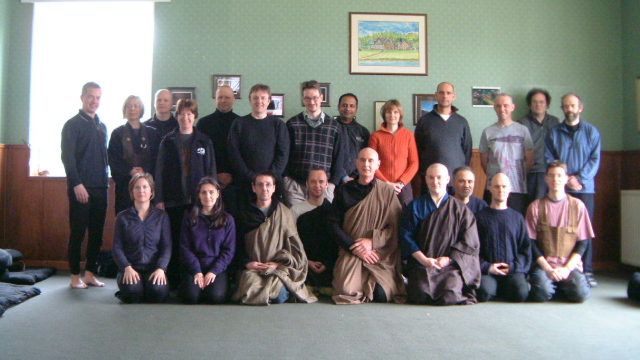
Michael Eido Luetchford
Winter 2006 — Shoaku Makusa, Session 5.
Venue: Rowardennan.
Michael Eido Luetchford · Winter 2006 — Shoaku Makusa, Session 5
From the retreatPhotosChronicle
What the talk says (short overview) — About these overviews
In the fifth talk on Dogen’s chapter Shoaku Makusa, ‘not doing wrong’, Mike reads Dogen on ‘Naturally purifies the mind’ and on the koan of Haku Kyo-I and Master Choka Dorin, and says that Dogen insists here that not doing wrong and doing right are not special events but the real events in our everyday lives. Mike says that Dogen thought that Kyo-I understood his master’s words only on the intellectual level and that Dogen suggests that Kyo-I maybe had not experienced the state called ‘not doing wrong’; Mike adds that doing right makes right real and that there is no real right other than doing right.
Mike says that in the line ‘Naturally purifies the mind’ the original has just the word ‘the’ where the English text has ‘[state]’, and that Dogen is not commenting but equating all the important words in the poem with each other. Mike says that in the koan Kyo-I, a lay disciple and the governor of a district, asked Master Dorin for the essential point of Buddhism, heard ‘Not doing wrong, doing right’, replied that even a three-year-old child can give such an answer, and was told that a child of three can, but that even an old man of eighty cannot practice what the child says. Mike says that he guesses Kyo-I, an important man with his own pride and position, must have been a little offended by a simple, to him childish, answer, that we can suppose Kyo-I left, having said thank you formally, but feeling rather put out, and that we do not know whether Dorin meant himself by the old man of eighty but can suppose he meant something concrete. Mike says that Dogen describes Kyo-I as a poet who has long been considered great but who in Buddhism seems to have been just a beginner and who thought that Dorin was only telling him ‘Don’t do wrong, do right’ as an intentional aim to hold in his mind, and says that the truth of Buddhism is always the same, whether we hear it from our teacher for the first time or experience it as the state in practicing Zazen. Mike says that thinking about our life in terms of causes and effects is not the Buddhist way, though we need it and it is the basis of science, and that to act in the world is to throw away cause-and-effect and just to act in the moment; we can think about the effects of our actions, but when we act we should throw away our thinking. Mike says that Dogen criticizes Kyo-I’s remark that even a child can say that, that Dogen is saying that a child is a buddha and that what children say is not simple and stupid, and that Dogen suggests that Kyo-I has never really met a child. Mike says that anybody who pursues one thing on and on knows the truth of Dogen’s sentence about knowing a single molecule and the whole Universe, that Dogen is suggesting that practicing Zazen is the pursuit of one thing and that this very simple pursuit can teach us about everything, and he adds that our standard for studying the simplest activities of our everyday life is Zazen.
Mike says that Dogen is saying that Kyo-I would be misled by looking at the non-socially-acceptable behaviour of children into thinking that they are not buddhas, and that we can suppose that Kyo-I, a general’s son, a famous poet and a governor, might have been studying Buddhism for other than pure reasons. Mike says that we can study children, who live in the balanced state unless we disturb them, that we all have certain childhood disturbances that make up our characters, and that to actually act in a balanced way is lifelong training; he adds that in the final paragraph Dogen points out that our opinion about right and wrong is utterly different from concrete action as right or wrong, and that this is the most important thing that Buddhism teaches. Asked whether this was one of the earliest essays in the Shobogenzo, Mike answers that it was quite early, 1240, when Dogen was forty years old, and to the remark that it is nice to think that Dorin meant himself by the old man of eighty he answers that it is nice to think so, but that we cannot conclude it either way. Asked about the sentence on cause and effect, Mike says that Buddhism has a view of the present as reality, that if reality is only here and now at this moment cause-and-effect does not have its normal role, that in the second, cause-and-effect view we can explain our existence while in the third, instantaneous view we cannot explain it but can act, and that the two views are irreconcilable intellectually and reconcilable only in the balanced state, and maybe in quantum mechanics. Mike says that quantum theory and atomic physics is approaching reality and that we do not know whether we can describe reality completely on the basis of science; to the remark that quantum physics is closely connected with ancient things he answers that some people say so but he does not agree, and he adds that Dogen has a general theory of truth with four views, or four theories in one, that contradict each other, and that we usually try to get rid of contradictions. Mike says that the truth is reality at this moment, that we can never escape it, that people are not in their own truth or reality but in reality, that everybody is connected with everybody else, and that he can think of himself as existing as a separate entity but does not and never can; we are all linked for ever more. Asked whether Buddhism accepts that it is inevitable and natural for a child to lose its buddha-ness and whether trying to come back is then unnatural, Mike says that you can say it does, that it depends what you mean by ‘natural’, and that societies in the Far East and Europe may educate children to fit into completely different structures; he adds that we can go round in circles on this but asks how coming back to our natural state can be unnatural, and thinks you can answer it yourself. Mike says that this question is the same as the problem he has been thinking about a lot, whether cleaning plaque off our teeth is natural when it builds up quite naturally; asked whether the natural state is the same as the balanced state, he says that this is what we have to study and find out, that we can only answer it for ourselves concretely in our real experience, and that the only action we can ever make and the only life we can ever know is our own. Asked whether the paradox is itself the truth, Mike answers ‘Yes’ and, asked to explain it, ‘No’; he says that paradox, or contradiction, only exists in our mind, that if we stop thinking and just act, as when asked to wash up all the cups and, at the same time, pour the tea, we solve the problem immediately, and that the koan stories are embedded philosophy that make clear the philosophy of Buddhism.
Complete English transcript — About transcripts
OK, so we got just onto the top of page five. From the bottom of page four, Master Dogen comments on the third line in the poem in a very straightforward, but very unusual way:
Naturally purifies the mind. In this line, not doing wrong is natural; not doing wrong purifies. The [state] is natural, and the mind is natural.
“The [state]” refers, in fact, in the Chinese, just to the word “the”. So, “the is natural”. And in Japanese, there isn’t usually a word for “the”. There’s not usually a definite article. But in the poem, “Naturally purifies the mind”. Where I’ve put “[state]”, the original just says “the”. He’s saying:
Not doing wrong is natural; not doing wrong purifies. [The word] The is natural, and the mind is natural. [The word] The is not doing wrong, and the mind is not doing wrong. The mind is doing good, and doing good purifies.
Which means he’s equating all the important words in the poem with each other. He’s not commenting, he’s just equating them with each other.
The [state] is doing good, and doing good is natural.
He goes on:
This is why ancient Buddhas said, This is the teaching of the buddhas. The many buddhas include Siva for example [the Hindu god of destruction and renovation], but there are many different kinds of gods and not all of them are buddhas. There is the example of Chakravarti-raja, but not all people like him are buddhas. We need to study this carefully.
Siva and Chakravarti-raja were two gods that had been included in Buddhism as Buddhist gods, in the traditional scriptures.
We need to study this carefully. If we do not learn what buddhas are, then even though it may look as if we are making a great effort, we are only the same as ordinary people accepting their suffering; we are not pursuing the Buddha’s truth. Not doing wrong and doing right form the real events of our everyday lives.
After reading Master Dogen’s commentaries about not doing wrong and doing right, we may feel that what he’s talking about are special kinds of events. But he insists here that they are not special events but the real events in our everyday lives. Our moment by moment actions. He then goes on to give a concrete example from one of the koan stories. And this koan is included in the three hundred and one koans that he collected and which we published in the Shinji Shobogenzo. It’s a very nice koan, and very simple.
Haku Kyo-I of Tang Dynasty China was a lay disciple of Master Bukko Nyoman, and a second-generation disciple of Master Baso Do-itsu. When he was the governor of the Koshu district, he studied Buddhism in the order of Master Choka Dorin. One day he asked his master, “What is the essential point of Buddhism?” Dorin said, “Not doing wrong, doing right.” Kyo-I replied, “Can that be true? Why, even a three-year-old child can give such an answer!” Then Master Dorin replied, “Yes, even a child of three can give such an answer, but even an old man of eighty cannot practice what the child says.” On hearing this, Kyo-I prostrated himself before his master to show his gratitude, and left.
Kyo-I was, in fact, rather a famous poet. But he was studying with Master Bukko as a lay disciple. That means he wasn’t a formal monk living in the temple. And, in fact, he was a governor of one of the districts. So he was an important man. And he must have had his own pride and his own position. And he said to his master, “What’s Buddhism all about? What’s the essence of Buddhism? Tell me what Buddhism is about.” And Master Dorin’s answer was very, very simple: “Not doing wrong, doing right.” And I guess Kyo-I must have been a little bit offended. Such an important man, who was the governor of a district, and this buddhist master gave him such a simple, to him childish, answer. So he said, “Huh! Even a child can say that! Why do you tell me the words a child can say?” But Master Dorin replied, again very straightforwardly, “Yes, although a child can say it, an old man can’t do it.” And we don’t know whether he was referring to himself as the old man of eighty, or just a generalised old man of eighty. But we can suppose from his answer that he was referring to something concrete. So, “although we can say the words, we can’t do them.” And Kyo-I prostrated himself, which was the normal way to say thank you, and then left. So we can suppose that Kyo-I left, having said thank you formally, but feeling rather put out. He felt he hadn’t been given a proper answer. Master Dogen comments on the koan:
Although Kyo-I was the son of a general, he has for many years been considered a great poet. He is said to be one of the 24 literary giants of China. Some people even said that he was an incarnation of Manjusri, the realised form of Gautama Buddha’s wisdom. Others said that he was an incarnation of Maitreya, the form in which Gautama Buddha would return to the world after his death.
Both Manjusri and Maitreya are gods who had been used in Buddhism to stand for certain things.
Everyone loved his poetry, and there was no-one in the literary world who had not studied his work. But in Buddhism, it seems that he was just a beginner, a late developer! It seems that he had never understood the point of not doing wrong, doing right, even in his dreams! Kyo-I thought that Dorin was only telling him “Don’t do wrong, do right” as an intentional aim to hold in his mind. He never recognised and had never heard that the principle of not doing wrong, doing right has been in Buddhism from the eternal past to the eternal present.
Master Dogen thought that Kyo-I understood his master’s words only on the intellectual level. He understood the words, but he didn’t see what it meant. He thought that the master was just giving a bit of information to him. He didn’t realise the real, fundamental principle about “Don’t do wrong, do right. Not doing wrong, doing right,” which has existed in Buddhism, according to Master Dogen, from the beginning, and will always.
Kyo-I said what he did because he had not experienced the Buddhist state and so had no power to see the truth of Buddhism.
Master Dogen’s suggesting that Kyo-I maybe didn’t practice Zazen, or maybe he only practiced it once or twice.
Even though Master Dorin’s words do caution us not to do wrong and urge us to do right, he is talking about the state called not doing wrong. In general, the truth of Buddhism is always the same, whether we are hearing it from our teacher for the first time, or whether we are experiencing it as the state in practicing Zazen.
Master Dogen says that the truth of Buddhism is always the same. And that Master Dorin is talking about a state called not doing wrong, and he’s not talking about just the instruction, “Don’t do wrong.” And he suggests that maybe Kyo-I had not experienced this state.
We say that the situation is right through-and-through, or that the workings of cause-and-effect are amazing, or we call it “Buddhist cause-and-effect”!
Those three expressions are ways that Master Dogen illustrates our feeling about the state not doing wrong. We can say ‘the state of not doing wrong feels right through-and-through,’ or that ‘cause-and-effect are amazing,’ or ‘this is Buddhist cause-and-effect’.
In Buddhism, we neither say that the effect is identical to the cause, nor that it is different; but without Buddhist causes we cannot experience the Buddhist effect.
To think about our life in terms of what causes and what effects there are, is not the Buddhist way. Although we need to think about our lives in terms of cause-and-effect, and to think about the world in terms of cause-and-effect - it’s the basis of science – Buddhism is not science. So Buddhism also has another view. Although it accepts the view of cause-and-effect, it says in the end cause-and-effect is the way we explain the world. But to act in the world is not to think about cause-and-effect. To act in the world is to throw away cause-and-effect and just to act in the moment. If we think about the effects of our actions, they inhibit us from acting. That’s not to say we shouldn’t think about the effects of our actions, but when we act we should throw away our thinking. We can think about what we’re going to do, and we can think about the effects of our actions, we can think about what’s happened to us, and we can think about the causes of that, but in the present moment, to be free, we have to throw away all our thinking. We have to stop worrying and just act. And whether our action is right or wrong is not the point.
The truth that Master Dorin speaks shows that he has grasped Buddhism. Even if wrong pervades the Universe, enfolding it and swallowing it over and over again, still we find salvation and liberation in the state of not doing wrong.
To Master Dogen, the state of not doing wrong saves us and liberates us.
And doing right, action which is right through-and-through, makes the essence of right real in form, substance and power.
Doing right makes right real. There is no real right other than doing right.
But Kyo-I had never trodden in these tracks, and so he replied “... even a three-year-old child can give such an easy answer”! In saying this, he is not actually able to express the truth of the situation. What a pitiful person you are, Kyo-I! Just what are you saying? You do not know the state of a buddha, so how can you know the state of a child of three? Do you know the state in which a three-year-old child lives? If you know the state of a three-year-old child, you must also know the state of the buddhas. How can anyone who doesn’t know the state of the buddhas of the past, present and future know the state of a child of three?
Master Dogen is criticizing what Kyo-I said about “even a child can say so!”, suggesting that the answer is so stupid and simple that only a child would say it. Master Dogen is saying that a child is a buddha. What children say is not simple and stupid.
We shouldn’t think that we know someone just because we have met them, or that we do not know someone just because we haven’t met them.
In that, he’s referring to Master Kyo-I’s use of the example of a child. He’s suggesting that Kyo-I has never met a child. And by ‘meet’ Master Dogen suggests really meeting, and really seeing what the child is.
To know a single molecule is to know the whole Universe. To know the essence of one thing is to know the essence of all things.
Blake. What’s Blake’s quotation?
Participant: It’s Wordsworth’s.
Mike: It’s Wordsworth’s, that’s right.
Participant: Well, ‘to see infinity in a grain of sand’.
Mike: Are you sure it’s Wordsworth?
Participant: It’s Blake.
Mike: Every time I guess who wrote, it I get it wrong.
Participant: That’s why I went for Wordsworth.
(Laughter.)
Mike: Who was it?
Participant: Blake.
Mike: Blake. I got it right! Anybody who pursues one thing on and on knows the truth of this sentence. “To know a single molecule is to know the whole Universe. To know the essence of one thing is to know the essence of all things.” If we want to learn all things, the best way to do it is not to pursue all things. The best way to do it is to pursue one thing.
Someone who does not know the essence of all things cannot know even the essence of one thing. A person who studies and attains the perfect state through Zazen can know the essence of all things, and the essence of one thing.
He’s suggesting that practicing Zazen is the pursuit of one thing. If we pursue Zazen we can know the essence of all things. Although Zazen is a very stupid practice, where we sit on a cushion facing the wall, not thinking and not analyzing the world, Master Dogen says that very simple pursuit of one thing can teach us about everything.
Studying one thing is in fact studying the whole Universe. It is really stupid to think that a child of three cannot teach Buddhism, or to think that a child can only talk about simple things. Clarifying what life is and clarifying what death is are the most important task in Buddhism.
“Clarifying what life is and clarifying what death is,” suggests finding the meaning of life and death.
One master of the past said, “When you come into this world, even your first cries proclaim the Buddhist truth!” And the baby’s ability to proclaim the truth is exactly the same as Gautama Buddha’s ability to proclaim the truth; what the baby teaches is what the Buddha taught. Another master of the past said, “The everyday activities of our lives make us real persons.” So to make the “real me” clear, and to proclaim the truth of Buddhism is never easy, and is the one great task of our life.
Master Dogen, in quoting the ancient master’s words, “the everyday activities of our lives make us real persons,” is pointing us to the simple actions that make up our daily lives. Not to esoteric study and trying to put together a vast, great plan of how all things work, but in studying the very simple activities of our everyday life. And our standard for studying the simplest activities of our everyday life is Zazen. This is our standard.
This is why it is important to be clear about the motives and actions of a three-year-old child. But because the conduct of a three-year-old child is the same as the buddhas of past, present and future in some respects, and different in others, Kyo-I would never be able to hear a three-year-old child teaching Buddhism.
We can’t become a three-year-old child again. And three-year-old children, not only do they teach Buddhism, but they pee in their pants and do other natural things for three-year-old children. He’s saying that Kyo-I would be misled by looking at the non-socially-acceptable behaviour of children, into thinking that they are not buddhas.
He is too stupid to suspect that a three-year-old child might be able to teach Buddhism, and that’s why he said what he did. He didn’t hear what Dorin was really saying, even though it was as loud as thunder, and so he said “... even a three-year-old child can give such an answer,” implying that Master Dorin had not expressed the truth in his words. But Kyo-I’s words show that he was not capable of hearing a three-year-old child teaching the truth of Buddhism, and that the time he had spent with Master Dorin had been in vain.
We needn’t necessarily assume, every time we read of somebody studying with a master, in the scriptures, that that person is studying sincerely. In medieval China, Buddhism was the national religion. And Buddhist masters were even appointed as National Masters, rather like the Archbishop of Canterbury. So it was a national religion. There were many people studying Buddhism. And there were many masters, some of them teaching true Buddhism, and some of them not. And there were many students, and they were studying for many different reasons. And we can suppose that Kyo-I, who was a son of a general, a famous poet, and governor of one of the regions, might have been studying Buddhism for other than pure reasons.
Participant: To round out his C.V.
Mike: To round out his C.V. So Master Dogen says the time he spent with Master Dorin may have been in vain.
But Master Dorin in his benevolence could not help adding, “Yes, even a child of three can give such an answer, but even an old man of eighty cannot practice what the child says.” What he was saying was “A child of three has words that express the truth, and you should study this fact very carefully.” It is also true that not even an old man of eighty can practice them, and we should study this diligently too.
We can study children, we can notice that they live in the balanced state unless we disturb them. That’s not to say we can’t find children who had disturbed childhoods and are not in the balanced state. But generally speaking when we come into this world we are balanced. How much society disturbs us depends on our individual circumstances. And we all have certain childhood disturbances that make up our characters. And “not even an old man of eighty can practice them,” suggests a real situation. Although we can read through this chapter, practice Zazen and feel “Ah, yes, yes, I understand,” to actually act in a balanced way is lifelong training. So Buddhism is lifelong training. And he concludes with this paragraph:
You are free to have an opinion on whether or not a child of three can express the truth, but your opinion is irrelevant to the child’s actual expression. You are free to decide whether or not an old man of eighty can practice them or not, but your decision is irrelevant to the old man’s actual conduct. These are the principles of Buddhism that we should follow, teach, and revere.
In his final paragraph, he points out that our opinion about right and wrong is utterly different to concrete action as right or wrong. And this is the most important thing that Buddhism teaches. Our opinions about right and wrong are different from real right and wrong. And we should recognise the fact.
Shobogenzo Shoaku Makusa. This lecture was given at Kosho Horin-ji Temple in the evening of 15th August, 1240.
Kosho Horin-ji Temple was the temple that Master Dogen lived in before he founded Eihei-ji. And Eihei-ji Temple is still standing today, and is the head temple of the Soto school.
Question: So this was one of the earliest essays in the Shobogenzo?
Mike: This was quite early, 1240. He was forty years old... So that’s it.
Participant: Nice to think that Choka Dorin was referring to himself when he said “the old man of eighty”.
Mike: It’s nice to think so. We can’t conclude it either way, but it’s nice to... It gives a realistic picture of somebody saying, in a rather humble way...
Participant: But it’s also indicative of his state, isn’t it? ‘This old man, now, can’t practice it.’
Mike: Yes.
Question: Can I ask you, Michael, on a previous page, this sentence here on page five, second paragraph down at the bottom: “In Buddhism, we neither say that the effect is identical to the cause, nor that it is different,” which is OK; “but without Buddhist causes we cannot experience the Buddhist effect”?
Mike: Yes. Well, cause-and-effect in Buddhism is a subject on its own. Because we have the peculiar situation where, although we know the world is governed by cause-and-effect, and we must affirm, as science does, that everything is governed by cause-and-effect. So there’s a chain - and we can call it karma, if we want to be old-fashioned – there’s a chain that links past events to present events. But Buddhism also has a view of the present as being reality. So if the present is reality, the past is no longer real. A cause which is in the past has an effect in the present. But how does that link? What is the link between the cause in the past and the effect in the present? Not even science knows. What science does is make smaller and smaller gaps, so it says “A caused B. So lets look why A caused B. Ah! Because A caused this one and that one caused that one and that one caused that one and that one caused B.” So science just chops time up into smaller, smaller periods But nobody on this Earth has ever found out why one thing causes another, in the infinitesimal causal link.
Participant: But that’s only looking at linear time, linear things rather than...
Mike: Linear time, yes. In linear time we have cause-and-effect. But if we say that reality is only here and now at this moment, then we have a kind of problem in our mind. If reality is here and now at this moment, cause-and-effect doesn’t have any role. We act now. Of course, if we think about it we can say, “Yes, my actions are affected by the past.” But in this moment there is only action. This is the peculiar view of Buddhism, the view of the instantaneous reality, and in that view cause-and-effect doesn’t have its normal role. Master Dogen’s suggesting causes and effects might be at the same time.
Participant: So “Buddhist cause” would be in that moment where...
Mike: Well, the difficulty is, even if we start to talk about it, we start to spread it out to understand it.
Participant: The ideas are impossible to reconcile intellectually.
Mike: Yes. In the third view, yes. In the second, or cause-and-effect, or scientific, or material view, we can think about and explain our existence. In the Buddhist, third, or instantaneous view, we cannot explain our existence, but we can act.
Question: But these two views are irreconcilable intellectually?
Mike: Yes.
Question: They’re only reconcilable in the balanced state?
Mike: Yes.
Participant: And in quantum mechanics.
Mike: And maybe in quantum mechanics.
Question: Ah, what do you mean?
Participant: Well, there are experiments showing instantaneous cause-and-effect.
Mike: Synchronicity.
Participant: Synchronicity, yes, without time between cause and effect.
Mike: Quantum theory and atomic physics is approaching reality. But people are trying to explain synchronicity, so they’re jumping back. It’s a kind of asymptotic progress towards reality. Whether we can describe reality completely on the basis of science or not, we don’t know. We can suppose we can get closer and closer to it, as you say, with quantum physics.
Participant: I think it’s taken [inaudible] quantum physics, the most up-to-date with the ancient things, because they’re actually closely connected, and that’s what the scientists are trying to do now, some of them.
Mike: Some people say so, but I don’t agree. I think ancient beliefs were more intuitive.
Participant: I find it incredible that a thirteenth century monk, obviously a very clever man, can make a statement like, “If you can understand a single molecule you can understand the entire Universe.” And then, with all this modern science and all these hundreds of years that have transpired since, he’s probably closer to the mark than we are today.
Mike: Yes. But we’re close to the mark, too.
Participant: Yes, well, maybe.
Participant: Although he doesn’t mean intellectually understand a molecule.
Participant: No, when he uses the word “know” I suspect it’s in that dimension that you can only experience but you can’t rationalise.
Participant: But that’s what it is, I think, that some scientists are coming round to realise, that it’s not about theory and intellect, and they’re doing experiments to be able to explain that ancient wisdom or intuitiveness, to make it more open to more people.
Mike: Yes, Buddhism says the truth has always been here and that’s why they posit the existence of seven legendary buddhas before Gautama Buddha. Because it’s always been here. The truth that has always been here has been expressed in different ways through the ages by different people. We can find a thin trace of truth everywhere, in different philosophies, different cultures, and so on. But we haven’t a general theory of truth, as Einstein was looking for a general theory of relativity. We can say the world is looking for a general, complete theory of truth, which we haven’t found. And science is pursuing it.
Question: I was just wondering whether you can have a general theory of truth?
Mike: Yes, I wonder too.
Participant: It seems a bit strange to me!
Mike: Yes, but that’s what people search for.
Question: Sure, yes. But I guess Buddhism wouldn’t agree with that. I mean, if everything’s momentary how can you have a general theory of truth?
Mike: Master Dogen has a general theory. But the theory has four views, or four theories in one, and they contradict each other. Whether that’s acceptable or not... If we think about it, we usually try and get rid of contradictions.
Question: So paradox seems to underlie everything?
Participant: Maybe it’s the wording again, because if everybody is in their own truth then everybody is connected with everybody else. But it’s the word ‘truth’. You know, ‘Are you telling lies or are you telling the truth?’ Or is it more the truth is the state or the dyne [inaudible].
Mike: The truth is reality at this moment.
Participant: Yes. So if everybody is in that reality...
Mike: We can never escape it.
Participant: ... which may seem to an outsider a different state that everybody’s in, but everybody, each person, is in their own truth or reality...
Mike: Not in their own truth or reality, but in reality.
Participant: Then they’re connected with everybody else...
Mike: Everybody’s connected with everybody else.
Participant: ... and so it becomes a bigger reality.
Mike: Yes, that’s right. We can think about... I can think about my existence and the world as separate. But I’ve never existed separate from the world. And it’s impossible for me to be here in this room without the room and you people in it. I can think about myself as existing as a separate entity, but I don’t and I never can. So we’re all linked for ever more.
Question: Does Buddhism accept the inevitability of a child losing its buddha-ness? And if so, if it’s inevitable, then you’d have to accept that it was natural to be born buddha and then lose it. So does Buddhism accept that it’s natural to lose your buddha state after childhood?
Mike: Does Buddhism accept it?
Question: That it’s inevitable, and therefore natural?
Mike: Yes, you can say it accepts it, yes.
Question: So, by trying to alter it later on, are you trying to alter what is natural?
Mike: Well, it depends what you mean by ‘natural’. For instance, society in the Far East might educate its babies and children to fit into one particular structure, but a society in Europe might educate its babies and children to fit into a completely different structure. Those two structures are different. And when they meet, sometimes they fight. That’s a conflict between cultures and religions.
Question: I just mean generally, just every single culture, every single society, every single child, will be altered by its upbringing from three onwards. And the question is, does Buddhism accept that that is inevitable, that you cannot, it’s impossible for a child not to be altered. If so, then that’s the natural state. The natural state is to be born buddha and then to lose it. And if it’s natural, is the process of trying to come back to the buddha state, later on, an unnatural... We’re actually trying to alter what was natural.
Mike: Do you mean, is our coming back to our natural state unnatural?
Participant: Because we are actually doing, we’re acting to do it.
Mike: Well if we think about it we can go round in circles on this one. But how can coming back to our natural state be unnatural?
Participant: Because the natural state is accepted as being altered from...
Mike: But that’s only true if we think in a particular way. But do you mean that it’s not natural to be natural?
Question: That’s the question. Is there a paradox there?
Mike: Well, I think you can answer it yourself. Is it natural to be natural? What do you think?
Participant: Yes, but the natural state might be the lost buddha state.
Mike: Yes, it is.
Participant: So natural could mean the primordial state, or the earliest state you could class as being natural. So if you look at a landscape and you say, ‘This is a natural landscape,’ but it changes over time.
Participant: The problem is that the word ‘natural’ has got a double meaning in English. It didn’t used to, so it acquired a meaning in the seventeenth century as normative. So ‘natural’ meant ‘should’ or ‘ought to be’, whereas before that it meant ‘usual’. So it’s natural for... you’re meant to be over four feet tall.
Participant: For a three-year-old child growing up into an adult, it’s been described as a process. But if there was a three-year-old child here in this room, then we could get a better handle on what a three-year-old child is like. Otherwise it’s just a concept. So I think all I can say is the backward steps I’m taking with Zazen to get back at that state, that’s just happening right now. For me. But, to talk about a three-year-old child... I mean, obviously I was a child once, but that was then.
Mike: It’s just the same as the problem, which I’ve been thinking about a lot, about plaque building up on your teeth: ‘Plaque builds up on my teeth quite naturally, so I wonder whether cleaning my teeth and taking it off again is natural or not?’ There are many problems like this in the world. We should think about them very carefully.
Participant: It maybe depends what you eat, because maybe the diet now is different and they maybe didn’t have so much plaque...
Mike: Yes, but in that case we’ve naturally progressed from ancient times to our present diet. If our present diet contains things which are not good for us, surely they’re natural because they’ve progressed naturally? So should we get rid of them or not?
Participant: I wouldn’t argue that we’ve progressed naturally. I think we’ve progressed quite unnaturally.
Mike: Unnaturally?
Participant: Ah, what are pre-cognitive teeth?
(Laughter.)
Participant: But then, naturally men are meant to be promiscuous, and the biology...
(Laughter.)
Participant: That’s natural!
Mike: Now we’ve got the real question!
(Laughter.)
Participant: No, that’s another example where you’d say that...
Mike: It fell out accidentally!
(Laughter.)
Participant: Thanks!
Mike: Yes, it’s natural to be promiscuous, and it’s natural to inhibit our promiscuity in order to live peacefully with our partners and friends.
Participant: But not too much or I’d be out of a job!
Mike: (Laughs.) OK, so we all make mistakes!
Participant: But luckily Anne is there to sort them out!
Question: Is being in the natural state the same as being in the balanced state? Are they the same thing?
Mike: This is what we have to study and find out. What is our natural state, yes. And we can only really answer it for ourselves concretely, in our real experience. Somebody telling us is not enough. But, for instance, you do lots of running – when you go running, do you feel that you get into a nice state?
Participant: Yes, sometimes, without thinking about it.
Mike: Without thinking about it. Would you call that something that feels natural? Are you doing something unnatural, do you think, in making yourself balanced and happy?
Participant: For me, yes, but then for other people perhaps no. Because for other people to go out and do that, they wouldn’t be in a balanced state and it wouldn’t be natural for them.
Mike: Yes, other people. ‘Which shall we do first, other people or ourselves?’ This is another problem. ‘Should we put the whole world right first, or ourselves?’ In fact, the only action we can ever make is our own. The only life we can ever know is our own.
Question: Mike, can I just ask you about the paradox. Because there does seem to be so many paradoxes in Buddhism, like, you know, the cause-and-effect and [inaudible]. Is the paradox somehow itself the truth?
Mike: Yes.
Question: It is? Could you explain that, could you talk about that a bit?
Mike: No.
(Laughter.)
Participant: It’s just something that I can’t get a grip on, you know.
Mike: Well, paradox, or contradiction, only exists in our mind. If we’re not thinking, there is no paradox. If we realise that, it doesn’t take the paradox away, but it tells us something - that even though there’s a contradiction, we can go ahead. For instance, if somebody says to you, ‘I would like you to wash up all the cups and, at the same time, pour the tea.’ That’s a paradox, if you think about it. ‘How can I wash the cups up and pour the tea at the same time? That’s stupid!’ But if you stop thinking and just act, you’ve solved the problem immediately.
Question: A lot of koan stories are just that, aren’t they?
Mike: Yes.
Question: Does Buddhism deliberately say that? Well obviously it sets up the paradox in the koan stories - but in the philosophy as well, it looks like! I mean, Dogen has four points of view that all contradict each other.
Mike: The koan stories are embedded philosophy. The koan stories make clear the philosophy of Buddhism.
(End of talk.)