Ceremony and Everyday Life
Mike: ceremonies are not sacred in themselves but a model for noticing the ceremonies of our ordinary life
Michael Eido Luetchford
February 2009 — Cholín, Talk 3.
Venue: Cholín, Czech Republic.
Michael Eido Luetchford · February 2009 — Cholín, Talk 3
Source: audio transcript.
From the retreatPhotosRecordings5Chronicle
Audio
3Talk-CeremonyAndTradition.mp3 in the Google Drive folder
What the talk says (short overview) — About these overviews
Mike argues that Buddhist ceremonies and objects are not sacred in themselves: we put value into them by making them symbolic, so everything has two sides and is both sacred and ordinary. We have ceremonies, he says, because through them we teach ourselves to behave properly, and ceremony in Buddhism is a kind of model for us to notice the ceremonies in our life, since the basis of Buddhism is to make our ordinary life into a ceremony.
He starts from the confusion of people who go from one Buddhist group to another and meet very different ceremonies and traditions, and from a dojo in Bristol, where new people were at first happy to follow a new way of doing things and even of dressing, but after some time wanted to know what else is there. Dogen, he says, taught that just to do zazen is everything, but he also wrote that we should explain what Buddhism is and criticised people who only did ceremonies without any explanation. After the original Buddhism was almost destroyed in Japan at the end of the 19th century, monks and nuns lost the ability to explain what they were doing and concentrated on doing it; in Japan, where people are generally obedient, this has not been a problem, but European societies are not like that, so we must be able to explain. Bowing deeply before a Buddha statue gives you nothing from the statue, and wearing a rakusu or a robe does not make you holy, although it reminds Mike to behave properly and feels to him like a tent of Buddhism around him; his own teacher used to take his robe off and drop it on the floor. Mike suggests that joining a choir and singing the Matthew Passion may bring a Buddhist the same merit as chanting Hannya Shingyo. If after the ceremony we go home and lie in front of the television for hours, our nice behaviour before and our lazy behaviour after may cancel each other out; people who behave well at the sesshin and then behave differently afterwards do not understand what Buddhism is about, because the ceremonies outside the sesshin, such as washing our face in the morning or eating a meal at a table, are more important than the ceremonies inside it. At the sesshin, away from home and the pressure of work, we can do simple things like cutting leeks a bit more slowly and carefully, and when we return to our normal life we can remember that the simple things are valuable and that the values we give to things in our busy lives are sometimes false. Changing our lives and rearranging our values in this way takes many years, day after day, which Mike calls a Buddhist way, a slow revolution.
Asked what the rakusu and kesa represent, Mike explains that the rakusu, a miniature travelling robe, has developed into a symbol of taking the Buddhist precepts and becomes important when your teacher writes your Buddhist name on the back and you receive it at a ceremony. He adds that the rakusu he is wearing is not important to him, because he bought it in a shop, and that each person has their own feeling about their rakusu, but we should not make it sacred. Asked whether wearing a rakusu can give people a false impression of hierarchy, he says yes and warns against making the robe a hierarchical symbol, because anybody can make a robe, its colours have no meaning and the Japanese system of black robes for trainees is only some kind of invention. For Mike, tradition is what you really learn from a real person, your teacher, not what you read in a book, so he does not add Hannya Shingyo, which his teacher never taught him, to what he himself does, though he is happy to chant it when others want to, as with members of a Scottish group, and he does not refuse people who want to do something a little different. Part of the precepts ceremony is giving a rakusu, and Mike does not refuse someone who wants to buy one, but he thinks that making one yourself is much nicer than people think; when a participant adds that a kesa cannot be sewn with the end in mind, only one stitch at a time, he calls it a symbol of your character: you meet yourself, in Buddhism we are always meeting ourselves, so we should not try to meet another self.
Complete English transcript — About transcripts
Editorial note: This transcript of a spoken talk has been lightly edited to read well as written text, keeping the speaker’s voice and meaning; the wording was adjusted with great care. We recommend listening to the original audio recording too.
Shall we recite Kaikyoge?
[recitation, 00:01:35–00:02:15]
Ceremony and tradition. Sometimes it seems that Buddhism is composed completely of ceremony. People who go to different Buddhist groups to find out what Buddhism is go from one group to another, encountering very different kinds of ceremonies and very different kinds of tradition. So it's very difficult for them to understand what is behind the ceremonies, what is represented by the traditions. And many people try to put together their experience of the different ceremonies and traditions.
So I think it's important, certainly for those people who are confused, new people who are interested in Buddhism, that we can say something about what ceremony represents and why we follow certain traditions. Of course, it's not always necessary to have an explanation. And just to follow a certain way of doing things without asking questions is very nice. But my experience with a group in England that has this approach is that new people, first of all, are very happy to follow a new way of doing things, a new kind of tradition, new kinds of ceremonies, and even new ways of dressing. It's natural to feel that you're joining a group of similar people.
So when I went to the dojo in Bristol, in England, based on the Deshimaru tradition, I put on the black koromo. When everybody wears a black koromo, they feel part of one and the same group doing the same thing. And when somebody new joins our group and we explain to them, when you enter the dojo you bow, then you walk around this way, at first they are a little confused. But after doing it one or two times, they get to know the form of the ceremony, the kind of tradition. And it makes them feel comfortable and included. They've become a member of a group.
However, what I noticed in the group I went to in Bristol is that after some time, people want to know: what else is there? Is it just joining a group and dressing like a Japanese monk, or not? And sitting on a cushion? If we can't explain to people something about what's behind this tradition and these ceremonies, people don't feel satisfied. The person who founded the tradition which we follow was called Dogen. And he taught that just to do zazen is everything. And he's right, in a sense.
But he also wrote that we should explain what Buddhism is. He criticised people who only did ceremonies, even though they just practised zazen and did ceremonies without any explanation. Unfortunately, people in later ages in Japan weren't able to hear his words clearly. And because of the situation at the end of the 19th century, which I mentioned yesterday, when the original Buddhism was almost destroyed in Japan, people, monks and nuns, lost the ability to explain what they were doing. So they concentrated on doing it: this is the way you hold the incense. No, not like this, like this. This is the way you hit the bell, like this. Not like this, not like that, like that.
And that kind of tradition is very strong in Japan, even now. Japanese culture is very strong on doing things, learning to do things by doing things, and not very strong on explaining. Generally speaking, people in Japan are very obedient. So, generally speaking, there hasn't been a problem with acceptance. So Buddhism in Japan has become a religion of ceremonies. People learn the ceremonies and follow the tradition. Then they feel members of a group. Then they feel comfortable, like sitting in a bath of warm water. As long as you don't get out, it's very nice.
However, the nature of European societies is not like that. So we must explain. We must be able to explain what we're doing to people. Even if sometimes the words seem to be too much and we feel it's useless, we should try.
Dogen himself wrote this. Although he wrote many, many instructions and details about his Buddhist practice, in the end he said, These are only words. They're useless. So we should do these useless things. The reason that we have ceremonies in Buddhism is not because they have some sacred meaning. Do you understand? For instance, if you stand in front of the Buddha statue and bow like this very deeply, you don't receive anything from the Buddha statue. It's only a statue. It's not a real person.
And if you wear certain kinds of things, like I'm wearing now, it doesn't make you holy. You don't get some special power into your chest. It's just a piece of cloth. However, human beings give symbolism to clothes and so on. So when I wear this, it reminds me, ah, I should behave properly.
And that symbolism I put here into this rakusu, or when I wear a robe, practising zazen: it's a kind of symbol of thanks to the person who invented Buddhism. It feels to me like a tent of Buddhism surrounding me. But it's only a robe made of cloth. If you take it off and drop it on the floor, you won't be punished.
Although people say you should never put your robe on the floor, my teacher used to take his robe off and drop it. For instance, if he wanted to go out to the toilet, he'd take his robe off and just... So it's not that these Buddhist symbols don't have any value. But we put the value in them. The things themselves aren't sacred. And they're not ordinary. They're just objects. And we put value into them by making them symbolic.
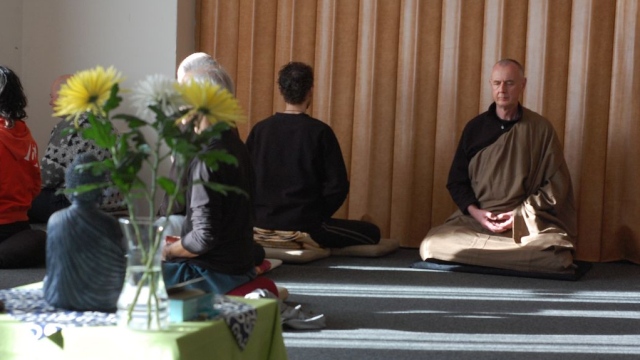
So when we make this room into a dojo, which is the style, we feel it's a kind of important place, or some kind of sacred place. But now we have moved the altar over there, and we're sitting in a different way, and it's just an ordinary room. So we should notice these facts. We shouldn't try to make Buddhist objects or Buddhist things, Buddhist ceremonies or parts of Buddhist tradition holy or sacred. And of course they're important, so we can feel that our rakusu is important, or that the things we use in Buddhism are important. The point is that everything has two sides. One side is important or sacred, and the other side is ordinary. Everything is both sacred and ordinary.
When we learn a ceremony in Buddhism, for example, some groups have a service after zazen and chant Hannya Shingyo and some other chants. And there it's important to sit properly and chant properly with other people, and to hit the mokugyo properly. If everybody cooperates, it's a very unifying activity. But you don't get some special merit from it. Or maybe you get some special merit from everything which is chanting or singing. Maybe the same merit comes from joining a choir. So joining a choir and singing the Matthew Passion has the same merit for a Buddhist as chanting Hannya Shingyo. So the reason we have ceremonies is that we teach ourselves to behave properly or nicely.
But if, when we leave the ceremony, we go home and lie on the floor and turn on the television, and our posture is very bad, and we watch a film for three hours until we're very tired and sleepy, then our nice behaviour before and our lazy behaviour after may cancel each other out. People who come to a Buddhist session, for instance, where we try to behave very correctly and very cooperatively, and then after the session behave in a different way, don't understand what Buddhism is about, because there are other ceremonies outside the sesshin which are more important than the ceremonies inside the sesshin.
For example, getting out of bed and turning on the tap and taking some water and washing your face and taking a towel and drying your face and taking some toothpaste and putting it on the brush and putting it in your mouth: it's a more important ceremony. And sitting down on a chair in front of a table with the meal, putting your meal on the table and then eating with a knife and fork. Not too slowly, not too quickly. And if possible, not reading a book at the same time. It's a kind of ceremony. However, we don't notice it. We don't notice its importance. And so we ignore the ceremonies in our lives. We say, I haven't got time for breakfast. I eat my lunch, I eat my dinner sitting in front of the television. And so on and so on, ad infinitum. And then when we go to the dojo, or we go to a sesshin, we behave very nicely. And then when we leave, we go back to our other habits.
Of course, it's not easy in daily life in society to find time to make our life a ceremony. But we need to realise that it's a very, very important thing. We can make ceremonies important in Buddhism when we're away from home, at the sesshin, because we don't have any pressure. But when we're at home and there's the pressure of work, oh, I have to be at work in ten minutes, it's very difficult. Or we have children and we can't find time to do things slowly. It's very difficult. However, the basis of Buddhism is to make our ordinary life into a ceremony. Not some kind of sacred ritual, but just to pay attention to the simple things that we do as the basis of our life. This is very important in modern life, because we give different values to different activities.
For instance, we say, Oh, my breakfast is not as important as a meeting with my boss. Or walking carefully down the street is not as important as getting where I'm going as quickly as possible. So living in modern society, we give everything a value: more important, less important. But those values are often false values. When I say false, I mean they don't help our lives in the end. If we don't live our lives regularly, then we will receive the result.
If we work very, very busily for 15 hours a day in front of a computer for four, five, six years, without giving any value to our posture, without giving any value to having a break, after five or six years we will receive a result. And society will receive a result. That result may be some physical illness, or there are many different kinds of results from our behaviour.
Ceremony in Buddhism is a kind of model for us to notice the ceremonies in our life. Being away from home at the session, we can do things a bit more slowly, a bit more carefully, and enjoy them. Simple things: cutting the leeks, or cutting the onion, or chopping the wood. Then when we return to our normal life, we can remember that the simple things in our normal life are valuable. And the values that we have to place on different things in our busy lives are sometimes false.
So it takes many years to change our lives. Little by little, we can rearrange our values. It's very difficult. It's a struggle to do it. Just practising zazen every morning is very difficult to fit into our schedule. So we make an effort today, stupidly, to value the simple things in our life. And then tomorrow we do the same thing. And then the next day, we forget and become very busy and unbalanced. And then the day after, we remember again. So going through life day after day, week after week, year after year, in this way, our life slowly changes. That's a Buddhist way. Slow revolution. I'll stop there. There are lots of things I haven't said, so we can talk now.
Participant: Rakusu and kesa for practice: what do the rakusu and kesa really represent, and how can one qualify for wearing a rakusu and kesa?
Mike: The rakusu was invented in Japan, or possibly China. It's a miniature travelling robe. But it's developed into a symbol of taking the Buddhist precepts. So when you make a rakusu, or sometimes receive a rakusu, and your teacher, who gives you the precepts, writes your Buddhist name and so on on the back, then you receive it at a ceremony, and that is a kind of formal entry into becoming a Buddhist. And then, of course, it becomes important.
So this rakusu is very important to me because it has very important things written on the back. Actually, it's not, because I bought it in a shop. No, it's not important for me. But I have another one, which I received from my teacher. But it's rather old and it's coming to pieces. So I bought this one to wear instead. But if I lose this one, it doesn't matter. So maybe it looks very important and very grand. Actually, to me, it doesn't matter. So each person has their own feeling about their rakusu. And of course, if you receive your rakusu from your teacher with your name written on the back, then it becomes valuable for you. But don't make it sacred. Doesn't make it holy.
Participant: Do you think that wearing rakusus can give people a false impression that there is a kind of hierarchy within?
Mike: Yes. The robe, for example, is more powerful than the rakusu. It's bigger. But the robe is the same: it's a symbol of something. But that symbol is created by us. So although my teacher used to drop his robe on the floor, his robe was still important to him when he wore it. But we shouldn't make the robe some kind of hierarchical symbol. Anybody can make a robe, even if they're not a Buddhist. So if somebody who has never practised zazen before comes with a robe, I don't mind if they wear it. Traditionally, first you receive a rakusu, and then afterwards you make a robe or buy a robe or receive a robe. Master Dogen said you can make a robe out of lots of different things: paper, or leather, or old material, and so on. And any colour is okay, but not a bright colour. And the colours don't have any meaning.
However, in Japan, they decided that black robes are for trainee monks and nuns. So if you wear a black robe in Japan, you're a trainee. And after you have finished your training, you can have a coloured robe. But this system is only some kind of Japanese invention. When I went to a sesshin with Philippe Coupey about six years ago (he is one of the teachers of AZI), people complained to him that I was wearing a green robe. So he said to me, Do you have a different colour robe you can wear? I couldn't understand why he wanted to change the colour of my robe.
But I suppose green has some special meaning. But I would like to say very strongly, if they think the colour of a robe has a special meaning, they don't understand anything about Buddhism.
Participant: I think I've got a question.
Mike: Why is the tradition important? Why don't people stop wearing them?
It's quite interesting how tradition develops and changes. I only follow what my teacher told me. I don't try to build up some kind of tradition which I didn't learn from him, by reading books or watching other people and putting it together. Because the meaning of tradition in Buddhism is what you learned from the person who taught you. He is quite a rough man. So he never taught us to chant Hannya Shingyo. And he used to drop his robe on the floor sometimes. But he encouraged us all to make robes and wear them. I didn't learn to chant Hannya Shingyo and have a ceremony with a mokugyo, so I don't do it. But if somebody wants to do it, I'm happy to do it.
So, for example, when we have a session with members of the Scottish group, which is Stuart's group, we all chant Hannya Shingyo. But I don't put it onto what I'm doing. So what I do has the strengths and weaknesses of my teacher. But it's only tradition. So tradition is what you learn from your teacher, not what you read in a book. That's not tradition. Tradition is something real that you really learn from a real person.
Actually, after I left Japan, one member of my teacher's group trained to be a nun. And when she came back to my teacher's group, she criticised him for not chanting Hannya Shingyo. But I never experienced it with him, so it's not my tradition. To me, it's not a question of learning something new to increase my knowledge of Buddhism. It's simply a question of doing what I was shown. But I don't refuse people who want to do something a little different.
Participant: Often people ask if they have to make a rakusu in order to take the precepts.
Mike: If you want to become a...
Participant: So I'm saying it's the other way round. The question is how to take the precepts...
Mike: If you want to become a Buddhist formally with a particular teacher, then you can ask the teacher to take the precepts. I don't know about other teachers, but if somebody asks me to do the precepts, I say yes. But in the simple ceremony, part of the ceremony is to give a rakusu. So if there's no rakusu, we can't do the ceremony. But if somebody wants to buy a rakusu, for example, I don't refuse. But I think making a rakusu yourself is nice, much nicer than people think.
Participant: This is just my opinion, but the nice thing about making a rakusu or a kesa is that you can't really make one with the end in mind, because it takes a lot and it's quite hard work. If you try and make a kashaya, a big robe, thinking about getting a robe at the end, you can't do it. So you just have to make one stitch at a time. A stitch. So it becomes a thing. It's not... well, it's a symbol of Buddhism. As a symbol of Buddhism, it's also a very real symbol of one simple action after another.
Mike: The symbol of your character. You meet yourself. Yes. In Buddhism, we're always meeting ourselves. Sometimes frightening, disappointing, happy, sad, worried. So don't try to meet another self. Just meet the self that you are.
Shall we chant Fueko?
[recitation, 00:56:07–00:57:04]