Morality as Balanced Action
Mike: right and wrong are part of what we do; he thinks balance is more practical than religious rules
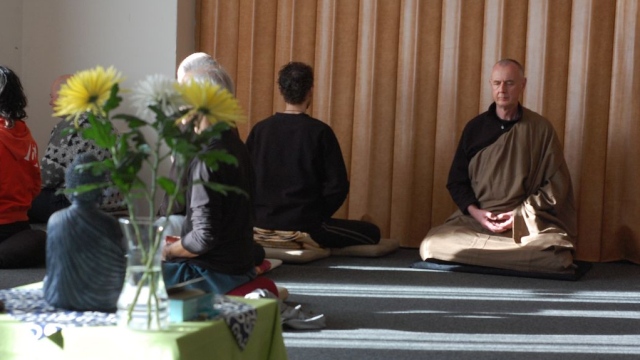
Michael Eido Luetchford
February 2009 — Cholín, Talk 4.
Venue: Cholín, Czech Republic.
Michael Eido Luetchford · February 2009 — Cholín, Talk 4
Source: audio transcript.
From the retreatPhotosRecordings5Chronicle
Audio
4Talk-Morality.mp3 in the Google Drive folder
What the talk says (short overview) — About these overviews
Mike contrasts Buddhist morality with the usual idea of morality as a set of rules given by a religion: in Buddhism, he says, right and wrong are part of what we do, and there is no concept of what is right waiting for us to do it, which is what Dogen writes in his teachings. So instead of thinking what is right and then trying to do it, Buddhism concentrates on being balanced when we act, and Mike thinks this is a more practical morality.
He admits that this sounds almost immoral, and that for most people in countries with a Christian history, where the moral code came from God and spiritual religions clearly separate and define right and wrong, it sounds like no morality. Yet in countries governed by such religions for hundreds of years, he observes, people can argue about right and wrong but cannot make their actions be right. For Mike, whether we actually do right or wrong is not a question of thinking but of our whole body-mind: when we are balanced, our action is the best it can be, and to make our state of body and mind the best we can, we practise zazen, though there are many other ways. Asked whether one can still judge decisions, since he had called the reasoning of the banks in the financial crisis immoral, he answers that it is not that there is no right and wrong, but that right and wrong are in what we do, and that judging something that has already happened is too late. We cannot stop judging, and he does not think that learning the lesson afterwards is a waste of time, but it does not work very well, as he knows because it does not work very well for him. To the question whether Buddhism believes that everyone is good at the core, he replies that right and wrong action exist in reality, but good and bad actually do not exist: only human beings, with their ability to think, separate reality into good and bad, right and wrong, while in our actual experience of living all these things are mixed up together. Being balanced, he adds, does not mean that everything will be perfect, because human beings can only do the best they can.
Of an approach that a participant has noticed in some Buddhist groups in the West, cultivating loving-kindness, he says that love and hate are two sides of the same thing, so cultivating loving-kindness seems to him to cultivate one side of reality and ignore the other, and he wonders whether it works. Analysing what we did and deciding not to do it next time works, he says, in the area of intellectual work, but if it really worked, we should have stopped making our big mistakes, and personally he had no success in changing himself by thinking about it. When a participant objects that society does not work, he replies that it does, and he says that analysing is not worthless at all, but that our state of body and mind while we analyse is important for a balanced analysis. Following Nagarjuna, he distinguishes social reality, samsara, where we cannot do without analysis and planning, for instance to open a bank account or to improve social systems, from ultimate reality, nirvana, which is just our action at this moment, and he says that just our action at this moment creates our future. At that level balanced action brings the best result, just as, while walking towards our aim, we should watch where we put our feet at every moment. Asked whether we should try to make the world better, he says no, nor even ourselves: in his view, if we give up trying to make ourselves better, we become a little better, because we let ourselves become naturally who we are. Since everything we do is always both for ourselves and for others, he says we need not worry about being selfish or altruistic, and from the life of his eldest sister, a missionary who loved other people but not herself, he learned that we should be a bit selfish and a bit selfless. Finally, he describes the sangha as people practising Buddhism together in a group, where just being together already means learning from each other, without any special effort to exchange experiences.
Complete English transcript — About transcripts
Editorial note: This transcript of a spoken talk has been lightly edited to read well as written text, keeping the speaker’s voice and meaning; the wording was adjusted with great care. We recommend listening to the original audio recording too.
What I said about the chants at mealtimes, the same is true of these chants. The first chant is Chinese. The second chant has got four lines of Japanese and three lines of Chinese.
Roman: That's where the rhythm changes. But it doesn't mean that it moves.
Mike: So let's recite the first Kaikyoge.
[recitation, 00:01:21–00:02:04]
This afternoon. But I'll start off talking about morality. People normally think of morality as a set of rules given by a religion, a set of rules that we should follow to make our behaviour good. But in Buddhism, morality is slightly different. First of all, I don't call Buddhism a religion, because we don't have a belief in God. We believe in this world. So the question then is, where does our moral code come from?
In Christianity, for example, the moral code came from God, written on pieces of stone. And in spiritual religions, ideas of right and wrong are very clearly separated and very clearly defined: this is right and this is wrong. But in Buddhism, we say that right and wrong are part of what we do. That means that there isn't a concept of what is right, an idea of what is right, waiting for us to do it. This is what Dogen writes in his teachings. And it sounds quite a terrible thing to say: there's no concept of right. But he doesn't mean there's no right, or no wrong. He means that right and wrong are not separate from our conduct. So what we do is right or wrong in the doing of it. So Buddhist morality is not separate from our behaviour.
This sounds almost immoral, but actually it's a nice way to live. Life is very complicated, and we need freedom to act. If we act right, if our behaviour is right, then the result is good. So in Buddhism we concentrate on our actual behaviour: not on thinking what is right and then doing it, but just on doing it.
But many people think that's impossible. If you don't think first of all, how can you do what is right? Or how can you stop doing what is wrong? Buddhism says that whether we actually do right or do wrong is not a question of thinking. It's a question of our whole body-mind, or our action itself. And when we are balanced, our action is the best it can be. And when we are unbalanced, our action may be wrong.
So in Buddhism we don't concentrate on thinking what is right and then trying to do it, or on thinking whether something is wrong and stopping doing it, but on being balanced when we act. That's a very strange idea. And for most people in the countries with a Christian history, it sounds like no morality. But actually, I think it's a more practical morality. For instance, in countries that have been governed by spiritual religions for hundreds of years, although those religions have very strict moral laws about right and wrong, and people can argue about and discuss right and wrong, they can't make their actions be right, and they can't make their actions not be wrong.
So in Buddhism we focus on the state of our body and mind, and then act freely. And to make our state of body and mind the best we can, we practise zazen. But there are many other ways to make our state of body and mind balanced. So when we are balanced, we can act without worrying about right or wrong. This is what Dogen taught. And it's very, very different from the concept of morality in normal society today.
But we have large problems with morality in modern society, because the power of religions is weaker. For instance, in the recent world financial crisis – based on what the others were doing: this bank is doing it this way, so it's okay for me to do the same. But that's immoral. So I think the question of morality has become quite important in society.
So that's all I'm going to say, and we can have a general discussion. But if you don't want to talk about morality, we can talk about something else.
Participant: Can one still make a judgement about a decision, like a bad decision having been made or a good decision? I mean, I'm a bit confused, because your last statement was about saying that the banks are immoral, but I understood that at the beginning what you said was that there isn't a right or wrong.
Mike: It's not that there isn't a right and wrong, but right and wrong are in what we do. I've forgotten what your question was. Is it right to moralise about the bank? We can't stop making judgements. We should notice that if we judge something that has already happened, it's too late. Because human beings can't stop judging things which have already finished, they say, we can do it, we can use it next time. Or they say, we can learn the lesson from this time. So we must discuss whether it was right or wrong after it has finished, and then next time we can prevent it. I don't think that's a waste of time, but it doesn't work very well. The reason I know that is because it doesn't work very well for me. But we can't stop.
Participant: I have also got a question; I will be able to express it. If you say that if one is balanced, they do the right things, I wonder: it would mean that people in their nature are right, or they are good, because if they are in a balanced state, they will do the right things. Does Buddhism believe in that, like, the basis that everyone is good? Because I'm not sure about that, that everyone is good from the core, but because many things in the world happen, they become, or they act, badly or something like that. Can you comment some more on this?
Mike: Well, the difficulty in your question is that right action and wrong action exist in reality, but good and bad actually don't exist. For instance, only human beings make judgements about good or bad. And the other problem is what I said about Buddhism: if we are balanced, then our behaviour is right. We think in our mind that this then means everything will be perfect and good, but it doesn't mean that. In reality, human beings can only do the best they can. In reality, there is no right separate from wrong. Right and wrong exist mixed up together. Good and bad exist together in everything.
Happiness and sadness are mixed up together in our lives, and so on. Only human beings, with our excellent ability to think, separate this reality into this is good, this is bad, this is right, this is wrong, this is happy, this is sad. But our actual experience of living has all those things mixed up together. Does that answer something?
Participant: I've noticed, Mike, a different approach in some Buddhist groups in the West currently. The approach seems to be that if you cultivate loving-kindness and compassion towards yourself and towards others, that will then translate into more moral behaviour.
Mike: Yes, I've heard that.
I think love and hate are two sides of the same thing. Love doesn't exist separate from hate, or like doesn't exist separate from dislike. If we love somebody very passionately, it can turn to hate very quickly, if we have an argument. So to cultivate loving-kindness seems to me to be cultivating one side of reality and ignoring the other side. So I wonder if what they say works.
I can't believe it works, but I've never tried it. I don't want to be a loving, kind person. I want to be me. Can I help you? This is what Christians... I went to a Christian church and Christian Sunday school, and it was the same: I'm your neighbour, I love you. And Christianity preached loving-kindness for many years. But if you look at the history of Christianity, it changed to the reverse: we want you to be loving and kind, and if you aren't loving and kind, we're going to kill you.
I didn't try it. Actually, I have tried something like what you're saying, really. I had a Buddhist teacher, and he was very loving and kind. So the whole group looked up to him as a role model of kindness and love, but it made me feel very bad myself, because I felt very inferior.
Roman: Yeah, it's true. So when I met Mike, I relaxed.
Mike: Because I'm an asshole sometimes.
Participant: Yeah, exactly.
Mike: Just sitting in front of an audience, I can hide my other side.
Question: Do you think we learn by experience, Mike?
Mike: I think we learn by experience through our body and mind. For instance, we learn to ride a bicycle by experience, and our body and mind remember. Or we learn some skill, a physical, mental skill, and it stays with us. But the idea of analysing what we did and then saying, ah yes, next time I'm not going to do it, works in the area of intellectual work.
But if it really worked, surely we should have stopped making the big mistakes which we make. We don't seem to. If you look at yourself and also look at society, it doesn't seem to be very successful. Although we want to change, and we can think how to change, we can't actually do it by thinking about it.
Of course, you can notice that something's wrong with the system, and then you can change something about the system and make it work better. But personally, I had no success with changing myself by thinking about it.
Participant: Do you think we're just avoiding unpleasant feelings, so we ignore, as you put it, the bad? Well, we avoid anything that's not pleasant, so that's why it's all so imbalanced. And society avoids unpleasantness, and so everything's got to be advertised as being good.
Mike: Yes, but it's kind of natural.
Participant: That's why it doesn't work. That's why society doesn't work, isn't it? Because it's—
Mike: Well, it does work.
Participant: It doesn't work. Banks, for example. It hasn't worked.
Mike: Can I say, I agree that analysing doesn't work sometimes, or often, but I don't agree that it never works. It often works: you can analyse and then decide that you will not do it next time, and often it works. It doesn't always work, this is true.
Yes, it's true.
Participant: Good. Then analysing is not worthless.
Mike: Not worthless at all, no. But our state of body and mind when we are analysing is important, to get a balanced analysis. So if we...
Participant: ...if we are hungry, for example, then the analysis might be diluted.
Mike: Yes. Or if we are very disappointed, and we are disappointed with ourselves, and we want to change something, we analyse it and say, next time I'm going to do this, but it may not be realistic.
So there seems to be a kind of conflict between what I say and what you say, or there seem to be two different levels, and it's true. And this is one of the difficult parts of the Buddhist view. Of course, our whole society is based on analysis and thinking, and if we don't think, we can't open a new bank account just by practising zazen. We can't decide the schedule for our future work just by practising balance. And we can't improve situations in society without thinking about the social systems and then creating them and changing them. So that's true, and we live in that world.
The Buddhist philosopher Nagarjuna called that world in which we live and think and plan and so on the world of social reality, or samsara. But he said there's another level, or... this is very difficult to talk about, because the words are misleading. But there's another aspect, because everything we do has a result. Every action we take at every moment has a result.
So while we're proceeding in social reality, analysing a situation or creating some situation and so on using our brain power, at every moment we're doing something. We might be sitting thinking and forgetting to eat, or working at the computer, making our plan and forgetting to rest.
So at that level, our balanced action is important, and our thinking is not important. So, these two aspects: one Nagarjuna calls the social reality, samsara, where we live and think and interact with each other. And the other is ultimate reality, or nirvana, which is just our action at this moment. And just our action at this moment creates our future, whether we're thinking and forgetting to eat, or working too hard, while we're making our plans. So at this ultimate reality level, our action, balanced action, will bring the best result.
So there are these two aspects to our life. While we're walking towards our aim, we should watch where we put our feet at every moment, because where we put our feet at every moment determines whether we get to our aim or not. Can you see that?
Participant: Yes. That means we should somehow try to be balanced, be practising zazen, and then another time analyse and think, and just together do work.
Mike: Yes, yes. So if we make efforts to balance our body and mind, then we can take part in the normal social world freely and do our best, make our best efforts to think and to correct our mistakes or whatever. Does that sound very complicated?
Question: Do you think we should try to make the world better?
Participant: I have a similar question. Because you mentioned in your comment of falling karma that there's something like: our good intentions lead to hell.
Mike: The way to hell... with good intentions.
Participant: I would like to ask if we can really do something on the way for other people. Is it possible to help this way?
Mike: Do something for other people?
Participant: Yeah, it's okay.
Mike: If we think about the situation, we say that I'm doing something for somebody else, or we're doing something for ourselves. But in reality, everything is both for ourselves and for somebody else at the same time. We can't separate them. So there are always both sides. Sometimes we only talk about one side, but both sides always exist.
So we don't need to worry about being selfish or altruistic, because we're always partly selfish in everything we do. So even if we are altruistic, we get some selfish benefit.
My eldest sister was a Christian missionary. And she loved to do things for other people. So she spent her whole life working in Thailand, doing things for other people, and other people thought she was wonderful. And when she came back from Thailand to England, she lost the ability to do things for other people, and she was faced with the fact that she didn't like herself. So in the end, she killed herself, because she loved other people, but she didn't love herself. She was selfless, and she wasn't selfish.
What I learned from that is we should be a bit selfish and a bit selfless. So she gave me a very clear lesson about Christian goodness. It was good for lots of people, but it wasn't good for her. I've forgotten your original point.
Participant: I think we should try to make the world better.
Mike: No, no. Nope. We should try to make ourselves better. But we shouldn't do that either. Who should we try to make better? Not the world, not ourselves. If we give up trying to be better, then the world becomes better.
If we give up trying to make ourselves better, magically, we become a little better, because we let ourselves become naturally who we are. And that's the best we can be. We all have our own characters, our own history, our own childhood background. So don't try to be worse, but don't try to be better. Just try to be normal. Don't hide the bad and promote the good, but just be normal.
Christianity tries to promote the good and eliminate the bad, to get rid of evil and fill the world with good. And then the people who believe things like that look around: where is the good? Where's the bad? It must be in you. So that separation has a very powerful and unhappy effect. Heaven and hell are here, unseparated.
So I think the Buddhist teaching of being normal or balanced is quite different from spiritual teachings. And Buddha's teachings of just doing the best you can, making your effort at the moment of the present, are very different from the spiritual religions' belief: to do the best, do good, and make ourselves better day by day to become closer to God.
Participant: About the function of sangha: I don't remember you ever talking about—
Mike: Sangha?
Participant: About sangha.
Mike: Yes.
Participant: I thought this might be like collecting experience in Buddhist life, so you can see what's happening in other lives and you can learn from it. But now I wonder: you said, or you are talking about, analysing one's own behaviour. So can you analyse behaviour this way, or on some level learn from it? Or maybe, generally, what then is the function of sangha, if this doesn't...
Mike: Sangha in Sanskrit means association or group.
Participant: Because what actually interests me is what the function of the sangha is. I assumed that the sangha would actually make it possible to collect experience somehow, for example also from the other members of the sangha, and so... Mike, but from the discussion, or from what he said here, it followed for me that actually it's quite hard to learn through some analysis, through some accumulating of experiences.
Mike: Yes. People who are practising Buddhism together in a group, we call sangha. Because we practise together in a group, it's impossible not to learn from each other. Being together itself means we learn from each other, whether we like it or not. But on top of that, we can discuss with each other and learn different ways of doing things. It's true. But the basic thing is, just being together itself, just practising together itself, already is learning from each other. So it's not necessary to make a special effort to exchange experiences. We can, but it's not something we have to do actively. It happens.
For instance, I don't ask lots of people questions about how they do things in our sangha, but I learn from everybody all the time. I notice your sincere behaviour and your very serious questions. So something comes from that: I learn something, I get something from that. Or sometimes if I feel irritated at something and I notice other people are very calm, then I learn something about myself and other people. So it happens by being together.
But sometimes we don't notice it, or we don't know about it. But still it happens. That's how I think about the sangha. You rang the bell, so we have to finish. So let's recite Fueko.
[recitation, 00:57:39–00:58:42]
When I'm talking, I look down here because I have to concentrate to explain what I want to say. But when I'm looking here, I keep thinking, oh, I want to look at people. But if I look at you, I can't remember what to say. Actually, it's all written here. Some things are very difficult to talk about, so I think we do very well to talk between two languages about quite difficult topics. And Roman is exhausted.