Sadness Is a Change in Balance
Mike explains that feelings are slight shifts in our sense of balance, so we need not get rid of unhappiness
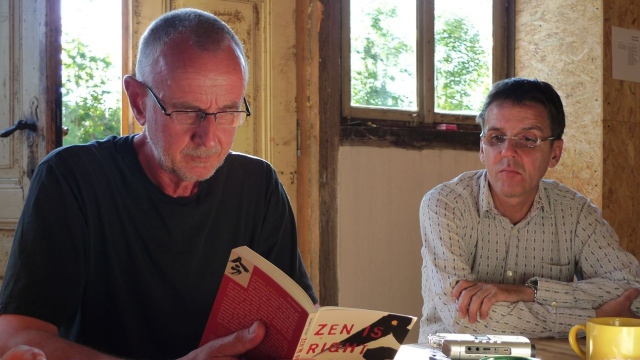
Michael Eido Luetchford
August 2011 — Dibbavana, Talk 1.
Venue: Dibbavana, Mariánské Lázně, Czech Republic.
Michael Eido Luetchford · August 2011 — Dibbavana, Talk 1
Source: audio transcript.
From the retreatPhotosRecordings5Chronicle
Audio
2011-09-Talk-1-Unhappiness.mp3 in the Google Drive folder
What the talk says (short overview) — About these overviews
Mike says that feelings such as sadness and happiness are not fixed things inside us but only a slight change in our sense of balance, so we do not need to get rid of something inside us called unhappiness. He takes this from a story told by Kodo Sawaki, who went down a coal mine in a lift and, while it moved at a constant speed, felt that it was standing still or even going up, although it was still going down.
Sawaki said that life is like that: we notice a slight change in the balance and think we are going up or down, and Mike concludes that feeling sad, happy, sleepy or awake is okay because it is the flow of our natural energy. If we just practise balance, which can be zazen, our flow of feeling goes back again, like a big tree that the wind blows one way and then the other. When we try to get rid of a strong emotion such as sexual desire, it gets stronger, just as a cork pushed under water pops out when the finger is taken away. Mike adds that every human characteristic has two opposite sides, so very strong people are also very fragile, and that trying to keep only the good and get rid of the bad is impossible, because good and bad are two sides of one thing. He calls it a paradox of zazen that because we give up everything in it, including trying to improve ourselves, zazen improves us, and he says that we can practise with our stupid thoughts coming and going, the same as everybody else.
In the discussion, Mike admits that he used Boris's kind remark about his sad face as an example and says that sometimes our feelings are private. To a participant who has to behave professionally at work even when sad, he says that sometimes we have to act, recalls an old Japanese man who taught him how to bow to people he did not like, and says that having a family teaches people this, a training he missed and now has to do himself. When Boris asks where the border of acceptance lies, Mike says that the conflict is the same whether we see it inside us or outside us, and that in Buddhism we make decisions with balanced intuition, prajñā, so the decision makes itself. Asked about depression, he says that zazen changes our mood if we can do it, but that it is very difficult then and that zazen is not a cure for everything: it gives us a balanced point of view, but we have to solve our problems ourselves. Recalling the Buddha's words "Be a light unto yourself", he says that there is no Buddhism to solve your life, only teachings that point out that if we balance ourselves we can avoid being extreme and be reasonably happy. He also says that he does not think he can find himself permanently, perhaps because he is changing all the time and some Buddhist teaching says there is no permanent self, that every action has a result for which we are responsible, and, when a participant says that we only have to breathe in and out, that we breathe out and the universe breathes into us.
Complete English transcript — About transcripts
Editorial note: This transcript of a spoken talk has been lightly edited to read well as written text, keeping the speaker’s voice and meaning; the wording was adjusted with great care. We recommend listening to the original audio recording too.
This morning, Boris said to me, Oh, something bad happened. You look... your face. Did you? So I guess my face looked like that this morning. So I said, no, not bad, sad. So feeling sad is okay. And feeling happy is okay. And feeling sleepy is okay. And feeling awake is okay. Feeling up, and feeling down, is okay. Because it's a flow of our natural energy.
Somebody mentioned Kodo Sawaki just now. He told a story about when he went to visit a coal mine and got in the elevator with the miners. The elevator went down for some time. He said in the beginning he could feel they were going down. But after a while, he felt they were going up. So he shone his light on the wall of the shaft, and he realised they were still going down, although he felt they were going up. So he said he realised that when we're moving at a constant speed, it feels like we're stationary. And so we can feel like we're going up when we're going down. Sometimes.
And he said, Life is like that. We notice a slight change in the balance in our life, and we think we're going up, or we think we're going down. But actually, it's only a slight difference in our energy. So he said that all feelings of happy, sad, good, bad are like this: just a slight difference in our sense of balance. So sad is okay because it's just a change in our sense of balance. Happy is okay. It's just a change in our sense of balance.
We often think emotions are fixed: this is happiness, this is unhappiness. So I want to get happiness inside me and get rid of unhappiness, put in happiness, and so on. But according to Kodo Sawaki, it's just a change in our flow. There's no such thing as sadness, like this cup. So if there's no such thing, we don't have to get rid of it. People often feel they have some kind of feeling they must get rid of because it's not good. But according to Kodo Sawaki, this is just change. We sense a change in the balance. So in his story, the lift is going down, and if it goes down faster, you feel you're going down. If it goes down at the same speed, you feel you're standing still. If it goes down slower, you feel you're going up.
Participant: And Einstein noticed the same thing afterwards. He called it relativity.
Mike: So the point is that we don't need to get rid of something inside us called unhappiness. We don't need to get rid of something inside us called suffering. If we just practise balance, which can be zazen, then our flow of feeling goes back again. Like a big tree in the wind: it blows this way, I'm unhappy; it blows that way, I'm happy; and so on. So if we feel, I'm unhappy, oh, I'm going to stop, then this makes the force. We can let ourselves be as we are.
A good example of a strong emotion that we try to stop may be sexual desire. In modern life, society encourages us to feel sexual desire, through advertising or some kind of wanting and so on. But if we try to get rid of it, it gets stronger. My teacher used to explain it like a piece of cork floating on some water. If you push the cork down under the water, which is like suppressing something, as long as you keep pushing down, it's okay. If you take off your finger, the cork pops out. So there are many simple examples like this.
Human characteristics are very many, and we prefer some characteristics to others. For instance, we may think it's good to be strong. We should be strong, quite strong; we wish to be stronger and not weak. But actually, strong is here and weak is here, one hand. You can't have one hand without strong on one side and weak on the other side. So very strong people have a very fragile nature too. If they're very, very, very strong, they are very, very, very fragile. So from the Buddhist point of view, instead of developing one side and ignoring the other... So you don't want to be strong anymore, you want to be weak, because I can't be strong anymore. And everybody knows this feeling.
All human characteristics have two opposite sides. But we stupid human beings only want one side without the other. But it's impossible. It's like, in Christianity, trying to make the whole world good and get rid of bad. It's crazy. It's impossible. Good and bad are two sides of one thing. So we have to have both. Please remember that.
If we don't push ourselves to be better, we become better. This is a paradox about zazen. In zazen, we give up everything. And because we give up everything, including trying to improve ourselves, this improves us. So zazen improves us because we accept both sides. For instance, if you try to get rid of thinking in zazen, it's impossible. But if you live with your stupid thoughts coming and going in zazen, you can practise, the same as everybody else, with the stupid thoughts. But if you intentionally try to get rid of your thinking and find some special peaceful state... That's it. So, does anybody have something to say, or a question, or a discussion?
Boris: I wanted to comment. When I said to you that you shouldn't be sad, I meant in this moment that you should leave it, that you should not fix on it.
Mike: I know. It's naughty of me to use your example, because I felt your kindness in your words this morning. But afterwards I'm thinking, oh, sad. Yeah.
Boris: Because I want to be more open, because I feel that you are sometimes closing yourself in yourself.
Mike: Yes.
Boris: Private.
Mike: Keep out.
Boris: And many people like you, and it's very good to be with you. And if you are closed inside yourself, then it's not so possible.
Mike: Do you want me to be open?
Boris: No, no, no. I like it when people are open.
Mike: Sometimes we can be open. Sometimes our feelings are private. That's being human.
Roman: What if we mention that our closing affects others, like your moment of sadness affected Boris a bit?
Mike: Yes.
Roman: What if we mention it?
Mike: I would say, if I'm a very nice, round human being, I'd say to Boris, Sorry, Boris, about my sad face. I just have some sadness inside, but it's going to be okay. But actually, I'm not so round like that. But your words solved my problem.
Participant: But we can't always be the way we are. Sometimes we are expected to be different. For example, at work, when I feel sad, it's probably expected that I behave more professionally. So how to act in this?
Mike: Yes, so sometimes we have to act. Hello, nice to see you. When I went to live in Japan, there was one old Japanese man who was looking after me. And he taught me that if you have to greet some important person but you don't like them, in Japan you have to bow like this. And when you do this, you go... Yeah. So this is his way. You know, sometimes at work you have to say, Oh, hi. Nice to see you. How are you? Good. I haven't seen you for ages. Yeah, you have to do it. It's business. Can you do it?
Participant: Sometimes. It's not a very nice feeling. Oh yeah.
Mike: Some people can do it very well. Some people are too honest, so their feelings show on their face immediately. So people are different. So if your feelings show on your face, don't be a salesman, for example.
Participant: Mike, but it often happens that, you know, I'm not in the mood to go to work, or I feel sad, or upset, but I have to go in and put on a sort of different face. But that face sort of changes me inside. In the beginning it's forced, but gradually you just take it naturally, and you cheer up, and by the end of the day it's over. I mean, by the end it has to melt much earlier, and it's going to melt much earlier.
Mike: Yeah, it's true.
Boris: In the Czech Republic, I don't know about Slovakia, but in the Czech Republic I can see that people do not force themselves very much to hide negative emotions or negative feelings, while in Britain, or especially the U.S., people feel they should not show any negative feelings. So my colleagues, when they don't like each other, hardly greet each other. The people who like each other start long conversations. So it's not much; they just don't try to pretend. In Britain, people are in general very nice to me, asking questions all the time. But I don't know if they like me.
Participant: I heard that in Germany, in business, they call the English and the American way lying, because they find it disingenuous, they find it dishonest. Yes, that's what I heard, because they have a very straightforward way of dealing with people.
Mike: But what Patricia says is very important, because many, many people have to get on with their life, and even if they feel sad or unhappy, they have to get on with their life. And if you have children, this is a very important point. So other people save us. And I think especially having a family teaches us that. But to be frank with you, I missed it, because I didn't bring up my daughter. My marriage broke up when she was three years old. So I didn't experience that training. My daughter couldn't train me. So I have to train myself.
Participant: But you also do it for your partner, not only for children: you try to change your mood so that you are not sending negative signals to your partner. It depends, of course, but...
Mike: Yes, it's true.
Participant: Or you try to suppress the negative feelings in order not to spoil the mood.
Mike: Yes. The point is, if we suppress negative feelings a lot and don't express them, it doesn't work. So yeah, I'm still training.
Boris: Because in some teachings in Buddhism there is great wisdom, importance given to acceptance. To accept without a border. You should accept everything and go through it. That brings you to be more open... because without acceptance there is always some fight inside. It's very, very difficult to do. Where is the border between all this here and something in myself that I don't want to lose? If I should lose everything inside me, the border... I have had a lot of experience with this border, and it doesn't work. Sadness, deepness in myself, there is no... it doesn't work. So we should hardly fight against anything in any way. But my experience is that I don't know where the border is, let's say, when it would already disturb my integrity, and at that moment I don't know whether to move the border further or to build a border. But when I built a border, I don't know whether that was any good either. Yes, the question for me every time is: where is the border between myself and acceptance?
Mike: Do you mean accepting in yourself or accepting outside?
Boris: Outside, accepting outside.
Mike: Yeah.
Boris: The world, people, relationships, work, everything, you know, like family. What to accept, what not to accept. Somebody says to you, I want to have children with you; you say yes. Somebody says to you, I don't want to have children with you; you say yes. If you give me all your money, you say yes.
Participant: Ah, that's not acceptance. No, no. If somebody says, I want to have children with you, and you don't want children, you accept your feeling. But what is also our point is that even things and people outside are somehow inside.
Mike: Yes.
Boris: What is more important, the feeling inside me or...?
Mike: It doesn't matter. They're both the same.
Participant: So you can choose which is more important.
Participant: The things that we feel, and sometimes some people are coming from outside. It's not always the same energy level. Sometimes it goes against.
Mike: Yes. So you must choose. But I mean, the conflict is inside us and outside us. So the conflict is the same, outside, inside. If there's no conflict, there's no problem. But when we have conflict, we see problems. So we think the conflict is outside, or the conflict is inside. Sometimes we think the conflict is outside. Or sometimes the opposite: something's wrong with me. But maybe both are the same problem. It's the same problem.
Boris: To accept yourself or to accept what is outside is the same. It depends on what you want, what you decide.
Participant: Yes. So it's up to you. You're right.
Boris: If I'm not wrong, I accept myself and I can refuse your recommendation.
Participant: If you want, yeah.
Mike: Well, this involves how we make decisions. In Buddhism it is said that we make decisions with balanced intuition, prajñā. So in our body and mind, something decides. Then we think about it. So the decision makes itself. But it's very complicated to talk about. I just want to point out that we don't need to try to change our emotions forcibly. For instance: I feel unhappy, I shouldn't be unhappy. Or: I feel annoyed, I shouldn't be annoyed. That's the starting point of the talk. But Patricia's way is nice. We can do something and change our...
Participant: There are times when something happens to us, and we tend to make a kind of programme: I will be sad, I will show myself to others. It's intentional; I decide to look sad or be sad. It's a sort of bad habit, playing. It doesn't seem like accepting, but more like, I don't want to get rid of this sadness, although I want to. As if you wanted to and at the same time didn't want to.
Mike: Yes. Everybody recognises that state, I guess.
Boris: And Mike, what about people in depression? You said that we are like a boat, and sometimes the wind blows this way and sometimes that way. And people in depression, for example, are like this for a long time. And they would like to get rid of it. So what is the...? Oh, they can go to a doctor and get...
Roman: The question was whether zazen helps... Zazen itself, because it helps to, let's say, go back somehow.
Mike: If you can do zazen when you're very depressed, it changes your mood, yes, but it's very, very difficult to do. If you're very depressed, it's very difficult to sit. So it's no use thinking zazen is a kind of cure for everything. I have this problem, I do zazen. Oh, I have a spot on my arm, I do zazen. Although ancient masters say that zazen can solve all our problems, it doesn't mean, you know, Oh, my motorcycle is broken,
Roman: in a way that you don't care anymore about the motorcycle.
Mike: Or even, you know, if your relationship has a problem, zazen helps, but it doesn't solve it. You have to solve it. All zazen does is give us a balanced point of view. And with a balanced point of view, we can do something. And our life moves forward. Who knows where. We think we are figuring out our life. Sometimes we think, what shall I do? I'm thinking about my life. While we're thinking about our life, our life is happening.
Boris: There are no words to think about life.
Mike: Yes. But the life we're thinking about is not the same as the life that is happening.
Boris: But thinking about life, about my life.
Mike: Yes. So, is it worth it?
Boris: I think it's worth it.
Participant: Ah, well, that's not worth it.
Boris: Not words.
Mike: Words. Not worth it. I think we need to think about our lives. Then we can find our own direction. We have a direction already, but then we think about it, and we go, ah, I see, I'm going this way. So zazen is nice to do in the morning and the evening. But if you do it all day, there's no time to live. Some people thought that if they practise, practise, practise, their life becomes better, better, better. So they're deluded. Don't be deluded. Because I'm already deluded, I need somebody to help me. So please don't be deluded.
Participant: How about a response to the previous question? We have some experiences, memories that are coming back. We want to change them, or...
Mike: Changing our habits.
Participant: Yeah, bad experiences are also coming back.
Mike: Yes.
Participant: What was the question? Well, this, about the experience that is coming back again and again from previous...
Mike: Well, as you say... I didn't understand. I understood what he said; I didn't hear the question. Maybe how to handle it. How to handle it? I don't know. How to cut it? I don't know. With me, sometimes I feel I want to be... I want to feel like this. I don't want to feel different. So a kind of stubborn feeling. So I find it very difficult to change myself then. So it happens many, many times, and then I can notice myself after many times. And maybe I can do something.
Participant: Sometimes I cry. Sometimes I run forty kilometres.
Mike: That's good.
Participant: Sometimes I cook.
Mike: Yes. I think I said in the retreat in Slovakia, don't think there is something called Buddhism to solve your life. There isn't. You have to solve your life. But the teachings of the people who followed the Buddha just point out some things we can use. And the most important thing they pointed out is that if we balance ourselves, we can avoid being extreme. Then we can be reasonably happy. So that's it. The Buddha said, Be a light unto yourself. Be a light to yourselves sounds very spiritual and profound. But it means solve your own problem. It's yours. And listen to wise words. And if they're not wise, don't listen to them.
Participant: I'm thinking, if we are stuck in some feelings, isn't it maybe useful to try to go back to the origin of it and find what caused it?
Mike: Yes.
Boris: To check if, at the moment, right now, it still remains. Is it still here, or am I stuck in some cycle? And this might help, Lucia thinks.
Mike: Is what still here?
Boris: The reason. To cut the knot.
Participant: Whether the reason is still there or it's just copying the reason of the past and the reason is no longer there.
Mike: Yes.
Boris: Is the problem still persisting right now, or only in the cycle?
Mike: Yes. So we can do that. Many people go to see a counsellor or therapist, and they look at the reason for their behaviour from the past, and they notice that although their behaviour is the same, the problem is not there. Just a trigger. Do you know trigger?
Participant: Mm-hmm.
Mike: Yes, that's the important part of therapeutic work.
Participant: Isn't it best to try first to learn who we really are and what we want, and then somehow to realise it? And through that understanding of ourselves, to learn, beyond conscious thinking, how to use prajñā, that instinctive wisdom, through practice, for example? That's how I understand it. Does it work like that?
Mike: Yes, I guess so. I haven't found myself recently. Sometimes I find myself, sometimes I lose myself. So I don't think I can find myself permanently.
Participant: Why not?
Mike: I haven't managed it yet. It's kind of...
Participant: A process. It's a process that is continuing.
Participant: This is the development.
Mike: Maybe, or maybe I'm changing all the time. In some Buddhist teachings they say there is no self, which means there's no permanent self. Everything's changing.
Participant: I think, you know, when we want to define ourselves as one fixed thing, then we are not open to different circumstances, and we get stuck at a certain point.
Mike: Yes, it's true.
Participant: On the other hand, Mike is unique. Only one. You are only one. Every river is unique.
Mike: Yeah, unique.
Participant: But we can't compare ourselves inside to some other selves.
Mike: No. It's true. Yes.
Participant: Now I'm self, now I'm self. It's very complicated.
Mike: Complicated, yes. True.
Boris: Because mostly we fix on something inside that we want to be, but actually we are unique. Unique all the time.
Mike: Yes.
Participant: Yeah. Doesn't that also bring us responsibility?
Mike: Responsibility? For...?
Participant: How we act, the way we put ourselves. Yeah, unique. Put ourselves.
Participant: Yeah, there are many, many such responsibilities, there are many responsibilities on ourselves. Is it, like, should it be, or is it responsible to try to know who we are?
Participant: For example, we cannot change jobs and companies every half year; I mean, it reflects on our life.
Mike: Yes, always. It's called karma. Every action has a result, and we have to accept the result. So if we accept the result of what we do, we are responsible for what we do.
Participant: But I think what you're saying about responsibility is something like: we have to do something.
Mike: But actually, we're responsible for everything we do. We can't escape.
Participant: The only thing we actually have to do is breathe in and breathe out.
Mike: Breathe out only.
Boris: And... it's all finished, no? Oh, great. Yeah.
Mike: No, the universe breathes into us.
Boris: That's right.
Mike: Yeah, we breathe out and the universe breathes into us. So we can do our half, and the universe does the other half.
Boris: But it's also a concept.
Mike: What? Concept?
Boris: Concept. Yes. Because we can say that the universe is also breathing out.
Mike: Breathing in. Yes.
Boris: Everything.
Mike: Yes. But it's time to stop now, so we can get to more serious things now.
Roman: Thank you very much.