The Truth as a Cup of Tea
Mike: the truth of Buddhism is being able to express your real self in real life; nobody can give it to you
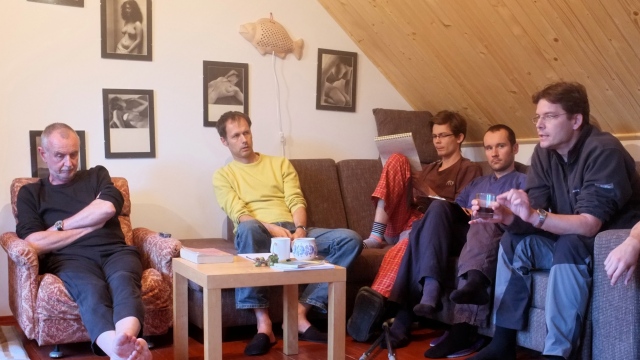
Michael Eido Luetchford
September 2013 — Banský Studenec, Talk 2.
Venue: Banský Studenec, Slovakia.
Michael Eido Luetchford · September 2013 — Banský Studenec, Talk 2
Source: audio transcript.
From the retreatPhotosRecordings5Chronicle
Audio
201309-talk2-Attaining-the-truth.mp3 in the Google Drive folder
What the talk says (short overview) — About these overviews
Answering Roman’s question about why the short koan exchanges that test the truth have disappeared, Mike explains that attaining the truth in Buddhism is not the special, spiritual thing it sounds like in English: the chapter title Dotoku means being able to express something, and in Chinese and Japanese Buddhist teaching the truth is not abstract but concrete and abstract combined, something real, like a cup of tea drunk in the present moment. In the end, he says, the truth of Buddhism is something very simple: to be able to express your real self in your real life, speaking from somewhere inside rather than from a clever brain.
For us in the West truth is usually spiritual, like the stars or peace, so a master who answers the question about the truth of Buddhism with “Have a cup of tea” seems to be contradicting himself or joking, yet he is pointing to a real act in the present moment. Mike traces this back to China, where an esoteric, very spiritual Buddhism, with the Buddha as a god living in Nirvana, was widespread, while the Chan practice that came with Bodhidharma was taught by very practical, pragmatic masters. Their koan exchanges, such as telling a student who asks about the truth to go and wash his bowl, tested whether the student was realistic, not how many books or sutras he had read. Mike sees the main teaching of Buddhism in not separating: the mental and the physical are the same thing, and our duty is to accept our goodness and our badness, our strengths and our weaknesses. People who preach strongly against wrongdoing while hiding their own bad side, like the American preacher and the English bishop in his examples, cannot keep it hidden, just as a cork pushed under water pops out again. So if a master asks you to say something about Buddhism, an honest “I’m really sorry, I don’t know anything” might earn you a “Well done”.
With the story of Mike Cross, who waited trembling for Nishijima to name him his successor and later blamed him for his own wrong zazen, Mike illustrates the spiritual attitude and advises us to try out for ourselves what such teachers tell us. When Roman suggests that sincere modern teachers observe their students for a long time instead, Mike answers that it is not like that: transmission of Dharma sounds too special; it is special, but it is not a way of evaluating people. He gives it to long-standing students who want it, guided, he guesses, by some feeling for the person, and he values it as an affirmation that helps when things get difficult. To have confidence in what you say is not to feel that you are right or to repeat your teacher, but to speak from yourself and accept that it is the best you can do, and Mike calls this kind of freedom something for everybody, not just for Buddhism. Nobody can give you the truth, he concludes, because you already have it; the truth does not belong to Buddhism or to any group, it is everywhere, even in the kitchen.
Complete English transcript — About transcripts
Editorial note: This transcript of a spoken talk has been lightly edited to read well as written text, keeping the speaker’s voice and meaning; the wording was adjusted with great care. We recommend listening to the original audio recording too.
Mike: A few weeks ago, Roman sent me an email with some questions about attaining the truth or realising the truth, and I answered him. He asked me if maybe we could have a talk about it. And Dogen wrote one chapter in Shobogenzo. So, would you like to explain something about your questions?
Roman: Yeah, I thought you said...
Mike: In Czech, because I know what you...
Roman: There is often the same pattern: a monk comes to the master and asks him what the truth is, and the master answers. And then there is also often the master asking the monk and testing him, like, what the truth is. And the monk again expresses it briefly somehow. And the master either approves it, or, like, no. It seemed to me that it is often there that when the monk expresses it correctly, the master says to him, So you have my Dharma, and I often misunderstood it as him passing on the transmission, that it was a transmission of the Dharma. And sometimes it is a transmission of the Dharma. Well, and I said, like, why these short exchanges and these short challenges and these short stories, like the ones we call koans, why did it, like, disappear from our Zen of the twentieth century in the line of Master Dogen? Because Sawaki never mentions that he would test somebody on what the truth is. Mike doesn't do it, Brad Warner doesn't do it, his teacher Nishijima Roshi didn't do it. So I asked Mike why it disappeared, these questions and answers, so that we would test ourselves, like, whether we can express the truth. Mike wrote to me, and he will probably say it in a moment, basically that it was a style in China, and that doesn't mean it must necessarily be, like, a general style for Buddhism.
Mike: Okay. So, the chapter in the Shobogenzo: the title is Dotoku. Dotoku is two characters, two Chinese characters. Do means to express or to say something. And toku means to be able to, to be able to do something. So dotoku means to be able to say something, or maybe to be able to express. But the character do in modern Japanese means way. So Dogen means the origin of the way. So dotoku means being able to express something. But over time it also came to mean being able to express the truth.
But the question is, what does this mean, the truth? And this is a big problem for us in Western society, because for us, truth is usually spiritual. If I say the truth is a cup, it doesn't make sense to us immediately. But if I say the truth is the stars, or the truth is the universe, or the truth is peace, we can imagine it. But the problem is that in Chinese and Japanese Buddhist teaching, truth is not abstract. It's concrete and abstract combined.
What is the truth of Buddhism? And the teacher says, Have a cup of tea. So in our minds this is a contradiction. It almost sounds like a joke. But it's not meant to be a joke. The way of thinking in China and in Japan in ancient times was not the same as our way of thinking. So if the master says, Have a cup of tea, he's saying that having a cup of tea is a real act in the present moment. Something real, not abstract. A concrete cup and concrete tea. And so we can drink the truth. Yes.
So the problem was that Buddhism came originally to China in maybe the second century. But it was a very esoteric practice, so they had many sacred customs. And if you look at statues of Buddhist deities from second- or third-century China, they look like gods. They have their fingers in special positions, embroidered things here, and beautiful clothes. So they are like some kind of abstract God. Buddhism, esoteric Buddhism, was already very, very widely spread in China. And there were many temples and many monks who were teaching this spiritual wisdom: if you chant the name of Buddha six thousand times, you will become enlightened. Or if you chant a special sutra with your hands in special positions, then you can go to Buddhist heaven. And the Buddha was a god in this teaching, and he lived in Nirvana. And Nirvana is a perfect blissful state, where we can all go if we're very good.
Oh wait, I heard this before, in Europe. Many spiritual religions have this theme. There is a perfect being who exists somewhere, and we want to be like that perfect being. But human beings are not perfect, so we need to make a great effort to become perfect like this being. Then we can go to heaven.
And this belief was also there when the Buddha was born. In Brahmanism, they had a god called Atman. And everybody had a small atman. So to make your atman the same as the big atman, you can go like this: a stairway to heaven. And this idea is in all spiritual religions. So in the second, third, fourth century, this kind of Buddhism was everywhere in China.
In the sixth century, history says, a monk came from India to China with a different kind of Buddhism. His name was Bodhidharma. And of course we don't know many details, but there are very old stories about him. And he brought the practice of dhyāna. And dhyāna, or in Pali jhāna, in Chinese became Zen. Sorry, Chan. In Chinese it became Chan, because Chan sounds like jhāna. So there were many legends about this monk who brought the practice of jhāna. They said he sat in front of the wall for nine years and his legs dropped off. Lots of stories, because we like to make people into gods. But from that time, a new kind of Buddhist practice, called Chan, came to China.
So even in the seventh, eighth, ninth, tenth centuries, even in the 13th century, there were two kinds of Buddhism: a very spiritual Buddhism, and this more practical Buddhism called Chan. And of course, over time, even the Buddhism called Chan became slightly different in different places. And by the time Dogen was born in the 13th century, there were five groups of Chan, five sects of Chan, all more or less the same, but a bit different. So all of them talked about the truth, attaining the truth, and attaining enlightenment, and reaching Nirvana, the perfect state.
So in the Chan school, the masters who were teaching there were very practical, pragmatic people. But the people they were teaching came from a culture that had a very spiritual kind of Buddhism. So there are many koan stories where a very spiritual student is thinking about enlightenment, a perfect state, and very complicated religious things. And he says to his teacher – it must be something very special – What is the truth of Buddhism? And the master sees a very spiritual effect in the student. So he says, Have you finished eating? Oh, yes. Then go and wash your bowl. So this is a teaching to be real, not to be spiritual.
And this way of testing whether the student is realistic or not became very common. So masters would want to make sure you're a realistic person. So not, How many books did you read? Or, Can you tell me the Maha Hannya Haramita Sutra without reading it? Or, How many hours did you spend reading the sutras? Or, Do you know the names of the ancient masters? So they wanted to cut through this very spiritual kind of atmosphere. So they would say something very practical: If you think you know what Buddhism is, say something to me. And then if the student said something like, Oh, all the many Buddhas in heaven are looking at us, the master hits him round the head and says, Oh, something like that. So in this atmosphere in China, the masters were very direct, and Chinese people are very direct. I can say, for instance, to you, Roman: You're writing a lot about Buddhism every week. Now tell me, what is Buddhism, without any words? So this is the kind of thing Master Dogen wrote about in the chapter, examples of this. It's a very short chapter.
So in Zen, or Chan, it's important to be real, not to be spiritual. Of course, we have the spiritual part. But the main teaching of Buddhism says that the mind, the mental or spiritual area, and the physical, material area, not that we have to make them the same, or that we need to find a link between the mental things and the physical things, but that it's the same thing. And that's very, very difficult for us to understand.
It was difficult in ancient China, when they had very spiritual ideas. And it's difficult in Europe, where we have very Christian ideas: good, heaven, God, right, somewhere here, and, you know, bad, evil, wrong. So, separation. But the aim of Buddhism is not to separate. So: to be right and wrong, to be good and bad. So our duty is to accept our goodness, and to accept our badness, to accept our strengths, and to accept our weaknesses. Without one half, we are not complete.
So we can be very good, and we are hiding the bad behind us. I always remember, maybe ten, twenty years ago in America, an American preacher, a Christian preacher, and he was teaching very enthusiastically: God made sex, sex outside marriage is wrong, it's a pure act between... and so on, blah blah blah. And then one day somebody found him in a motel meeting with a prostitute, which he did regularly. So that's okay. But he's hiding, hiding his badness.
We can find examples among politicians in England now. There's one politician... No, no, not a politician. He's a Roman Catholic bishop. And he was always speaking very, very strongly about homosexuality in the church: it is wrong, and Christianity says it's wrong. And then last year, three senior priests made an accusation against him of improper conduct with... So he had to leave. These kinds of people are hiding their bad part; they think it is good. But it doesn't hide. It's like a piece of cork in water: you can push it down under the water, but if you take your finger away, it pops out. Buddhism says we need both. So if somebody said something only spiritual, then the ancient Zen masters told them to wash the dishes, or hit them with a stick.
So these days the situation is a little better, because the Christian teaching is not so strong. Actually, I think in Eastern Europe you're very lucky, because maybe your parents remember the time before communism, but the socialist era didn't teach about Christianity. So I think you're more free than some places, for instance Italy or England, which are still quite deep. I don't know if it's true, but I feel you're more pragmatic.
So the aim of Buddhism is to be whole. To attain the truth is simply that. So if the master says to you, Tell me something about Buddhism, you could say, I'm really sorry, I don't know anything. And he might say, Well done. You can be my assistant.
Robert: Mike, Mike, you can be my assistant. You little assistant. Or we can tell you to wash the dishes.
Mike: Yeah, oh yes, yes, yes, yes. So we have to remember that... I don't know how it translates into Slovak, attaining the truth or realising the truth. But in English it sounds special, or something spiritual: getting something special.
Robert: In Slovak it also sounds like that, because the word truth on its own is very intellectual: spiritual truth.
Mike: Yeah, intellectual, yeah. But it's not the original word. Do is not spiritual, not only spiritual. That's a big difference. So we can read books which translated Dogen or other ancient masters, and we don't need to imagine some kind of... where there are very dynamic masters who are saying to their students, What is the truth? And then the student says, Oh, this is the truth. And the master says, Ah, yes, you attained the truth. You can be my disciple.
Actually, interestingly, these translations were done mainly by Nishijima Roshi, my teacher, and Chodo Cross, Mike Cross, an Englishman, and me and another man, four of us. But I wasn't doing the translating; I was doing the editing and publishing. Mike Cross came to Japan when he was very young, twenty-two. He discovered Nishijima Roshi, and he came to learn with him, and he was very, very enthusiastic. And he told me that in the talks he would sit like this. He was waiting for Nishijima to say to him, You! You are my successor. You know the truth. I choose you. And he said he was so excited that he was trembling for many weeks. And in zazen he used to sit like... A very, very strong young man. He couldn't cope with going to the talks every week and feeling so excited. So he stopped going. Yeah, Mike Cross. But nevertheless, he did translate.
Robert: And then afterwards they had some very strong disagreements.
Mike: Yes, they had a disagreement. The disagreement was because Mike Cross thought you must practise zazen like this, like a samurai, yeah. And after maybe five or six years like this, he started studying the Alexander technique. And the Alexander technique teaches you to use your body properly. So, you know, you have to stand up not like this.
Participant: But like this.
Mike: You know, use your body, not to be tense. So Mike Cross realised that his zazen had been wrong for so many years, so he blamed Nishijima. He said to Nishijima, You told me to do it like that. It shouldn't be like that. And he also said, And all your students are doing it like that. So you spoiled it all. Only I know how to do it.
Participant: What happened with him?
Mike: Afterwards, after he translated into English, he lives in England.
Participant: After... Doesn't he teach?
Mike: He teaches the Alexander technique, and also something very nice: young children who have some problems with keeping still and being quiet, it teaches them how to become balanced.
Anyway, that's an example of a spiritual attitude. If you meet a teacher who has this spiritual attitude and says things to you that sound... You have to try them yourself and find out if they're true. Because there are lots of teachers teaching lots of strange ideas, just like in ancient China.
Roman: But you wrote to me, you wrote something very interesting and important. When I was reading the Shinji Shobogenzo, it seemed like a monk comes and he can express the truth, and the master says, You have my Dharma, or something like this. And sometimes it seemed like, I'm giving you my Dharma transmission, based on one poem or on banging the floor once, or something. It seemed like a one-time exchange. Somebody comes, says something, does something, and the master says, That's it, I confirm. And so I thought this was so quick and always based on testing, checking, you know, in one single situation. And I asked you, Why was it so quick? And now it's not like that at all. And you explained that it wasn't based on one single exchange. Probably the teacher had spent even months or years with the student and confirmed, or, if they gave Dharma transmission, it wasn't based on one poem or one action, but on getting to know the student well, evaluating his sense of reality. In modern Buddhism, sincere teachers get to know students and just see how they really live, not just how they can answer questions, what they do in their lives. And you don't check the students, like, how can you express this, or express the truth, but you just observe everyone and you notice when they are real and when they are not. Is that so?
Mike: I don't... It's not that, it's not like that. Transmission of Dharma sounds like... too special. It is special, but not like that. And it's not evaluating people. So I gave transmission of Dharma to some members of Dogen Sangha this year, including Pavel. They've been practising with me for ten years. And some of them, two of them who are running groups, Dan and Ralph. Three, and Paul Cromie. And they said to me, Can we have some certificate to be a teacher? So I said, Oh yes. But I can't give it to you without other people. So I wrote to other people and said, Would you like to have a ceremony? And with the people I wrote to, I didn't think, Ah, do they know Buddhism? Or, you know, will they make a good teacher? But at the same time, I guess I have some feeling for the person. And that's enough. So then I asked them, and some people said yes. So I did it. And anybody who wants a transmission of Dharma, and who is studying with me, so that I feel I know them, after some years, if they want to, they can do the ceremony.
So it's not... In Japan it's just a ceremony to become the master of a temple. But Dogen said it was very special, because he felt some line of special teaching, pure teaching, different from all the other teaching he heard in his life. So he revered it. And I agree with that. At the same time, it's not special in the special sense. And if somebody's running a group, and they're happy running a group, it's fine. But sometimes it's nice to have some kind of affirmation. So then, when things get difficult, you can think, Ah, it's all right. My teacher affirmed me. I should be okay.
In my case, I had lots of arguments with my teacher. His name is Stupid Way, Gudo. And my name, the name he gave me, is Excellent Way. So I have an excellent name from a stupid teacher. Is that excellent, or is it stupid? Or excellently stupid. But even so, even though I had very strong disagreements, still, sometimes I think, Oh, so he said I was okay.
Participant: Sometimes it seems it should be this kind of joke inside that comes over this border, like these names of your master, so that immediately there is no logic inside, and all these rules are gone afterwards, if you understand.
Mike: Yeah, yeah.
Participant: You can't hold on to anything special. You can't hold on to anything special.
Mike: No.
Participant: You know, it's
Mike: No, you can't.
Participant: this situation of the names of your master and you. So...
Mike: No. I think it's very amusing. I like it. I'm very happy. No.
But we have to remember that Buddhist truth, the truth of Buddhism, is something very simple. It's to be able to express your real self in your real life. Not speaking from your very clever brain, but speaking from somewhere inside, and saying what you want to say, and having the confidence to say it. So to have the confidence to say it is not to feel, I am right, or, My teacher said it, so I say it, but to speak from ourselves, and then to say, It's the best I can do, so it's okay. This is not just for Buddhism. This is for everybody. To be able to say or express ourselves fully and wholly: this kind of freedom. Yes, of course, sometimes we make mistakes. But it doesn't matter. Everybody has a different character. Sometimes I lose my temper. So. Right, I've stopped talking.
Robert: If you have enough minutes...
Mike: I don't have any more to say.
Robert: But we paid for sixty minutes.
Mike: Okay.
Pavel: So we mentioned something also about Buddhist names. How do the masters choose the names of the younger disciples? How is it?
Mike: How they choose the name? I can only tell you how I choose a name. First, I always put do in the name. Do means way or truth. So Dogen: do is way and gen is origin. So, origin of the way. And my teacher always put the way, do, in everybody's name. So I like to do the same. I think about... I don't think about the person. I reflect on the person, a mirror: very careful, very sincere, makes a lot of effort. What character can I choose? Maybe honest way, sincere way? Or I look for a character. And then I wait for a few days, and then I decide. And then the second part of the name: I choose some characters that sound like the person's name, because this is what my teacher did. So I looked in a big Japanese dictionary. So, for instance, Pavel's name is...
Robert: And how do we call him? Pavel Menon? Pavel Menon?
Mike: You can't say Pavel in Japanese.
Robert: In Japanese?
Mike: So, haberu. Haberu sounds a little bit... Haber. Haber.
(laughter)
Mike: So, anyway. And my name is Ratchi, because in Japanese it sounds like Ratchifodo. My name, Luetchford, in Japanese is Ratchifodo. Ratchi sounds like my name. So he gave me ra, which means taming, like taming a wild animal, and chi, which means mind. So, taming the mind. So this is what I did: my mind, sit down. So people who take the precepts have a name. And some of you have names from Kaisen. So those names have meaning. Well, maybe the system for choosing a name is a little different. Well, Deshimaru gave names to his students. But nobody can give you the truth, because you already have it underneath.
So I like to say that truth doesn't belong to Buddhism. So I think groups that say they have something special called truth, it's not true. But it's everywhere. It's in the kitchen.
Robert: Yeah, cooking.
Mike: Nice truth, you can smell it. Yeah, nice truth. So, should we stop now?
Robert: Yes, yes. No, three minutes left.
Participant: I don't think we have to. It's tomorrow.
Mike: Oh.
Robert: That doesn't really... Okay, we will give it to you for free.
Mike: I could sing a song.
Participant: No, no.
Robert: Maybe a sutra.
Mike: Yeah, yeah. The truth is everywhere, you can find it in your hair.
Participant: Okay, two minutes left.
Mike: It's good enough to eat, you find it in your feet.
Participant: You like that song?
Mike: Yes. Yes, no, we will chant this song at every session.