Three Teachings from Japan
Mike: reality is only here and now, actions have effects without moral judgement, prajñā precedes thinking
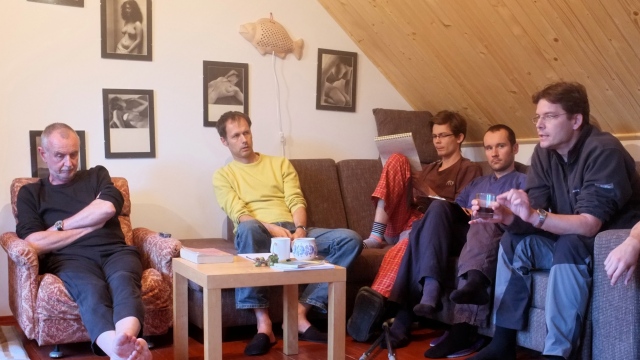
Michael Eido Luetchford
September 2013 — Banský Studenec, Talk 1.
Venue: Banský Studenec, Slovakia.
Michael Eido Luetchford · September 2013 — Banský Studenec, Talk 1
Source: audio transcript.
From the retreatPhotosRecordings5Chronicle
Audio
201309-talk1-What-I-learn-in-Japan.mp3 in the Google Drive folder
What the talk says (short overview) — About these overviews
Mike describes three Buddhist teachings he learned in Japan that slowly changed the way he lives: reality is only here and now, everything we do has an effect without any moral judgement, and before we start thinking there is something important, which Buddhism calls prajñā. He did not decide to live this way; it happened, and he finds it a nice way to live and recommends it to everybody.
He first notes that in Japan zazen belongs to temples and formal ceremony, that most Japanese people dislike it because they had to sit at school, and that temple habits such as eating with three bowls probably did not exist in India and cannot be called original Buddhism, but make life easier on a retreat when everyone shares them. The past is a kind of memory and the future a kind of idea, yet it is very difficult to live only in the present, especially now that technology lets our mind be somewhere else. In Europe, he says, we live in a virtual world of ideas and beliefs, while in Japan, China and other Eastern nations people, though not completely, see what is going on here as more important than what is going on in their heads. Deep inside him he had carried a Christian idea that doing bad makes you sinful and God punishes you, whereas the Buddhist teaching says that whatever you do will always have an effect, without exception, but there is no moral judgement, just simple fact. He found this comforting and liberating, because in Japan the criterion is not good and bad but whether you disturb yourself and other people. Prajñā, he explains, means before knowledge or before thinking, and many lifestyles in the West know this, yet in the West thinking before acting has become much more important than acting before thinking. If we are brought up to think about everything before we act, we are imprisoned by our brain; we need to think to live in society, but he can act without thinking too much about something.
In the discussion Mike says that we all have this as babies and little children, but school and socialisation cover it up, so as adults we lose touch with the child inside us. He compares Dogen's dropping off body and mind to taking off our ambition, pride and masks during zazen and putting them back on, so that we get to know them very well. When participants argue that school is inevitable, he answers that he is not judging, only stating a fact, and that in zazen we can return to our natural state, not a special state but a simple one. Disturbances in life, especially in childhood, can make us lose this balance, but as adults we can understand our situation and re-establish it, and Dogen says that besides zazen there are many other practices of balance. Asked whether a world with more balanced people would be better, he says he does not know, while participants suggest that people who are present make others more present, and Mike points to the power of a baby in the room.
Complete English transcript — About transcripts
Editorial note: This transcript of a spoken talk has been lightly edited to read well as written text, keeping the speaker’s voice and meaning; the wording was adjusted with great care. We recommend listening to the original audio recording too.
I've just got this new poetry. If you want one, you can pay me. So, we have a talk. I gave a talk in Banská Štiavnica on Tuesday night. Is it Wednesday?
Robert: Yes.
Mike: Okay. Well, because it's gone. And people came from the town, I guess. And I wanted to explain to them important teachings that I learned in Japan. But actually, it's impossible to tell people about important teachings in one hour, so there are many things I didn't talk about. But I'd just like to give you an outline of what I said was important for me. Of course, when I was in Japan, we practised zazen in the Japanese way: quite formal, and lots of bowing.
We practised in the Japanese-style dojo, which you can find only in a temple. You can't usually find dojos in other places. For instance, you can't find a mountain cottage with a dojo, because traditionally Japanese people think zazen is Buddhist religion. And most Japanese people don't like to do zazen, because when they were at school, they had to do zazen.
And they were told they had to sit in the posture and not to move, and they didn't have any choice. So they remember it from when they were schoolchildren: an unpleasant and painful experience.
So if you say to a Japanese person that you practise zazen, they usually say, ‘Oh.’ Can you translate that?
Robert: They will think that you are crazy.
Mike: Yeah, yeah. But at the same time, Buddhist tradition is deep in Japanese society. So even if they don't do zazen, Japanese society is based on some Buddhist beliefs. But I learned Buddhist habits because I lived there for so many years, and because I practised often in the temple. I learned to eat in the temple tradition, with three bowls and chanting, that kind of tradition. And for me, it became a kind of habit.
But actually, I guess they didn't eat like that in India, so we can't say it's part of original Buddhism. Of course, it's become part of Buddhism if you practise Zen, but that's all. So as long as we have some habit, some tradition, some custom which we have in common, it makes life easier on the retreat. So it doesn't matter if we do it as you used to do in the Kaisen group, or by the method that we used to do in the Dogen Sangha group. But if we agree and everybody knows, then we can do it easily.
But I changed from my original talk, to tell you about the important things I learned in Japan. One important thing I learned in Japan, which I didn't talk about on Wednesday, is that it's okay to do things in a group. Some people feel, if everybody's doing the same thing, I don't like to do it. And that attitude is also very important. Yeah, but when we're on retreat, to do things in the common way makes life very simple, something very simple.
The most important thing I learned in Japan was from a Buddhist teaching which says reality is only here and now. So the past is a kind of memory.
And the future is a kind of idea, and the only reality is the present. And that sounds very nice, but in fact it's very difficult to live only in the present. So I talked about living in the present, or being here, especially in modern times. Often we're in this place, but our mind is in another place. And this has become more and more common because of technology. For me to stand in the field out here and to talk with my partner, who is in England, is very weird.
Of course, we take it for granted, but it's actually very weird. And we're talking to her. That's strange. So this kind of virtual world has become part of our lives. So it's real. But at the same time, it takes us away from the present, so in that sense it disturbs us.
So anybody who works on the computer knows that you can be very disturbed by the virtual world, by living in the virtual world of the internet. So in Europe we live in a virtual world of ideas and beliefs.
But in Japan and China and the Eastern nations, they live more in the present. Of course, not completely, but they see what is going on here as more important than what is going on in their head. And I noticed that big difference, and it helped me a lot. Then the second important thing I learned from the teaching in Japan was the Buddhist idea of cause and effect. Of course, I already knew cause and effect in a different way, because science is based on cause and effect.
But the kind of idea which I had deep inside me was a kind of Christian idea: if you do bad, you will be sinful, and God will punish you. Of course, it's not conscious, but it's very deep inside me. So if I do sinful things, there will be a bad result. If I do good things, there will be a good result.
In my experience in Europe, there's, deep inside me and maybe other people, an idea of good and bad, and right and wrong: our behaviour must be good, our behaviour mustn't be bad. But when I went to Japan, I found there was no such belief. Their belief comes from the Buddhist explanation about cause and effect.
In Buddhism, the teaching is: whatever you do, which is the cause, there will always be an effect, without any exception. But there's no moral judgement, just simple fact. If you do something right, then the effect may be good. And if you do something wrong, the effect may be bad. But in Buddhism, there is a whole different explanation of what is good and what is bad.
Of course, people have the same moral code in society. For instance, you mustn't kill somebody, and if you help somebody, that's good. But they don't have a judgement that good is like God and bad is evil. Just simple belief.
Pavel: It's a simple matter.
Mike: When you do something right, the result is right. When you do something wrong, the result is wrong. There is no judgement, because you receive the result of your own action, always. I found that very comforting. So, for instance, I grew up in England in the 1950s, and in 1950s England, the attitude to sex was very old-fashioned. So it's not so good.
‘I think it's wrong if you're not married,’ or many kinds of things like that. But I found in Japan they don't have any feeling like that. They say, oh, sex is good, but if you don't behave properly, you will disturb yourself and other people. So their criterion is not good and bad, but whether it disturbs other people or not. And I found that very liberating.
Then the third thing which I said was important is what in Buddhism they call prajñā. Prajñā is a Sanskrit word in Buddhism, and some people translate it to mean wise. And this morning we chanted the Prajñā Paramita, the Heart Sutra. So the word is everywhere in ancient Buddhism. And I explain to people that in prajñā, pra means the same as, for you, pred, and jñā is the same as gnosis in Greek. So: before knowledge, or before thinking. So I found a teaching which said that before we start thinking about something, there is something important.
And there are many lifestyles in the West which know this and which encourage this: to do something before you think about it. But generally, we are taught to think about things and plan and then to do. Of course, both of these are important. But in the West, thinking about things before we do them became much, much more important, and doing something before we think about it has become very much less important. So that was very important for me to understand: I don't have to think to live.
I'm living, even if I'm not thinking about it. So life is different from thinking. Well, that was great for me to hear. Of course, you can't live without thinking; society doesn't work without thinking. But if we're taught and brought up so that we have to think about everything before we act, we are imprisoned by our brain. So that's the other thing which was important for me. So using those three things, three understandings, three teachings, I slowly changed the way I live. I don't have to think about my life. Of course, I need to think to live in society, but I can act without thinking too much about something.
I can trust prajñā. Even though I don't know what it is, I can trust it. And I can concentrate on the present, and not remember too much the past, and not worry too much about the future. But everything I do has an effect, so my conduct is very important. So I started to live like that, slowly. But I didn't decide to live like that; it happened. And it's rather a nice way to live.
So I recommend it to everybody. That's it. There are many difficulties with giving a talk about these subjects, because people want to know, well, what is prajñā? And then they think, oh, how can I live in the present? I have to make a telephone call about tomorrow. And they start thinking about what I said, and in the end they think, ah no, it's not possible.
But in our head, we can think something's not possible, but in our real life, we can do it. And maybe our lives are living us more than we are living our lives. Or we always think, I'm living my life, so next year I will do this, and last year I did this, and we think, I'm in control of my life. But meanwhile, while we're thinking like this, our life is living us, different to your idea.
So we can notice our real life. And sometimes we can notice where we're going, and it's not always where we think. So if you want to discuss, please do.
Boris: One important thing that you said to me yesterday: that you can't eat prajñā.
Mike: You can't eat prajñā. No, it's true, I forgot. You can't eat prajñā.
Boris: Because I forgot to make a meal. If you stay in prajñā, then you can forget to make a meal.
Mike: I see. No, prajñā is a word. But what I'm talking about is something we all have. When we're little children, we have it, and when we're babies, we have it. And then the adults notice it, so they put us in school. And they say, okay, we cover it up: you have to do what I say, and I tell you about the world, how it works. So please sit still and listen.
But children have prajñā easily, but our socialisation covers it up. So we can uncover it. And Dogen, the 13th-century monk whose teachings I'm studying, said that practising zazen is dropping things off.
Or taking things off, like taking off your clothes. And after you've taken off all these beautiful clothes, you are naked. That's a human being. Please don't do it now. I'll be happier, yes, later. So, of course, Dogen didn't say take off your clothes.
He said dropping off body and mind. But he means to drop off all the things which we put on top of ourselves: our strong ambition, our pride, some kind of mask we use, everything like this, which we think we need in society. And Dogen says, take them all off during zazen. And then you can put them back on again if you want. But if you take them off and then put them on again, you notice what they are.
So he talks about zazen as knowing ourselves. So we're practising zazen and taking off all our masks, and then putting them back, and we get to know them very well.
Pavel: Thanks.
Robert: But I think this idea of the kids having this special state, or that they have this thing naturally, is a nice idea, but they don't have other important things they need, so school is inevitable.
Pavel: Oh yes, inevitable.
Robert: We can't yet download some software into our minds.
Pavel: Ah, not yet.
Robert: So school is inevitable. So it's okay, maybe the kids have it, but they need school to teach children, and it all makes sense, so they get other important things at school.
Mike: Yes, they have it, yes. But is that—
Boris: Well, they should abolish it. If you take Aboriginal people, they don't need to do it at school. They just live.
Pavel: Okay, but we don't want to live like Aboriginal people, because we don't go to the toilet. We use the water toilet, and we use the heating, and we use everything, cooked meals and so on. Most of us don't want to live like Aboriginal people. We are not very happy with that.
Boris: It's not fair. They are happier than most of the European people.
Mike: I don't know.
Boris: It's important to choose a way of education which will not totally disturb and kill your natural state.
Mike: I don't mean we shouldn't send children to school. All I'm saying is that when we were sent to school, they covered up something important, which we still have. That's all. So I'm not making a judgement, just stating a fact. So there are some schools which try not to do that. I think Gabika teaches at a Steiner school.
Participant: I don't think that it is the best either.
Mike: No, not the best either.
Participant: I don't know.
Mike: There have been many experiments to find how to make our children suitable for society. That's very important. But what we tend to do in the West is we teach our children that life is in our mind, or life is knowledge, or life is thinking.
Of course, it's true, half true, but we don't often teach them that life is something else. Of course, in some subjects we do. So as a result, as adults, we lose touch with our child, the child inside us.
Robert: You mean with the state which we were in as kids?
Mike: With our natural state. So when we practise zazen, we can return to our natural state: not a special state, a simple state.
Boris: Most people make a direction to the society or whatever, to school, because of fear, which they actually have in themselves. You have fear, and then you want some stability, some certainty. And then you're thinking about stability, you are looking for stability, you are looking for knowledge, for partnership. But it is still inside you, without fear, if you want to see it. And then it's okay. In reality, that certainty, that stability, is in the person himself; it is what Mike says, that we don't have to go anywhere, it's always here. So many times we are afraid that we don't have something, or that something will escape us, or that we will lose something.
Participant: And what if you don't have this inner stability inside yourself, and you are suddenly lost in some situation?
Mike: Yes. If you have some disturbance in your life, you can lose it. And many children have disturbed lives, so they lose their natural state. So then, as adults, we can look at what a natural state is. And Buddhist teachings suggest that it's a kind of balance, so not extremes. But of course, children seem to be extreme: they cry very loudly; I mean, laugh. But I don't mean that kind of extreme.
So if we had a disturbing childhood, or when we were younger, we can re-establish our balance. And of course, it's hard work, because, for instance, if we had ten or fifteen years where our life was disturbed, it becomes normal. So sometimes children who had a very difficult life don't realise that their life was difficult.
They think that life is like this. But as adults, we can understand a situation more clearly and try to re-establish some balance in our life. Dogen says that zazen is the practice of balance, but he says there are many other practices of balance. So we can find many ways to re-establish balance in our life. It takes a long time, but we can do it.
Participant: The young are already more focused on the present moment.
Mike: Yes, they are.
Participant: Because my immediate perception when I came back to Europe was: oh, where are all the colours? All the people looked grey, in the tunnel, focused on what will happen next, next, next, next. I wanted to talk to somebody like I talked in India or Indonesia, just immediately, with immediate contact, and it was impossible to get such a feeling. It will just disappear; they disappeared in their, let's say, mind or mind programme. For me, the experience in Asia that Mike spoke about at the beginning was the concrete experience of India and Indonesia, where I spent a month, or rather three weeks. When I came back to Europe, it was not possible for me to talk directly with people: I had the feeling that I was talking with programmes that those people had created in their heads, this will happen now, then that, then that, and I had no possibility of having a normal conversation in the present moment.
Mike: Of course, it's the cause, it's the reason for our excellent civilisation. So without this intellectual attitude, we can't have modern civilisation. So we can't text our friend: Hello, I'm coming, I'm nearly here, where are you? We can't do these important things if we don't have such an excellent civilisation.
We can't like Facebook pages. Yeah, so that… It has many benefits. So again, it's balance. Of course, Miro says that Eastern civilisations are different, but it doesn't mean they're better. But maybe they have some things we can learn, and we have some things they can learn. So we can see some kind of balance in the world.
Boris: If more people in the world are balanced, do you think the world will be better?
Pavel: I don't know.
Mike: I don't know. My teacher, Nishijima, said that when Buddhism spreads through the whole world, the whole world will become Buddhist.
Boris: Buddhism would do something to me. Buddhism's pointing to the main thing is… Buddhism's…
Mike: I suppose that's right. Yeah, but he's an old Japanese monk. His vision was that everybody in the world is practising zazen.
Boris: I think that, you know, sorry, Miro pointed to this kind of experience we have every day. Maybe we have it with many people: they are not in the moment, you can't contact them, you can't really talk. And if many people are there in the moment, it's easier to understand.
Mike: It is, yes.
Boris: Well, no? To me, it's more interesting.
Pavel: True. Yes, I guess it becomes better, yeah.
Robert: But I don't think that zazen will spread, because in the whole of the two republics we are thirty-two people, so…
Pavel: You have to make a bigger dojo.
Boris: And you'll see, you influence, no, you influence your partner; you go home and you influence. You influence without anything, without talking. I think we should always see that if we are balanced in some situation, we don't need to talk or to give some explanation. It's there, I think; it's a little bit influencing the whole situation.
Pavel: That's my experience.
Participant: If you are present, people tend to be more present.
Mike: Yes. Is there a baby in the room? Babies are always present. So everybody is looking at the baby. It's incredible power, amazing power, just because the baby is present.
Robert: Well, I think it's our genetic programming that a baby is very, very important for us, and it's in our hardware.
Boris: There are many explanations. You can go to the spider theory: whether the spider first feels how to make the net, or it makes it and then… Or the dog outside: whoever is playing with the dog is happy and in the moment, playing with the dog. Nothing to build up, no, what kind of person am I? What is that?
Mike: Yeah, animals keep us in the present. So it's nice to have our dog—
Boris: Or a pet.
Mike: —to keep us in the present. Can we stop now? Can we stop now? Okay. Ring the bell.