An Introduction to Shobogenzo
Mike: Dogen sets out all of Buddhism consistently; the difficulty is medieval language, not mysticism
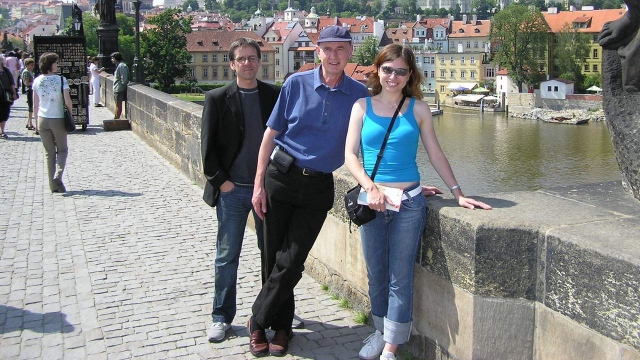
Michael Eido Luetchford
June 2005 — Lotus Centre, Talk 2.
Venue: Lotus Centre, Prague, Czech Republic.
Michael Eido Luetchford · June 2005 — Lotus Centre, Talk 2
Source: audio transcript.
From the retreatPhotosRecordings4Chronicle
Audio
Shobogenzo.mp3 in the Google Drive folder
What the talk says (short overview) — About these overviews
Mike uses the last talk of the weekend to introduce Shobogenzo by reading the opening of its first chapter, Bendowa, a conversation about pursuing the truth, and then explains why the book is worth the effort of studying. His answer is that Master Dogen sets out the whole of Buddhist philosophy and practice in one consistent work, and that its difficulty comes from medieval language, wordplay and the distance of a thousand years, and not from anything theoretical or strange or mystical.
He reads Dogen's own account of how he went to China, completed his great task with Master Nyojo, returned to Japan in 1228 determined to spread the truth he had found, and, worried that sincere practitioners would be misled by teachers who were not genuine, decided to write down the customs and teachings he had received for people who learn by doing things. The paragraph Mike reads first describes the method of the Buddhas as a practice without any intention of reaching an aim, whose authentic form is zazen in an upright posture, a natural state in which reality is not separated into mental and physical and which brings true freedom. Mike adds that Dogen writes very honestly about things that really happened to him: unsure what to do on his return, he weighed waiting against acting, chose to act, and wrote and taught from the age of 31 to 52 or 53, so that Shobogenzo is the record of all his lectures. Asked why Shobogenzo matters, Mike first says that it is very difficult to study because it is written in medieval Japanese, and that versions in English, German, Spanish and French are appearing only slowly, since translators must understand what they translate and it takes fifteen or twenty years, while he is now making a simpler version. Its importance, he says, is that a book on Buddhism usually shows only one point of view, so that one book does not fit with the next, whereas Dogen covered the whole of Buddhism, and this is the only such work that has been written down and preserved.
Questioned about translations, he explains that three foreign students of Nishijima Roshi first translated Shobogenzo in a rather free style, that Mike Cross later joined and, with Nishijima Roshi, made a very literal version because they felt people would accept it more readily than a free one, and that he himself edited and published the books. He now feels it is time to be more interpretive and, building on the literal translation, to explain the text more simply, working through the chapters one by one, with four finished, perhaps ten more years to go, and a book planned after six or eight chapters, while the chapters can already be downloaded from the internet. Asked how to understand the very abstract chapters and Dogen's analysis of koans, he answers that some parts are difficult to interpret, not because they are theoretical or philosophical, but because Dogen uses similes and plays games with words, which can be done in Chinese and Japanese by changing characters but is very difficult in European languages. He illustrates this by saying that he could describe coming into the room, sitting down and giving a talk, or equally say that the room opened to accept him, the chair came up to his behind and his mouth opened and talking came out, and that both are true descriptions; Dogen uses such techniques to take away our self-centred point of view. Dogen's commentary on koans can sound very mystical, he says, but the koans themselves are straightforward: in the story he reads, a master turns to the wall in zazen whenever a monk approaches, and when Master Nansen puts a hand on his shoulder and says that this is just normal conduct, Mike takes it to mean that we should not use zazen to escape from normal behaviour, although he admits he once sat in zazen to escape an argument with his wife. He calls the American commentaries on koan stories that he has read rubbish, because they make a mystical situation out of a realistic one. Spreading Dogen's teachings is therefore slow, since studying one book can take ten or twenty years and making that book took fifteen, the work is done in spare time without government money, and every generation can make one step, so that in another thirty years people may stand on the shoulders of those working now, while Mike himself spent nearly thirty years in Japan listening to a little Japanese man, understood after about twenty-five, and hopes it will take others only twenty-four. He closes by saying that all areas of human endeavour are making the truth clearer, from healthy diet and exercise to the causes of illness and living a balanced life without working so hard, that all of these are part of Buddhism even if we need not call it that, and that explaining Dogen's teachings therefore becomes easier and easier, even if it is perhaps not easy yet.
Complete English transcript — About transcripts
Editorial note: This transcript of a spoken talk has been lightly edited to read well as written text, keeping the speaker’s voice and meaning; the wording was adjusted with great care. We recommend listening to the original audio recording too.
This is the last talk we have this weekend. I thought I would read some of the first chapter of Master Dogen's Shobogenzo, and you can see if it's possible to understand. Of course, it depends on the skill of my interpreter, so this is a kind of test. The first chapter in Shobogenzo is called Bendowa. And Ben means... conversation.
Do means truth or way, and wa means a conversation. Ben means conversation— Ben means pursuing or following. Do means the truth, and wa means conversation. So, a conversation about pursuing the truth. Master Dogen wrote it soon after he returned from China. Twelve thirty-one. So he was 31 years old.
When the Buddhas, those who live fully in the present, each of whom has learned the Buddha's truth from a real person, when they realise what the truth is, they achieve it by the best method there is. This method, in which there is no intention of reaching an aim, is subtle, and is only taught by one Buddha to another Buddha. It never deviates from this. It is a practice that balances active and passive, and it puts the body and mind right. The authentic form of this practice, which is known as zazen, is sitting in an upright posture. Although we each have the natural state— although we each have our natural state, if we do not return to it in this practice, it does not show itself, and if we do not experience it, we do not realise what it is. As soon as we give up our intentions, it comes to us and fills us, and it is not a thinking state. When we speak, this state expresses itself through our mouth in complete freedom. Buddhas live in and maintain themselves in— and maintain themselves in this natural state, in which they do not separate reality into two parts, mental and physical. People who do not separate reality into two parts are Buddhas. The way I am teaching now, to follow the Buddha's truth, is a way that allows us to really experience everything as it is, and it gives us a state of wholeness that brings true freedom. When you get rid of everything that hinders you— hinders you— and find this freedom, these words that you are reading now are completely useless.
That's his first introduction paragraph. He then talks about his trip to find the Buddha's truth, in China.
Establishing in myself a firm resolve to search for the Buddha's truth, I travelled to many parts of Japan, looking for teachers that I hoped would help me in my search. One of these was Master Myozen, who lived at Kennin Temple. I stayed as his student for nine years, learning the teachings of the Rinzai lineage. Master Myozen was the most excellent of Master Eisai's students, and he had received the teachings of the Buddha's truth directly from him. None of the other students were comparable. Then I travelled to China, searching in the east and in the west for a good teacher, and I learned about the traditions of the five lineages who practice zazen. Finally, I visited the temple on Mount Daibyakuho, and I met Zen Master Nyojo, with whom I finally completed my great task of a lifetime of practice. Then in 1228, I returned to Japan, determined to spread the truth that I had found to other people, in order to save them. I felt as if a heavy weight had been placed on my shoulders. But if I wait for good circumstances to carry me forward, I thought I may spend some time wandering from place to place, following the flow of events, like wise teachers have done in the past. But I also felt that there may be people who were already sincerely practicing zazen, if these people were not seeking for fame, not wanting to get something, they might be misled by teachers who were not genuine, whose teachings would only lead them away from a correct understanding. They might then deceive themselves with those wrong ideas, and they might become caught by their own delusions. How could they strengthen their intuitive ability to know what is true? How could they have the chance to practice what is true? If I just wandered around waiting for the right time, where would they be able to find a true place to practice? This seemed to me a very sad situation, so I've decided to write it down, all the customs and rules that I experienced myself during my visits to the monasteries in China, together with the teachings from my master, which I have received and put into practice. Then I will leave these writings for people who learn by actually doing things, and who find it easy to live in reality, so that they will know the true teachings of the Buddha that have been passed on from person to person. I feel that this task may be very important.
That's the end of the second paragraph. So you can see from those two paragraphs of Shobogenzo that Master Dogen is writing very honestly about his experiences, things that really happened to him. He says that when he came back to Japan from India— from China, he didn't know what to do. On the one hand, he could wait; on the other hand, he could do something. In the end he decided to do something, so he started to write and then to give talks. He continued from the age of 31 to the age of 52 or 53. Shobogenzo is the record of all his teaching, all his lectures. So, if anybody wants to ask any questions, or if you prefer me to carry on reading, which should we do?
Question: Okay, maybe a question that might interest other people. Why do you think that Shobogenzo is so important for us? Why should we study Shobogenzo? What do you think? Can you explain to us?
Mike: Actually, Shobogenzo is very difficult to study, because it's written in medieval Japanese. But slowly, slowly, we're making versions in different languages. We translated it into English.
And now I'm making a simpler version. We translated it into German; Gabriele is doing that, she lives in Munich. We translated it into Spanish, and somebody is translating it into French. Those people are lucky, because if you translate something, you have to understand it. But it takes many, many years, fifteen years, twenty years. So in the future we can hope that what Master Dogen writes about will be easy to find, but that situation hasn't arrived yet. The reason why it's so important is that in the Shobogenzo, Master Dogen writes the whole of Buddhist philosophy and the whole of Buddhist practice in a consistent way. So it's a complete work. If we sometimes read a book on Buddhism, it looks at only one point of view, so maybe we can understand something theoretically. But then we read another book about Buddhism, and it doesn't fit together. But Master Dogen, in his writings, covered the whole of Buddhism. So it's the only work which covers the whole of Buddhism that has been written down and preserved. So it takes a long time to make it accessible to people. But in the future it will be much easier. Okay, thank you.
Question: Can I ask— because I ordered the... I believe that Nishijima's version of Shobogenzo was the best. There are different versions, different translations into English, so of course I was very enthusiastic. I wanted to have the best, and I forgot how I came to the conclusion that the best is the one. I think it was because I liked the idea that Gudo Nishijima tried to translate exactly and then maybe explain, but most translations are very free translations. So I wanted to ask if the other person who helped him with English is you? There's Nishijima and somebody...
Mike: Mike Cross. Chodo Cross. He lives maybe two hours from me, and he teaches zazen, but he used to live in Japan. Originally there were three foreign students of Nishijima Roshi, and we started to translate the Shobogenzo in a rather free style. And we completed it.
Then Mike Cross joined us, after five or six years. He was very interested in studying the Japanese characters very closely, and he suggested that we make a more literal version. Nishijima Roshi agreed, so Mike Cross and Nishijima Roshi together made a very literal version, because we felt that people would accept a literal version, compared with a more free version. I helped: I edited and published the books. So Windbell Publications is me. But now I feel it's time to be more interpretive. Based on the very literal translation which we have, we can explain it more simply. So it's a kind of long process. I'm working through the chapters one by one. I've finished four chapters, so maybe another ten years to complete everything. But after maybe six or eight chapters, I'll publish them in a book. And I think it's important to say that you can download the chapters from the internet. So you can download them on the internet.
Participant: Can I ask one more?
Mike: No, go ahead.
Question: This is so interesting, this whole... we could talk about it for hours. But, for example, the part of Bendowa that you read is an example of Dogen's style that is quite— I think he says what he means and it makes sense. I went there, I was pursuing the truth, I found the right master, I came back, etc. But then there are chapters in Shobogenzo that are very philosophically analytical. For example, he takes a koan and he analyzes the koan for three pages or something. I'd like to know what you can do with those parts that are very abstract, very philosophical. How can we interpret them more freely? And what do you think about the analysis of koans as part of Dogen's teaching, which is quite strange, because we usually concentrate on zazen without trying to solve koans? But he also studied koans in very great detail, which is interesting.
Mike: Some parts are difficult to interpret, not because they're theoretical or philosophical, but because Master Dogen uses similes, or he plays games with words. In Chinese and Japanese, you can play word games by changing characters. So he can play nice games with words to change our viewpoint, so it's very difficult to play the same games in English. For instance, I came into this room, sat down on the chair and gave a talk. I could say it another way: the room opened to accept me, the chair came up to my behind, my mouth opened, and talking came out. Both are true descriptions. He uses these kinds of techniques, and this is very difficult in European languages. That's the problem. So he says, I see the chair; the chair sees me. He wants to take away our self-centered point of view.
Participant: We take it for granted that we come here and sit down, and we are not willing to accept that it would be the other way.
Mike: It's both ways.
Participant: So he says, I sit on the chair. The chair sits on me. I sit on myself.
Mike: The chair sits on itself. The universe sits on itself. Something like this. He wants to describe reality, which is like this. That's the problem.
Participant: And it's the same with koans: he analyzes them word by word and plays games with the words in the koans.
Mike: Yes, he does. He does play games. We can explain the same thing without the same kind of games. He collected 300 koan stories in China, and this is our translation of them. They're understandable, they're not strange, and we can make a commentary about them which is not so mystical. So, Master Dogen's commentary on koans is not so mystical. For instance:
When Master Hone in the Chi district saw a monk coming towards him, he would turn to face the wall and begin sitting in zazen at once.
So the master, when he saw the monk coming, would turn around and practise zazen.
One day, when Master Nansen went to see him, he turned to face the wall and began sitting in zazen. So Master Nansen put his hand on his shoulder. Master Hone said, Who are you? Master Nansen said, Fugan.
That's his name.
Master Hone said, What are you doing? Master Nansen said, This is just normal conduct.
Mike: So the koan is simple. The master is not so sociable; he doesn't like talking to people. Every time somebody comes to him, he turns around and sits in zazen. So he's using zazen to escape. But Master Nansen comes up to him and puts his hand on his shoulder. What are you doing? And the monk turns around and says, Oh, who are you? Still he's trying to escape. But Master Nansen said, This is just normal conduct.
So he's saying to the monk, you should behave normally. Don't use zazen to escape from normal behaviour. We can use zazen to escape from normal behaviour sometimes. For instance, I remember many years ago having an argument with my wife, and to escape from the argument, I went and sat in zazen. So all koans are quite straightforward. But again, Master Dogen's commentary is often very symbolic, playing games with words, so sometimes it sounds very mystical. But it's not. There are some people in America who study koans, and some of them have written books with commentaries about koan stories. But the ones which I have read are rubbish. They make some kind of mystical situation out of a realistic situation, so I can't understand why they interpret it like that. Would you like it?
Participant: I was just going to ask you if it's possible to order it somehow. This is wonderful.
Mike: I'll give it to you.
Participant: No. No. Yeah, it's expensive. I'll pay for it.
Mike: No, it's all right. I've got lots of boxes.
Participant: Thank you very much.
Mike: Do you have one?
Participant: Yeah.
Mike: Unfortunately, it's not in Czech. But it's in German. They're publishing it in German at the end of this year. So it's quite important to realise that what Master Dogen is talking about is not actually theoretical or strange or mystical. But we have to make a great effort to understand, because one thousand years is a very long time. If you think of the Czech Republic one thousand years ago, or the UK one thousand years ago, it's very difficult to understand the way people were communicating with each other.
So the process of spreading Master Dogen's teachings is quite slow. It takes maybe 10 or 20 years to study a book which is written in a very different language, and then, to make that book took 15 years, because we can't do things full time. All of us practice zazen in our spare time. We can't get money from the government to study and translate books. But every generation we can make one step. So I think after another thirty years, people can stand on our shoulders. I spent nearly thirty years in Japan, listening to this little Japanese man: What is he saying? What does he mean? After 25 years I can understand. So if somebody listens to me, I hope it only takes 24 years.
Participant: I pray for it.
Mike: Maybe we can. It takes a shorter time; it becomes clear. And not only Buddhism: all areas of human endeavour, effort, are making the truth clearer. We find out that a healthy diet is... So we have people making healthy bread and healthy vegetables. We find out that exercise is important. We find out the cause of illness. We find out how to live a balanced life without working so hard. All of these are part of Buddhism, but we don't need to call it Buddhism. So I think explaining Master Dogen's teachings becomes easier and easier.
Maybe not so easy at the moment, but it becomes easy. After 24 years. Okay, twenty-three. So this is the last talk. Thank you everyone for listening to me. If anyone would like to say anything about their experience here at the weekend, or a suggestion.
Question: What can I do to be your student?
Mike: Be my student?
Participant: Yes.
Mike: It's a long way to travel to Bristol, but Pavel is my student, so you can be my student.
Participant: Okay. Thank you very much.
Mike: No, it's a pleasure. Without anybody to talk to, I feel very unhappy, because talking, for me, is teaching myself. When I open my mouth and explain Buddhism, I hear it myself. Any other comments? Okay, thank you very much. Thank you very much for inviting me.
Participant: Thank you very much for coming.
Jana: We thank you.
Participant: And thank you for having me here.
Mike: So we can now have a 20-minute break before the last session.