Shoaku Makusa 1: Not Doing Wrong Here and Now
Mike reads Dogen on right and wrong as concepts, on pre-conceptual wisdom, and on our conduct here and now
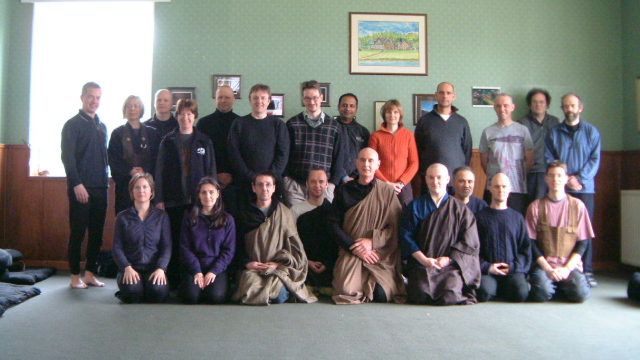
Michael Eido Luetchford
Winter 2006 — Shoaku Makusa, Session 1.
Venue: Rowardennan.
Michael Eido Luetchford · Winter 2006 — Shoaku Makusa, Session 1
From the retreatPhotosChronicle
What the talk says (short overview) — About these overviews
In the first talk on Dogen’s chapter Shoaku Makusa, ‘not doing wrong’, Mike reads Dogen as saying that right and wrong are concepts, and that what the buddhas have passed on through the chapter’s opening poem is our real behaviour here and now. For Mike this means that the point is not abstract argument about morality but how we act in each moment, which, he says, is what Dogen is always interested in.
The chapter opens with a poem that was written in Pali and that Dogen gives in a Chinese translation; the poem says that not doing wrong and doing right naturally purify the mind and that this is the teaching of the buddhas. Dogen says that all buddhas teach it, not only the Seven Legendary Buddhas, and Mike adds that, according to Dogen, we sit in the state of buddha when we practise zazen, so we are buddhas whether or not we think about it. Dogen separates the concepts of right, wrong and neither-right-nor-wrong from the real events they describe, and then, Mike says, turns to relativism, which Mike knows from twenty-five years in Japan, where he came to see that what he had first taken to be wrong was only his own belief, from his English gut feeling, and that others held different beliefs. Dogen writes that right and wrong occur at a time and are real events, but that time and reality themselves have no rightness or wrongness, which, Mike remarks, many people in spiritual societies would dispute. In Mike’s reading, Dogen is saying, somehow, that what we think of as right and wrong is not etched into reality and that to see what is right and what is wrong all things should be balanced. Mike takes this balance to be the psycho-physical balance we reach when sitting zazen, a state in which, Dogen says, our view of wrongness is balanced, though Dogen does not say that it is right. Dogen then says that we hear about pre-conceptual wisdom, prajñā, from a teacher or from the scriptures and that it tells us ‘Don’t do wrong’; any teaching that does not sound like this, he says, is not the Buddha’s teaching. Mike explains that this pre-conceptual wisdom is not like society’s rules, which are intentionally laid down and which we internalise, and that hearing it changes us, so that we no longer want to do wrong.
Mike calls the idea that a ‘voice’ inside us tells us not to do wrong a metaphor, and says that Dogen goes on in the chapter to try to explain morality without little voices inside us or separate spiritual beings, though Dogen has not yet got there. Underneath our intellectual dialogue, Mike suggests, our smallest actions are governed by intuition, subconscious drives and our state of mind and body, and catching this pre-conceptual realisation is itself not doing wrong. To a participant who says that right and wrong no longer pertain once something is done, Mike answers that this is one point of view and that, although it is true, saying ‘it’s gone now’ to someone we have upset does not work, and that our conduct now is what is important, so that in discussing wrong in the past we miss the wrong in the present. Dogen says that a person who is fully at this time and in this place cannot do wrong, which, Mike says, is quite difficult to accept, and that wrong is not something that invades us or that we have to destroy, which is a relief to Mike, who had understood Christianity as being about getting rid of evil. Acting fully, uniting body and mind, means for Dogen seeing the situation clearly just before acting and afterwards noticing that we have not done wrong, and Mike says that this applies even to simple acts such as picking up a cup or pouring tea. Asked about responsibility, Mike says that we have complete responsibility to the society we are in, but that what Dogen always returns to is not abstract morality but our decisions here and now, such as whether to eat the meat in front of us rather than whether to stop eating animals. According to Mike, Dogen holds that the only wrong we can actually do is here and now; Mike adds that we cannot do a wrong in the past or a right in the future.
Complete English transcript — About transcripts
At this retreat, I want to talk about, or go through, one of the chapters that Master Dogen wrote in the Shobogenzo, which is in Book One. It’s a very important chapter because the subject is right at the heart of all religions. The chapter’s entitled “Shoaku Makusa”, and shoaku makusa simply translated is “not doing wrong”. But I’ve just changed it a little because I want to suggest more than one meaning, because the chapter itself contains discussions of what right and wrong may be, and what our attitude towards right should be and what our attitude towards wrong should be and so on. And the chapter is very much concerned with doing or not doing. So I changed the title: “Wrong and Not Doing”; but the simple title is “Not Doing Wrong”. The chapter starts with a poem. I don’t know where it originates from, but it was originally written in Pali. But the version that Master Dogen includes is the Chinese translation, and both versions I’ve given on the very last page. The Pali version, which is thought to be the original, can be translated quite simply:
Not doing any wrong. Or ‘Not doing all wrong.’ Sabba is the same as the Sanskrit sarva, which means ‘all’ or ‘altogether’ or ‘completely’. But you can’t really say ‘Not doing completely wrong’ so, “Not doing any wrong”. Sabba papassa akaranam. Papassa is ‘wrong’, it’s singular. Akaranam: a- is negative of the verb kr, so akaranam, ‘not doing’. So, Sabba papassa akaranam: ‘Not doing completely wrong’, or ‘Not doing any wrong’.
Kusalassa upasampada. Kusalassa: ‘good’, good acts in general. Upasampada: ‘doing’, ‘enacting’, ‘undertaking’.
Cleanses your own heart/mind. Sa citta means ‘this mind’ or ‘your mind’ or ‘my mind’, literally ‘this mind’. Pariyodapanam: ‘cleanses’.
That is the teaching of the buddhas. Etam buddhanam sasanam. Etam means ‘that’. Buddhanam: ‘the buddhas’, plural. Sasanam: ‘teachings’. So, ‘That buddhas teachings’.
So, it’s quite a simple poem. In the Chinese it was translated, in the Japanese pronunciation:
SHOAKU MAKUSA
SHUZEN BUGYO
JIJO GO-I
ZE SHOBUTSU KYO
And that’s been translated into English in our book:
Not doing wrong
Doing the many kinds of right
Naturally purifies the mind
This is the teaching of the buddhas
So there’s very slight differences, and we can often find this in translations from the Pali or Sanskrit into the Chinese, that there are slight differences. We can find a lot of them in the Lotus Sutra which was translated into Chinese, and also in things like Nagarjuna’s Mulamadhyamakakarika which is translated into Chinese. But anyway, I’ve chosen a slightly simpler version including both:
Not doing wrong
Doing right
Naturally purifies the mind
This is the teaching of the buddhas
And Master Dogen comments on the poem.
This was the common precept of the Seven Legendary Buddhas, and has been passed on from past buddhas to present buddhas; and so present buddhas have received it from past buddhas.
As many of you will be familiar, Master Dogen likes turning things around to quote two views on one subject, so he says “passed on from past buddhas to present buddhas” and also “received by present buddhas from past buddhas”. So two points of view. “The Seven Legendary Buddhas” refers to the Buddhas in legend existing before Gautama Buddha, and there are seven of them. And they are legendary which means they may not be real. I think it was an attempt in ancient Buddhism to say that the truth has always been here. So although Gautama Buddha made the truth clear, the truth existed before him in the Legendary Buddhas, they passed it on. So it’s a metaphorical way of saying the truth is always being passed on.
It was not only taught by the Seven Buddhas; it is taught by all buddhas. We need to reflect on this teaching, and make sure that we can practice it. And this teaching of the Seven Buddhas is always recognizable as the teaching of the Seven Buddhas. For what has been passed on by them and received by us is just our real behaviour here and now.
Master Dogen is always concerned with reality. So not ideas, although he’s writing ideas and we’re discussing ideas, he’s concerned with what the ideas represent. So he says that what has been passed on is real behaviour. And if we look back at the poem - “Not doing wrong, Doing right, Naturally purifies the mind” - it’s about behaviour or conduct, not about ideas – although it’s an idea. The essence of the poem is about what we do, how we act.
The teaching of the buddhas is here already; it is the teaching, practice, and experience of hundreds, thousands, and tens of thousands of buddhas.
So first of all he says that this teaching is something here, in the present. So, if we read an ancient poem we may be inclined to discuss the meaning of the ancient poem as it referred to people in the times when the poem was written or whatever. But the poem is speaking to us now. And not only the practice of seven strange legendary buddhas with funny Sanskrit names, but “the teaching, practice and experience of hundreds, thousands, and tens of thousands of buddhas”, or all the buddhas. So he’s saying in some ways that all buddhas teach, practice and experience some kind of conduct which is not doing wrong, is doing right, and purifies their mind. So something concrete and real, which is passed on in the conduct of buddhas, and has been from the original discovery of the nature of truth by Gautama Buddha right through to present buddhas. ... Are there any present buddhas here? If you remember, Master Dogen says that when we practice Zazen we sit in the state of buddha, so we are buddha. And we don’t have to think of ourselves as ‘Buddha’ with a big B, or even ‘Buddha’ with a decorated B with curly bits on it, we can think of ourselves as buddhas with small b’s, but according to Master Dogen we are buddhas.
Participant: Or we could not think of ourselves at all.
Mike: Right. Even better. We are, whether we want to think about it or not, according to Master Dogen. So that means that “the teaching, practice and experience,” for us who have come here this weekend to practice Zazen, is something very relevant. It may be something we’re doing. ‘What?’ It may be talking about us. ‘Really? I’ve done lots of wrong things. Is my mind pure? Agh, is my mind pure? Not as pure as in my imagination!’ But we have to investigate what Master Dogen means, and he gives us plenty of opportunity by discussing each of the aspects of the poem one by one. He starts off by talking about the notion of right and wrong in rather an abstract sense. And those of you who have studied some of the Shobogenzo will remember that he often uses four phases of discussion. He discusses his subject from the abstract point of view, the intellectual point of view. And then he’ll move on to a more concrete point of view, often with concrete examples. And then he’ll move into a point of view based on real behaviour, where his writings often become very complicated. And then he tries to put together something which describes reality itself, sometimes with a poem, sometimes with very beautiful phrases, to capture the nature of reality. So those four phases are also present in this chapter. And he’s just started in that first paragraph to give a kind of statement, of principle if you like. So although his statement of principle is about something real, the principle itself only exists in our mind. And then he goes on to the second paragraph to discuss right and wrong in an abstract sense.
What we are discussing here is what we consider to be wrong, right, and neither-right-nor-wrong, and wrongness is just one of these properties. But the property of “wrongness” is a concept, and has no real substance. And the same is true of what we think of as right and neither-right-nor-wrong. In essence, these concepts are used to describe events that themselves are something real in the present.
So he wants to say that we must always be aware of the difference between words, concepts, and what those words and concepts are talking about. And this is nowhere more relevant than in discussions about ethics or morals, because we can discuss right and wrong in an abstract sense forever, and we are always doing so. But now he changes tack:
But if we consider actual events that have really happened, we do find innumerable concrete occurrences that we can describe with these three properties.
So the abstract properties have a function in describing concrete events that actually happen. Now he goes on to talk about relativism. I don’t know if anybody heard Melvyn Bragg’s ‘In Our Time’ last week. The subject was relativism, and three eminent academics discussed with Melvyn Bragg about how it’s becoming clear that the thoughts of certain philosophers, who said that right and wrong are relative between different societies and different cultures, is actually something we need to look at quite clearly in the modern world, which is becoming smaller, a global village. We notice that other cultures and countries and societies actually have different values. I’ve noticed it very clearly by living in Japan for 25 years where I was confronted with millions of people who were doing things in a different way. And some of those ways they did things I originally thought were wrong, from my gut feeling, my English gut. But then I suddenly noticed that it was just me and my belief, and everybody else had a different belief. So as societies interact and the world gets smaller, we can notice the basis of relativism, and Master Dogen says here:
There are similarities and differences between acts that are considered morally wrong in this society/culture and acts that are considered morally wrong in other societies/cultures. There are similarities and differences between acts that are considered morally wrong at different periods in human history. There are similarities and differences between acts that would be considered morally wrong in ideal societies, and acts that are considered morally wrong in human societies. And the difference in the meanings of wrong, right, and neither-right-nor-wrong between the Buddhist and the secular worlds is even greater than in those instances.
So he realises clearly, although he lived in the thirteenth century, in a small temple in the mountains in eastern Japan, that there were differences between societies and cultures. He lived in China for three years. Other than that he is not recorded as travelling to other countries, but it was clear to him. And it’s clear to us in the modern world. And he says that in Buddhism, the meaning of right and wrong and neither-right-nor-wrong is very different from in secular worlds. So that’s interesting. He goes on to discuss in more concrete detail the nature of right and wrong.
Right and wrong occur at a time, but the time of occurrence itself is not right or wrong.
These are very simple statements, but quite important.
Right and wrong are real events, but reality itself is not right or wrong.
That’s quite a statement. First of all he says right and wrong occur in time but time doesn’t have a rightness or a wrongness about it. Then he says right and wrong are real happenings but happenings themselves don’t have right and wrong as part of them. And many, many people in spiritual societies would disagree with that, but that’s what he says.
When all things are balanced, then our view of wrongness is balanced. When all things are balanced, then our view of rightness is balanced. Because this is so, learning the supreme state of pre-conceptual wisdom, hearing Buddhism explained, training ourselves with Zazen, and experiencing the effects bring us a state that is profound, all-embracing, and happy.
So in this simple paragraph he’s saying, somehow, that what we think of as right and wrong are not etched into reality. We can’t catch hold of a stone and look at it to see if it’s right or wrong. We can’t look at this table and find ‘right’ written on the back. And he suggests that in order to see what is right and what is wrong all things should be balanced. And we know from his other writing that his meaning of balance is the psycho-physical state of balance that we attain when we sit in Zazen. So, “When all things are balanced” means balance between ourselves and the world; balance within ourselves; balance in our mind between opposing arguments and concepts; balance in our body between different parts of the nervous system that make us aggressive or make us passive; balance between ourselves and our surroundings. So, “when all things are in balance” suggests a state, and in that state he says our view of wrongness is balanced. He doesn’t say our view of wrongness is right. And our view of rightness is balanced. Then he goes on more about the state he’s talking about:
We hear about the state of supreme pre-conceptual wisdom sometimes from a teacher, and sometimes from the scriptures.
The “pre-conceptual wisdom” suggests our intuition that we have before we analyse; or, before we start to discriminate the world in front of us we have a pre-conceptual wisdom. And that’s written in Sanskrit prajñā. Pra- is the same root the Latin pre-, and jna is the same root as the Greek gnos, ‘to think’. So, ‘pre-thinking’. So this pre-conceptual wisdom or knowledge or state is very important in Buddhism. And we hear about this state “sometimes from a teacher”, from a person, “sometimes from the scriptures”, by reading about it.
From the first we hear it telling us “Don’t do wrong!”
So he’s suggesting that in our pre-conceptual wisdom we have an admonition that says “Don’t do wrong!”
Any teaching that does not sound like it is telling us “Don’t do wrong!” is not the teaching of the Buddha, and may be some other misleading teaching. Just remember that if it sounds like it is telling us “Don’t do wrong,” it is the Buddha’s authentic teaching.
So he establishes the basis of Buddhist ethics, if you like, as in the first line of the poem, but not in an intellectual way. He says our pre-conceptual wisdom, our balanced state, contains some kind of admonition, “Don’t do wrong!” And it’s there, it’s the Buddha’s authentic teaching.
Question: So, we always know the right thing to do before we start thinking about it?
Mike: That’s what he’s saying, yes, in effect.
Participant: But we don’t always know the right thing to do.
Mike: Well, we’d better wait ’til the end.
Question: The balanced state is the state of not doing wrong. So not an admonition as such contained within it, but it actually is that state?
Mike: We can say so, yes. This is Master Dogen’s way of creating metaphors. So he’s suggesting that inside us there is something that tells us not to do wrong. But in explaining it in this way, I’m separating; by saying ‘inside us there is something’ I’m creating a kind of separation, as if there is some little voice inside me. And what Master Dogen carries on to do in this chapter is to try and explain morality without resorting to little voices inside us. Because if we say that there’s a little voice inside us that says “Don’t do wrong!”, that comes from our intuition, then we have to think who is saying that, who is that little voice? And then we can posit a spiritual being, or some kind of a spiritual substance and so on. But he doesn’t agree with belief in separate spiritual beings. So his intention – and we’ve only just started his explanation – is just as you say, but he hasn’t got there yet.
It is not like the usual rules of society, which are intentionally laid down and maintained; it is our pre-conceptual wisdom that is telling us this.
So he’s distinguishing here between that kind of guilt thing we may have from our upbringing, our social background, our circumstances: ‘I shouldn’t do that!’ And often as we grow older we realise that lots of the little ‘shouldn’ts’ that pop up in our mind are just our parents’ voices, the vicar’s voice, you know, our partner’s voice, all kinds of voices. Not to say that therefore we should ignore them, but simply that society has its rules “which are intentionally laid down and maintained” and we internalise them. So those internalised rules of society are not what he’s talking about. He’s talking about something pre-conceptual.
It is simply our supreme pre-conceptual wisdom speaking to us. The admonition itself is produced pre-conceptually, and so it speaks to us from out of our pre-conceptual wisdom.
Now remember, Master Dogen lived in the thirteenth century and at that time there was no psychology and no studies into the human psyche and so on, so he’s using his own framework to explain something which in many ways is more easy to put into words in modern times.
Question: Is he saying that we don’t need religion to tell us what’s right and what’s wrong?
Mike: He might be, yes. Certainly what he’s saying, we will see, is very different from all spiritual religions, yes.
When we hear pre-conceptual wisdom speaking, hearing it changes us; then we don’t want to do wrong, we manifest the state where there is no doing of wrong, and wrong continues not to be done.
That’s a strange sentence. He’s trying to catch the nature of our experience when we hear the “Don’t do wrong!” inside us and don’t do it. So “hearing it changes us”. In other words, if we catch our intuition it changes us. And in changing us, “we don’t want to do wrong”, and then “we manifest the state where there is no doing of wrong, and wrong continues not to be done.”
Question: Does “hearing it” mean becoming consciously aware of it, having a thought about it, or does it mean just ...?
Mike: That, but more whole than that. So what happens at the instant that we act in our everyday lives, the millions of times that we act in our everyday lives, at every instant, is very difficult to catch. We have a dialogue with ourselves which we think is how we’re going through life. So we’re almost constantly thinking: ‘Shall I do this?’, ‘Shan’t I do that?’, ‘Shall I go here?’, ‘Shan’t I go there?’ But underneath that intellectual dialogue are our real simple actions, and the real simple actions are governed by all kinds of things – by our subconscious drives, by our intuition, by our state of mind, by our state of body. And underneath our intellectual dialogue, in other words the way that we think that we’re going, there is this pre-conceptual realisation, and when we catch that, the catching of it is not doing wrong. So words really mislead us. But in trying to grasp the nature of our instantaneous decisions we can say when we catch our intuition saying something (it doesn’t say anything, this is a metaphor), when we catch it, immediately we feel ‘Oh I don’t want to do wrong, it’s changed me’.
Question: Is it prajñā realising itself?
Mike: Yes. But this is only a description in words. What actually happens in us is what we all actually experience. But we don’t often notice. Many people, and I, were brought up thinking ‘Think before you act!’, so ‘I should think my way through my life’. And we are so indoctrinated with that point of view, especially in intellectual Western societies that we believe that we do think our way through life. But I would suggest that it’s demonstrably not true. Of course, on a macro-scale we can say ‘Of course I decided in my mind I was coming to Rowardennan, and then I thought I’ll go on the internet and buy an airline ticket’ and so on. And at that level, yes, we do think our way through our social existence. But at the very basic, fundamental level, each action at each moment, we can go left or right, stand up sit down, open the door not open the door, speak or not speak. So at the instantaneous action level something else determines our actions. We can’t possibly think about the smallest actions that we make, and yet those smallest actions that we make actually determine the course of our lives far more than the large intellectually-based decisions we make in society. So it’s like we’ve got two levels, and we think we’re living on ‘this’ level, but actually we’re living on this level.
Question: Is it that feeling that when you do something, say, just make a choice to open or close or whatever, and immediately after you just get this feeling, kind of ‘Oh I shouldn’t have done that’, or some kind of elation, and then that’s when you know, that’s when you can tell when you’ve done it wrong?
Mike: It’s very complicated, isn’t it? We often feel like that.
Participant: It’s just a sort of sense that, you don’t really know why but you just know it wasn’t the thing to do.
Mike: Yes, but we need to find out whether that’s what he’s talking about or not. But we do have that, we act from our feeling or from what we feel is intuition and then after acting we get a horrible feeling ‘Oh that’s the wrong thing to do’. But is it the wrong thing to do just because we feel like that? There are many, many questions here, aren’t there? The world has passed the stage where we can believe that just because somebody says it’s the wrong thing to do, or just because we feel it’s the wrong thing to do, therefore it is wrong. Because we’ve got so many societies and cultures interacting in the modern world we can’t believe that anymore. Maybe a hundred years ago people would have believed in ‘This is right, this is wrong, no problem.’ So if I did something which is against the Bible, or against society’s rules, then ‘I am wrong - full-stop.’ We can’t believe that anymore. If we could believe it, then we could still happily be a very religious society in the traditional sense. But then do we follow the path that you’re talking about, where we try and find our way through the maze of reactions we have to our own actions? Will that guide us? But we only realise afterwards, don’t we? After I did something, ‘Oh God, no, I shouldn’t have done that! Send him an e-mail!’ And then down the line we realise ‘Oh no it was OK after all!’ And this kind of thing happens to me on a daily basis. ‘I was wrong! Oh no I wasn’t, I was right! (Sigh.)’.
It’s a very common experience, isn’t it, that something we do appears wrong after we’ve done it, and then afterwards we can see another side to our own action, and we think ‘Oh, no, there was a value to that.’ So we wobble about. So how should we decide? And what should we decide? So all this is what Master Dogen wants to discuss. But what he’s talking about now is something about that very ... that point at which we act can’t be separated out into ‘this happens then that happens’, although I’m sure that at some time scientific investigation will separate it out. In order to have a theory about something we have to separate it out. So ‘A causes B, B causes C’. But Master Dogen’s talking about the point at which we act, and at the point at which we act, he says, we have this pre-conceptual wisdom saying “Don’t do wrong!” And that’s a separation, but the point itself is just a point. So the voice we hear, and the feeling ‘Oh I’m not going to do wrong’, the change in us, and manifesting the state where there is no doing of wrong, and continuing not to do wrong, are all one thing, one instantaneous thing. But we can’t talk about the instant, so we create metaphors and theories, and this is one of them.
Participant: I’d just like to return to the earlier point. If you’ve done something, then right and wrong doesn’t matter anymore because you can’t undo it, so whether it was right or whether it was wrong ...
Mike: That’s one point of view. And if you have that point of view and believe it firmly you can go through the world and do whatever you like. But I would suggest that if you do believe that and carry on, you’ll get a few whacks from reality. Because for example, you’ll say to your wife ‘Oh it doesn’t matter, it’s finished now, it’s gone.’
Participant: I’m not saying it doesn’t matter, I’m saying whether it’s right or wrong doesn’t pertain anymore because it’s done.
Mike: We can say so, but other people might feel different, they might want to discuss it. And they might want you to apologise and all kinds of things. So us saying to the other person, ‘Look, you see, what I did was wrong but I don’t need to apologise to you because actually it’s gone now,’ doesn’t work. It’s true, but it doesn’t work, so there’s something else that’s true too about our conduct. And that is that our conduct now is what is important. So if we do something wrong, if I do something wrong and upset my wife, for example, and I say to her ‘Well, it doesn’t matter because it’s gone now,’ and she says ‘It does matter, I’m very upset,’ and I say ‘Well that’s absolutely your problem, I know the truth and there’s nothing wrong here’ – my own behaviour at that moment is what is wrong. So in discussing wrong in the past, we miss the wrong in the present.
Question: How far are you going to take that argument? Should the Japanese apologise to the Chinese for what they did in the war? Should the whole English nation apologise to Africa for slavery? How far back do you go? Should the Anglo-Saxons apologise to the Jutes for something they did in 3000 B.C.?
Mike: Should the Japanese apologise to the Chinese? Should the Americans apologise to the Japanese? Yes, this is a big problem, isn’t it, in the modern world? If we apologise, sometimes it has a good effect and sometimes it doesn’t. For example, if we apologise for something we don’t really feel, then we don’t feel good about it. And that might be the seed of something else coming up. So it’s a whole labyrinth, ‘How do we deal with it?’ This is the problem, how do we not do wrong?
Question: Can I check something, because this is the closest to anything of Dogen that I think I’m grasping so I suspect I’m off on a wrong tack here.
(Laughter.)
Question: I want to check it before I go too far off piste. Is it about ... if you’re in this balanced physical and mental state what you do will just flow with what else is happening? That it’s not a rule, that it isn’t that you must always apologise to people, but if you’re in that balanced physical and mental state what you do will then fit the circumstances, and it’s never a formula but it’s just it will flow.
Mike: Yes.
Question: And it’s just coming back to that...
Mike: Yes.
Question: ... and recognising that it’s coming from that physical and mental state.
Mike: Yes. Yes it is.
Question: So I’m not too far off piste then. OK, this is a first.
(Laughter.)
Mike: You’re not wrong. I’m sorry it’s taken so long.
(Laughter.)
But, in saying that - yes I agree, that’s what he says to me - but, how do we believe that is very important. If we can believe it, then we can act in a certain way. If we can’t have any confidence in it then it’s just a load of words. So the key point is, if he says practice Zazen and everything is fine, that’s so sweeping, how can anybody really believe it? Even though I practice Zazen every day, how can I believe it? And by reading his writing like this we can slowly extract some kind of confidence. At least I can. Because human beings have been grappling with the question of right and wrong ever since they came out of the sea. Was it the sea we came from?
Participant: A long time ago.
(Laughter.)
Participant: But we can’t extract confidence from the words without practicing Zazen, because then they have no context.
Mike: Yes. Yes. Let’s see what he says as we move on.
... we manifest the state where there is no doing of wrong, and wrong continues not to be done.
And that really sounds like a recipe for freedom, doesn’t it? But then we think it means the freedom in which we can do wrong without doing wrong.
Just at this time we realise the power of practicing Zazen. And our realisation is as wide as the whole earth, the whole world, through the whole of time, and the whole of reality. This is how wide the not doing of wrong is.
So he’s suggesting that the state of not doing wrong has something wide about it. And that would suggest not a focused intellectual state. Not a state that’s focused to a point, but a state that’s without edges. ... Shall I carry on? In the next paragraph he says some even more difficult to believe in.
No wrong can be done by a person who is fully at this time and in this place, even if that person lives in a place where they could do wrong, faces circumstances in which they could do wrong, and associates with friends who do wrong. The power of not doing wrong is put into action, no concrete wrong is done, and so the qualities that characterise a wrong action do not appear.
So he’s suggesting that there is a state in which we don’t do wrong. And that’s quite difficult to accept, if we think about it.
It is just the fact of whether we do or whether we don’t do. Just at that moment, we realise the truth that wrong is not something that invades us, or that we have to destroy.
He’s saying that at the moment in which we’re not doing wrong, at the moment that we’re in that state, we realise that there isn’t something called wrong that comes into us. A very common belief in spiritual religions, and certainly Christianity in the Middle Ages, was that the Devil would come into people, or that evil would enter people, and people were burnt as possessed by the Devil and so on. So he’s saying that there is nothing called wrong that can come into us. We can’t be invaded by evil. So it doesn’t exist as a separate thing. If we extrapolate from what he’s saying we can say that he doesn’t believe that evil exists as a separate thing floating around somewhere, and that can come into us or that we have to destroy. Now, I was brought up as a Christian, and my understanding of what I was taught is that the world is full of two things - good and evil – and our task is to destroy evil and make everything good. That seemed to me to be what Christianity was about, to get rid of evil and to keep only good. He’s saying that there is no thing called wrong, or we could say evil or bad, that is floating around as a kind of property that will invade us, or that we have to get rid of. That’s a relief to me.
When we act fully, uniting body and mind, then we see the situation clearly just before the moment of action, and we notice the fact that we have not done wrong in the back of our mind afterwards.
So he’s describing our actual action. “Acting fully, uniting body and mind,” suggests balanced action or complete action. And we’ve discussed this before, but we can say that it’s possible to act while we’re thinking, but our action is partial and unsatisfactory and unsuccessful. And any sportsman knows that if they think while they’re acting then their action is incomplete and unsuccessful. So the tennis player jogs up and down the baseline trying to get himself or herself fully into the moment, to forget about the last point they lost or the next point they’re going to gain, and just to be fully in their action. And in that state we can see “just before the moment”, is what Master Dogen says, “we can see the situation clearly just before the moment”, we have a kind of clarity; and “just after the moment we notice that we have not done wrong.” And that would suggest a kind of complete completeness about an action. So something that, if we act from the balanced state, fully and completely, we’re clear when we act and afterwards we don’t feel any feeling that ‘Oh, I shouldn’t have done that.’ Something complete and simple. And we needn’t think he’s talking about complicated kind of moral actions such as, you know, ‘Should I take out a writ against this person or not?’ It can be very simple things. So, for instance, the way we pick a cup up from the table, or the way we might pour tea from a teapot into the cup. Even at that level there is complete action. And we can say complete action is clear just before and afterwards it’s something satisfactory. So it’s simple; we don’t notice.
Question: We might feel like that, but what happens if our partner or our social grouping is of an entirely different view?
Mike: We don’t know that until the moment after. And the moment after, when we hear from the group, we are in a different moment and we have a different right and wrong to cope with and a different action. So we’re always acting at every moment. And Master Dogen’s talking about that momentary, simple action that makes up our life.
Participant: But you can do actions which fulfil Dogen’s criteria, to use a phrase, but everyone else around you would say is wrong or was wrong.
Mike: Possibly, yes.
Question: How does responsibility fit into this, then? Are you responsible for these actions that have occurred before you’re consciously aware of them?
Mike: Not actions that occur before we’re consciously aware of them. Normally we’re conscious when we act, but to be conscious of our action and to be thinking about our action are different. And where is responsibility in our action? Does it come before it or after it or both? Or during? In your opinion?
Participant: Well, your responsibility to your social group or to your culture - if you have one, let’s assume you do – then you’d be aware of your responsibility afterwards if you had carried out an action that was against your social grouping. But do you accept that responsibility and say ‘I have broken my society’s rules’ or...
Mike: Yes.
Question: You do? So you have a responsibility to your society?
Mike: Yes, we have complete responsibility to the society we’re in. So one of the Buddhist precepts is to obey the rules of society. And we’re always responsible for what we do, whether we feel it or not.
Participant: But with the smaller world we have we are aware of many different societies...
Mike: Yes.
Question: So, if you’re a Chinese person in amongst fifty million Chinese but you want to have an i-pod and listen to some cult music, you have a responsibility to the Chinese society? Or to the American society? It’s complex now because you have an awareness of so many different societies.
Mike: Yes, and this is our problem. And this is the problem of many Chinese, many young Chinese, their responsibilities or their loyalties may be shifting, so they don’t feel a loyalty to the society in which they live as strongly as their parents, for example. So if they follow their feeling they might get hammered.
Participant: I don’t understand that statement that you should keep to the rules of your society. Let’s say, for example, this society says ‘Thou shalt not kill’, and you have an elderly parent or somebody who has a degenerative disease, for example, and wants you to assist them in dying. Now, if you do that openly in this society then you’re going to get hammered by all the courts and everything else. But in terms of what is right in that situation it might be right to assist them in dying.
Mike: Yes, but what we’re talking about is a kind of intellectual problem. The actual problem might be, while we’re driving the person to the clinic in Switzerland where they can receive euthanasia, we get stopped for speeding. We’ve broken the rules of society and we get fined. So you’re concentrating on one thing which is a kind of intellectual moral problem: ‘Should we be able to do this or not?’ But we can decide about those things on the level of society, of society’s rules: ‘Should society allow people to end their own lives?’ But that’s a different kind of morality. It’s the building of social laws. And having built social laws we should obey them, because if we don’t our lives won’t be happy. But sometimes we need to break them, the laws are not right. But then we come down to ‘When should we keep them and when should we break them?’ So there are many different levels, aren’t there? But how can you decide, for all time and for all people, whether people should be allowed to end their own lives or not?
Participant: You can decide when you’re a doctor confronted with a terminally ill patient and you know his family, in a real situation...
Mike: In a real situation...
Participant: ... and then you make a decision.
Mike: Yes. And what Master Dogen is always talking about, unfortunately, disappointingly, is our decisions now, here and now. So, not the abstract morality which we have all the engines and organs of modern societies and cultures to construct and modify; but how we act in each moment. Because, according to him, how we act in each moment is actually the root of how these larger things come to be decided. So if, for instance, you have, as in Burma, military government, that military government may over a period of years enact social rules which are completely unacceptable to the Western world. So, what Master Dogen is saying is that all these higher levels come from these, our simple actions here and now. This is what he’s always interested in. He says the only thing that’s real is here and now. But our minds are so powerful we can think about right and wrong on the historical level, about whether events in the past were right or wrong, whether America should have dropped the bomb on Japan, and so on and so forth, and we can go right back to the Middle Ages or the French Revolution, or we can range through history deciding right and wrong. And then we can go into the future and we can say ‘What should we do? How should people be allowed to act? What should our children be allowed to do and what should we stop them doing?’ And all these are kinds of intellectual decisions. And Master Dogen says, not that they’re not important, not that we shouldn’t do them, but there is a right and wrong that is more vital because it’s the right and wrong that we are creating here and now. And the only right or the only wrong that we can actually do is here and now. We can’t do a wrong in the past; we can’t do a right in the future. So our actions here and now are our life. But unfortunately for us intellectual modern people, it brings us down to very simple stupid things, like, you know, how do we sit, how do we get up and down, how do we speak to each other, how do we cook our food. ‘But that’s not what I want to talk about! I want to talk about important things, like rules for the world!’
Participant: I had a conversation with John this morning and he said the Dalai Lama was asked by someone, ‘So, should I stop eating animals’, and he said ‘I don’t know.’ Now I understand that answer because it’s a bigger argument than...
Mike: Yes, so not ‘Should I stop eating animals?’, but ‘Do I eat this meat in front of me or not?’ The decision at the moment – this is where Master Dogen’s focus is always ... brought back to at least.
Question: So if, hypothetically, the whole of all the societies of the world all acted in the moment all the time, then we wouldn’t get difficulties because there’d be no intellectualising or ...?
Mike: We can have a dream like that, yes.
Question: If that were so then none of these issues would arise because everybody would be acting right?
Mike: We can dream that, yes. We can imagine it, yes.
Question: But it’s not going to be ...?
Mike: I don’t know if it can be or not, I have no idea. I can imagine it. But whether imaginary situations can ever become real or not, I wonder. Because although I’ve spent most of my life imagining what’s going to happen to me, when it actually happens it’s never the same. Sometimes it’s completely different; always it’s a little different. ... How are we doing for time?
Participant: We’ve gone over.
Mike: Have we? So let’s stop here and then carry on this afternoon. Thank you very much.