Precepts as Guidelines
Mike: precepts are limits of freedom; for Dogen, simple, sincere action is not wrong when practising balance
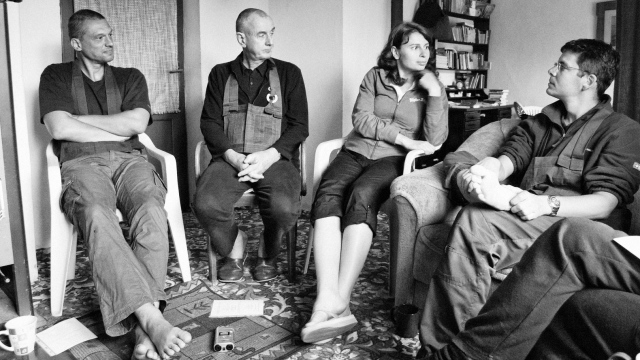
Michael Eido Luetchford
July 2009 — Dibbavana, Talk 4.
Venue: Dibbavana Meditation Centre, Mariánské Lázně, Czech Republic.
Michael Eido Luetchford · July 2009 — Dibbavana, Talk 4
Source: audio transcript.
From the retreatPhotosRecordings4Chronicle
Audio
200907-04-Action-and-precepts.mp3 in the Google Drive folder
What the talk says (short overview) — About these overviews
Mike reads the Buddhist precepts not as instructions but as guidelines that tell us the limits of our freedom, and he follows Dogen, who says that when we break them there is no blame and we should just continue. Drawing on the Shobogenzo chapter Shoaku Makusa, he explains Dogen's surprising claim that there is nothing called right waiting somewhere for us to find, so that for someone who practises balance, to act simply and sincerely is not doing wrong.
Mike notes that the original Japanese form, nani nani shinai koto, is more accurately translated as not doing, so not getting angry rather than do not get angry. Sometimes we only find the limits of our freedom by stepping outside them, as some little children have to touch; there is no sin in Buddhism, but there is wrong conduct, and it brings a result. Where spiritual religions ask God for guidance, Buddhism has no God, and in the koan story that Dogen writes about, a master answers that the most important thing is not to do wrong and just to do right, which a child of three can understand but an old man of eighty cannot do. For Mike this means, as Dogen says, that right doesn't exist as an abstract concept: what is right and what is wrong depends on the real situation at this moment, and making an abstract decision about it is not realistic. When a participant doubts whether they can trust themselves, he answers that even without believing it we can practise zazen and act, an experiment called life whose result we can only judge after a long time. Asked about learning from mistakes, he says that, according to Dogen, if we practise zazen all our mistakes lead us to the truth, and that instead of learning lessons we realise what we are like, a realisation that is itself a kind of change. Our life is full of wobbles even when we practise zazen, but regular practice keeps us from wobbling extremely, and that is the best we can do.
In the discussion Mike contrasts the traditional Western reference, God, with the Japanese one, what everybody else is doing, and presents Buddhism as a middle way that says balance yourself, so that your life is affected too much neither by others nor by abstract thinking about right. We cannot get rid of the feeling about right and wrong that comes from our culture, but we can let it be background music and, as Dogen says, just move on even if we break the precepts. Mike sees the spread of sport and the many balanced people it produces as a hopeful sign, while participants answer that in the former communist bloc people seem more stressed, and he grants that they may be right, while still seeing the world as getting better overall. When a participant objects that just acting does not work for decisions such as financial ones, Mike agrees that activities based on thinking need thinking, but, when the participant suggests intuition, adds that underneath the thinking we have intuition, which is also based on balance. He calls it prajñā, which he explains as what comes before thinking, and says that a balanced state gives a balanced intuition, although he himself cannot tell when he has intuition.
Complete English transcript — About transcripts
Editorial note: This transcript of a spoken talk has been lightly edited to read well as written text, keeping the speaker’s voice and meaning; the wording was adjusted with great care. We recommend listening to the original audio recording too.
At the beginning of the talk, let's recite Kaikyoge.
[recitation, 00:00:08–00:00:53]
This afternoon I'm going to talk about the relationship between action, which we talked about this morning, and the precepts. That is, not to do wrong. The precepts which we heard in the ceremony: instructions, what not to do. And these are the ten fundamental precepts. These precepts are written in the Shobogenzo by Dogen, the same precepts. They're written in the chapter called Jukai. And yet he writes in other places in the Shobogenzo that even if we break the precepts, we can continue without blaming ourselves. So then, what are the precepts?
And what can we do to stop doing wrong? The question how do we stop doing wrong is a question everybody asks themselves, sometimes generally, sometimes specifically. Not only individuals, but also countries, because when we're making decisions about what to do, we always want to choose the right way. The right way is not the wrong way, so we're choosing not to do wrong. And the precepts themselves are not such detailed guidelines.
Rather than instructions, they seem to be guidelines or advice. In English they're written, Do not get angry, Do not criticise, and so on. In the original Japanese, the verbal form is nani nani shinai koto. Nani nani shinai koto is more accurately translated as not doing, so not getting angry. Not getting angry, rather than do not get angry. Not criticising other Buddhist monks or lay people, rather than do not criticise.
So if we look at them in that way, they seem to be guidelines. They tell us the limits of our freedom if we want to have a satisfactory life. But sometimes we can only find the limits of our freedom when we step outside the limits. Even a child: if you say, Don't touch, don't touch hot. Hold. Some children never touch. Some little children have to touch. So Master Dogen recognised that sometimes we step outside the boundary, which is breaking the precepts. And so he said, There is no blame. We should just continue. There is no sin in Buddhism. However, there is wrong conduct.
And when we do wrong conduct, we receive the result. So the question is: there are only ten precepts, which say rather general things. Don't desire too much. Don't desire too much, so what does that mean? It's not so exact. So the question is, how do we decide what is right and what is wrong? In spiritual religions, the people who believe in the religion will often pray to God, for example, to guide them. So, please God, make my action right so that I don't do wrong and go to a good place called heaven, and not the bad place called hell.
But in Buddhism we don't do that, because we don't have a God. Master Dogen wrote one chapter in the Shobogenzo whose title in Japanese is Shoaku Makusa, and it means not doing wrong. And in it he talks about this problem. Usually we think that we can decide in our mind what is right and what is wrong, and then we can do what is right and not do what is wrong. This is what we think. But reality is often very different.
There's an ancient Chinese koan story, which Master Dogen writes in the Shobogenzo, where a Chinese government official asks a Buddhist master in China, What is the most important thing in Buddhism? And the master replies, Not to do wrong. Just to do right. So the government official says, If that's all it is, even a child of three can understand it. But the old Buddhist master replied to him, Even a child of three can understand it, but even an old man of eighty, like me, cannot do it. So we can see in our societies many discussions, abstract discussions about right and wrong, and many criticisms of past actions. This was wrong, this was right, this wasn't good, we must learn the lesson. But still, it's very difficult for human societies to decide what is right to do. In the chapter Shoaku Makusa, not doing wrong, Master Dogen says something which, to me, is quite surprising. He says there's nothing called right which is waiting somewhere for us to find it and do it. So he means that thinking about right, even making an abstract decision about what is right, is not realistic. Then what's his idea of acting right? Again, his answer is surprising. He says that if we act, if we practise balance and act in a balanced way, then our actions are not doing wrong. So if we practise zazen every day and act sincerely in our daily life, we don't do wrong. This is the best situation for human beings. But it sounds too simple. So I wonder what people think about it.
Participant: We trust ourselves to do right.
Mike: Can we?
Participant: Well, it sounds a bit... I don't know, actually. I like the idea, and I kind of believe it when you say it, but I wonder whether in daily life, even practising zazen, I can trust myself not to transgress at work, in relationships.
Mike: Yes, I wonder if I can.
Participant: But he's saying you can.
Mike: He's saying that is the way not to do wrong. So the Buddhist life based on zazen and the balanced life is not doing wrong. And he says right doesn't exist as an abstract concept. This means that what is right and what is wrong depends on the real situation at this moment. So in this real situation at this moment, there is something right and something wrong. And in our action we can avoid doing wrong, and we can act. And that's the best human beings can do. So your question is very important: can we believe it?
And another question is, even if we don't believe it, can we do it? And I think the answer is yes, we can. Even if we don't believe it, even if we're not sure whether what Dogen teaches is true or not, we can practise zazen every day and just act freely and see what the result is. And then, after a long time, we can have some kind of feeling about whether what he says is realistic or not. Without the experience, we can't evaluate what he says. So we have to be stupid and say, Yes, he's right, I'm going to do it, and then twenty years later we can decide.
Participant: Okay. Experiment.
Mike: Yes, an experiment called life. So to follow the Buddhist way is a kind of experiment. I think if you maybe don't believe, then you need to ask yourself if you know something better, and if not, then anyway there is no choice. If you know something better to do... I don't know.
Participant: Because if I need to wait 20 years, then after 20 years it will be too late.
Mike: Yes.
Participant: It still won't be good, so I need to know now.
Mike: Right. So you have to answer that yourself.
Of course, describing it in words makes it sound simple, or too simple, or too crude. But if we practise zazen and balance our body and mind, then our actions will not be wrong. We are not doing wrong. But although we're not doing wrong, sometimes we feel we're doing wrong. So we don't need to worry about those situations, because if we're leading a sincere life, it's the best we can do. As you say, there's no alternative.
So it's not a question of how much we worry, or whether we can decide in our mind or not. It's simply a question of leading a life which is based on doing things, rather than thinking about doing things first and then doing them.
Although we think about doing things before we do them, it's actually impossible for us to decide what will be right and what will be wrong in many situations. Of course, I don't mean things like, Shall I rob a bank? Yes or no? Just do it. Not that kind of situation. I mean real situations where we are concerned to act in the best way. So in that situation, Dogen says, to act in the best way, if you are a person who practises zazen, is just to act.
Not that if you're a drug addict you can do the same, or, you know, if you're a mercenary soldier you can do the same. He's talking to people who are following a life based on practising balance. So he says, if we practise balance in our life every day, then to act is to do right.
Not to force ourselves to act, but simply our actions will be the best we can do, and the best we can do is not doing wrong. So it's different from our thinking about it. Even after we act, when we think about it, we may think, Oh dear, I shouldn't have done that. But sometimes life is very complicated: sometimes we do something and we think, Oh. Then one day later we realise that actually the situation seems different again. We think, Oh, I see. So situations are always changing.
And what Dogen is saying is that there is no abstract rightness. There is nothing in our mind that can guide us by thinking, This is the way to go, this is not the way to go. If we are practising balance, then to act simply and sincerely is not doing wrong; it's the best we can do. That's what he's saying.
Question: And what about learning from our mistakes, when you clearly see that you have made a mistake? Or you have hurt somebody, or you have crashed a car because you drove too fast. I think it helps me to remember: next time don't do it, last time it didn't work out, so I can...
Mike: Did it work?
Question: Maybe. Yeah, maybe I can remember some place somewhere: last time I went too fast, so this time I will go slower, whether I practise zazen or not. Right?
Mike: Have you tried both? Going around the corner before you practise zazen and going around the corner after you practise zazen?
Participant: Well, sometimes after zazen I'm very energetic and enjoy doing things, and I do too much.
Roman: You know, so zazen doesn't prevent me from making a mistake. But I agree that...
Mike: So Master Dogen says that if we practise zazen, all our mistakes lead us to the truth.
Of course, sometimes we think like this, yes, and we think, I won't do it again, or, Oh God, that's terrible. But I think another way to look at it is that instead of learning lessons, we realise what we're like. So if we make some big mistake, we notice it, and we realise what we did. I think that realisation itself is a kind of change. You don't have to keep remembering it.
Participant: Yeah, it's unnecessary to blame, because it doesn't help the situation to feel guilt, but to remember, Oh, that was a mistake.
Mike: Yes, sure, we can remember it.
Participant: But that was a mistake, and just keep going without worrying about it.
Mike: Yes, that's right.
So we can't stop our mind, we can't stop evaluating, we can't stop criticising ourselves sometimes, praising ourselves sometimes. But separate from those mental activities, what Dogen is saying is, for somebody who practises balance: just go on, just go on, just go on. Our life is full of wobbles. Sometimes we are overexcited, sometimes we are depressed, even though we practise zazen. We have wobbling.
But if we practise zazen regularly, or if we practise some kind of balance activity regularly, we don't wobble extremely. So we may be depressed this morning, then we get up and practise zazen and we feel a bit better. So the wobbling is not so much. So our life goes like this, not like this. That's the best we can do. That, according to Dogen, is not doing wrong. That's all we can do. Everything else is part of life.
Question: Can I interpret it for myself as letting our actions find their own way?
Mike: Yes, that's very nice. Yes, that's a very nice expression.
Participant: It seems to me very contradictory to our culture.
Mike: Yes, it is. And it's...
Participant: I've heard this before, but it's quite difficult to practise it, to live it, to accept it.
Mike: Yes. And in a way, what we have to accept is what we're doing. So we have to accept our life, which we are doing.
Participant: Yeah, but still you are talking to yourself: Was it right? Or was it wrong? And still having something in the back of your head talking to you.
Mike: Yes. So we can let that continue, this background music.
Participant: Is it the same in Asia? I mean, they have no Christian background, so...
Mike: I don't know about China and Korea, but in Japan, for example, there is no strong concept of sin. So there is no strong concept of right and wrong as a concept. Of course, people are concerned with doing right and doing wrong, but they think that discussing it is not so helpful. And so instead of that, they are concerned about what other people see. In the West we're concerned about, I must do what is right under God, for example. So right is a spiritual, abstract thing. I mustn't sin, I must be good. Rather talking, abstract thinking.
Question: Individual?
Mike: Individual. So our reference is God, traditionally. But in Japan, for example, their reference is everybody else. So: should I go across the road here? The light is saying red. What's everybody doing? Oh, they're going, so I go. And this is a big weakness in Japanese culture. Many forms of sexual misconduct in Japan grew from this habit. Oh, he's doing it, so it's okay for me to do it. Oh, she's doing it, so it's okay for me to do it.
So, for instance, 15 years ago people discovered that some clever men encouraged schoolgirls, 15, 16, 17, to sell themselves to older men for some money. So they go to a hotel with the older man and have sex, and everything is arranged by mobile phone. Once these clever men encouraged one or two schoolgirls to do it, it spread through the whole of the country. So there's a huge problem with schoolgirls who are quite normal, but all their friends are doing it. Ah, I went with this man to a hotel and he gave me, you know, 2,000 crowns, and I could buy this nice coat. Oh, good, so I'll do it too. So in that way, their moral base is what other people are doing.
Jana: Some people are more feminine than others. It's a different attitude.
Mike: Yes, yes, yes. Yes, a different attitude, it's true. That's extreme, of course. So Buddhism is neither one nor the other, but says, balance yourself. Make yourself balanced, and then your life will be balanced, will not be affected too much by others, and not affected by your thinking too much about right in the abstract. So I think many Eastern societies don't have such a concept as sin, for example, whereas in Europe we have an old feeling: sin, sex is bad except in certain special conditions, spiritual things are good, physical things are bad. So we have a very exact feeling about right and wrong. No, that's wrong. I'm right, you're wrong, this kind of thing.
And we can see it quite clearly in our politics and everything. But in the East, most Eastern countries have a less clear attitude. It doesn't mean they're immoral. They have a different attitude, not from Buddhism.
Participant: If you take Islam.
Mike: Islam.
Participant: Yeah.
Mike: I think Islam is all coming from God, isn't it?
Participant: Yeah.
Mike: So if you're wrong, you must be punished. So Buddhism is a middle way between following other people's morality and constructing an abstract morality for yourself. But it says, act, act in a balanced way. Act without doing wrong. And then if you make a mistake, that's the best you can do. So move on, move forward. Mistakes are in the past. Move forward. So not irresponsible, but a sincere way of living. All situations are different. All solutions to different situations must be different. Life is very complicated, and so the best we can do is to act straightforwardly, if we practise zazen, as Master Dogen teaches. But we can say something a bit wider than that: I think in the modern age there are many ways of balancing the body, and certain kinds of physical activity also give us a nice balance.
So we can say that if we have a balanced life, then we can act. We can step forward. But still, you act within the framework of your culture, the society you live in. So if we think about it, it might be better to get out of the society in which we live. But this is a kind of dream. I lived in Japan for 25 years, but I am still a European through and through. I still have a feeling about right and wrong, for example, in my culture. So we can't get rid of them. We can learn to move forward and let it be background music. So Master Dogen says that even if we break the precepts, just move on, just move forward. We don't need to do a hundred prostrations and pray to Buddha.
Participant: Mike, about what you said: I think that even in China, during the time when Chan, Zen, was really popular, that was also the time of Confucianism... So there was... because Confucianism is the total opposite of Buddhism, with its own morality, doing what's good for society. And they attacked Buddhism for being immoral: that Buddhist monks only care about meditation, they are not earning money and... So I think, I don't know what I think, but I think that Buddhism is pretty much isolated in that kind of lifestyle.
Mike: Yes.
Participant: I don't know any other philosophy or teaching which has that kind of approach.
Mike: Isolated, yes, understood.
Participant: Because usually when people hear that in Buddhism there is no right or wrong, they may think, Okay, I can do wrong.
Mike: Yes, but it's not true. It's not true. There's no right or wrong, but right and wrong are actions.
Participant: Yes, not defined.
Mike: Yes.
Participant: Like pixel-defined.
Mike: Yes. But I think one hopeful thing... In medieval China, for example, which you were talking about, and even up to the present day, Buddhism has been isolated and misunderstood. But because of the spread of physical activity like sport in the modern world, there are many balanced people. They don't call themselves balanced, but they're balanced. So the world is discovering balance. And at the same time, spiritual religions overall are becoming weaker. In Europe, for example, Christianity is becoming weaker overall, in some places a bit stronger, and Islam seems to be becoming stronger.
But I think even in Islam there is an internal problem between people who want to be modern and people who want to be... the Orthodox. Yes, Orthodox. So that internal struggle is going to become stronger. But at the moment the Orthodox people are fighting very hard. I think that's a sign that it's getting weaker.
And you can see it in Iran, for example, because the power of the mullahs is getting weaker. People are demonstrating in the streets, and the Iranian government is becoming stronger to suppress them. So I think the modern world is noticing that leading a balanced life produces a contented society, slowly. So in that case, maybe they will notice what Buddhism is saying, or they can steal what Buddhism is saying. It doesn't matter.
Question: Do you feel that people are more balanced now?
Mike: Yes, I think so.
Participant: In Western countries?
Mike: Yes. In Western countries, I think so, yes. When I was a child, my parents were very restricted by the church and Christian ideas, and that restriction made them unhappy. But I'm more free. And lots of people have more freedom to lead their lives in Western societies, and they have more free time to relax and make their lives balanced. And many companies have introduced conditions so that, for instance, women don't have a lot of pressure. Of course, it's not complete. Or they are watching to see whether people are too stressed at work. All these things didn't exist fifty years ago.
It's optimistic, isn't it?
Roman: I have a different, or I have the opposite feeling, that people are more stressed, or I don't know, maybe in the Czech Republic, or maybe it's just my view.
Mike: Yes, maybe you're right.
Participant: It's a point of view of fifty years; your point of view is twenty years, or sixteen. You see only a short, short period. You know, in the Western countries... in the communist bloc it's not so. It's very dynamic and very stressed. The people are more free, but many people don't know what to do with the freedom, or people getting richer, there is richer, there is not richer. It's very...
Mike: I agree with what Karel says, and people's lives are very busy and so on, and I understand that. But I think that's part of the process.
Participant: Many possibilities too. The balance, yes.
Mike: I wonder if maybe under communism people were happier. Your father says it's better.
Jana: It's the same: people want to catch up with the West, so that's why they are busy. The Western countries are more relaxed because they continue their development at the same pace. But we had forty years of nothing, and then we want everything.
Mike: Yes.
Jana: So that's why the situation is rather different here.
Mike: Do you think that the Eastern Bloc countries learned something from that experience that the West didn't learn?
Jana: No, I don't really know. Nothing different.
Participant: No, not at all.
Mike: It was just a waste.
Participant: I think basically the politicians are like children. They must grow up in our countries. The children cannot see. In France there is a good politician. I mean, if I'm a five-year-old politician, then there is no culture of democracy. It's a very long process.
Mike: So what I said is too optimistic.
Participant: Everyday life during communism was quiet. For most people, normally, they didn't want to find something else, but it was not so dynamic. Quiet.
Mike: They don't have responsibility for their life. So, like...
Participant: Yes, in this case only a small part, a small part.
Mike: Well, there are many problems in modern society, yes, and different parts of Europe are moving, and even parts which didn't have a communist regime have many problems.
But overall, I see people with the freedom to balance their lives everywhere. You have the freedom to balance your life. And Japan has a very vertical society, and people have always been very obedient, so they are in a very narrow place and they can't move. They just have to go like this. But at work this was worse than anywhere else. In Japanese companies you just have to do what you're told. And many, many people had a lot of stress and mental conditions and so on.
Participant: Yeah, many suicides.
Mike: Many suicides, that's right.
Participant: Yeah. That was all.
Mike: But now these big corporations, for instance Fuji Xerox or Panasonic, are all trying to restructure their corporations. So, we must have special seminars for women to encourage them to be managers, and we have to give men time off to be with their wife when they have a baby, and all these things they're putting in. Incredibly quickly, they're changing their whole structure. So there are many optimistic things too, all mixed up together. But I think the world is getting better.
Roman: I want to ask you about this acting, when you are deciding whether to act or not. I think this applies only when you are judging good or bad. But does it apply, or I think it does not apply, when you make, for example, financial decisions. I think it does not apply just to act, because there are... I think I heard this from you already earlier, so I tried to apply this to other decisions. And I think it does not work when you are trying to judge, you know, I don't know, in my work, for example, whether to start this project or, I don't know, something else. So in this case, in this decision, it does not apply. Only when you are judging this is good or this is bad, like from morals or from, I don't know how to say it.
Mike: Yes, I agree with you. If activities are based on thinking, then we have to think. So if you have to decide whether to put your money in this company or invest your money in these shares, you have to think about it. You can't go, I'm a Buddhist. I agree, absolutely. So it's actually quite difficult to talk about this, because even if I talk about right and wrong in action, my words... How can I talk in one hour, two hours, three hours, one week, two weeks, three weeks about how to act in this world, with all the different activities and all the different kinds of jobs? So I agree absolutely with what you say. If we're in business based on thinking about what to do, we must think about what to do. Yes.
Roman: But sometimes, even in business, for example, you don't have clear information or clear data or whatever, so you cannot decide consciously, or based on intellectual decisions. So I thought it may engage your subconscious or unconscious, or intuition activity. So in that way it may help, but I don't know if... I'm just considering. Or maybe I just wanted to point out that it applies more in deciding this is good and this is bad, but maybe not in the other things.
Mike: Yes. It applies to going ahead with something or not going ahead with something. So even if we think about alternatives to make a decision, underneath the thinking we have intuition, even in business. And excellent business people have very good intuition. So we're going to make a contract with this company, then something: no, I'll stop. This kind of intuition is very important in business. So intuition is also based on balance. In Buddhism it's called prajñā. And pra...
Question: Prajñā is balance?
Mike: Intuition.
Participant: The intuition, so...
Mike: So, prajñā. Pra means pre, before, and jñā means consideration or thinking. So prajñā means before thinking, or what comes before you think about it. So this is intuition. So even when we're thinking about a problem, we already had some intuition. And if our state is a balanced state, our intuition is balanced. So we can rely on it.
Question: We should decide it more by intuition than... when we practise zazen, it's more important to decide by intuition than by thinking.
Mike: I don't know, because I can't tell when I have intuition. It's not some kind of ping. Just sometimes, oh, I don't know. Intuition is so delicate. So I don't know when it comes, or whether it comes, or whether it's intuition or not. So I can't answer your question.
Participant: I think that intuition is included in action, so we don't need to worry about it.
Mike: Yes. Yes, yes. It's very quick. So anyway, talking like this creates many images. These images are only our ideas. Real life is not even like what I'm talking about. And this is important. So we can just use the talks as some kind of stimulus, stimulation, something of that sort.
Roman: Or... hmm.
Mike: Yeah. Or the opposite. Thank you very much. So let's chant Fueko at the end of the talk.
[recitation, 00:56:44–00:57:57]
Mike: The difference between the Japanese sentences and the Chinese sentences: a different, completely different rhythm. Like if you're chanting in Czech and then in Latin. Really? What were you chanting?
Jana: I remember it from films, but I can't. I've never...
Participant: Yeah, you could be the producer.
Jana: Yeah, but we couldn't even go to classes like that at grammar school, for example. But I don't know.