The Heart Sutra: Labels and Reality
Mike reads the sutra as a teaching on zazen: labels have no separate existence; reality lies beyond them
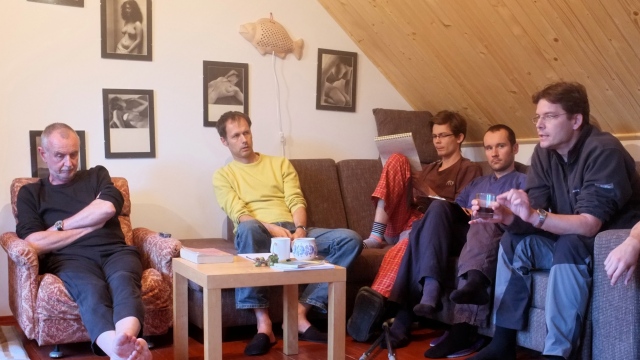
Michael Eido Luetchford
September 2013 — Banský Studenec, Talk 3.
Venue: Banský Studenec, Slovakia.
Michael Eido Luetchford · September 2013 — Banský Studenec, Talk 3
Source: audio transcript.
From the retreatPhotosRecordings5Chronicle
Audio
201309-talk3-Heart-sutra.mp3 in the Google Drive folder
What the talk says (short overview) — About these overviews
Mike explains the Heart Sutra, which most people chant without thinking about its meaning, as a teaching that the labels we give things have no separate existence and that in zazen we realise reality is beyond those labels. The sutra itself speaks of the practice of prajñā paramita, not of zazen, but to Mike it can only mean zazen, and what Avalokiteshvara says matches his own experience.
He first explains the Japanese title, Maka Hannya Haramita Shingyo, as the Japanese pronunciation of Chinese characters that try to copy the sound of the Sanskrit Maha Prajñā Paramita Hridaya Sutra, which shows how many problems translation brings. In his outline, Avalokiteshvara, sitting in zazen with the Buddha, recognises that the five ways of describing the psychophysical body, physical form, feeling, perception and the others, are only labels, not real things. When we sit in zazen and are not thinking about something, Mike says, we stop discriminating and separating the world into things, so we can see that anger, for instance, is a label we give to a state, not a separate thing we have inside us. The sutra's reversals, which the Japanese chant as shiki fu i ku, ku fu i shiki, are in his view an Indian logical way of insisting that two things are identical, like a modern truth table. The list then goes through the organs of the body and the senses, and in Mike's paraphrase, since there is nothing to attain, the practice of zazen gets rid of mental illusion and grounds people in reality, while the closing mantra means gone over to the other side, which to him is the side where everything is oneness.
Some interpretations speak of emptiness, but Mike asks what emptiness means, since even space is full of text messages. His teacher said that the state which is empty is the state we have when we act fully, with thinking and moving, mind and body as one, and that in this state we do not give labels to things. Mike's own explanation is that the form we give a name to is different from what is there without the label. In modern life this means remembering that we only make models of the world, and that even Buddhism's model of becoming balanced through zazen is only a model, a finger pointing at the moon. He offers another model, four phases of zazen, from a mind going round and round to simply sitting in the room, and says that the important thing is the balanced posture, even when we seem to be thinking the whole time. When Boris asks how the sutra can say that there is no death, Mike answers that it does not deny death but says that real death is different from the word death. Human beings have built up ways of thinking and feeling about death, and in the balanced state of zazen these inventions of society do not exist for us, because the world of the present is different from the everyday world. He admits that this is difficult, wonders whether he himself will experience his death or will simply be here and then gone, and says that the people around him certainly will.
Complete English transcript — About transcripts
Editorial note: This transcript of a spoken talk has been lightly edited to read well as written text, keeping the speaker’s voice and meaning; the wording was adjusted with great care. We recommend listening to the original audio recording too.
Okay. This morning I'm going to talk about the… because I was requested to. And it's traditional in Japanese Buddhism to chant the Heart Sutra. Almost all Buddhist groups chant the Heart Sutra as a kind of morning ceremony after zazen. And it's very nice to chant it, to bring everybody together. Hello. Actually, I don't enjoy chanting, because making a singing sound fairly low, low, low, low, I usually have some feeling that I want to cough.
And it may be connected with my asthma. So I enjoy hearing the sutra chanted around me, but I don't enjoy making the sound myself. So in my group, we don't chant. But if somebody says, I want to chant, it's okay. I'm happy. And Yoko, my Japanese ex-wife, used to like to chant, so we chanted in those days. Most people think it's just a kind of… because it's in Japanese. Actually, it's in Chinese, not Japanese. And they hear something about the meaning.
But most people don't think about the meaning when they're chanting it, which is good. There's no need to think about the meaning. But I just want to talk about the meaning, because we're not chanting it. So, Maka Hannya Haramita Shingyo is the Japanese pronunciation of Chinese characters. And all these sounds which we chant, kan ji zai bo satsu jin han, and so on, are the Japanese pronunciation of Chinese characters. This very strange situation happened because in ancient times all Japanese literature was written in Chinese. If you give this to a Japanese, a modern young Japanese person, they can't understand anything. Of course, they can't see the characters.
Even if you give them the characters, they can't understand it, unless they studied Chinese literature. Similarly, in Europe, in ancient times, all the religious writing was in Latin. So I guess each country pronounced Latin in its own way, maybe with a different accent. But in the case of Japan, Japan adopted Chinese characters for its writing system a long time ago.
But they decided to pronounce them with a different sound. So, for instance, Chan, the character Chan, is pronounced Zen in Japanese. So similar, but not the same. So if you give this to a Chinese person, they can't understand. If you show them the characters, Maka Hannya Haramita Shingyo, they don't pronounce them like this. So, anyway, Maka Hannya Haramita Shingyo is kind of trying to copy the sound of Sanskrit. It's a phonetic translation, except for the last word. So maka stands for maha in Sanskrit. Maha… what's the next bit? Yeah, yeah, but I forgot. My mind is not so clear. Maka. Yes, maha means great, so maka also means great, but I forgot the word exactly for… where is it? Hannya, yes, it's easy. Hannya stands for prajñā. Actually, probably the more accurate pronunciation of prajñā is pranya. Haramita stands for paramita. And Shingyo is a different translation, a literal translation of Hridaya Sutra. Hridaya means heart.
So in Sanskrit, Maha Prajñā Paramita Hridaya Sutra, translated into Chinese and then pronounced by the Japanese as Maka Hannya Haramita Shingyo. So in that simple fact, you can see what problems there are with translation. Anyway. Another factor is that in Sanskrit there is some extra in the beginning and some extra at the end. So this is only part of the sutra. And the bit at the beginning is a kind of introduction.
And then this is the main teaching. And then at the end there's some discussion by the group. So I'll give you a quick outline of what it says. The part which is not written here says Gautama Buddha was staying on Vulture Peak with lots of monks together in a crowd. And he was just about to stop sitting in zazen, and all the bodhisattvas gathered round. One of them was called Avalokiteshvara. He is a kind of legendary bodhisattva. Anyway, he was there. And he recognised some things while he was practising zazen.
While he was practising zazen, he recognised that the five different ways of describing the body and mind, the psychophysical body — physical form, feeling, perception, human constructs, constructions — have no existence of their own. So Avalokiteshvara was sitting in zazen with the Buddha and lots of other people. They were in a sesshin, maybe, and Avalokiteshvara recognised that these labels, form, feeling, perception and so on, were only labels. They weren't real things. And there was another venerable bodhisattva there called Shariputra.
And Shariputra said to Avalokiteshvara, if you know a sincere young person who comes from a good family and they're interested in practising zazen, what should we teach them? And Avalokiteshvara said to Shariputra, well, when a sincere young man or woman from a good family starts to practise zazen, they will start to recognise that these five labels that we use to describe the psychophysical body have no separate existence of their own. Okay, that's the introduction. So, does that make sense to you?
What he's saying is that when we sit in zazen, there is a state in which we don't see things as things, because things have names. And if we stop naming things, then there are no things. It's a bit philosophical, but he's just saying that if we sit in zazen and we're not thinking about something, we're not discriminating. We're not separating the world into things. And so we can realise, oh, I see, the things like emotion or anger or feeling are labels. So, for instance, take anger. People talk about anger as if it's something that you have inside you.
And you can kind of get rid of it, or push it down. And that's a nice, sensible way to think about it. But the real situation is not so simple. There is no special thing called anger, separate from everything else. It's just a label we give to a state. Does that make sense? So we are always constructing models of the world. And I'm constructing a model now, using words. But the reality is beyond the words. So we can understand that what Avalokiteshvara is saying is that in zazen we realise reality is beyond our labels. That's pretty advanced, really.
Then Avalokiteshvara goes on to say physical form is not something separate. And then he says it the opposite way round: there is nothing separate which is called physical form. And then he says the same thing in a different way. He says there's no physical form different from what is not separate, and there is nothing that is not separate different from physical form. So this is kind of part of Indian philosophy, which is like a modern truth table. Any scientist will know what a truth table is.
Roman: What kind of table?
Mike: Truth table.
Roman: Truth table?
Mike: Zero, one, one, zero. So it's a kind of fundamental principle in logic. The Indians liked to use this when they explained things. So physical form is without its own existence. Own existence is like physical form. And then the negative: there's no physical form that's different from being without its own existence. So it's a way of explaining that two things are identical, in a strange logical way. And when we chant the Heart Sutra, we can hear this reversing in the Japanese chanting.
Shiki fu i ku, ku fu i shiki. Then shiki soku ze ku, ku soku ze shiki. So a lot of the Heart Sutra is written like that. It's a way of insisting on identity. So he goes on. Physical form is the first of the five ways of describing physical existence. Sorry, the first of the five ways of describing the psychophysical body. And these are called the five skandhas. Skandha was a term used in ancient Sanskrit, not only in Buddhism but in philosophy and simple science.
These are five ways of describing human consciousness. So the physical body was the first, physical form was the first one. And then Avalokiteshvara goes on to say that the other four also don't have their own separate existence. And in fact, all things in the world are without their own separate existence. And so when we think of things in the world coming into the world, they're not in fact separate. We call things, for instance, pure or impure. Or I can put some other examples: good or bad, big or small.
And so on. So we discriminate. So none of those things have a separate existence. They're just our ways of making a model of the world. So I'm big, you're small. Water is pure, mud is impure. But they're only classifications, and they're not reality. And then he goes on with a long list of different things which don't have separate existence. And he goes through all the organs of the body, such as ears, eyes, nose, tongue, the body.
Mind. And the things which we… the characteristics of sight, sound, smell, taste and touch. They're all labels. And we can think, for instance, we talk about the eye being here, but actually the eye includes the optic nerve. Which is the eye and which is not the eye? So when science looks at the borders between things, it finds that things are not so separate. So he goes on: all these different labels are not what reality is like. So we think that we're building up understanding, but there's no building up of understanding.
Nothing to attain, nothing to get. And then he says to Shariputra, since there's nothing to get, the practice of zazen gets rid of mental illusion. People who practise zazen realise that mental illusions are not real. So they overcome their delusions and are grounded in reality. All the Buddhas of the past, present and future have found salvation in the practice of zazen.
It wakes them up to wisdom. So the mantra which describes zazen is great, supreme, unequalled. It can heal suffering, and it is true, not false. And this is the mantra of zazen. In Sanskrit: gate gate paragate parasamgate bodhi svaha. Gate gate paragate parasamgate bodhi svaha. Or in the chanting: gyate gyate haragyate harasogyate boji sowaka. Boji sowaka. So that's a kind of mantra. And that's the end. Sorry—
Participant: The meaning of this?
Mike: If you read at the bottom: the meaning is gone, gone, gone over to the other side. To me, that means gone, gone, gone over to the side where everything is oneness. Hail to perfect intuitive wisdom. So that's the end of the chant. And then there's just a little bit at the end. So the Buddha gets up from zazen and praises the words of the great bodhisattva Avalokiteshvara. He says, Good, good man. That's how you should teach people to practise zazen. It will make all the Buddhas very happy. And when the Buddha said these words, Shariputra and all the other people in the sesshin rejoiced and praised the Buddha's words: Yeah, yeah, man, he's really right. Yeah, yeah.
Participant: Big party. Big party. Yeah, open-air party.
Mike: Yeah. Yes, yes. That's true. And that ends the sutra of the heart of the practice of zazen. No, it doesn't actually say zazen. It says the prajñā paramita. It says the practice of the prajñā paramita. It says the Buddha was practising the prajñā paramita.
And it says, what should we do to tell somebody how to practise prajñā paramita? And I explained what prajñā means yesterday. Paramita means a kind of practice. So, to me, it can only mean zazen.
And when Avalokiteshvara talks about everything being different from the labels that we use, and we realise this in zazen, I can say, yeah, man, right on. Because that's my experience. But it doesn't actually say zazen. And in fact, you can find even in the Shobogenzo that Master Dogen only talks about zazen in specific terms.
He uses lots of different ways of referring to zazen: the great practice of balance, the practice that will give us freedom, and so on. So it was quite common in ancient times not to use a specific word, but to refer to the practice in terms that sometimes sound exaggerated. And lots of the descriptions sound rather exaggerated or spiritual. But we have to remember that people's way of thinking was very different from ours. So that's the meaning that I understand from the Heart Sutra. You can find lots of different interpretations, some more spiritual.
And some refer to emptiness, because the two words in the Sanskrit that are used for this changing around are rupa and shunyata. Rupa means physical form, and shunyata means emptiness. But the question is, what does emptiness mean? Even space is not empty. It's full of text messages. When are you coming home to lunch? You said you'd be home at eleven, and now it's three. So what is emptiness?
This is the problem. I interpret emptiness based partly on my teacher's understanding and partly on my own understanding. He liked to say that shunyata meant the state which is empty. Emptiness is an abstract noun, but the state which is empty brings it to us. So he said, the state which is empty is the state we have when we are acting fully, when we don't split ourselves into thinking mind and moving body, when our thinking and moving and mind and body are one. He said, in that state, we don't see things separately. We don't give labels to things.
So he interprets emptiness in that way. Sometimes he said emptiness means the balanced state. Sometimes he said emptiness is the state in zazen. I like that, because it gives some real understanding for me. But I think in the sutra it refers to an even more abstract meaning: physical form, and what the physical form is talking about, which is different from its label. So it's quite difficult to talk about. Form is emptiness, emptiness is form. This is the way people translate the Heart Sutra. Form, great, I understand. Emptiness, I don't understand.
What do you mean, emptiness? So I found my own explanation for what the Sanskrit is referring to. The form which we give a name to — body, knee — is different from what is there without the label. Empty of the label. So, quite a philosophical way of thinking, really. But if we take it into modern life, we can say: just remember that all the things, the labels we give things, are not real. Just remember that we only make models of the world. The world itself is different from our models.
Just remember the model that Christianity made of the world: controller, heaven, human area, hell, which seemed to work. It seemed to work for a long time, but it's only a model. Just remember that the model that Buddhism makes of balance — practising zazen to become balanced, then your life will be okay, and acting without thinking — is only a model. Don't mistake the model for reality. A finger is pointing at the moon in an old Buddhist story. The finger is our model. The moon is the real situation, which we can't know. So zazen gives us an opportunity to experience undivided wholeness. Oh, my zazen doesn't.
What's he talking about? Well, I don't know myself. I'm just thinking about all the things I have to do next week. So even the model of zazen is only a model. So I'll make another model now. There are four phases in zazen. In the first stage, we sit in zazen and our mind is going round and round. And then, as we notice our mind is going round, we come back to reality.
Again and again and again. And the second stage: our knees hurt, noise, ding, dong outside, you know. So the second stage is that we notice the physical world. In the third stage, we kind of alternate between the thoughts that come in, and then they go, and then we notice our body, and then it goes. So it's mixed up. Sometimes we're thinking, but we just leave it, and we concentrate on our posture. And then sometimes we forget about our pain, and we forget about the ideas, and we're just sitting in the room. So that's the stage that he's talking about, where we don't think about the world, we stop focusing on our physical situation. But that's only a model. And actually it's mixed up in zazen, mixed up. And sometimes we're just thinking the whole time. Why are we thinking the whole time sometimes? Because we train ourselves to think the whole time. We don't give ourselves any break. Some people need to think about something all the time. They don't like not thinking about things. Or sometimes we have a very busy time with our work or our life's work. So consciousness is like a kind of engine. It takes a long time to slow down. But even so, usually after two or three days we can settle down. But in our daily practice, if we sit for half an hour in the morning or something, or in the evening, maybe we appear to be thinking the whole time. But the important thing is our posture.
Because we are sitting in a balanced posture, we get the benefit of that posture. Sometimes it feels like there's no benefit, only pain. But even learning to live with pain is a benefit, up to a point. So the best attitude to zazen is just to concentrate on sitting. And if you find your mind is busy, busy, busy, you can say, oh, I need a break. Then my mind will settle down, maybe. So we don't need to worry.
And I usually sit facing outwards. I see all these people sitting very quietly and balanced. But inside all these people's heads, there are lots of little electrical signals going around. Bzzz, bzzz, bzzz. Is my zazen okay? Should I sit straighter? Why does my knee hurt? Oh, I'm going away next week, you know. But I can't see any of it.
Participant: Girls, girls, girls, girls, girls.
Roman: Lisa said…
Mike: After you sent her that, she said to me she wants to come on the next retreat if there are naked men. Okay. So, I've forgotten now. So… inside your head, human beings are very stupid. We sit very calmly and inside our head the whole world is shooting about. But it's nothing. Well, that much. But we give so much importance to all these little signals in here. You can't even measure them. Whatever is happening in your head is okay. It's probably the result of what you've been doing with your life. So it's your fault. So, you know, you can't spend two weeks getting very excited and getting very tired, and then want to sit in zazen very peacefully. Zazen just shows you what you are. So anyway, I'll stop talking.
Boris: I want to come back to the Heart Sutra and to Avalokiteshvara, who mentions there that there is no ear, no eyes and so on. And he also mentions that there is no death, there is no birth, and there is no way to reach satori. How can you explain this, that there is no death? How do you explain it? As to how Mike feels it, I would also add that some maybe not, but some maybe yes, are certainly touched internally by the fact that things are finite, and so also by death in some way. Everybody has some experience, maybe, with this death in everyday life. So for me this is an important question, in the Heart Sutra, I mean, this kind of thinking.
Mike: So where is death?
Boris: There is no death now.
Mike: I can't see any death now. I'm alive, I'm not dead. You're alive, you're not dead. So from one point of view, if there is no death here, there is no death. But maybe your father's going to die soon. Then there will be death for you, for him, and you will experience his death. But it's because we built society that we think like this. So we think about death. So we have a word, death. But actually, it's a very simple event. But human beings have built up a way of thinking about death and feeling about death, and so on.
So he's saying real death is different from the word death. So he's not saying there is no death, there is no ageing, and so on. He's saying that in zazen, when we reach a state which is nice and balanced, then we can say all these things which human beings invented in society don't exist, because we're not taking part in that world. So the ancient masters said there are two worlds. There's the world of reality, and there's the everyday world.
And the everyday world is the world where we fall in love, eat food, experience death, get old, and so on. And the ultimate world is the world of the present. And in the world of the present, these concepts don't have any meaning. So it's a philosophical point of view. But it doesn't mean there's no death. It means death is the way human beings describe this event that happens to us, plus all the different ways that we recognise it and deal with it and feel about it. So you can say death is the human model. The fact itself is different.
It's quite difficult, because of course there is death. We can't say there is no death. It doesn't make any sense. But for me, when I die, I wonder if I have a death, or whether I'm here and then gone. I don't know. But certainly people around me will experience my death. Will I experience the same thing as them? I don't think so. So maybe we've constructed a way of experiencing that we share.
But actually: now alive, now alive, now alive, not alive. But it sounds very abstract, doesn't it? It's enough to make you go to sleep, really. I mean…
Participant: I'm just quiet.
Mike: No, you know, you think, oh, Heart Sutra, it's okay chanting. What are they trying… what are they trying to tell me?
Indian society was very philosophical, very spiritual originally, and then very philosophical. So even Buddhist theory became very complicated in India after the Buddha died. And if you read the Pali sutras or the Abhidharma, you can find a very, very complex, complicated interweaving of ideas.
But, you know, if you're in an emergency and you jump to save somebody, and you lose your life, I don't think you experience death. But other people experience your death.
Pavel: Time to go.
Participant: Time to sleep.
Pavel: Time to sleep. Okay. Thank you.