Dogen’s Teaching as a Way of Living
Mike: a simple but very difficult way of living that suits him; not a religion, not the only way
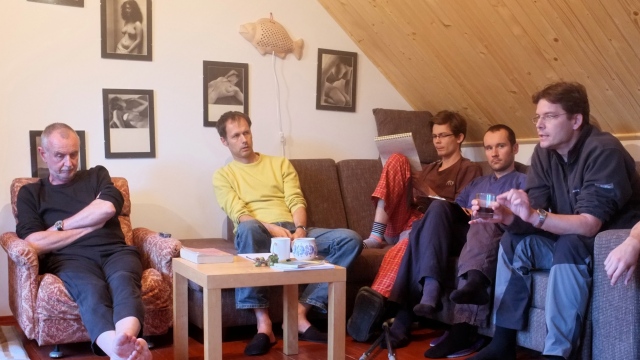
Michael Eido Luetchford
September 2013 — Banský Studenec, public talk.
Venue: Banský Studenec, Slovakia.
Michael Eido Luetchford · September 2013 — Banský Studenec, public talk
Source: audio transcript.
From the retreatPhotosRecordings5Chronicle
Audio
201309-public-talk-How-to-live-your-own-life.mp3 in the Google Drive folder
What the talk says (short overview) — About these overviews
In this public talk Mike presents the way of living he found in the teachings of Dogen: life is only here and now, everything we do has a result, and it is not necessary to think before we act. He offers it not as a religion or as the only way to live, but as a simple teaching that suits him and that is very difficult to practise.
Living for twenty-three years in Japan, he noticed that Europeans think in a strong polarisation of right and wrong, while Japanese culture is more vague, and such differences made him think about himself. He admits he does not know why he went to Japan or why he came back; the only way he can find a reason is by looking backwards at his footprints. Dogen's teaching to live for today sounds freeing, but Dogen adds that whatever we do gets a result without any exception, so we need to concentrate on what we are doing now, which is especially difficult in the modern technological world. Mike explains prajñā as before knowledge and, as it seems to him, as doing something before we understand it or think about it, a kind of intuition or creative impulse that we all have. Little children have lots of it, he says, but school covers it up, and when he heard these teachings he wanted to take away the rubbish on top and be himself, remembering that he will get the result of his actions.
In the discussion he says that each person has to find their own present, which is a kind of feeling, because we always know when we are not in it. In human society we have to plan, but we can remember that a plan is only a plan, and changing our mind can sometimes be responsible: if we hold on to a plan, we lose our freedom. Asked what is right, he says Dogen taught that there is no right waiting for us to do it, so we can act sincerely and trust ourselves, which does not mean being irresponsible or selfish. He sees zazen as one way, not the only one, to balance ourselves, so that we stop separating ourselves and feel whole, and he calls the idea of a special path to becoming an enlightened Buddhist rubbish. He does not feel that Buddhism is a religion, reads the precepts as signposts that show what disturbs ourselves and other people rather than as rules, and criticises the habit of projecting everything onto a perfect teacher. Recalling his depression and anger after a heart operation, he says we have to accept what we are like. Intuition is not emotion but lies underneath it and works before thinking, so we cannot think it out and make it stronger, but we can take away what lies on top of it, and practising meditation means taking things away or dropping things off.
Complete English transcript — About transcripts
Editorial note: This transcript of a spoken talk has been lightly edited to read well as written text, keeping the speaker’s voice and meaning; the wording was adjusted with great care. We recommend listening to the original audio recording too.
Okay. My name is Mike. I live in the UK, in London. But for twenty-three years I lived in Japan. And during those twenty-three years, I studied what people call Zen. People in Japan don't call it Zen. Zen means meditation, and it's half of the word zazen. And zazen means sitting meditation. So I studied with a Japanese monk.
And twenty-three years passed very quickly. I came back in 2000. When I came back, I was very shocked by European culture again, because it's very different from Japanese culture. So it took me four or five years to get used to European customs again.
But I started a small group of sitting meditation in England, where I was living. And in some mysterious way, I now have people who are practising with me in seven or eight places in England, and in the Czech Republic, and Slovakia. I don't really know why. But when people ask me, I usually say yes. So, for instance, Boris asked me to come here, so I said yes. And then Robert arranged to have a retreat near here. So I said yes.
So it makes me very happy to say yes. I think the title of today's talk, I saw a poster of myself, and it said How to live in today's world, or something. How to… Right, and I can't tell anybody how to find their own way. But I have found my own way, what people call Zen, or what I like to call the teachings of the Buddhas. I have found a way to live. It's not the only way to live. There are many ways to live.
But it suits me. And the main points in my philosophy came from the Buddhist teachings that I studied in Japan, which were very different from the culture I grew up in, which was basically a Christian culture. Even if on the surface it wasn't Christian, underneath it was Christian. So, living in Japan for twenty-three years, I noticed the differences.
When I say I noticed the differences, it was very difficult when I went to this very different culture for the first time. After a year or so, I started to think the Japanese people are crazy. They have a different way of thinking. And I felt my way of thinking must be right, so their way of thinking must be wrong.
And after three or four years, when I noticed this fact, I realised one big difference: because I was from Europe, I thought about right and wrong. I'm right, therefore you're wrong. Or you're right, therefore I must be wrong. Oh dear, oh dear. So this polarisation between right and wrong is very strong in European culture.
Maybe it's different in different countries in Europe, but it's there as part of the culture. And in Japan, they don't have that polarisation. It's more vague. And so people might say, as I felt, oh, the Japanese don't have any morality, because they don't have a clear right or wrong, yes or no, black or white. But slowly I realised that their culture worked in its own way, and the polarisation of my culture had some disadvantages. So many differences like this made me think about myself. And I don't know why I went to Japan. And I don't know why I came back from Japan.
And the only way I can find a reason is by looking backwards. If I look backwards, I can see my footprints. And so I can see, oh, I came from there, so I must be going this way. Maybe that's unusual. But I think many people don't know where they're going or why they're going there. So they make up reasons, and the reasons make them feel satisfied. So they're happy. But frankly speaking, there are many things I don't know about my life: where I'm going, why I'm doing this, and so on.
And since I came back from Japan, talking to people, I found that privately or secretly many other people feel like this. Of course, you can't say it to other people, so you just keep it secret, do you? But I'm going. Now, all these kinds of things were moving around in me during the time I was in Japan. And then I came across the teachings of Buddhism, but not as some kind of religion. I'm not interested in religion. In fact, I dislike religion, because it has some kind of effect of putting you in prison. But in studying some teachings of an old Japanese monk from the 13th century, I found that he was saying things that answered my uncertainties. So I'd like to tell you about some of those. The Japanese monk from the 13th century is called Dogen. And he wrote many essays, which people in Japan ignored for more than five hundred years.
But recently people started to translate what he wrote, and they found that his thoughts are very modern. So he became very popular in America, and with scholars of Buddhism, and so on. But his writings are from the 13th century, so they're very difficult to understand. But I helped to translate his works into English for eighteen years, and published books in English. So eventually I could understand what he's saying. The first thing he says is: life is only here and now. Don't worry about tomorrow.
Don't worry about yesterday. That sounds too easy. If we try not to think about tomorrow and not to remember yesterday, it seems almost impossible. However, it sounds really nice. Live for today. Sounds great. It makes you feel happy. And let's not delay. Now is the only time. That's great. Then he goes on to say: but everything you do has an effect. So that's a bit disappointing. Disappointing.
Go on, go on. It's disappointing because if somebody says, Live for the day, you feel, I'm free, I can do whatever I like. But then he says, yes, but whatever you do, you get a result, without any exception, even if you don't know it. Putting those two things together suggests that we can live for today, for now, but we need to concentrate on what we're doing now. That's a very, very simple thing. But it's very, very, very difficult to do.
We're concentrating on our future at the minute. I don't know. You know, you know what it's like. We try to live for now and concentrate on the present, but we're pulled into another place. How should we solve that problem? The teaching is that we should live for the present, concentrate on the present.
And make sure that what we're doing now is okay. It's great. But if we are talking on our phone and don't see where we're walking, we may get knocked down by a car. Then we get the result. So, a very, very simple teaching. Very simple. But especially in the modern technological world, very difficult to do. So there we are.
We have a very nice teaching, but it's very difficult to do. So there are many stories in Dogen's writings and in other Buddhist writings talking about concentrating on what we're doing now. The other thing he says, which is very helpful, is also very difficult for us in Western culture. He says we don't think our way through our lives. But when I was brought up, people said to me, Think before you do something.
But Dogen said it's not necessary to think before you do something. He didn't say, Don't think before you do something. But he said it's not necessary. We always think before we do things, at work especially. We have to plan. And it's impossible to go into work and say, I'm a Buddhist, I don't need to think before I do things. But if we study a bit more of the explanation, there's something very interesting in that teaching. In these teachings, which people call Buddhism, there are many words. People who call themselves Buddhists all know these words. One of these words is prajñā. Ah, prajñā, yeah. What is prajñā?
Well, prajñā is a Sanskrit word, and pra means the same as Latin pre. And jñā is the same as the Greek gnos, which means knowledge or understanding. So prajñā means before knowledge, before understanding. Some people say prajñā means wisdom. Very wise people know how to live. But it seems to me the true meaning of prajñā is about doing something before we understand it, or before we think about it.
So what Dogen was teaching, and what many people after him taught, is that we can live without thinking about how to live. And many people find that very strange. But I think maybe if you're a kind of artistic character, it's not so strange. We can call it some kind of intuition, or creative impulse, or pre-knowledge. But it's something which tells us what to do before we clearly think about it. And we all have it, all the time. But we cover it up. Actually, it is covered up for us. When we're little children, we have lots of prajñā. And then people say, You've got too much prajñā.
Go and sit in the school and do what I tell you. Sit still. I'm going to tell you about the world. And a child wants to say, I know about the world. I don't want to sit still. I can find out without listening to you.
But it's no good. Except for very difficult little children who are very stubborn. You maybe grow up to be artists, or musicians, or something where you need to be stubborn and follow something. So this is a kind of prajñā. Now, when I was young, my prajñā was covered up for a long time. Then, when I heard about these teachings, I thought, okay, I don't want all this rubbish on the top. I want to be myself.
So I can just do whatever I like, providing I remember that I will get the result of my action. So this is a kind of outline of a way of living that the person I studied is talking about. Okay, so concentrate on the present. There isn't anything else. So don't worry so much about what's going to happen next year, or the year after next, or in ten years' time. Remember, everything you do has a result. And you don't need to think about everything you do. Sounds good.
So I started living like that. Not because I chose to live like that. It just happened. And it works. And this was amazing to me. So after ten or fifteen years, I realised, I see, it's a good way to live. So it's a valid way to live. So maybe there are other people who would like to live like that. So I started giving talks, and I ended up here in this room. So all the rest of the things that you hear about Buddhism, I'm not interested in.
I have what is called a rakusu. Very sacred. This makes me into a Buddhist now. It's some kind of symbol. But actually, it's nothing. It's a piece of material. If I put it on, I remember the Buddhist monk I studied with, who wrote on the back here. He is a very stubborn man, and he used to lose his temper sometimes.
So I learned a lot from him. But it's not important. To me, what is important is a kind of freedom from my thinking, and my worrying, and my lack of confidence, and many things like that. Because I can have confidence in myself. Maybe what I do is not so good, but it's the best I can do. And I found over thirty years my life is not so bad.
I have arguments with my partner, and I make bad decisions, but it's a great way to live. And I like to take away all the rubbish that the groups teaching Buddhism talk about. I enjoy it. Because for me, and this is only a personal view, they miss the point. So my way of teaching is very simple. Very simple to teach. Very difficult to do. So I'm still trying.
So I'd like to finish here. And if anybody wants to ask any questions or disagree with me, it's fine. You follow your intuition inside you. Stupid questions are most important. The more stupid, the better, because we're all stupid, nobody is better. The more stupid, the better.
Boris: When it is said that one should live for the present, what is the measure of the present? Is it the hippie measure, this day, or the standard measure of some normal human life, where, say, one plans as part of the culture? Or only this day? Or is it the standard perception in a culture, for a person who is thinking about ordinary life over a period of time, months, years? So what then is the present?
Mike: Yeah, it's a good question. So I have my present, you have your present. I know my present; you have to find your present. And what I said just now in my talk is a kind of ideal. Actually, where is the present?
Participant: The present is also wide. The present is one moment, one instant.
Robert: She suggested a different translation for the word present, a different Slovak word for it.
Mike: Okay. So if my telephone rings and I answer it, that's present. If my child cries in the other room and I…, that's present. So how can we decide what is present? It's a very big question. But we always know when we're not in the present. You know, you meet a friend, okay, and you have coffee together, and then into the room over there comes a very attractive, I don't know, woman. And you say, oh yes, yes. You're not in the present.
You know immediately. If your baby is crying and you're thinking about something else, you feel you're not in the present. So being in the present is a kind of feeling. Even if somebody texts you: if you read the text and ignore everything, you can feel you've lost the present. For instance, if you say, Just a minute, please, I've got a text here, I'm just going to read it, okay, it feels different.
So we have to find for ourselves what the present is. What is being in the present? It's a kind of feeling. In ancient times, they wrote: have your feet on the ground. But it's a very important question that I can't answer. So I don't mean to suggest any kind of life, like a hippie life or anything. Just feel a way of living, a way of living whichever life you choose. Yes.
Participant: Well, if we think about it in our brain, you can say, if I hadn't planned, I wouldn't have come here now. And I can't imagine, you know…
Mike: But I don't know where I'm going. Of course, we have to plan. Okay, so we can make a plan. But we can remember that it's only a plan. And halfway through our plan, we can say, oh no. Yeah, you meet somebody and say, I want to be with this person forever. After a couple of months, you think, no. Yeah, we can change. We don't have to be consistent.
Question: And the responsibility?
Mike: To change our mind sometimes is to be responsible. I know somebody who had a very rich friend. And that very rich friend invited them to go and live with her in the country, in her very big house. And she said yes. But in her gut she knew it was not good. But she had many feelings of obligation: maybe I should. Underneath, she knew. So if she had said no, or even changed her mind, maybe that would have been better. Yes.
Participant: I think it's much more difficult.
Mike: Much more difficult. So how can you be responsible?
Participant: I meant, I forgot what we were talking about before. How can I be responsible? When you were talking, I meant that I go somewhere and halfway I make a different decision. I make a different decision. But sometimes, if you are not alone in your work, and your decisions have an effect on other people, it may sometimes be selfish to make the decisions when you think individually. Shame on you. What is right? Like what you feel, this is it, or also what you are?
Mike: Yes, I know. These are very difficult questions. What is right? And this priest in the 13th century called Dogen said there is no right which is waiting for us to do it. So he means we can't think what is right and then make ourselves do it. But we can act right. That sounds strange, because we're taught to think and then do. Sincerely, directly, our action is the best we can do. And that's the best we can do. It's not a very good answer.
So we spend a lot of time, we use up a lot of time worrying. I want to do right, I don't want to do wrong, what should I do? Dogen says just do. Trust yourself. Trust yourself, trust yourself, and do. He doesn't mean just do anything, or be irresponsible, or be selfish. But it is something difficult to talk about. Many years ago, our culture separated thinking and the mind from the body. So in medieval times, the spiritual world is here, and the physical world is here.
So they even thought that God maybe is controlling us like puppets. And the physical world is not sacred, maybe even sinful. Maybe even sinful. So we have to worship the spiritual world. We should become whole.
Whole means everything: good, bad, selfish, unselfish, right, wrong, all together. When we act, there is some intelligence in our action. But we are taught that intelligence works like this: first we think, then we control our body, then we act. And Dogen said no. You can experience this especially in sport.
A tennis player puts the racket to the ball. No time to think. And there are many different examples in music. And my partner is a potter, and she makes pots. It doesn't come from here. It comes from here. Any creative person knows that something you create fully, all of you… Or a musician who is playing. A composer.
Yeah, but I have a friend who plays in an orchestra. He plays the cello. And once at a talk, I said, It must be wonderful to be a musician: then you and your instrument are one. And he said, No, no, usually I'm thinking, what shall I have for supper? But you know what I mean. If I say doing something fully, we know. If I say being in the present, we know what it's like not being in the present. So it's some kind of fullness. Or gut feeling. Does that make sense?
Participant: I've forgotten the question. I want to ask you how we now connect all the things that you said just before with this: why is it important, or do you think it's important, to practise meditation?
Mike: Yeah. Well, meditation is not the only way. But basically, zazen, or what people call meditation, is a way to balance ourselves. So, for instance, now I'm sitting leaning against the chair, to the right-hand side, with pressure here, and my legs underneath here. And this posture has an effect on my body and on my mind.
Or if I watch television, where's the controller? You know, after an hour or so, you feel… So our posture has an effect on all of us. So if we meditate, we sit. So balance is not leaning anywhere. And somehow, when that is possible, we stop separating ourselves and we let ourselves come together.
If you go running, you do the same. Anybody who goes running here: for the first ten minutes you're thinking, and after half an hour you feel, ah. So, something that makes us whole. We know when we feel whole. We feel quite happy, satisfied. So doing zazen is a very simple way to do that. We can find a physiological explanation about the effect of posture on the nervous system. Well, actually, the best way is to try. I've been teaching meditation retreats for twenty years, and of course, people who did it before like to do it again.
But often there are one or two people who haven't tried it before. And I've almost never found anybody who didn't feel whole after a couple of days. So I think, for me, zazen is a nice way to make myself at home. That's all. It's nothing more special. People say it's some kind of special way to become an enlightened Buddhist.
But that's rubbish. You can become a human being. And if you find out how to live, and if you are happy with yourself most of the time, that's a kind of enlightenment. Oh, I know who I am.
Argumentative, stubborn, kind, selfish.
Participant: I don't know if I can formulate my question; maybe I will skip some sort of language…
Mike: Good.
Participant: It's about you. You told us that you were not very interested in religion. But, you know, when you are talking about Buddhism, it is very much connected with religion. And also this talk is more about how to be here and how to live here. So you mean we don't even think about some other questions, like, you know, what is afterwards?
Mike: I wait and see. It's enough. I don't even know what tomorrow is. How can I know what is afterwards? So I wait for tomorrow, and then the next day.
Participant: Maybe this monk has said this, the one in your photo.
Mike: This monk has said this. Yeah. But the question is not that that monk said it, so I believe it. I knew it in myself already. This is the point. So whether there's a life after dying… It would be nice, if it's a nice life. But I don't know. It'd be nice. And I studied a few Buddhist masters, for instance Nagarjuna, who's a very ancient master. And he said, You can't go on to have a life after this one. Ah, okay, I thought so. Yes, you're right. So I don't know whether I'm right. I'll find out later. But it doesn't interest me, actually.
Question: The acceptance of the situation? Why do you think about that? Of your situation, of your life, even the afterwards…
Mike: Well, in a way, but also accepting my attitude. So, for instance, in January, quite unexpectedly, I found I had to have a heart operation. So I had to have a heart operation. Afterwards, I became very, very, very depressed.
And angry, and shouting at my partner. So I have to accept that. So if I say, Oh, you are a Buddhist teacher, you must be…, and then I feel angry with myself, and so on, it's no good. So I have to accept myself. We have to accept that. Yeah. So we have to accept what we're like.
Participant: I am always thinking about real life on a very simple line, maybe with your everyday reality. And it is not very easy in our reality. And you have to, because you have children and no money, so somehow you have to think, oh, you have to…
Mike: Yes. You have to do.
Participant: Maybe I have this inclination to plan my future in some way, to make me feel more relaxed about it, because I have a family. I can't really just live for the day, because I think about them, to give them as much as I can. But that also makes me nervous, because I can do it now. How to balance this?
Mike: How to balance, that's right. That's right. So it's all about balance, really. So we can't stop planning if we live in human society. And we can't stop having problems, because problems are life. There's no life without problems. So we can make plans, but we have to notice that our plans don't always turn out. So if we make a plan and we hold on to it, we lose our freedom. So we make a plan, and then we don't hold on to it.
Participant: You said it before.
Mike: So, balance, yes. Yes. Even worrying: we can't stop worrying. But we can remember that worrying doesn't really do anything except make us tired. But we can't stop. We're human beings.
Boris: You said that when you came to Japan, for some time you thought they are crazy. And when you returned to Europe, you felt the Europeans are crazy. Could you say something about it, what you felt or how it was?
Mike: Crazy. Okay.
Robert: Or the Japanese are crazy when you return?
Mike: That's the first thing. When I went to Japan. This is only a small example: people waiting to cross the road, and the traffic lights say red.
Everybody's waiting. Lots and lots of people stop. There's no traffic. And everybody's waiting. And then, because I'm a foreigner, I'm looking, so I cross. Crazy. Blimey. That's one thing. Then I come back to England, and I go to the bank to get some money.
And the person in the bank is counting out the money. And while she's counting out the money, she's talking to me: Did you have a nice holiday? I'm thinking, Count the money. It's crazy. Or…
Robert: They might all have machines to count.
Mike: Well, they do now, yes, they do now. So small things, but, I mean…
Robert: So, a generalisation, you know: what's the difference, or in what?
Mike: A difference: for instance, English people quite like to argue, to disagree. I'm right, you're wrong. Well, I don't know if it's the same in Slovakia. In politics: We are right, and you are stupid, stupid people, and we are very good people. That's impossible. Everybody knows it's impossible.
Yeah, these adult people are saying things like this. And in Japan, they never say it like that. And if people never say, I'm right and you're wrong, they always look for something in the middle. Yeah, so compromise. But of course, that has disadvantages. Sometimes you don't need compromise; you need to push. So, different. But I find polarisation in politics in Europe.
Can they say, I'm right and he's wrong? It doesn't make any sense to me.
Robert: Who lies better than is true? Who is better lying than is true? He is right. Who lies better? Is better at lying?
Mike: Sorry, I don't get it.
Robert: Who is a better liar, this person is right.
Mike: Okay.
Participant: Or the better you lie, the more right you are.
Mike: Okay.
Robert: Yes, maybe like that.
Mike: Yeah, yes, yes, yes. Yes, because you want to convince yourself. Yeah.
So when I think, you know, there are many problems in society, but the way we have to solve them is to argue. Me too. You know, I argue with my partner about something stupid. But I found in Japan it's very nice to be able to say, no, let's find the middle. And maybe the Japanese need to argue more.
Participant: Culture varies. People prefer to show off or to be heard instead of listening. And I feel listening is a great spiritual practice, because, like, you suddenly stop and start listening.
Mike: Yes. Listening is nice. I think many people feel that if they just listen, it's too passive.
Participant: Active listening, not only using your ears, but empathy and everything that involves.
Mike: Yeah. Yes, yes. Of course, I give you a picture which is not true. All pictures are not true. Even what I'm telling you tonight about the teaching is not true. Absolutely. Reality is not so simple.
Participant: Could it be said that this teaching is not about following certain dogmas, or about what we should and should not do, but about searching for the one way to ourselves?
Mike: Yes. Yes, exactly. There are some Buddhist precepts, ten of them. And I don't know about Slovak, but in English, literally translated, you should not do this, he should not get angry, and so on. But I don't think they mean that. They mean if you do this, you disturb yourself and other people. So if you get angry, you disturb yourself and other people.
If you criticise, if you criticise strongly, you disturb yourself and other people. So they're not a kind of rules. They're like signposts. That's all. That is it. I don't feel that Buddhism is a religion. And I can't believe it was a religion for a man called Gautama Buddha, because he made it up from his own experience.
My experience with religion is with Christianity, and it didn't help me at all, really. Although Christian people and Muslim people made huge contributions to society. But what I have been looking for is not religion, but a practical way to live. Happily, or a bit happily.
Boris: Doesn't it atomise society more, rather, that it plunges those people into themselves?
Robert: It doesn't atomise the people in Japan if they don't turn inside.
Boris: It is culture. Buddhism is major.
Mike: No, it's not. In Japan too, Buddhism has been made into a religion. We like to do this. What we do is we find somebody who can be our teacher, and then we project onto them everything we want to be. And then we push them upwards. And then we have religion. Well, they do that in Japan too. And then when you push somebody up to be your religion, because they're important people here, then we have a nice organisation. You don't know what he said; I know. And this is the organisation. That's how the Japanese… I don't know, people like to do it. Instead of looking at themselves, they want to have some wonderful teacher who is perfect. And it doesn't help anybody, really.
Robert: Is this a reason to search for the roots of Buddhism?
Mike: Well, there is a kind of structural analysis.
Robert: To escape from these organisations or hierarchy?
Mike: There's no escape. Avoid, yeah. Yeah, you can try to avoid, yes.
Participant: Like when you are looking for something, like what you are, then what do you do? Is this the reason why you studied the origins, in order to avoid it?
Boris: In your case, was this the reason why you tried to find the original roots of these…
Mike: In my character… Some people like to think and plan, feel comfortable, then they… Other people like to jump. I don't think it's better or worse. I go into a restaurant, everybody in the restaurant has decided: Shall I have this? What are you having? I usually go, I'll have that. And then afterwards, when the food is coming, I think, oh, I wish I hadn't said that. So when I went to Japan, I jumped. I just went. And when I took the Buddhist precepts, I just jumped. So I became a Buddhist by jumping.
And the main reason I found it interesting was this. When I was younger, I did a lot of mountaineering and rock climbing. And it made me very happy, because I was a very intellectual person already. But after rock climbing, I felt, now I feel satisfied. And then in Tokyo, I went to this meeting where people were practising meditation.
So I practised zazen for, you know, two or… I found, oh, this is the same feeling. Oh, I thought, I'll do this. And I did it. It's stupid, though, I guess. So I didn't have any idea about Buddhism, or any knowledge about it.
But then I became interested, I think because my teacher was telling me about this. I thought, ah yes, this makes sense to me.
Robert: We should do according to our feelings. When I'm angry, I can feel that the best way to solve this situation would be to attack someone. And it was said that each action has a reaction or some effect. If I attack someone, then maybe the reaction will not be positive. But it's my feeling at that moment.
Mike: So not feeling, but intuition. Intuition is not feeling. It's more subtle. But anyway, are you going to attack somebody? No.
Robert: If you want to explain some difference between feeling and prajñā: it's just that it's more subtle?
Mike: Well, feeling, emotion, is like waves. And we all have different feelings at different times. But intuition is underneath, underneath. I don't actually know how to explain it.
Robert: Yes, intuition is also a concept, isn't it?
Mike: Intuition is something that directs us, separate from our feeling. So it's very difficult to distinguish sometimes.
Robert: That means it may be that I will never be able to distinguish if it's prajñā or if it's emotion.
Mike: Yeah, maybe, yeah. But it doesn't matter.
Participant: That's what I'm saying. If emotion hurts and intuition doesn't…
Mike: Maybe, yeah. Emotion doesn't always hurt. Sometimes it's just a…
Participant: Well, you feel it, right?
Mike: Yes. Intuition makes you do things without thinking. So if I throw something at you… Or you're walking down the street and you feel, I'll cross over here. So we don't think about intuition, because it's before thinking.
So we can't think what it is and then make it better: I'm going to make my intuition stronger. But you can take away everything on top of your intuition. My intuition is here, everything's on top. So take them away. So we say that practising meditation is taking things away, or dropping things off.
And if you're very stressed and worried, and you go for a hike in the Rocky Mountains, after some time, things fall away. Then you have something uncovered, which is you.
Robert: If someone is throwing something at me and I catch it, that would mean that intuition is independent of our perception, our senses. Then I should catch it even if I close my eyes, if I don't see.
Mike: Or it is… It's not independent, but… It's very difficult translating, isn't it? Very tiring.
Robert: Yes.
Participant: I have no idea what that feels like. I can't even name what negative… If you get angry, you need to escape from that, right? But I need to ask about that previous question. You said that you need to…
Mike: It's very difficult to talk about intuition.
Participant: It was not about intuition.
Mike: Okay.
Participant: I was just talking about the first question, about being able to hurt somebody. I said that you can't only act, but I think you said that you had to think about yourself too. Sometimes it's very difficult. If you are angry, it would not be freedom, it would be anger.
Mike: It's very difficult, if you're angry, to think, I mustn't be angry.
Participant: You're supposed to not… I'm not behaving… Any time that I am not behaving, it's because I'm a human being, and I'm here, alive.
Mike: Yeah. So it's very difficult.
Participant: My duty is to somehow control myself.
Mike: If you can.
Participant: To put it in a bad way. Or all the time.
Mike: Yes. Self-control. Yes.
Question: Does meditation help your self-control?
Mike: Self-control, yes. Teach yourself to sit with yourself. Ah, it's me again. It's me. It's me again.
Participant: But it is easier to control yourself when you are balanced. So it's very new. It's done here like this. I think it has to be. I don't know.
Mike: Yes. Yes. Go to the gym every day, and you don't get so angry. Okay.
So shall we carry on or shall we stop? Enough, okay. Yeah, but I can't speak Slovak. So, thank you very much for listening. And maybe I'll see you again sometime, because I like this place. Okay.
Robert: He wants to thank you for visiting us.
Boris: And that you are not ready to go.
Robert: Okay, okay. It's a man who is walking in a tank top.
Mike: Yeah. It's a new shirt. Well, do you like it? It's fantastic. Yeah. Well, anyway, it's nice. I like Slovakia. English people are very, very intellectual. I find that in Slovakia you are more pragmatic, which I find really nice. No, it's very important: pragmatic, pragmatism. So who's going to leave first? Thank you, Robert, very much.