Old Writings and Our Own Life
Mike: writings full of legendary Buddhas, gods and demons are best read taking our own life as the basis
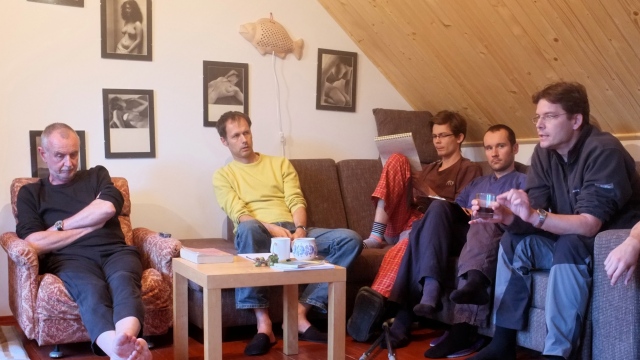
Michael Eido Luetchford
September 2013 — Banský Studenec, Talk 4.
Venue: Banský Studenec, Slovakia.
Michael Eido Luetchford · September 2013 — Banský Studenec, Talk 4
Source: audio transcript.
From the retreatPhotosRecordings5Chronicle
Audio
201309-talk4-Understanding-old-writings.mp3 in the Google Drive folder
What the talk says (short overview) — About these overviews
Mike says that the most helpful way to read old Buddhist writings is to take our own life as the basis: we can remind ourselves that Buddhism is realistic and about life here and now, so what an ancient author wrote must have a simple meaning, and if we cannot find it, we can close the book and go and read the newspaper. In zazen, which Dogen describes as sitting with ourselves and facing ourselves, we find ourselves, and once we find ourselves, we can understand which books are valuable.
Roman asks why Dogen believed in the seven legendary Buddhas, and Mike turns the question to how there can be legendary Buddhas that Gautama Buddha learned from; his answer is that he does not know, because these stories come from many hundreds of years ago, when the way civilisation expressed itself was very different. Where we might say that everybody has a subconscious, he suggests, people in second-century India may have said that there is a god or a demon inside us, which does not mean they were not realistic. Because what Gautama Buddha discovered was already here, people said there had been another Buddha before him; Mike does not know why there are seven, but thinks it may be a sacred number, and he says these Buddhas are not real and we do not need to look for the gods and demons that even Dogen writes about. As an example of a simple meaning, he reads Dogen's words that a donkey has not left yet but a horse has already arrived as a picture of a busy day, when one load of wood has not yet left the storeroom and the next one arrives. Searching for complicated meanings, he says, may be interesting for scholars, but it does not help us, and many Buddhist books are not so helpful.
When a participant tells how he looked for value in wearing a kimono, ringing the bell and sitting straighter than others, until he found the value in himself, Mike agrees that value is very important and adds that, to him, the story may be about respect as well. He recalls that in England in the 1950s he was taught to value cleverness and to put physical work at the bottom, which he compares to the Christian idea of abstract things at the top and physical things at the bottom, while in Japan people thank the person who cleans the toilet. From his own experience and his Buddhist study, he concludes that our habit of separating intelligence and physical action is very wrong, because physical action has intelligence, and this is why he likes it that zazen is so stupid and yet so valuable. When Robert objects that a spider, whose intelligence comes mostly from genetic coding, cannot be compared with a human brain, Mike says that Robert is not wrong. Yet Buddhist teachers, he says, keep saying that the mind and the body are the same thing, and when we do something fully, without thinking about it consciously, there is a feeling of completeness; so the model of the brain controlling the body is not enough for him, although we must accept the findings of science and remember that they are models. When Pavel retells a poet's account that his words come from something in him in the gap between two thoughts, Mike answers that our language misleads us: it is not something in him, it is him. And to the idea that a no-self experiencing now is the same as one that experienced long ago, he replies that the blood flowing to the brain clearly affects the mind, that he does not believe anything constant goes on from ancient times, and that he does not think there is some third thing observing something: it is just him.
Complete English transcript — About transcripts
Editorial note: This transcript of a spoken talk has been lightly edited to read well as written text, keeping the speaker’s voice and meaning; the wording was adjusted with great care. We recommend listening to the original audio recording too.
Roman: Could you explain why Master Dogen believed in such things as the seven legendary Buddhas? Because when he asked his teacher Tendo Nyojo how Kashyapa Buddha could be Gautama Buddha's teacher, since Kashyapa Buddha died a long time before Shakyamuni Buddha was born, Tendo Nyojo told him something to the effect that he doesn't understand how time works and how Buddhas meet Buddhas, something like that, and Dogen said, Ah, now I understand.
Participant: If you know that story, that problem is the legendary seven Buddhas.
Mike: The legendary.
Participant: Yes, the... I don't know. Here it's the view from Sitno.
Mike: Where?
Participant: Somewhere.
Mike: Where's Sitno?
Participant: Sitno is the hill Martin was speaking about.
Participant: Oh, find it.
Mike: This morning's talk is the last talk. I don't have a special subject, but there are lots of little subjects we can talk about. I'll start off with a subject that Roman just raised, and then if you have a subject to talk about, please say. Roman was asking about the Shobogenzo, the writings of the 13th-century monk. There are many stories about legendary Buddhas and gods in heaven and demons and so on.
And if you read the Lotus Sutra, a lot of the Lotus Sutra sounds very, very spiritual. If I say Buddhism is a realistic way of life, what do these very spiritual things mean? For instance, in the sutras it says that before Gautama Buddha there were seven legendary Buddhas, and Gautama Buddha learned how to practise zazen from the legendary Buddha. To our scientific way of thinking, it sounds too spiritual. And if we read, or if we hear, that the Buddhist way of life is realistic, here and now, how can there be legendary Buddhas that Gautama Buddha learned from?
My answer is, I don't know. Because we're talking about stories from many, many hundreds of years ago. And in those days the paradigm of civilisation... Does that make sense? Yes,
Roman: I don't
Mike: okay.
Roman: know what paradigm is.
Mike: Okay, the method of civilisation or the structure of civilisation was very different. We usually think, oh yes, different, but, you know, people are the same everywhere. Yes, people are the same everywhere, but their method of expressing themselves can be very different. For instance, if I try to explain to people what it's like living in Japan, it's almost impossible. If they go to Japan as tourists, they get only one point of view.
So I feel that even between Japanese culture and European culture the difference is huge. So the difference between our culture in the modern world and the culture of, for instance, second-century India is huge. And they used ideas about imaginary beings, gods or demons, to describe things. We might say everybody has a subconscious, because Freud introduced the idea.
But in second-century India they may have said, We have a god inside us. Or, could we have a demon inside us? Or, there are gods in the world, or demons in the world. So it doesn't mean that people were not realistic. It means that they had a very different way to explain the non-visible parts of the world.
And when Gautama Buddha started to teach about his understanding, he was talking about discovering the real, normal human being. But he lived in the middle of a very... People wanted to say that what Gautama Buddha discovered was already here. And we might say, in modern times, that what we discover by practising zazen is already here. So because it's already here, people said that there was another Buddha before the one that found it. Because that Buddha must have learned from someone else, they said there was another Buddha before him.
And I don't know why they said seven legendary Buddhas, but it's maybe a sacred number. So, of course, these Buddhas are not real. They lived in heaven. These kinds of stories were a way of explaining things that they couldn't talk about easily. And even Dogen writes about gods in heaven and demons. But we don't need to look for them. So we have to be very careful when we read ancient scriptures. Even when we read the Shobogenzo, it's very difficult to understand the way that Dogen is explaining things. A simple example: in one part of his writings he says, A donkey has left. A donkey hasn't left, but a horse has arrived already. And many people think, oh, it's some kind of illogical way to break through the intellect. In Dogen's time, the donkey was used for carrying things.
And horses were used for carrying things. So he means just simply: we loaded the wheelbarrow up with wood and we wheeled it into the storeroom, but there was a wheelbarrow in there full of wood that hadn't left yet. Before they could unload one truck, another truck arrived. So it means a busy situation in daily life. The donkey hasn't left yet, but the horse has already arrived. But you can't guess that unless you think about it a lot.
So I think the best way to approach all the old, ancient scriptures and writings is to say to yourself, I learnt that Buddhism is realistic and about life here and now. It's not about ghosts or spirits or devils, or magical things. So what this ancient person wrote must have a simple meaning.
So I have to find the simple meaning. And then, if you can't find the simple meaning, you can just close the book and go and read the newspaper. Because searching for complicated meanings in ancient Buddhist writings may be interesting for scholars, but it doesn't help us. What we tend to do is read a book, think about what the book is saying, and then try to find what the book is saying somewhere in our life. But a more helpful way is to make our own life the basis. Yes.
And we can interpret the writing based on our own experience. So if it doesn't make any sense with our own experience, then we can leave it. I'm talking about Buddhist writings; I'm not talking about how to build a house. But there are many, many Buddhist writings telling us things about ourselves and about the world, and we have no way to evaluate them. This Buddhist master says this, and this Buddhist master says something different, and another Buddhist master says something different. And then the Tibetan writing says this, and the Japanese writing says that.
So if you'd like to become a scholar, you can read them all and say, yes, the Tibetan writing says this, and you can make a big book about the differences and so on. But if you're looking to find yourself, you can't find it in the books. But if you find yourself, then you can understand which books are valuable. And actually, there are many Buddhist books that are not so helpful. So how do we find ourselves without books? Well, Dogen says that practising zazen, his meditation technique, is sitting with ourselves, facing ourselves.
So we find ourselves. That's not so pleasant sometimes. And we don't like to sit with ourselves. It's better to talk with someone else. And some people don't like to be alone. But in zazen we are alone together with others: many people in a room together, all alone. And then we can face ourselves. And when we face ourselves, we can use ourselves as a basis to decide what books to read. And then we can read the ancient stories, and we can understand them. Sometimes, of course, the translation is not correct, so we can never understand them. So it doesn't matter.
So that's the first subject. So I need another subject. Yes, yes.
Thomas S.: It's about this question, about what I'm thinking during zazen now. And I have some experience; maybe it will be helpful, I don't know.
We're talking about valuing things. Yes. And I remember when I started with zazen, I was sixteen, I think, and I was trying to find something which could give me value, because it was not a good situation in our home, and I was feeling a little bit like a crippled piece of shit, and I needed something which would give me a value, something.
So I found a way: I started going to sessions and so on, and all these things gave me a value. Wearing a kimono: yes, I have something, I am something. Ringing the bell: I am something, yes. And then I could tell the younger students what to do, so I'm something important. I could play the drum.
Year after year I tried out this mask. It's just that we were playing Indians, you know? Yes, like people in the woods.
And this stuff had no value. It's not important who, for example, rings the bell or who starts the session or who does samu. It's not valuable at all. And for me it was like a race. I sit in the dojo and I have to sit straighter than Pavel, and something like this. I was having a great race to get value, according to what I play.
And I realised slowly that I'm not these things. I'm not the kimono, I don't have to sit straight. It doesn't matter what I do; it doesn't have value in itself. And then I realised that I started really facing myself, realising, okay, this is something valuable, the facing itself, and I try to... hmm, how to explain. I just leave all the books and learning and all the things. Just leave it. And then my life appears, real life. So it's... I don't know.
And then I have a great responsibility for that. I should change, when I sit and when I don't sit, and I stop using the power. So I don't push people to do something, because I think I found the value; it was in me all the time, not in the stuff. It's all stuff. It's just empty. That's why I stopped having a race with somebody: I stopped competing, it simply became all the same to me whether I sit straighter or who does the sesshin better. Because I found the value in myself.
Mike: Good. Yes, value is very important. And maybe, to me, what you were talking about was respect as well.
So, for instance, I grew up in the 1950s, in England. And I don't know if it's very different from here, but in England we were taught to value cleverness, intellectual excellence. And using your hands, physical work, is at the bottom. This is very similar to the Christian idea: abstract things at the top and physical things at the bottom. So at school, if you were very bright, then you did intellectual things.
And if you were not good at intellectual things, you did woodwork. Underneath there's a kind of system of values, which certainly in my education was quite strong. But fortunately my father was a carpenter, so I knew that people who work with their hands are intelligent. But we tend to give value to our role and ourselves according to society's rules, which unfortunately are not always helpful. So somebody who intuitively recognises that society's rules are not helpful...
Roman: Are there rules or roles?
Mike: Rules, rules and rules. They feel like they're being put in some kind of prison. So they search for something more free. Some people, when they're young, want to escape, to make their own life. And so we can say that society's values sometimes are not helpful at all.
And different societies have different value systems. So, for instance, in Europe I found that somebody who's working at a computer has quite good value. And if they're doing science on the computer, a bit better value. If they're making money with the computer, it's even better. But the person who's cleaning the floor and cleaning the toilet has value down here. So two very important people who are making money on their computers are talking to each other, and they go into the toilet in the airport.
And they're talking on their mobile phones and discussing very, very important things. And there's some person who's cleaning the toilets. And they don't notice that person. Maybe they don't even think he's a person. Must be some very poor person.
I found, for instance, that in Japan the situation is a bit different. If you go into the toilet and somebody's cleaning the toilet, people say to them, Oh, thank you very much. And that person who's cleaning the toilet feels valued. So, of course there are many things wrong in Japan, but one thing I liked and learned a lot from:
they value everybody much more evenly. Even my partner is a potter. She's working with her hands, but she's some kind of artist. But in England there is the Arts Council, which deals with everything to do with arts and crafts. And in that council they think that somebody who makes a black empty room with one light in the Tate Gallery, or some fantastic abstract art, is much more important than the potter who's making things with their hands. So it's still there.
But I learned from my experience and from my Buddhist study that our habit of separating intelligence and physical action is very wrong. It's very wrong. Because physical action has intelligence. And very clever, intelligent people are very stupid sometimes. So this kind of tendency in Western civilisation, I think, we need to change. So I like very much that zazen is so stupid. We're doing very stupid things. But they're very valuable. And they're very clever. And we don't talk about the spider.
Participant: This is a boy's favourite theme. He has told me about it maybe fifty times.
Mike: This is a joke, but in a previous session I was saying that if you watch a spider, it's very intelligent, but it's not thinking. It's just doing. So action has intelligence. So our hands have intelligence. The model which says our brain is the central control, controlling everything, doesn't explain reality. But Robert, maybe that's what he's thinking.
Robert: I don't think it's a good comparison, because the spider has a very different brain from ours, very much simpler. And most of the spider's intelligence is from genetic coding. He can make a beautiful net, but he cannot learn new things, or very, very few. He developed this over maybe, I don't know, a hundred thousand years, and it's all stored in his genetic information. In people very little is genetically coded: what is genetically coded is how the lungs should form and how the organs should develop, but most things we have learned. But we have different brains, and this cannot be compared. This is like comparing some worm with, I don't know, a cow, because it's a completely different scope.
Pavel: I think you ask people how many people now agree with you. What do you think?
Robert: I don't know. I don't care.
Pavel: Mike told you it's wrong, wrong...
Robert: I don't care, you see. It doesn't matter to me whether I'm sure or not, whether you all agree with me or not. If you find a hundred thousand people who agree with me or not, I don't care.
Pavel: This creativity... For me it's a very interesting idea that the hands, the hardware, are somehow also interfering with the brain.
Robert: Yes.
Pavel: And they have some intelligence in design, for example. There is some way it could be real.
Robert: Yes, but the hand is controlled by the brain.
Pavel: But the first... Well, it's a matter of control, but also the reverse effect.
Mike: Yes, it's a very interesting problem.
Pavel: But the first part is true with the spider, I agree.
Robert: Okay.
Mike: Robert is not wrong. And we are not right. But I think in the Buddhist way of life one central theme is that the mind and the body are the same thing. All the writings of teachers through the centuries keep saying that. So it's difficult to understand that. But we know that when we are doing something fully, without reflecting or thinking about it consciously, there is a feeling of completeness or wholeness. Buddhism says that the mind and body are the same thing. So the model of the brain controlling the body is not enough for me. But we must always accept the findings of science. But we must remember they are models. So I say Robert's not wrong.
From my feeling, I like to think the spider is acting intelligently. And it fits with my real life. So, poor spider, I'm using it.
Robert: So I also agree with you, with what you said, the explanation. I just said that the metaphor with the spider is very simplistic. So I was just saying, not about what you are saying, the sense or the meaning, but just that the metaphor is maybe too simplified. But it is nice, yes; it's a nice metaphor.
Participant: How about a butterfly? A butterfly is not... But a butterfly is not... So, you know, when you... I don't know, the day before you said that children need a school. So are you saying that they don't have a good brain, or something like that? That's why they need it?
Robert: The question is: they have a good brain, but the software is missing, and you need to acquire the software, because the brain of a child is like a very good computer without the software, or with very little software. And what we know is that for most of us, what we have in the brain is the software. This is according to science.
Participant: But the question is how you made that software, and your software now works so that having a clever mind is something special. That's why you probably can see that meaning...
Mike: We have a new guest who is not educated yet. It's a computer without a software interface.
Pavel: No, it's your guest.
Mike: But a very nice one. Welcome. Welcome.
Participant: Jaroš?
Participant: Jerguš.
Participant: Jerguš. Is it that Jerguš, or...
Participant: We don't know that name, you know.
Mike: Yes. Okay. If you want some software, don't go to Rob.
Roman: I don't know.
Mike: He has that bodhisattva look in his eyes. Bodhisattva look. Bodhisattva eyes.
Roman: Yes. Perfect. When I first saw Boris, I thought he was Ramana Maharshi. His face is also a bit Indian, you can see.
Robert, I was building walls with cement, water and sand at the age of three, because I saw my grandfather doing it, and I did it by myself. I didn't have any theory of making concrete.
Pavel: But the question is whether you believe there is another intelligence, or you believe the brain is the only intelligence. I think this is the point. We know the brain is controlling, but we're saying that there is something else we can use, which artists are probably using, and something in the heart. We talk about it, but we know the feeling. If you want to take this feeling from me, I will fight for it.
Participant: But the question is whether you want to have a nice feeling and believe it, or whether you want to check the experience.
Participant: It's my experience. It's not theory.
Participant: I work in that way too: I'm making a model of a building now, I have a lot of room for imagination, I have something thought up, but my hands get going and I make a line in the clay. I make it first with my hands, and then the brain accepts it: yes, I could connect it to this idea, for example.
Mike: So something she does before thinking helps her be creative.
Robert: So maybe it's coming from the unconscious part of the brain, because most of the brain is never controlled by consciousness. So where should it come from? From some... up, or from some space? Although it comes either from the conscious part of the brain or from the unconscious part of the brain.
Pavel: But you can ignore your hands.
Robert: You do something, you're not aware why, because it's coming from the other part of the brain.
Pavel: That's true. But you cannot ignore the hands.
Robert: And then consciousness wants to be the one who is controlling, and tries to find a clever reason why the hand is doing this. But...
Pavel: When I was travelling here, I listened quite by chance to some radio programme with an underground poet from Brno. And they asked him, like, how he writes. And he answered simply: the words always somehow emerge from somewhere after the moment when one thought has ended and the next one hasn't begun yet. In that space in between, it simply falls out of him from somewhere. And that's how he sort of creates.
But at the same time that thought interested me, because it seems very similar to what you are saying; it basically denies in me that in that space between the two thoughts there would actually be nothing, no intelligence, no... The will of that life to sort of go on somewhere.
Participant: Can you translate it?
Roman: No.
Pavel: He doesn't want to translate, so I'll translate. When I was travelling here, I was listening on the radio in the car to an interview with, or a programme about, an underground poet from Brno
Roman: who said that the way he wrote poetry was based on some kind of... he writes whatever comes to his mind. There are pauses between ideas, and the pauses are not just empty, so it's something based on intuition, right?
Pavel: Well, what he's writing, the words he's putting on the paper, his poems, appear in the gap between two thoughts, as he said. You know, when the old thought ends and the next thought hasn't come yet, there's something in him that he just expresses and puts on the paper. So that's how he described his work.
So that's why I was asking: what is in the gap between the thoughts?
Mike: Well, our language misleads us. He said there is something in him. It's not something in him, it's him.
Pavel: So I can't believe that if one thought ends and the next hasn't appeared yet, there is no life. I can't believe it. So there is life. Obviously there is life. But this gap is full of life. It's life itself. So for me, it's the intelligence.
Question: I'm not quite sure if I agree with the concept that body and mind are one, but does it mean that the limits of the body are the limits of the mind? When the body is limited, can the mind also be limited? If we are able to observe our own mind, I'm not sure that what observes is myself. The one who reflects and describes, that is me. And the no-self that reflects is the same as something that has been here forever; it is the same experience. Some kind of non-self that is experiencing something is not different from the non-self that was experienced even a long time ago by someone else. It's like a flow, a flow that is independent of whether I am here or my mind is here.
Mike: Well, if the blood to your brain stops, you can't think. And if the blood to your brain contains some chemicals, you can have wonderful spiritual ideas. So definitely the blood affects the mind. So it's impossible, if you have something wrong with the blood flow to your brain, to have any spiritual or mental life at all. And I don't believe there's anything constant that goes on from ancient times or something like that. I don't believe it. But I believe that my mind can create that kind of idea, as long as the blood is flowing okay from my heart. So maybe my idea is too simple.
So I don't think there's something observing something. I don't think there's some third thing observing something. That's just me. I can't stop. I think we should ask Jerguš. What do you think, Jerguš? Do you have some words for us?
Participant: Because they are leaving early, she would like to say something.
Participant: I would like to thank you all for letting me be and stay here with you all, and I thank Mike for his teaching and the discussions,
Roman: and have a nice time.
Mike: Thank you. Thank you. Have a safe journey home.
Participant: Isn't it some kind of provocation or something else? It's purely practical, why...
Participant: Oh yes, the reason why we are leaving early is not some kind of provocation. It's a very practical reason.
Participant: Exactly, I mean, we know where the cows are coming from...
Participant: We don't want to disturb the atmosphere.
Participant: So let's take photos, shall we?
Participant: Let's take a photo.
Participant: Oh, is it?
Mike: Do you want to take a photo?
Participant: Yes, yes.
Mike: All together here?
Participant: Where's the best place?
Participant: Here.
Participant: So that Jitka is in the photo with Pavel.
Participant: Today, at the end of the sesshin, we take photos. As a souvenir.
Participant: Bravo!