Shoaku Makusa 3: Balance and Not Doing Wrong
Mike on unconscious tension in zazen, then reading Dogen on not doing wrong as a state of natural balance
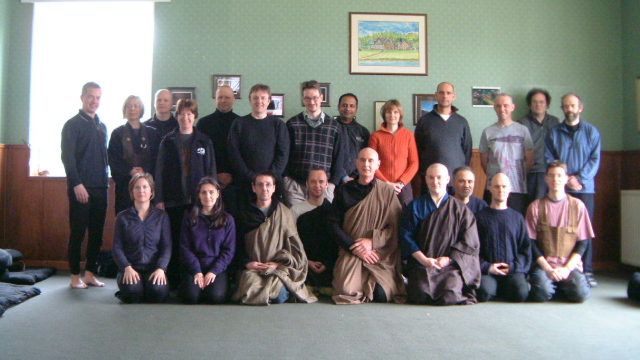
Michael Eido Luetchford
Winter 2006 — Shoaku Makusa, Session 3.
Venue: Rowardennan.
Michael Eido Luetchford · Winter 2006 — Shoaku Makusa, Session 3
From the retreatPhotosChronicle
What the talk says (short overview) — About these overviews
In the third talk on Dogen’s chapter Shoaku Makusa, ‘not doing wrong’, Mike opens with a few words on zazen, saying that he has unconscious tensions in his body, as we all do, and that, ideally, zazen is balance without holding ourselves. Reading on in the chapter, Mike says that Dogen’s ‘not doing wrong’ does not mean not doing something that is called wrong; it is a state in which no wrong can be done, a state of natural balance.
As an example, Mike says that after nearly thirty years of zazen he began to get pains down his legs and slowly traced them to a muscle that he had been holding in tension without being aware of it, and that when he walks round the zendo he tries to move people who look rigid; resistance, for example in the head, can be a sign that we are holding ourselves in a posture. Mike says that although Dogen says that zazen is sitting upright, the uprightness is not due to holding ourselves in a posture but to the balance of our body weight down through the spine, as if the vertebrae were piled one on top of another like pebbles, and that it is useful to sway a bit before and during zazen. To a participant who says that straightening their back makes them rigid, Mike answers that the posture of zazen is neither the straight posture nor the slumped one but lies between the two, and that achieving it is why we sit. On the head, Mike says that stretching up and pulling the chin in creates quite a strong tension at the back of the neck, that he never tells people to do it, and that he thinks avoiding a fixed posture is quite important. On the hands, Mike says that if they rest on the legs we lose the sense of where our body is vertically; he adds that the hands may touch something, but that hands on the knees or down in the lap are not the way Dogen instructs us to do it. Asked why Dogen’s instructions on zazen are so simple, Mike says that he does not know why Dogen did not write more about it, but thinks that people in the thirteenth century lived in an utterly different paradigm, and suggests that perhaps people then did not have so many tensions in their bodies. When a participant wonders whether Dogen deliberately wrote so little because anything one tries to say about zazen becomes leading and almost certainly misleading, Mike says that this could be so, and later he says that we can perhaps say something about zazen but should not say too much, though we certainly should not be quiet about it.
Returning to the chapter, Mike says that in the previous paragraphs Dogen insists that the concept of wrong, identifying wrong and denying wrong are not the same as not doing wrong, and that in the last paragraph read he seems to say that not doing wrong is some kind of natural state; he illustrates it with a pine tree in the spring and chrysanthemums in the autumn. Mike says that ‘state’ is probably the wrong word for this, because nothing is static, and that he would like to invent the word ‘dyne’, from ‘dynamic’, for a moment and the activity in it: we freeze the moment in our minds when we visualise it or talk about it, but the moment itself is not frozen. Mike says that Dogen describes the relationship between wrong and not doing as a oneness, using an example from a koan of a donkey looking into a well while the well also looks at the donkey, and that we can likewise say ‘Zazen is practicing me’, while Shunryu Suzuki often expressed the oneness of things we normally separate with the phrase ‘things-as-it-is’. Mike says that ‘not doing wrong’ is a concept in our minds, whereas an actual not doing wrong is not fixed, does not necessarily agree with our concept and takes the form of the circumstances it is in; asked whether that means there is no absolute right and wrong, he answers ‘yes and no’: there is none that fits our concept, but Dogen is saying that there is one, the actions in the present themselves, although their manifestation is not fixed. Mike says that we tend to intellectualise what Dogen says and think that as long as we are in the state of not doing wrong we can do what we like, but that if we do wrong we lose the state of not doing wrong, and that Dogen is not saying that there is no wrong or that we cannot do wrong. Asked about the last sentence of Dogen’s paragraph on the state of not doing wrong, Mike says that the idea of a state in which one can do no wrong is very attractive and that the move from the state to a memory of it is very quick, whereas in the state itself we do not think about right and wrong, as in the kitchen, where people move around each other smoothly without thinking about it. Mike says that we have been brought up with a deep, fixed belief that there is something called wrong; for us, not doing wrong is not doing something, but Dogen is not saying that, and Mike also agrees that on one level not doing wrong has nothing to do with right and wrong. To a participant who explains not doing as accepting and allowing causes and conditions, Mike answers that he does not think so: that is an explanation, and to explain we create a process, whereas Dogen is talking about something more fundamental; the Alexander technique of inhibiting ourselves and then allowing ourselves is, he adds, a valid explanation too, but Dogen is not talking about recognising something we should not do and stopping it. Mike ends by turning to ‘doing right’, where Dogen says that the concept of rightness covers many concrete right actions but does not mean that the right action already exists somewhere waiting for someone to do it, and Mike adds that we think like that about both right and wrong, that we have been brought up to think like that, and that Dogen is pointing out that it is not true.
Complete English transcript — About transcripts
Before we start on the chapter I’d just like to say a few words about Zazen. Master Dogen describes how to practice Zazen in his writings several times, in Fukanzazengi and also in other places. His instructions are very straightforward: just sit upright, don’t lean to the front or back or side, and so on. But if we practice Zazen for a long time we slowly get little clues how to sit comfortably. And one thing I noticed over the years is that I had and still have unconscious tensions in my body. Because they’re unconscious I don’t know about them. And we get the result of those unconscious tensions. So for instance, in my case, because I have rather flexible hips, sitting in full lotus every day with the same posture, I was pushing down on my thigh bone on the left hand side. So the muscle at the back, called the periformus, which holds the joint together was always in tension, but I didn’t realise it. So in the last year or so I’ve found a kind of problem with that muscle becoming stiff. And that muscle has the sciatic nerve passing through the middle of it, so I get pains down my legs. It’s very strange that I should suddenly, after nearly thirty years of practicing Zazen, start getting pains down my legs, but slowly I traced it back to this muscle because it’s always holding my joint. So I’ve been holding my joint together in Zazen for twenty five years and not been aware of the tension. Strangely, now that I know, I can notice that tension and relax that. But it takes a long time to notice these things. And we all have our tensions. When I walk around the zendo in the morning, usually if I see somebody who looks a little bit stiff, I don’t mean their posture is wrong but they look a little bit rigid, I try and move them. And if that person moves easily I think, ‘OK, that’s alright.’ But if they don’t move I think that can be a sign to the person that they have some kind of tension in that posture. And one thing which is very common, several people tend to sit slightly leaning backwards, just slightly. And that causes very, very subtle tensions here (points to back of neck), and we don’t notice it because we do it every day. But if, when I come round and move you, you feel ‘Oh, I can’t move like that,’ then that’s a sign that there’s a tension somewhere. And also in the neck. I often touch people’s heads and try and wobble them round and it’s surprising how much resistance there is sometimes. I put my hand on somebody’s head just to wobble it gently and it’s rigid! And if I push it that way it doesn’t move! So that’s a sign that we’re holding ourselves in a posture. And although Master Dogen says that Zazen is sitting upright, it’s a subtle sitting upright where, although we’re sitting upright, the uprightness is not due to holding ourselves in a posture but due to the balance of our bodyweight down through the spine, down through the neck and down through the spine to the pelvis. So it’s very useful, before Zazen and during Zazen, to sway a bit. And even during Zazen we can check to see if we’re holding ourselves in a posture. If we’re holding ourselves in a posture it’s nice to let go of it. If we think we ought to be very straight, we can hold ourselves like this (demonstrates rigid posture). But holding ourselves like that creates a lot of tension. And if we do it habitually we become unaware of it. So Zazen is like sitting with our vertebrae piled up on top of each other like a pile of pebbles, one on top of the other. So if somebody comes and pushes us we should go whichever direction they push us easily. Of course that’s ideal, but we’ve all got our own bodies, and if somebody pushes me I’d probably think ‘Ugh!’ But ideally - we can have an idea – Zazen is balance. And so balance without holding ourselves.
Participant: I think when I’m sitting, when I notice that I’m off thinking about something or something and I think, ‘Oh, I’ll just straighten my back,’ but I think, because I do that quite often, then that makes me go, you know, very sort of rigid, like you were just saying.
Mike: Right, yes. So the posture in Zazen is very subtle. So if we think, ‘Oh, I’ll straighten up,’ that straight posture is not the posture in Zazen. Neither is the slumped posture. It’s between the two. And to achieve that posture between the two is why we sit. So we may find it difficult to recognise any posture between sitting up straight and sitting habitually slightly slumped. But there is. There is a position between the two. Our muscles get a lot of stick during our normal lives so we all get set forms in our muscles and tensions, from driving or using the computer or whatever. So when Master Dogen talks about ‘dropping off body and mind’ we can include in that ‘dropping off all the tensions in our body’.
Participant: The position of the head is quite difficult, I find.
Mike: Yes.
Question: Because when you sit in Zazen, you know, the crown of the head is the uppermost point, and when you begin to sit I stretch that up a little bit, pulling the spine up, and then let it sort of relax down again. But during Zazen, especially at sesshins, I get stiffness in the neck, because actually that... even coming back to that and then releasing it is quite unnatural, it’s quite an unnatural position for the head. So I was just wondering what you could say about that.
Mike: You mean unnatural in which sense?
Participant: Different from the way we hold our head naturally.
Mike: So how we hold our head naturally is OK. But not how we hold our head habitually. So I do a lot of work on the computer and probably hold my head habitually like that (juts head forward). But naturally my head balances on my shoulders.
Participant: Well, naturally I find that the head comes forward slightly more than it does in that position of Zazen that pulls the spine up. It sort of comes out a little bit.
Mike: Which position of Zazen that pulls the spine up?
Participant: When you take up your position of Zazen the crown of the head is here, and I would set the eyes, stretch the spine up to begin with and then let it relax down, and the chin naturally sort of comes in as you do that (demonstrates position of head).
Mike: Right.
Participant: But that’s different from... that’s something that you don’t do anywhere else, I don’t do anywhere else.
Mike: So I don’t do it in Zazen either. So I think the instruction to move the chin in is actually only an instruction to rotate the head. So rotating the head is the same as moving the chin in. But if we teach to stretch up and pull the chin in, we create quite a strong tension down here (indicates back of neck). So I never tell people to do that.
Participant: In our natural posture, the ear, the shoulder, and the hip and the heel are in line. It’s only when our posture’s gone slightly out of kilter that we have to, you know, sometimes ... [inaudible].
Mike: Yes, but where the natural position is we don’t know. So if in Zazen we’re constantly wondering if it’s right or not that’s OK, to constantly wonder whether it’s the right posture or not. But if we can recognise tension in our neck then maybe our head’s being pulled back too far. But if we let our neck be loose and then try and feel the weight of our head, which is quite difficult to do, although it weighs something, we can’t feel the weight. But if we move, subtly we can feel it and then try and balance it. And that’s the best we can do. But I think to avoid a fixed posture is quite important. And there are members of Dogen Sangha who teach how to adjust our posture, people like Mike Cross, using other techniques. And there are many different techniques to adjust our posture.
Question: Could I ask about arms? Because for a long time I had my hands supported when I sat, that was my kind of default mode, that was the way I suppose I was introduced to sitting so it became quite an ingrained thing. And now that I’m having my hands not resting on something that seems to be fine for the shorter periods of sitting that we normally do, but I find that where it’s over a longer period I’m getting quite a lot of pain at the bottom of my back.
Mike: Is that from holding your hands?
Participant: Well I haven’t had it before so I’m assuming it must be. So I’m not sure if that means I’ve got the wrong height or if it’s just something I’ve got to kind of sit through because it’s just something my body is kind of getting used to.
Mike: No, you shouldn’t sit through it. If you’re holding your hands... it’s very difficult to describe. I don’t feel I’m holding my hands. But my hands aren’t resting on my legs. But I don’t have any feeling that I’m holding them. Maybe if you drop them a little bit until you feel that disappears. The reason, I think I said before, the reason we don’t put them on our legs is because if we do that we lose the sense of where our body is vertically. If you touch something you can’t feel your balance. If you put your hands on your knees you tend to support yourself even subconsciously. If you take your hands off your knees, you’re on your own.
Question: How far should the space be between the main trunk and the arms? Just whatever feels right?
Mike: Just let your shoulders relax and let them hang where they hang.
Participant: I suppose I’ve been trying to consciously create a space.
Mike: And if you feel you’ve got tension... Often if our mind is busy we feel pressure between our thumbs. It seems to be something to do with our mental state. So if we feel the pressure there we can just relax.
Participant: I don’t entirely agree with you that if we’re touching something our balance is interfered, it depends how we touch it and what we’re using that for. For example, I use a cushion because I feel I can put my little finger just below the navel and keep it there and also keep my elbows out which feels good, without any tension coming from having to hold muscularly my arms up, which perhaps Anne is experiencing problems with. So I don’t feel that because my hands ultimately are resting on a cushion they are disturbing my balance, because it also helps me to concentrate on that particular part of my body.
Mike: OK. What, you put your cushion under there (indicates lower abdomen)?
Participant: Yes, just the right height for...
Mike: Yes, or you can get a little bit of your clothes, you know.
Participant: Oh yes, sure, sure...
Participant: That’s what I did before, was to have something which brought my hands up to about there.
Participant: I think it could be a mind thing that you actually... you’re kind of doing something that makes you keep your hands supported. Because I used to use something as well and I realised since I’ve been coming back that I haven’t been using something but I’ve been strengthening my back. And I just thought just now as you said that that’s maybe why. So maybe you’re actually subconsciously kind of maybe tensing slightly.
Participant: It’s quite likely, because it’s more... I’m thinking about it.
Participant: Because it’s in that area as well that you want to keep your hands.
Mike: Yes, I don’t mean that, you know, your hands shouldn’t touch anything. But if they do touch something it’s inevitable you rest it on whatever it’s touching. You know, often in your clothes there’s a kind of ruck in your clothes that your hands fall on. But some people practice with their hands on their knees. Or some people put their hands down in their laps, and that’s not the way that Master Dogen instructs us to do it. And for me I can see the reason for that.
Participant: It’s very difficult, well of course it is... Well that’s it really!
Mike: (Laughs.) Yes, it’s a training.
Participant: Yes, because, you know, [inaudible]... I try to sit up straight, which is a fundamental problem of course. But then of course, you know, I try and relax, I try my best to get into a good posture, I breathe and I sort of try and relax into it. And then, you know, the things I find, you know, thoughts come into your mind and then suddenly you realise that you’ve just very subtly moved [inaudible]... subtly you’ve kind of just caved in a bit. And then you sit there and kind of, ‘Right, OK.’ It’s very hard not to come into an unnatural posture because you’re trying, you know, to bring yourself back and sort of go over the process again. And sometimes, as you say, you miss, well mostly miss the moment when you’re...
Participant: It’s interesting because that in itself... I’ve found with that as well that when I do slip into that, by actually feeling the tension of that, because there’s tension in that, and then just letting go, that brings me back into it. Rather than thinking to pull up, I actually feel the tension that I’ve got into by kind of slipping into a slouch, because I mean it puts a tension there and different places, and just by letting that go that brings me back.
Participant: No I don’t sort of feel tense. I just sort of realise that I’m off...
Mike: Yes, well that’s Zazen, isn’t it?
Participant: It is, yes.
Mike: Yes. So Zazen’s kind of training. So training means we’re...
Participant: Endlessly practicing.
Mike: ... We’re, yes that’s right, endlessly practicing it.
Participant: Accepting and using the self.
Mike: Accepting and using the self.
Question: What about the breathing, [inaudible]?
Mike: Naturally.
Question: Just naturally?
Mike: Yes. I breathe without any effort usually. I think most people do.
Participant: I have a tendency to forget to breathe, just in everything that I do, so I have to remind myself.
Mike: Yes? So then you can remind yourself, yes. (Laughs.) Otherwise, (mimics collapsing)... ‘Oh, she’s done it again!’ Clump! ‘Oh, it’s Elspeth!’
(Laughter.)
Anyway, I only meant to say a few pointers. Master Dogen’s instructions are very simple. But our actual experience with our bodies is constantly changing.
Question: Sorry, one more thing. I’m confused about why his instructions are so simple, when one could write vast amounts about it and yet, you know, other areas, for instance morality, are sort of well documented in the canon and explored. But the actual practice of Zazen is, in no tradition really, explored. Is that because it’s fundamentally something we have to do ourselves?
Mike: But we can start now. So for hundreds of years Zazen has been... Zazen, as opposed to dhyāna, meditation, has been in China and Japan, and in Japan it’s been kept by the monks and so on, and they haven’t ever written more about it. But to investigate Zazen is good! And if during that investigation we can give more pointers, that’s good. I don’t know why Master Dogen didn’t write down. But in the thirteenth century I think the paradigm in which people lived was utterly different. And we forget that. We imagine that Master Dogen was like us and therefore he could have written more, but maybe that wasn’t what it was like. Or maybe people didn’t have so many tensions in their bodies.
Participant: No computers in those days!
Mike: No computers. I can’t imagine actually.
Participant: I wonder whether it’s because anything that you try to say about it becomes very leading and almost certainly misleading. Certainly, other traditions that have tried to teach it in greater detail end up by going off in a strange direction. For instance, that kind of enforced static posture and, you know, you must concentrate on the tanden and all of those kind of ideas which become misleading.
Mike: Yes.
Participant: So I wonder whether it’s actually, you know, with intent that he’s written as little as possible and it’s about a person doing the exploration.
Mike: Yes, could be. I’ll shut up!
Question: Could I just ask you one thing? Did he write about... Sort of physically, really, it’s kind of better if you change, alternate legs. Did he teach sort of one leg over the other, just one particular side or anything?
Mike: No he didn’t, no. Well, his description is one side. His written description describes putting the right leg on top of the left thigh. But he doesn’t mean only do that way.
Participant: No, I mean I can only, well I can’t sit very well anyway, I can only sit cross-legged one way, actually, although I do try every so often, because actually it’s...
Mike: Completely different.
Participant: Yes, I think it’s quite good really to alternate it if you possibly can, it’s better for the pelvis.
Mike: Yes. So maybe we can say something about Zazen but shouldn’t say too much about it. But certainly we shouldn’t be quiet about it.
Participant: It’s interesting, because for years I sat with one leg in one position and I avoided the other way because I thought it was going to be more difficult. And actually trying it it’s easier! It’s just amazed me this weekend that it’s much easier to sit the other way than I thought it would be. Because I tried it a few times and it was painful, but actually when your in a different situation and you try it again...
Mike: Yes, that’s right. Yes, our body changes, doesn’t it, and our attitude, our feeling changes. Anyway, let’s go on with the chapter. ... In the previous few paragraphs, which are quite difficult, Master Dogen is insisting that the important thing is not doing wrong. The concept of wrong is not the same as not doing wrong. Identifying wrong is not the same as not doing wrong. Denying wrong is not the same as not doing wrong. And so on. And then in the last paragraph that we read he seems to be saying that not doing wrong is some kind of natural state. And as illustrations of a natural state he talks about a pine tree in the spring, and chrysanthemums in the autumn, buddhas, pillars holding up the temple roof, lanterns in the temple grounds, the whisk or hossu which he would hold when giving a lecture, which is a wooden carved stem with white horse hair coming out, or a staff, a buddhist staff. All those he says are not doing wrong. And by that he means they are in a state and that state itself is not doing wrong. However, the word ‘state’ itself is probably the wrong word, because nothing’s static. So I’m at a loss to find another word instead of ‘state’. I’d like to invent a new word called ‘dyne’. ‘State’ comes from ‘static’ and ‘dyne’ comes from ‘dynamic’. So I think he’s talking about being in the dyne called not doing wrong.
Question: Couldn’t we say ‘thusness’?
Mike: ‘Thusness’? ‘In the thusness of not doing wrong.’
Question: How would you define a ‘dyne’?
Mike: A dyne is this moment. Activity in this moment. In order to visualise or talk about this moment we freeze it in our mind, but the moment itself is not frozen and static, it’s dynamic. So instead of calling it a ‘state’ we should call it a ‘dyne’.
Question: What about ‘flux’?
Mike: A flux. That’s nice.
Question: Or a plasma, they’re a similar thing aren’t they?
Question: How about a ‘dynamo’?
(Laughter.)
Mike: Yeah. But anyway, what he’s talking about, which I’ve used the word ‘state’ for, a pine tree in the spring, he means a momentary state which I’d like to say is a dyne. That’s my choice.
Studying practically in this way from both the subjective and the objective viewpoints is the Universe made real, and it is also Universal realisation. When we are already in the state of not doing wrong, no wrong can be done, and even regretting that we have done something that we should not have done is just energy that promotes our effort not to do wrong. But if anyone thinks that since the state of not doing wrong is like this, then we can deliberately do wrong, then they are walking north and expecting to arrive at the south coast.
So there’s a tendency for us to intellectualise about what he’s saying and say, ‘OK, so as long as I’m in this state I can’t do any wrong, so I can do what I like.’ So he’s saying, ‘No, if you think that just because there is a state in which we can’t do wrong you can do what you like without ever doing wrong, then think again.’ In the state of not doing wrong we don’t do wrong. If we do wrong we lose the state of not doing wrong. He’s not saying that there is no wrong. He’s not saying that we can’t do wrong. He’s saying that there is a state which is not doing wrong. So in the state of natural balance there is no wrong; but we can then create wrong and do wrong.
The relationship I want to express between wrong and not doing is not onesided. Although when a donkey looks into a well, the well also looks up at the donkey, the well is also looking at the well itself, and the donkey is looking at the donkey itself; the person is looking at the person themselves, the mountains are looking at the mountains themselves. It is because Buddhism teaches this principle of full manifestation in the present that wrong is just a matter of not doing.
So, unfortunately, when we use language we create relationships between the words and concepts that we create. But he wants to describe that relationship as a oneness. And the way he does it is with this little example of a donkey looking into a well. He uses that because it comes from one of the Chinese koan stories. I think the story itself is quoted in the book, in which a student expresses his knowledge to his Master by saying, ‘The donkey looks at the well,’ and the Master says, ‘You only told me half the story, the well is also looking at the donkey.’ And that suggests that everything has two sides. So although we often look from the subjective point of view, me as opposed to the other, Master Dogen wants to insist that there’s also the opposite point of view, the other is looking at me. So, ‘I do something’ can also be expressed as, ‘Something is done by me,’ or ‘Something is doing me.’ And we can say, ‘Zazen is practicing me,’ for example. And sometimes we can catch the truth in that expression. Zazen does me. Walking does me. So he’s taking that further and saying, ‘The donkey looks at the well is also the well looking at the donkey, but it’s also a person looking at a person and mountains looking at mountains.’ And Shunryu Suzuki, in his books, in his teaching, often expressed this co-relationship or oneness between things that we normally separate with the phrase, ‘things-as-it-is’, that’s right. Intentionally having the plural and the singular in the same sentence. Grammatically incorrect, but Buddhistically perfect. Things-as-it-is. So this is the “principle of full manifestation in the present”.
Real form in the Buddha’s world is just like space; each thing causes it to manifest its form differently, like many different surfaces of water reflecting the image of the moon. Not doing wrong is a thing manifesting itself in the present, and so it is made real with each actual form.
So ‘not doing wrong’ is a concept in our minds, but what manifests itself in the present takes the form of its surroundings. Or in other words, an actual not doing wrong is not fixed, it doesn’t necessarily agree with our concept of ‘not doing wrong’, it takes the form of the circumstances of the space it’s in.
Just like space, it manifests its form in each separate present. It is like the images of the moon reflected in many surfaces of water, and at the same time, the many surfaces being made real by the images of the moon they reflect. We should not doubt that this state of not doing wrong is made real at every moment.
So in this paragraph he’s talking about the difference between our conceptualisation of what he’s talking about and the form in which it manifests itself. So he’s saying that not doing wrong manifests itself according to reality at that time.
Question: So is he saying as though there’s no absolute right-and-wrong, it depends on circumstances?
Mike: Yes and no. There’s no absolute right-and-wrong that fits our concept of right-and-wrong. But he’s saying there is an absolute right-and-wrong; they are the actions in the present themselves.
Question: They manifest it?
Mike: Yes. So that’s absolute; but the manifestation is not fixed.
Participant: Sorry, I don’t understand the paragraph at the top at all: “When we are already in the state” down to “south coast”. I don’t understand a single word in that.
Mike: “When we’re in the state of not doing wrong, no wrong can be done.” No?
Participant: That’s fine. Then he proceeds to pull the carpet away.
Mike: “And if we regret that we’ve done something wrong, that energy just promotes our effort not to do wrong.”
Question: And what does that mean?
Mike: It means if you regret and you think you’ve done something wrong and you feel sorry about it, and worry about it, that feeling sorry and worrying just helps you not to do wrong.
Question: So it’s positive? He’s not saying we shouldn’t worry about [inaudible]?
Mike: No. ... The two halves of the sentence don’t seem to match, do they? Alright. This is only my first draft, so we can change it and improve it, which is one thing that John and I are hoping to do as a result of these talks.
Question: Is he saying that although you can regret having done something wrong, and that promotes your effort not to do wrong, your effort not to do wrong is just to be present in the present moment? So although you can worry about having done wrong, not to do wrong just now is just to be present just now?
Mike: Yes, that’s true. But the way I’ve written it the two halves of the sentence don’t flow into one another, so I can change it in some way.
Participant: I’m not trying to find grammatical incorrectness or something, I just don’t understand what the whole paragraph means.
Mike: Yes, but that’s the function of grammar as much as other things, isn’t it? So if we...
Participant: I don’t understand the last sentence either: “But if anyone thinks that since the state of not doing wrong is like this, ...”
Mike: So, if you get the idea that there is some kind of state which is not doing wrong and therefore in that state you can’t do any wrong, as an idea it’s very attractive. So then you start to think, ‘Well, I can do anything then!’ I’ve heard people say that, ‘Well, Buddhism says you can do anything then!’ But it doesn’t. So if you think that you can do wrong within the idea that there’s a state called not doing wrong, then you’re mistaken. Or, for instance, if you think, ‘Oh, I just practiced Zazen all weekend, and I’m back in Bristol, and I want to do this and I know it’s wrong so I’ll do it because I know all about not doing wrong,’ then you’re mistaken.
Question: Because ‘not doing wrong’ has become an idea? A concept?
Mike: Yes. So the transferring from the state of not doing wrong to having a memory of the state of not doing wrong is very quick. In the state of not doing wrong we don’t think about right or wrong, we’re just acting naturally.
Question: So it’s much easier just not to do wrong?
Mike: We’re not doing wrong! So, for instance, we all practice Zazen then we all eat and we go into the kitchen and in the kitchen there’s hundreds and thousands of people coming in and out with the breakfast stuff to be washed up, and there’s Mike trying to arrange everything, but we quite smoothly move around each other. And we don’t think about it. We don’t think about, ‘Oh, should I go there or should I do this?’ So our movements flow quite naturally.
Question: So that’s not doing wrong?
Mike: That’s not doing wrong.
Question: So if you say not to do wrong is to be present in this moment, is that like it would be wrong to think ... yeah as you say, there’s an idea that, ‘Well, if you can’t do any wrong, it doesn’t matter what I do.’ But the reality of it is, in order not to do wrong, be present at the present moment and you won’t do any wrong? And if you’re present in the present moment, there’s nothing wrong?
Mike: Yes. That’s right. But we then immediately transfer that into an idea. And then once transferring it to an idea we want to do it. So we think, ‘Right, I’m going to be present and I can’t do anything wrong! So, as long as I make myself present I can do anything I want!’ But that’s not what he’s saying.
Participant: So to lose, or to not be fully present in the present moment, that’s when you’re doing wrong and that’s when...
Mike: Well, that’s an extrapolation from what he’s saying.
Question: And that’s why things can seem as if they’re wrong, because you’re not fully present in the present moment?
Mike: If you’re fully engaged in doing something you don’t have any time to think whether it’s right or wrong.
Question: The bit about “energy that promotes our effort not to do wrong”. It suddenly reminded me about what you were saying about your joint - that if you haven’t been fully present you’re not aware of being kind of out of alignment in some way, but as soon as you become aware, that awareness can lead you to doing something that will then be aligned again, but you’ve got to be aware of it. Is there any point about being aware, and getting that awareness really that leads you out of it again?
Mike: We could say so, yes. Our problem is that we have an idea of what wrong is. Even though we’re discussing about not doing wrong, we all have an almost immovable idea of wrong. We all think that there is something called wrong and that Master Dogen’s talking about not doing it. But that’s not what he’s saying. But we can’t shift that idea, we’ve been brought up with a very, very fixed, deep belief that there is something called wrong. So if somebody says something else, we can’t get rid of that. So not doing wrong, for us, is not doing something. And that something is what we believe is wrong. But he’s not saying not doing something. Very difficult, isn’t it?
Question: He’s not saying not doing something, he’s just not doing it?
Mike: He’s saying the truth of the matter is in not doing wrong. If we want to talk about right-and-wrong we should realise that the only important thing is not doing it. And his explanation of not doing it is to be balanced, to be in the state of not doing wrong. But the state of not doing wrong doesn’t mean there is something he’s not doing which is called wrong. But that’s something we find difficult to think about.
Question: So not doing wrong has nothing to do with right-and-wrong?
Mike: You can say so, yes, on one level, yes.
Participant: Because when you’re doing it you’re not...
Mike: You’re not interested!
Participant: ... interested in the difference between right and wrong.
Mike: Yes.
Question: Mike, is not doing wrong the same thing as right action?
Mike: We can say so, yes.
Question: Because right action... I don’t understand grammar, but... it’s not ‘right’ as in ‘right-and-wrong’, it’s a different slant on the word ‘right’, isn’t it?
Mike: Yes.
Participant: Whereas when I hear, as you say, the word ‘wrong’, automatically I’ve got this sort of programmed thing that I’m told it’s something negative or sinful or harmful in some way.
Mike: Yes, which we’re not doing.
Participant: Yes.
Mike: Yes, that’s right, that’s what we find difficult to get around. We’ve been trained to believe that something called wrong exists.
Participant: Well I can understand ‘right action’, that has something I can latch on to that doesn’t feel negative.
Mike: Right. So as usual, Master Dogen moves slowly towards deconstructing and merging all the concepts into one.
Question: Using Zazen as a microcosm, as it is, then finding tension and so on, accepting the tension, allowing it, releasing it, noticing it essentially dissipates it. So in our daily lives, accepting, allowing causes and conditions frees us from them so that this is the action of not doing. And because we are not doing the wrong things of seizing these things and making something of them, then right happens. Is that...?
Mike: No, I don’t think so. That’s an explanation, yes. But the problem is in order to explain we create a process, we create a series of events - so you know, we’re doing wrong, we recognise it, and then the tension disappears, so... Actually recognising tension and the tension disappearing are the same thing, momentarily. So we create process, and then we believe in process. And Master Dogen is talking about something which is more fundamental. That’s the best I can do, it doesn’t answer what you said.
Participant: Ah no, it does, it does. I was trying to explain not doing.
Mike: So for instance there are people around who say if we stop doing, if we inhibit ourselves, then the right thing does itself.
Participant: The Alexander technique.
Mike: Yes. So, if we stop doing ourselves then we allow ourselves. And that’s a valid explanation, but it’s not what Master Dogen’s talking about. He’s not talking about recognising something we shouldn’t do, stopping doing it, and then allowing something else to happen. I don’t deny that Alexander’s explanation is a valid explanation, but that’s not what he’s talking about. When he says ‘not doing wrong’ he’s not talking about inhibiting the doing of something which is wrong.
Participant: No, but by not doing you take an agent out, so there’s...
Mike: What is not doing?
Participant: It’s quite literally not doing.
Mike: What is it that we don’t do?
Participant: We don’t put ourselves in the way of our existence, we don’t get in the way of ourselves by, for instance, reacting to circumstances in a negative way. Because the balanced state doesn’t manufacture that, which would be an obstruction.
Mike: Yes. Yes, you can describe the balanced state like that. But I wondered if you were referring to that, for instance Alexander’s explanation of how we can correct our habitual rushing through life is by inhibiting ourselves and then allowing ourselves. So for instance the phone rings and instead of jumping out of the chair you wait and then you stand up slowly. And that’s very valid but it’s not what Master Dogen’s saying. He’s not saying, ‘Inhibit yourself from doing what is wrong.’ He’s saying that there is a state which is not doing wrong. Not as a state which is not doing, so we should stop doing something. But there is state in which no wrong can be done. And it’s subtly different really. Can you see the difference?
Participant: Yes.
Mike: It doesn’t invalidate things like Alexander’s explanation.
Question: So is it a state of action and inaction at the same time?
Mike: Eh... yes.
Participant: Right, that answers the question!
(Laughter.)
Participant: Inhibition is action though, isn’t it? If I notice my leg’s trembling, or I notice my leg’s about to tremble and I inhibit that, I’m doing something aren’t I? It’s just rather, it’s more subtle.
Mike: Yes. So it’s the quality of what we’re doing. So if we do it because we’re trying to stop ourselves doing something else, or if we just do it, is different.
Participant: Whereas Mike’s idea is that there’s, that we’ve got like a common belief that somewhere inside there’s a whole zoo of your wrongness that, you know, is about to come out any moment, so we’re just, you know, pinching ourselves so it doesn’t actually pop out.
(Laughter.)
Mike: Yes. You can see in Mike’s dialogues that some of you’ve been reading from time to time, Mike Cross – two years ago he had a very strong belief in Alexander’s idea that we should inhibit ourselves and allow right to do itself. And that was all he talked about, and you would write him an email and he would not reply for three days and you knew Mike was inhibiting himself, and then he’d reply.
Participant: Yes, he’s just realised something else.
Mike: Yes, that’s right. He’s realised that there’s no wrong to be done!
Participant: That’s right. It’s quite funny really, because it’s almost as if he sailed past the port and he’s sort of gone off quite a big long route and he’s come back to the same place. But actually I think quite a lot of people never missed that port.
Mike: (Laughs.) Right. Hmm... So, coming back to the text. The bottom of page three:
Doing right.
Right, we’re on to the next phase now.
Doing right. Rightness is one of the three conceptual properties: wrong, right, and neither-right-nor-wrong. The concept of rightness covers many concrete right actions, but this does not mean that the right action already exists somewhere waiting for someone to come and do it.
“Doing right” is the second line in the poem which opens the chapter, if you remember. Rightness is a concept. “The concept of right action covers many different concrete examples.” In other words, we do have a concept of right action and we can use it to describe many different concrete examples. But the fact that there’s a concept of right action doesn’t mean that right action exists somewhere waiting and all we have to do is find it and do it. Now that sounds almost amusing to think that we think like that, but we do think like that. We do think that right is waiting for us to come and do it, and we do think that wrong is waiting for us so we should avoid doing it. That’s the way we’ve been brought up to think. So he’s pointing out that that’s not true. Andrew’s just going to ring the bell!
(Bell rings.)
Thank you very much.