Uji — Session 3
Dogen’s contradictory views of time read as models pointing to a present moment that is already complete
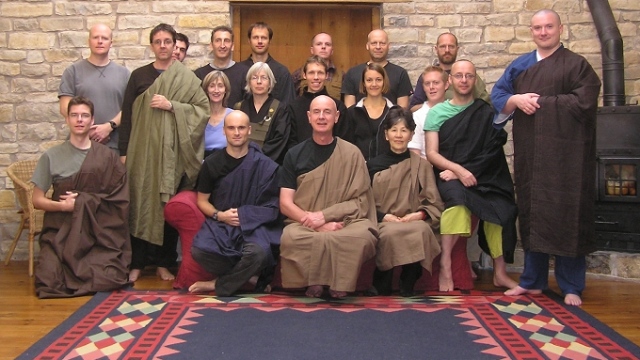
Michael Eido Luetchford
Summer 2007 — Uji, Session 3.
Venue: Earth Spirit.
Michael Eido Luetchford · Summer 2007 — Uji, Session 3
Source: audio transcript.
From the retreatPhotosChronicle
Audio
The audio comes from dogensanghas.com.
What the talk says (short overview) — About these overviews
In this session Mike reads further in his modern interpretation of Dogen’s Uji and treats its conflicting pictures of time as models, not as descriptions of what time really is. What they point to, in his reading, is a present moment that is already complete, which we tend to overlook because we are trained to prefer words about it to our own experience.
The passages he reads from the chapter say that seeing time simply as flowing away is not enough, and that time present can also be thought of as a process, yet moments neither pile up nor extend in a continuous line. Mike stresses that Dogen does not call either the flowing or the momentary view wrong but presents both as true, and that he puts each new view as though it were the only one. Even Dogen, he says, cannot actually describe what time is; the importance of his work lies in giving more than one viewpoint. Against the usual belief that what we are like now was caused by our past, Mike presents Dogen’s other view: what we are like now is just what we are like now. His example is a sore throat after a night of talking, smoking and drinking, with the sore throat and its causes all contained in the present. Mike notes that Dogen does not deny the scientific view of cause and effect, and Mike himself grants that in another way we can of course learn from the past. Tennis professionals who drop everything that happened before so as to be ready for the next ball illustrate for him the view Dogen puts forward: just being in that moment.
The chapter then says that people who do not see reality as this time present treat the state of a buddha as something to be attained by effort, although even that effort is time present. Mike sums this up, with a reference to Wittgenstein, in the line that the place we are all trying to get to is the place we are already at. In a concrete now, he says, the whole universe is complete at once, so that we cannot move someone off the sofa and keep the sofa here. He reads the chapter’s lines that even heedless blundering is time present, and that the vivid state of being in our own place should neither be confused with not being present nor forced into being present, as a middle way between trying to be present and avoiding it. Our confusion while trying to understand such words shows, for Mike, how strongly our civilisation prefers words to the reality they describe. The words of the talk are only about what is here now, he concludes, and after the talk everyone goes to sit.
Complete English transcript — About transcripts
Shall we recite Kaikyōge?
[recitation, 00:00:03–00:00:39]
If you remember, yesterday we did the first few paragraphs from Uji. First of all, the poem, which presents concrete instances of happenings, concrete nows. Then Master Dogen's commentary that although reality is just concrete nows, we also need to accept the view of time as a process through 24 hours in a day. And in that process view of time, we have sometimes a subjective feeling. We say time flies, or time drags, and also an objective feeling. We can measure time with measuring instruments, clocks and watches, position of the sun and so on.
And then he said that time presents, or nows, belong to each person independently. But we all share one now, so now is also inclusive. And then he said that we construct our life, we construct our image of ourself that existed in the past, is here now, and will be here in the future, and that we think of as myself. And we also construct a picture of the universe, a picture of our life through time.
So that's talking about the process view of time, which relies on memory. But then he switches his viewpoint and says that somebody who has clarified their real state only sees now, now, now. And doesn't hold on to the past. Lets go of understanding the nature of what's in front of us. And that sounds rather idealistic if we read it, to imagine being in that state. It sounds a kind of superhuman state. But of course he's not talking about something permanent. He's talking about the state of action. And in action, we do what's in front of us, and immediately we move on.
We're presented with the next thing. So in action, when we're not evaluating the world or constructing an image of the world, we just have now, now, now, now. And we all experience this in our own lives, hiking, swimming, martial arts, music, painting, and so on. All our activities have a large proportion of action. And in action, we clarify our real state. In action, we are in the same state as buddha. And then he said, ordinary people who haven't studied the Buddhist view imagine time as a line. He doesn't say a line, he says a journey, where we are going over mountain pass and along the valley and so on. So the things that happened to us last year or last month are back there, and the things we haven't come to are in front.
So his image is of a line of our life, and we think that that's the way that our life is. But he suggests another way to think about it. Instead of a line with the past behind us and the future yet to come in front of us, as all events as mountain peaks. So we stand from the top of the peak where we are at this instant, and all the past and future are arrayed spatially as peaks.
It's an image he's creating. He's not saying that's really how time is. He's creating different viewpoints, and these viewpoints are models. And just as with scientific models, the model is not the reality. So even Master Dogen is not able to put reality. He's not able to actually describe what time is, but he gives more than one viewpoint, and that's the great importance of his work. He contradicts himself. He says, It's now, now, now, and then he says, No, it's not. It's a journey, and then he says, No, it's not. It's arrayed like this. And he says that— oh, that's where he got to.
He suggests by using the word... The past swallowed up in the present, and the past being spewed out by the present, which suggests kind of one containing the other. And this, of course, is very interesting to scientists, people who are trying to investigate the nature of fractal time, fractals and nestings, inside something inside something else inside something else inside something else. So that image is rather useful. Do you remember whether we did the next paragraph? ‘Although the angry person is in the past, the Buddha is here today.’ Ah yes, that's the one that we're arrayed over many peaks.
So that's where we got to, the end of that one. For the next paragraph.
Seeing time simply as flowing away is not enough. Thinking that the only property time has is the ability to flow is not enough.
So our normal linear view of time is not enough.
If we think of time only as flowing away, then there must be gaps between the instants of time present as they pass.
Ordinary people only see time as something that flows away, and that is why they do not experience time present and have not heard it explained.
[unclear, 00:08:54–00:09:01: “Ordinary people. Oh yes, I suppose they might do.” / “ordinary people he's Well, yes, I suppose I might be.”] He's talking about, in our ordinary life, we are immersed in the process view of our life. Especially when we're working, we've got appointment, deadline, and time that things happen, and we're totally immersed in that time. And we hardly have time to be where we are.
We are somewhere else, thinking about the next thing because we've got some kind of pressure or we're in a hurry. And so we're totally immersed in this process of time. Time is flowing and carrying us with it, and we can't even sometimes appreciate where we are. Although we can't appreciate where we are, we are always here. But ordinary people only see time in that way, and they cannot, they do not experience time present, or do not fully experience time present. Of course, in a way they do. We all experience time present.
But if our mind, if in our mind we are carried away somewhere else, we don't appreciate what's around us. So if we hurry, we may trip over our shoelaces.
In actual fact, all the things in the whole universe are time present, that are both continuous and separate. Real time is always time present, and so it is always this time present.
In this line, Master Dogen introduces a huge contradiction.
He says, Time flowing, we think of time flowing as if it were a river, but if we look at it more closely, in order to make sense with the present being now, there must be a gap between this present and the next present. So that's a separated or discrete view of time as moment, moment, moment, moment. But even though we can imagine time as moment, moment, moment, moment, we can still believe that those moments are part of a flow. So he says, well, he doesn't say no, both are wrong. He says both are true, both are true views.
One view of time is flowing like a river. Another view of time is a series of momentary flashes like frames in a film. The next paragraph begins with a but, and I wonder if that but should be there. Anyway, I can take it off.
Time present can also be thought of as a process. Time proceeds from today to tomorrow. Today proceeds back to yesterday. Yesterday proceeds on to today. Today proceeds on through tomorrow. Today. Tomorrow proceeds on through tomorrow.
So he's saying that if we think of time, we can think of time going through today through to tomorrow, but we can also think backwards.
We can go backwards, what happened this morning, what happened last night, and so on. So if we imagine time as a process, we can move forward and backward. Along that line. Are we maybe going backwards or are we going forwards? Some people, I've read some people investigating the nature of the arrow of time. Anybody heard of the arrow of time? Yeah, and whether time is going, whether we're moving forwards or moving backwards. Sprung into my mind.
Although time can be seen as a process like this, times arriving do not pile up on top of times past. Neither do they extend out in a continuous line.
So he means that times don't come on top of each other and make a pile of time. So now, next moment, the next moment, the next moment, and they don't come one after the other as a line. So now, next moment, next moment, next moment. So he's denying that our images are true.
And for this reason, we see that Master Seigen's life was made up of moments of time present, and so were the lives of Master Obaku, Master Baso, and Master Sekito.
So the life of these three great Buddhist masters was made up of moments of time, but those moments of time didn't add up to make a line, neither did those moments of time pile up to make a pile. So Master Seigen's life wasn't a line of events through time, neither was it a pile of events in time.
So in that way he's saying that although these three great masters lived moment by moment, those moment by moments don't accumulate anywhere.
Both I and the external world exist in time present, and so practice and realization of the truth exists at time present. All our daily struggles are also at time present. People have their own views today, and they think these views are produced by their own causes and circumstances. Although they think that their views form the basis of and are based on their experiences, they are not the basis of their reality.
They themselves are only reality presenting its results at this time present as causes and circumstances.
That's a completely unsatisfactory group of sentences there, but it's the best I can do to make it easier. I wonder if it has done. We think our views now are determined by our circumstances in the past. So we think who we are has been made by who we were in the past. And we think, for example, that what we're like now has been caused by what happened in the past. But he's presenting another view where he says what we're like now is caused by what we're like now.
What we're like now is just what we're like now. So, for instance, we could say. I've got a sore throat this morning because I talked too much last night, smoked twenty cigarettes and drank two pints of beer. So I've got a sore throat this morning. But Master Dogen's saying another view is just you have a sore throat this morning, and the sore throat, the cause of the sore throat, are all contained in now. So he's denying our process view of life. It sounds kind of almost heresy, certainly as far as scientists are concerned. Oh.
Participant: You could even
Mike: Yes.
Participant: Right. It's you know, it's clear.
Mike: Yes.
Participant: Right. It's it's clear.
Mike: Yes, that's right. Yes, that's a nice example. Well, people say to me, Why did you go to Japan? And I trot out my little story, but in the end I went. And there's a very famous koan story which is actually quoted later: Why did Master Bodhidharma come from China to India? And I guess Master Bodhidharma could trot out his little story too. And why did you come here? And you can trot out your little story, Master Dogen saying that the fact that you're here contains all the causes and circumstances of you being here. In other words, he's suggesting that the present moment is complete.
And science, of course, is founded on the belief that the present is caused by the previous moment, or in other words, that cause and effect is absolute. So what happened now is caused completely by the circumstances. Otherwise, we couldn't have any kind of scientific investigation, and we couldn't have any science at all. And Master Dogen doesn't deny that view, but he keeps putting a different view. And when he puts a different view, he puts it as though it is the only view. So you get paragraphs with completely contradictory views all put one after the other.
So people mistake their view of reality, which they form from their past experience, they mistake that for reality itself. But Master Dogen says, well, reality is not actually based on past experience. It's just complete here and now.
Question: So how long do you really have to wait?
Mike: Yes.
Participant: You didn't even delete it. You just deleted it.
Mike: Yes. Yes, so he might say, the most important thing is not to cut yourself. It doesn't matter how you cut yourself, when you did it before, what the reasons were before. The most critical thing is don't do it now. And he's suggesting that not to do it now is in a way unrelated to anything other than now. It's only related to me, my finger, the knife, and my action. So it's a kind of denial of our civilized view. But I don't know why I always bring up the example of tennis.
I can't play tennis, but it seems to me a kind of excellent example, because watching it on the television, if you see professionals playing tennis, seems to me very clear that when they're jogging on the baseline there, they're trying to drop off everything that happened before and to be ready to hit the ball. So whether they made a mistake in the last... So, because their racket was too high or too low, or whatever, they seem to throw it away.
And to me, they seem to be just trying to be in that moment, to drop off all examination of their failings, their negative feeling if they lost a point, their excited feeling if they won a point, and just to be there. That's the kind of view that Master Dogen put in. Right. You can't learn from the past. Yes. However, in another way, of course we can learn from the past. We can discuss how we did things and make sure we don't do them that way again, or discuss how we did them, make sure we do them that way again.
Participant: Except that everything is too old. They can't be
Mike: We
Participant: doing it.
Mike: do believe it works, don't we?
Participant: Can you just come tell me what I mean in terms of a simple thing? The changing The changing? What the f we do with it. Non-speech, like the other I don't really have to say about it, I could be out like that. Yes, nothing to be afraid of.
Mike: No.
Participant: It's okay.
Mike: Yeah.
Question: Just like I thought this reasoning, there's just like an effective philosophy. Just as we will It just seems very very bizarre that it won't just Is there anything I should do?
Mike: Yeah. It's a way to lead our lives, and it's a way that society often teaches us to lead our lives, but there's an alternative way. That's right. That's right.
Participant: But then we have all these paradoxes just to give them a lot of being what we're doing, if you decide why did you do that? The enemy came and said why did you do that? Tell him that's what he's doing wrong.
Mike: Yes. Yes.
Participant: That's a fine example.
Mike: Yes, and often we don't know that we're making up a story.
Participant: Yeah.
Mike: We believe that what we're doing is explaining.
Participant: Yeah. It is important for politicians to report everything that comes to their feet, but it was a moment of my
Mike: Well, that's a very good example.
Participant: What does that add to anything? I mean we can't say.
Mike: Yes. Oh, not to be able to explain what we're doing is a big, a big weakness in modern life, isn't it? Somebody says, Why did you do that? He says, I don't know. Then you do something else. Why did you do that? I don't know. People think you're crazy.
Participant: You can get knocked out for talking about that as well.
Mike: Pardon?
Participant: You can get knocked out for talking about that as well.
Mike: Can you?
Participant: Is it because she's asking the right thing? I don't know. She might not know what he's doing.
Mike: Doesn't know what he's doing. It's the most dangerous kind of person there is, somebody who doesn't know what they're doing. Yes. What was I doing? Next paragraph.
People do not see reality itself as being this time present. What exists at this moment. And so they feel that the state of a buddha is not time present, but a state they must make efforts to attain.
That's a very common situation in Buddhism. People think that the state of a buddha can't be just being here and now, the mind in the present moment, the body in the present moment.
They think it's something they haven't got and therefore must get.
But even the moment in which they make their efforts and reject the state of buddha because they cannot see that it is their state is also time present. It is the time present of a person who has not realized who they are.
So the place we are all trying to get to is the place we are already at.
Wittgenstein, Culture and Value, [unclear, 00:28:46–00:28:47: “verse 78.” / “verse seventy.”]
It is time present that causes the hour of twelve o'clock and the hour of two o'clock, as arranged as they are today, as they rise up and drop away at their place in the universe. Two o'clock is a time present, six o'clock is a time present, living beings are time present, buddhas are time present.
So he's just— He's going back to the viewpoint that the poem expressed in the beginning.
Participant: He's switching it, what is normally your beings in the foreground and time is in the background. He's switching it in the foreground, so time is in the foreground.
Mike: Or maybe trying to arrange them one on top of the other. So he's saying all the process markers of time that we use in our lives — two o'clock, six o'clock, now, later, a little earlier, yesterday, tomorrow, this year, next year — are all markers that we use to indicate time. And all those are time present. They're actual concrete time. We are concrete times. Or we are concrete nows is better. So we are all a concrete now. Now is complete with all of us exactly as we are now.
The concrete time present of being angry makes the whole universe real. The concrete time present of being a buddha makes the whole universe real. The time present in which the universe makes itself real is called perfectly real.
So now he's really deep into reality. ‘The concrete time present of being angry makes the whole universe real.’ Here he's trying to collapse our images into each other, if you like. So concrete now, me, angry, universe, all one. At one moment of nowness, we are all in this room. At that instant, reality is complete. So the whole of the universe is arranged exactly as it is at each concrete [unclear, 00:32:00–00:32:08: “meal.” / “nail.”] We usually think the world is made up of parts, and we give all the parts names, and in our minds we can move the parts apart. But at this instant of time, there's nothing separate. We can't move David off the sofa and keep the sofa here. Everybody is in a complete universal instant. ‘The time present in which the universe makes itself real is called perfectly real.’ So I can't comment on that, really.
The state of Buddha, which wants to search for the truth, practice zazen, attain the truth, and enter the balanced state to make the state of Buddha real, exists at time present. It is making perfectly real that the whole of time is the whole of existence, with nothing left over. But since something left over is just left over, even making the whole of time present only half real is making half of time present wholly real.
Well, he's saying time present is the only reality, and it's indivisible. The universe is created at this moment.
We can't escape from this moment. Yes.
Participant: Half a centimetre.
Mike: Yes, it's beyond our discrimination. So beyond good, bad, half, whole, one or two, and so on. So he makes a wordplay on that. Half of reality is wholly real, whole of reality is half real. Yes. Could be. ‘To leave those heedlessly—’ oh, sorry.
Even the times when we seem to be blundering along heedlessly are at time present. To leave those heedlessly blundering time presents as they are is to see that they have their own places as time present. The vivid state of being in our own place in the universe is time present. We should not.
We should neither confuse it with not being present, nor force it into being present.
‘Heedlessly blundering time present’, he's suggesting that we can never escape from reality. And when we're confused, don't feel clear, feel a bit ill, feel well, whatever, they're all reality as it is. And when we are in our own place in the universe, then we are in time present and in a vivid state. And to be in our place in the universe is not to avoid being in the present moment, and neither is it trying to be in the present moment. So he's suggesting a middle way between two positions.
One is to try to do something, get something, or be something, and the other is to avoid it. We may be trying desperately to understand what these words mean. The feeling that we're heedlessly blundering along, and if we feel like that, we can notice how biased our civilisation is towards understanding. Because actually, it's only me sitting here reading out these words that I made up to try and explain the words that a thirteenth-century person made up, to try and describe something that we're all in now, that we may have time where we think.
Although we are experiencing time present, right in front of us here and now, we might tend to be confused by somebody's words about it, because we are trained to prefer those words to our own experience.
[inaudible, 00:38:29–00:39:50]
Participant: And I’m worried somewhat about how much I’m going to do, because I should be doing more, more. I was maybe wondering if I’m trying to be more present.
Participant: I’ve actually done this in experience.
Participant: [unclear, 00:40:01–00:40:15: “In, in done, I think, when people try and be very, use the literature, try and be very careful, and then they become very ...” / “Is it? Is it done? Or is it finished? It's been People who try and be very Oh, here is you look at two sides, you try to be very quick at Okay. And then they were trying to be very quick at despair.”] But a few years afterwards, [unclear, 00:40:18–00:40:19: “confused.” / “it just seemed to happen.”] But we're obviously present all the time.
Mike: What was the difference? Try not to try. Yeah. Risking it. So we can do the same thing listening to Buddhist talk. If we get, if you get trapped in my complicated attempt to describe Dogen's complicated words, all we're doing is preferring the words over what the words are talking about. What the words are talking about is actually what's here now, at this moment. That's all. So to get confused and to heedlessly blunder along trying to understand is our kind of habit. So if you like to go for a walk instead, that's nice.
I can't put it in any other way, if you'd like to.
Question: Why are they even coming up with it?
Mike: I can't. I mean, I can't. I don't know what to say about that, really. The universe... ‘The time present in which the universe makes itself real is called perfectly real.’ I can't help you, but I can't say anything about it. Is the universe... can we find an example of the universe making itself real?
Question: What it means to expect the five senses in which everything is whole. So is it not the five senses?
Mike: Could be.
Participant: It doesn't have that fuzzy screen like that. We think it is the other one. We think it wants to come forward.
Mike: Could be.
Participant: Because it led to the previous chapter, the entire paragraph, the topic paragraph in today's paper, makes the whole world appear. whole of the community.
Mike: Well, I think it's not concerning me at all, so I can't really speak about it. If it talked about, as in the previous sentence, the state of Buddha makes the whole universe real, then there's me in there, because I practice zazen. But that sentence is about something that's beyond me, so I don't know what to say about it. As I said in the beginning, I can't say anything about this sentence. Yes, it's true. Yes.
So I'll say again, sometimes when we listen to a Buddhist talk, we hear the words that the person giving the talk is using to describe a state which is right here and now in front of us that we're all experiencing. But we prefer the words to the state, and that's the kind of habit of our civilization. So that's our habit, is to discuss the words. Which are about something which is in front of us. That's all it's about. That's all it's saying. That's all it's about.
Participant: I can't get rid of something that you have. It's kind of exciting, but I mean, it's kind of exciting to just
Mike: Yeah.
Participant: sort of watch.
Mike: Yeah.
Participant: It can't be in. It's
Mike: Yeah.
Participant: just you're describing it in a different way.
Mike: Yeah.
Participant: You know, even if it's your kind of slicing your slice of a crop, you
Mike: Yeah.
Participant: know, these tiny things through the normal conception of kind of describing it kind of down a way. So there's all the different individual ears.
Mike: Yeah.
Participant: And So one could say it has a little clip of a human, you know, growing through time.
Mike: Yeah.
Participant: There is other perspective, because you're sort of describing it.
Mike: Yeah. So, can you see what I mean about us preferring the words to the reality? This is us, and this is our civilization. Fortunately, we then end the talk and we go and sit. And when we go and sit, we realize that the words were just words. And you may even think, well, Mike Luetchford's only saying, you know, these words, they're only words. But the words are about something real. And the something real is the reality that we're in now. In now. In now. So I think I'll stop there. Because I've run out of words. Thank you very much. Oh, we have to recite Fueko.
[recitation, 00:47:30–00:48:28]