Uji — Session 4
Reading Uji, Mike explains that wholehearted effort in each moment makes reality without first removing hindrances
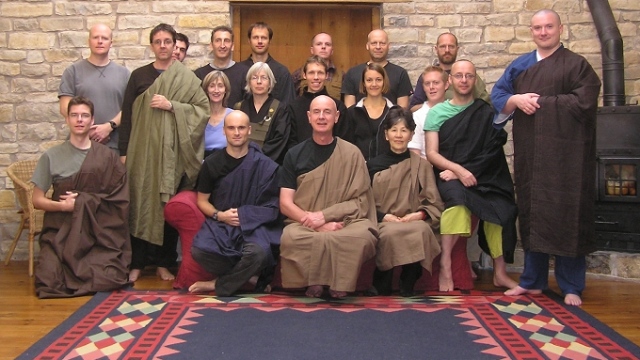
Michael Eido Luetchford
Summer 2007 — Uji, Session 4.
Venue: Earth Spirit.
Michael Eido Luetchford · Summer 2007 — Uji, Session 4
Source: audio transcript.
From the retreatPhotosChronicle
Audio
The audio comes from dogensanghas.com.
What the talk says (short overview) — About these overviews
Mike reads on through Master Dogen's Uji in his own modern interpretation and draws out how we come into the present moment: not by first getting rid of hindrances, but naturally, by leaving things as they are. The chapter says that time-present is always made real without ridding ourselves of hindrances and delusions, and Mike notes that trying to get rid of what hinders us actually hinders us. In Mike's reading, Dogen suggests that wholehearted effort in this moment does not only place us in the present but makes things real, so that reality is a person and the world meeting in an instant.
Mike begins with the chapter's remark that time never arrives and that few people see time clearly as here and now. Even those who have long asserted that they have it, according to Dogen, are still groping around trying to find out who they already are. Coming into the present, Mike explains, happens naturally rather than as the result of an effort to remove obstacles, because being fully present is a state of body and mind, not just a mental state. He is careful to distinguish this from solipsism: Dogen does not say that the world exists only in my mind, but that reality is the joining of me and the world in this moment. In the discussion he describes wholehearted effort as participating in the world instead of interpreting it, and he gives sport and zazen as examples of activity done for its own sake. The reality Dogen means, Mike says, is not the abstract reality of what a film portrays but the simple, direct reality of sitting in front of the screen and watching it.
The chapter then says that this momentary continuance is not like wind or rain sweeping from east to west, and that the passing of time from moment to moment involves no external object. Mike compares this with science, which links one event to the next in ever greater detail but can never find out what is in the gap between them. In Dogen's example, spring is made real at every time-present, and Mike explains that we construct the season we call spring by stringing those moments together. To think that some unchanging entity passes from moment to moment behind changing things is, the chapter says, to become lax in studying Buddhism, and Mike adds that this is how we put our self, our life and our concept of time behind the present. Returning to zazen, he says that practising it teaches us that our being here at this moment is reality, and that Dogen goes further and says that it makes reality. He then distinguishes three worlds: the reality in which we always are, the world of ideas and thoughts, and the physical world of the senses. When we act, he says, the other two worlds disappear and instantaneous reality shows itself, not through our senses but not without them. In zazen we focus on neither of those worlds, a defocusing that embraces everything, although Mike admits that all these words are very difficult.
Complete English transcript — About transcripts
Okay.
[recitation, 00:00:32–00:01:06]
On with time.
We suppose that time just passes away. And do not understand that time never arrives.
Time never arrives. Time never arrives. Although we talk about the present passing into the past and the future coming, we don't have any feeling of time arriving. We don't have any feeling of this moment changing into this moment, changing into this moment.
Although our understanding itself is time present, our understanding of time does not influence circumstances.
So the character of here and now is not changed by the fact that we understand it or misunderstand it.
People see time as coming and going, and there are few people who can see it clearly as time present, here and now.
So we're so used to our processed view of time, coming, future coming and the past going, that few people can see clearly this moment, here and now.
Then how can it be easy for them to get the time to attain the truth?
Attaining the truth means to see what's real here and now, and what's created here and now. And seeing what's real here and now means being in time present.
So people who see time only as coming and going can't see just the present moment here and now. And because they can't see the present moment here and now, they don't attain the truth. It's difficult for them to attain the truth.
Even among those who see time as what is present now in the universe, who can express clearly what the ineffable something is that they have already got?
So he's saying even people who can, who are, who live in the present, who are not distracted into thinking about a place where they are not, even among those people, it's very difficult to find somebody who can express what is here and now, and he describes what is here and now as the ineffable something. And he describes it as the ineffable something because it's impossible to describe the content of the present moment. So whether he includes himself among those who cannot express it clearly or not, I don't know.
And even among those who have long been asserting that they have it already, none of them have stopped groping around trying to find out who they already are.
So he's referring to people who say that they've realised what the Buddhist truth is, and among those people who assert that they know what the Buddhist truth is, they're clear about it, most of them, according to Master Dogen, are still groping around trying to find out who they already are. So if we realise what is true here and now, we don't need to grope around to find out who we are.
But leaving these people to their time present, even attaining the truth and the balanced state is just time present that appears to come and go.
But his last paragraph describes the real situation. Everything is just time present. Reality is just this moment of the present. It's difficult to grasp the nature of the present moment intellectually, and it's even more difficult to express what is already here.
Next paragraph. In short, time present is always made real without ridding ourselves of hindrances and delusions.
It's not a question of getting rid of things that prevent us being in the now. If we get an image or an idea that we want to be in the here and now, like Master Dogen tells us, we may think that we've got to get rid of something. We've got to get rid of the things that stop us being in the here and now. But he's saying we can always come into the present without getting rid of things that hinder us.
That's quite an interesting statement, because it suggests that trying to get rid of things that hinder us actually hinders us. And it contains in it a sense that, for instance, if we hear what the Buddha's state is, we immediately want to try and get it. And to get it, we imagine we have to get rid of all things that are not the Buddha state. So we try and get rid of our thinking, or we get rid of our busy mind, and so on. But he says none of that's necessary.
And the reason he says it's not necessary is because in order to be fully in the present moment, it's not a question of getting rid of things, but just leaving things as they are.
The benevolent forces that appear to the right and left of us are the time present of our wholehearted efforts in this moment.
So he suggests that there are benevolent forces to the right and left of us. When we make a wholehearted effort, these benevolent forces are helping us.
He's describing a situation where we come into the present moment quite naturally, not as a result of trying to be here rather than somewhere else, but just quite naturally. And the reason he describes it as a natural occurrence rather than result of our efforts to get rid of things that stop us being in the here and now is because to be fully present in the here and now is not a mental state, but a state of our body and mind. So it's as a physical component as well as a mental component.
All the living beings of the land and oceans are also the time present of our wholehearted efforts in this moment. All the beings in this world and other worlds are also the time present of our moment-by-moment wholehearted effort. Our practice teaches us that without our own moment-by-moment effort in time present, nothing could ever be made real or continue from one moment to the next.
What he seems to be suggesting there is that our effort, wholehearted effort in this moment, is all. Not only is it being in this moment, but it's everything. We could say it creates the world.
It makes everything real. We normally think that the world exists independent of us, and we can imagine that if we're not here, the world is still here. But actually, we can never ever test that situation out. And our real experience is always the world, the real world in front of me and me are one inseparable whole. So me acting in the present moment, being fully here, to Dogen, is the world, is creating the world. A very strange statement, really.
So, explain what solipsism is. It's that I am dreaming the whole world, or my mind is producing the whole world. So as far as I know, it's not, you can't know that anything is real at all, because it's all being thought of. So the difference in, between Master Dogen's view and solipsism, is that Master Dogen doesn't say the world only exists in my mind.
He says reality is the joining between me and the world in this moment. So it's not that there's nothing real out there. It's not that reality is inside me, or reality is outside me, but me and reality at this moment joining, that is me being here at this moment together, inseparable. That's reality.
Participant: [unclear, 00:14:31–00:14:37: “Not consciousness. Not all together.” / “What does that sort of thing look like for the whole heart of effort could be? Not consciousness.”]
Mike: Could be consciousness, yes, but if we can define consciousness, we could, yes.
Participant: I just wonder if he's saying something more like that than what we normally understand by a wholehearted effort, which is...
Mike: Well, yes, he talks about wholehearted effort in the sense that when we make a wholehearted effort, we are not interpreting the world, we're participating in the world. So we have different modes of being. If we're interpreting the world, we're separating ourselves mentally from the world, which means we're splitting something in our perception between me and things. But when we make wholehearted effort, we stop doing that. But because we stop doing it, it doesn't exist.
Participant: Well, it's not not a wholehearted effort or understanding directly that is the expression of wholehearted effort. It's not a
Mike: It might be.
Participant: I think where I have a bit of difficulty, if in the, in the, say, eleventh century, this writing would make sense because you... I can't imagine what it's like to be in the eleventh century, but your experience would be very much based upon your existence and your life. Whereas in the modern world, we can turn on a television and you can see images from another side of the planet.
Mike: Yes.
Participant: And I think that's where it becomes a bit more difficult to interpret what Master Dogen's saying, because what comes into your existence is something which is not part of your world, although it is actually part of your world, but it seems like, well, it is not a different part of the planet.
Mike: Yes. Yes, because we've created a whole virtual world which
Participant: Yeah.
Mike: we share and inhabit.
Participant: I think we're impeded in the modern world in that respect because...
Mike: In one respect we might be, but in another respect, for instance, we human civilization has thought about what it's all about for much longer, so we can say things like consciousness, and we can say words like action, and we all practice some kind of activity, not because we're apt to plant carrots, but just for its own sake. And all those things probably denied to people in the 13th century. To practice something for its own sake is very difficult. But we always practice for their own sake, and we practice zazen for its own sake.
But if you've got to work from dawn to dusk to make enough food to live, then you can never realize... that you're doing things for their own sake.
Participant: I think that's the wrong stuff I was thinking about. [unclear, 00:17:56–00:18:02: “It's just a matter of if it's a problem with the fact that we just can't let anything exist to happen at the time.” / “It's just a matter of existence. It's just a matter of anything that exists to happen at the time.”] [unclear, 00:18:06–00:18:10: “I mean, I don't think you can catch your breath, but I will work in the best you can.”]
Mike: Yes.
Participant: [unclear, 00:18:11–00:18:17: “and so if you have to get along with it and it's your part of it.” / “You're not going to pass it in one place or anything. Just so that the fact that they're alive, it's not quite worth it.”]
Mike: Yes, lots of different levels we can discuss this at. If you go into biology, I suppose you could say, you know, if you look at a cell under a microscope, all you can see is little things dashing around. So really, life is wholehearted effort. It's all these little things dashing around. You see a slide of the microscope blow-up of blood vessels and the blood pumping away there. Yes. On the other hand, we can say at our level of our ordinary lives, we're all always making a wholehearted effort, but we think that the effort we're making is for an abstract goal much of the time.
And so, in a strange way, we direct part of ourselves outside what we're doing. However, sometimes we don't do that. And when we don't direct part of ourselves outside what we're doing, it becomes more whole, or full, or something. And this is why all the sporting activities of the modern world have become so popular. Because unconsciously, people notice that to make wholehearted effort, not because they have to finish a deadline, not because they have to go somewhere at six o'clock, but just because they're on the running treadmill, they're running for the sake of running.
And then some people find that too simple, so they put earphones on and watch television above in the sports hall, and take themselves out of the moment that they're in. So we have a choice. So yes, wholehearted effort is Master Dogen's phrase to describe the instant of our life existing, which is some kind of full dynamicness. And reality is a person and the world meeting in an instant, in an instant. This is his image. This is his description of reality.
So ‘our practice teaches us that without our own moment-by-moment effort in time present, nothing could ever be made real.’ So real for Master Dogen is a very simple, direct real. It's not an abstract real. We have lots of abstract reals. One abstract real might be the reality of watching a film in the television, and knowing the film is portraying something that was real, or may be real somewhere. But he's not talking about that reality. He's talking about the reality of sitting in front of a television screen, watching film. So that itself is reality.
Film portraying a slice of reality in another place or at another time is not what he's talking about. But the reality of being in front of the screen, watching the screen, that reality. It doesn't mean that the film is not real. It doesn't mean that what it's portraying was never real. But it's a different kind of real. I wonder how many people understood his talks when he gave them. And after he died, they put all his, after Master Ejo had edited them, they put them all in the big box and kept them locked up for [unclear, 00:22:36–00:22:50: “a hundred” / “400”] years.
I suppose it was because they're so very difficult that people couldn't grasp what he was trying to say. And it's still the case now. But we can somehow grasp little parts of what he's saying because, in a sense, the world has moved on through the centuries. Because human beings have been living. Another 800 years since Master Dogen's time, we've been peering at who we are and what we're doing a bit more. So all the disciplines that we engage in, whether they're scientific disciplines or artistic disciplines, are all peering at what we are. When the artist paints a picture, he's peering at what everything is about.
When the scientist peers into the microscope, he's trying to see what it's all about, and so on. So because we've been peering at ourselves for longer, we may have a few more clues when we read what Master Dogen wrote. I'm not sure whether we have or not, really. But I think it's possibly we can grasp a bit more of what he's saying than people living then, in one way. But because our lives are much more complicated, and we're much more trapped in the virtual society, it may be more difficult sometimes [unclear, 00:24:47–00:24:50: “to...” / “to proceed.”]
Participant: You answer my question, though. The fact is I'm sitting in the living room watching a television screen, and that is my reality.
Mike: Yes. So in that paragraph, two important things. First is, we don't come into the present moment by getting rid of things that stop us coming into the present moment. That's the first thing he says. Something brings us into the present moment. He suggests benevolent [unclear, 00:25:26–00:25:36: “fortune.” / “thought in it,”] But we might say that our physiological state changes, and the endomorphins in our blood stop our brain activity being so busy, and we feel more at peace, or something like that. So we can find more detailed explanations of what benevolent forces might be. But the fact is that the moment when we become fully present just appears.
We can notice it in zazen. We may have a very busy mind in zazen, or achy legs, and then suddenly we're sitting just where we are for a second or half an hour.
So the last sentence says, Our practice teaches us that without our own moment-by-moment effort in time present, nothing could ever be made real or continue from one moment to the next.
But he then picks up on that last statement: We should not understand that this momentary continuance is like the wind or rain sweeping from east to west.
So he wants to say that moments continue moment after moment, but it's not like a kind of progression, like the wind or rain sweeping across the country.
The whole universe is progressing from one moment to the next. Not static, but also not a continuous process.
And then he gives an example. An example of this momentary progression is spring. It has many different aspects, the passing of which we call the progress of spring. But our practice teaches us that the passing of time from moment to moment involves no external object.
So again, he's saying that there's some kind of process or progress from moment to moment, but those moments are independent. There's nothing external that changes the world from this moment to the next moment. And that appears to deny that there's any law of cause and effect, because the law of cause and effect links this moment to the next moment. But if we look at the law of cause and effect in great detail, we find the same conclusion at the root of cause and effect as Master Dogen says here.
When scientists study cause and effect, the way something is working, they look at what's happening in this moment, they look at what's happening in the next moment. And they make a theory. So this happened, and then that happened. So, for instance, if I take an organism and I inject this amount of chemical into it, then it does this.
And then, in order to find out why it does this, they look at even smaller detail at the moments of time where things are happening, and they say, Ah yes, I inject the chemical there, and then that causes another chemical to be generated here, which causes another chemical to be generated there, which has that effect. And then they say that's a more detailed explanation. And then later on they go in more and more detail. So scientists are always looking in more and more detail to link one action to the next action by a law.
But however closely you go, you can never find out what's in the gap between one action and the next action. So even science will never be able to fill up that gap.
Participant: [unclear, 00:30:41–00:30:47: “there was this sort of thing that you think was a crime, was a separate thing.” / “And then you can swap out that just upside, so it's exactly the same. I thought it was the same, but”]
Mike: Yes.
Participant: [unclear, 00:30:48–00:30:49: “So you just kind of move in and” / “it didn't just seem to move in.”]
Mike: Yeah.
Participant: [unclear, 00:30:50–00:30:53: “move it, but where is this problem?” / “There, that's where it is. Where is it? That's completely.”]
Mike: That's the problem, yes. I can't think of some really good examples. But if you look at the procedures of a particular science, you'll see that what all science is doing is looking at more and more detail at what's happening in their particular field. If you take atomic physicists, they want to find out what's happening with little particles of matter. So they build huge accelerators and smash these particles of matter into smaller particles, and they want to smash those smaller particles into ever smaller particles.
Then they can see why did this particle go that way, and that particle go that way. So then they have to build a bigger accelerator to see in more detail. But there is no end to that process. As we proceed with the process, we understand more and more clearly why that A happened, and then why B happened next. But the closer and closer we get to it, the more difficult it is to find out the reason why one event causes the next event. And this is the real problem in modern physics, the modern atomic physics.
So what Master Dogen says is, ‘the passing of time from moment to moment involves no external object.’ There is nothing external that causes this moment to pass on to the next moment.
And he comes back to the example of spring. For example, momentary spring passes through a process that we call spring. But the passing is not spring itself. We just think of spring as the movement of momentary spring through the process of spring.
So he's deconstructing the words we use to describe, in this case, the passing of the seasons.
So we can say it's spring now, there's blossoms on the trees, and we can say that spring is passing because momentary spring, blossom on the tree, blossom on the tree, is progressing, and that progression we call the passing of spring. So he's deconstructing the way we talk about process, progress.
But spring is made real at every time present in the process of spring.
So at this time it is spring. At this time it is spring. At this time it is spring. But we construct a season we call spring by stringing all those together.
We need to come back to this again and again. In discussing the momentary passing of time, if we think that there are only individual things that change on the outside, but there is some real unchanging entity that passes from moment to moment, moving through all worlds and all times, we are becoming lax in studying Buddhism in our practice.
So in this last sentence he's saying, if we think that things change from moment to moment, but behind that there is something that continues, then we're not understanding Buddhism clearly. So we can say, we often put some unchanging entity behind the present moment in which we exist.
We put a constructed self, our idea of who we are, behind it. We put our idea of our life behind it. We put our concept of time behind it. So we're putting a concept of time behind this talk as it proceeds from moment to moment, unchanging, flowing, unchanging, flowing entity moving behind it, which we call time. But he says that way of thinking is becoming lax in studying Buddhism.
Question: [unclear, 00:36:56–00:36:59: “How do you think your work is carrying within your thought?” / “How do you think your work is going to continue to grow?”]
Mike: Yes.
Participant: [unclear, 00:37:07–00:37:08: “Well, that's the way to do it.”]
Mike: Yes.
Participant: [unclear, 00:37:09–00:37:11: “It's unjustified, isn't it?”]
Mike: Yes. No. We give a name to a container called spring, but our actual experience of spring is momentary. So our collection of momentary springs we call spring. So ‘momentary spring passes through the process of spring.’ Very difficult, isn't it, what he's talking about. Yes.
Participant: [unclear, 00:37:50–00:37:51: “Is this the”]
Mike: Yes.
Participant: [unclear, 00:37:54–00:37:57: “This one will be completely in in life.” / “This one, we probably put it in a T-monet block.”]
Mike: Yes.
Participant: [unclear, 00:37:58–00:38:01: “And we will just get completely” / “And we will do something strange.”]
Mike: Yes.
Participant: [unclear, 00:38:01–00:38:04: “into it.” / “Because it's going to be something quite different. It's just”]
Mike: Yes. Yes. Sometimes, but we can never get rid of them, because to be human and to discuss things like time is to use containers, or to use…
Participant: [unclear, 00:38:21–00:38:26: “An extra word I think is a good idea, because all kinds of things” / “Yes. You can make it for them. You can make it with a foreground thing.”]
Mike: it would be impossible.
Participant: [unclear, 00:38:27–00:38:29: “it wouldn't be easy.” / “It wouldn't be impossible.”]
Mike: Yes.
Participant: [unclear, 00:38:30–00:38:31: “An extra word.” / “It isn't.”]
Mike: So what Master Dogen's trying to do is really impossible. He's trying to talk about what it would be like outside all the labels that we put on things, using labels.
Participant: [unclear, 00:38:47–00:38:50: “It's not about getting rid of things, it's just exposing them.” / “It's not about getting rid of them, but just choosing them.”]
Mike: Yes.
Participant: It's just falling through them, it's just like we did.
Mike: Yes. Yes. We can't escape from it.
Participant: [unclear, 00:39:35–00:39:36: “We can't escape.”]
Mike: Yes. We can't escape from being here.
Participant: [unclear, 00:39:41–00:39:42: “We can't escape from being here.”]
Mike: Yes.
Participant: [unclear, 00:39:43–00:39:44: “We can't escape from being here.”]
Mike: Yes. But when we practice zazen, practicing zazen teaches us that our being here, sitting in zazen at this moment, is reality. The very simple experience. So he goes further than is reality. He says makes reality, creates reality.
Participant: [unclear, 00:40:22–00:40:23: “And if you don't make any difference.”]
Mike: Which paragraph?
Participant: [unclear, 00:40:30–00:40:39: “There is something around here is wrong. We don't really really need to do this yet.”]
Our practice teaches us that without our own moment-by-moment effort in time present, nothing could ever be made real or continue from one moment to the next.
So, without making the effort to practice zazen, we can never see that actually being here in this moment is this moment, makes this moment. And without making this moment, there can't be another moment. I can't do any better than that. It's quite inadequate, really.
We think that we're separate from the world. We think that, for instance, that we're, I am practicing zazen in the zendo with everybody else. But our actual momentary experience is not like that. The momentary experience of me practicing zazen is the whole of the universe at one moment. So he says we create it. Reality is me and the world meeting at this moment, you and the world meeting, me and you meeting. So we are making reality.
Participant: I wasn't conscious or aware of it.
Mike: Reality is being made at this moment, at this moment. And reality is being made at this moment in this room by all this collection, at this moment. We notice that we're just sitting here, and there is something. And we notice it again and again and again. And we notice not time passing, but just this, just this, just here, just now, just everything. So that very, very simple, indescribable, ungraspable experience is Master Dogen's reality. Always present, always here. On top of it, we put our interpretation.
Participant: Yes, because the
Mike: So we can say there's three worlds. There's the reality. In which we are, here and now, always, there's the world of our ideas and thoughts and interpretations, in which we think that we exist, and there's the physical world, which gives impulses to our nervous system and our senses, smell, touch, taste, hearing, and so on, and we think that's real. And when we think about the world, we can never get out of the world of thinking. When we experience the world through the senses, we can never get out of the world of sensual perception.
But when we act, both those worlds disappear, and the world of instantaneous reality shows itself. Not through, but not without our senses. So it's a question of focus. For instance, we can focus our consciousness. We can focus our consciousness. The right word's here, but let's say the right word's here. But let's say, so for instance, sitting in zazen, we can, so for instance, sitting in zazen, we can focus on the pain in the knee, or the sound of somebody coughing, or a bird outside. And if we focus our senses on the physical, then we're in that physical world.
Or we can focus our consciousness on our idea, and in which case we're in the world of ideas. But in zazen, there is a state where we don't focus on either of those. We focus on something else. And it doesn't exclude them, but we're not focusing our consciousness on one or the other. If you like, we're defocusing. So we're embracing everything. Or another way is we're getting rid of those other two worlds and entering a world of reality. But all these words are very difficult, aren't they?
Participant: They can disappear in the heat of summer again in the winter.
Mike: Yes. Yes. But when we focus on, for instance, the rain on the roof, it's there. But if you run across the room to do something in an emergency, because Nick tumbles off the sofa clutching his chest and you're a doctor and you run across the room, the rain— all right, clutching his leg. The sound of the rain is still there, but it's not in— you're not focusing on it. You may be focusing on everything. So it's not that our senses disappear, but we don't focus our consciousness in one direction.
Participant: [unclear, 00:49:24–00:49:31: “or not very unusual for a father to want them to be made in by a regular and experience one side of the other.” / “I have to go again and use it on one on the beat, you might think about one experience one side of the line to the other.”]
Mike: Yes. Yeah.
Participant: [unclear, 00:49:37–00:49:45: “It's noticeable beyond what is amount of father how that is is like one side of the other.” / “The statement you're talking about is either how that fits into a second time period being one side of the line to the other statement.”]
Mike: Well, I always say it's like walking on a tightrope. And in order to keep our balance on a tightrope, we need to wobble. And the two sides that we wobble between are the world of thinking, or our thoughts, and the world of our senses, or the physical. So we wobble between the mental and the physical. But that's only a picture.
Participant: [unclear, 00:50:11–00:50:26: “In the core of your conceptual world, which is such an idea of reflective way of experience of other as something, which is” / “See you later. in the context of conceptual use, such in the ideas, if it's just a range of experience or something like that.”]
Mike: Yes. Yes, I don't know whether idealism and materialism sound like philosophical categories to me. We're trapped in the world of thinking, and we're trapped in the world of hearing, seeing, touching, tasting. But our ability to describe our real experience is so limited, because even if I say, you know, we're trapped into the world where we're only listening to the rain, actually, we're never in the situation where we're only listening to the rain. Our consciousness is darting around all over the place, all the time. So to try and pin it down is always to miss the point. But that's the best we can do. Our senses are also limited.
For example, we know radio waves exist because you can turn a radio on, or you can turn your mobile phone on. Well, not here, but you get reception. You, what we don't worry about the fact that we don't have a, we don't have radio antennas as you. It's just a part of reality that we're just not able to sense. It's still there, isn't it? Yeah. So, positing of what reality is is very, very difficult to grasp. Very difficult to grasp. Just this moment here and now, us and the world, the benevolent forces that are...
Participant: [unclear, 00:52:37–00:52:44: “With the short complicated sentences, you can actually get a very long …”]
Participant: Because if you don't draw that the bottom of the balloon is going to be still, the bottom of the balloon is going to be still, then you only begin to get any idea of the balloons, you need to think about how they're going to be without a balloon. And I'm not worried about that, because you have to realise that they are already attacking the balloon.
Mike: Sometimes animals do have a way of explaining, and some people like to keep a pet because the pet is always showing them how to be in the present moment. So it's a kind of teaching, and trees teach us too. When they wave about and make nice sounds, and the rain teaches it. So they know how to explain it, but they don't need words.
Participant: So what we just said in this example in this thing is that when we want something very much we immediately put a label on that and we give a definition for what we want. So when we don't want it, we just have it. We don't label it by what they are.
Mike: So babies are like that, and so we have to train them. You can't have it now; you have to wait a little bit longer. And if you successfully train your baby, they don't wake you up in the middle of the night. They wake up at six o'clock. She sleeps through to six now.
Participant: [unclear, 00:54:40–00:54:42: “You do see the social appeal to it.” / “Yes.”]
(laughter)
Mike: But on the other hand, babies also train us. Very difficult, isn't it? Yes. My words are only my attempt to make Master Dogen's words easier. But some of you might read what Mike Cross wrote in the books and find that easier than my easier version. But we can only try. But certainly, mine is easier than looking at the Chinese characters.
So he was a very unusual man to spend the whole of his life trying to put into words some... ‘left of us, are the time present.’ Fifty-three when he died, and I think he wrote, and I think he wrote the majority of the Shobogenzo chapters within quite a short time, when he was at Kippoji Temple, I think a lot of them were written. So he had a kind of, seemed to have a burst of three or four years where he wrote lots of the chapters. But I'm not, I'm not, I don't have the details in my head.
Anyway, I won't go on because the next part is the story. So I'll leave that to the story and the rest. Can we get through the rest? Oh, I see. Oh, we can probably get through the rest, [unclear, 00:57:12–00:57:14: “am I?” / “of mine.”] Questions. Oh, I'll read the story now. Questions. Oh, I'll read the story now, then we're prepared.
One day, at the suggestion of Master Sekito Kisen, Master Yakusan Igen asked Master Baso Doitsu a question.
They weren't all masters at that time; they were masters and disciples, but posthumously they get awarded the title.
The question is, I have more or less understood the meaning of Buddhist theory and its classification. [unclear, 00:57:48–00:57:55: “But Bodhidharma's intention in coming from India to China. Bodhidharma's intention in coming from India to China.” / “but what is Dharma's intention in coming from India to China? What is Dharma's intention in coming from India to China?”] On hearing the question, Master Baso replied that one time present he was moved to raise his eyebrow and wink.
At another time present he was not moved to raise his eyebrow and wink. At another time present— at one time present to raise his eyebrow and wink was right, and at another time present to raise his eyebrow and wink was wrong. When Master Yakusan heard these words, the whole of Buddhism became clear to him, and he said to Master Baso, When I studied with Master Sekito, I was just a mosquito sitting on the back of an iron ox.
So we can discuss it tomorrow.
Shall we chant Fuekō at the end of the talk?
[recitation, 00:59:00–01:00:18]