Uji — Session 5
Mike reads the raised eyebrow in Baso's answer as a life created by present action, and words as restricting what they describe
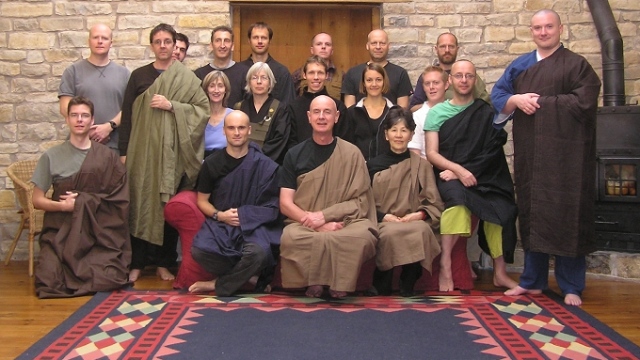
Michael Eido Luetchford
Summer 2007 — Uji, Session 5.
Venue: Earth Spirit.
Michael Eido Luetchford · Summer 2007 — Uji, Session 5
Source: audio transcript.
From the retreatPhotosChronicle
Audio
The audio comes from dogensanghas.com.
What the talk says (short overview) — About these overviews
In this last session on Uji, Mike reads Baso's answer about Bodhidharma raising his eyebrow and winking as the fundamental Buddhist view of what a life is: our life is created moment by moment by our action now, not by a course planned in advance. Because the same gesture was right at one moment and wrong at another, Mike takes the story beyond right and wrong to what is actually done in the present. He does not deny the value of plans, saying that we could not function in society without them, but they are not our life itself.
Looking back, he explains, we can see a path and project it into the future, while action itself is directed into the here and now and does not know where it is going. Dogen's line that being right has become part of him and pulls him in leads Mike to the reading that, when zazen balances body and mind, the balanced state pulls us into right action. Doing right or wrong, he adds, is not only a function of intention or moral views but of our whole state of body and mind. When Dogen writes that the mountains and oceans are time-present and would not exist without it, Mike says Dogen is welding together circumstances and space-time, the here and now. Master Kisho's poem about will and words being present or absent is for Mike a realistic description of giving a talk, in which we often just speak without knowing a moment before what we will say.
Noting that in the original Dogen uses a word that actually translates as restrict, Mike concludes after long thought that to describe something is to restrict it, because a label turns a flow such as anger into an object. In Mike's reading, Dogen's own version of the poem, with will and words half present, deconstructs those objects so that we can experience the world now, now, now, rather than only through the process view that often traps us. Mike calls the chapter very difficult because, without denying our normal view of time, it puts forward an almost unacceptable point: that we are just living at this moment. He traces Dogen's realization to what we notice when we practise zazen. In the closing discussion, explaining a passage of the chapter, he says that people think the state of Buddha is something to be attained, while it is the state of somebody being natural in this moment. We cannot find out who we are, but knowing that we can't find out who we are is finding out, and to know who you are is to be comfortable in the present. For him, everybody is a Buddha when acting naturally and sincerely in this moment, and is not one when they cover their natural self with their own views.
Complete English transcript — About transcripts
So we recite Kaikyōge.
[recitation, 00:00:05–00:00:38]
One day, at the suggestion of Master Sekito Kisen, Master Yakusan Igen asked Master Baso Doitsu a question. I have more or less understood the meaning of Buddhist theory and its classification, but I want to ask you, what was Bodhidharma's intention in coming from India to China? On hearing this question, Master Baso Doitsu replied, At one time present he was moved to raise his eyebrow and wink. At another time present he was not moved to raise his eyebrow and wink. At one time present to raise his eyebrow and wink was right, and at another time present to raise his eyebrow and wink was wrong.
When Master Yakusan heard these words, the whole of Buddhism became clear to him, and he said to Master Baso, When I studied with Master Sekito, I was just a mosquito sitting on the back of an iron ox.
The reason Master Dogen introduces this story here is because it illustrates natural behaviour in time present, in the now.
Usually we think that somebody's life, or our own life, is a kind of path that we walk, and we decide which way to go, where our life is going to go, and then we follow it. So the question of whether, why did Master Bodhidharma come from India to China, is really a question about how do we decide the course of our life. Why did Master Bodhidharma come to China? What was his intention? Or, in other words, did he plan to come for a certain reason? And Master Baso Doitsu's reply says, just at one moment he raised his eyebrow and winked.
Just at another moment he didn't raise his eyebrow and winked. Just at one moment he raised his eyebrow and winked, and it was the right thing to do. Just at another moment he raised his eyebrow and winked, and it was the wrong thing to do. And that illustrates the fundamental Buddhist view towards what our life is, rather than— our life being a planned course, which we then sail along, our life is determined at each moment by our action in this moment. Not our plans or thoughts, hopes, desires, wishes, dreams, but our action in this moment.
Our action in this moment, our action in this moment is our real life. So, in a very real sense, just what we do now, just what we do now, just what we do now creates a path. But the thing is, in the present moment, there is no direction. We don't know where we're going. Of course, we can think where we're going, but our action doesn't know where it's going.
Our action is directed into the here and now. So our action directed into the here and now doesn't have a direction into the future. We can see where we're going by looking backwards and seeing where we came from. And then we can see that we're on some kind of path. And then we can think where we must be going in the future, and we can even plan it. And having planned it, we can walk along that path. That's one view. But the ultimate Buddhist view, in a very real sense, says actually our life is just created at this moment.
At this moment, just what we do now. Is our direction at this moment.
Participant: What science not includes the thoughts of its members to be.
Mike: Sometimes they do, sometimes they don't. Sometimes we make a plan and it influences our action. Sometimes we don't make a plan and it doesn't influence our action. Sometimes we make a plan and it doesn't influence our action, and so on. But it's our action which actually is the course on which we're headed. That's not to deny the value of making plans. We could never function in society without plans. But our plans are not our life itself. What we do in this moment is the footprint of our path that we're following. This is what the essence of the story is.
So beyond right and wrong even, in the story, Master Baso says, Bodhidharma raised his eyebrow and winked and it was wrong, and another time he raised his eyebrow and winked and it was right. So beyond right and wrong, whether we like it or not, our life is actually created moment by moment. Each... Step. That's the actual fact. But on top of that simple fact, we have our life in society.
So of course we make plans, and then we follow the plans, and sometimes our actions seem to follow what we imagined in our head, and sometimes closely, sometimes not so closely, sometimes not at all. Sometimes we make plans but throw them out of the window. Sometimes we don't make a plan, but we follow a very nice course. So there's many different situations. But at the very fundamental level, just where we put our foot at this moment is where we're going.
So it's a very short-sighted view. Yes. Yes. Yes. Yes. No. And that's the secret of good management. Yes. No. That's right. So we can have excellent plans.
For instance, you can go and study how to make management plans and become an excellent theoretical manager, but be absolutely useless in practice because you're looking where you're going, but you're not looking where you are. Yes. Yes. Yeah.
Participant: In reality, there is a difference.
Mike: Yes. And reality is what we must follow.
Participant: But at what point in your evidence does God say there is a public defence against it,
Mike: Yeah.
Participant: that overall, should God and Allah not possibly be thinking about the death penalty?
Mike: Yes. Yes. That's right. And whether the thoughts in our head about where we're going influence our action or not, our action is what determines where we are. And so this story about Master Bodhidharma illustrates that our action in the present is our life, beyond right and or wrong, beyond good or bad. But that doesn't mean that therefore we should try to live a life that doesn't care about good or bad, right or wrong, and doesn't care about anything in the future. That's right. Yes. Simply pointing out a very, very simple fact. And when Master Yakusan heard that, it clicked.
So he said, when I was studying with the master that I studied with before, I was just a little insignificant thing, sitting on his back. So Bodhidharma acted naturally at each moment, following the circumstances of his life. And his actual, actual life was not limited by ideas of right and wrong. Ah, yes. Oh, maybe, yes. I don't know why he says, raised his eyebrow and winked.
Question: I could just raise your eyebrow, don't we?
Mike: Yes. And John was saying yesterday that there's some information or record in a sutra that Master Bodhidharma was actually sent to China by his Indian master. I don't know anything about Master Bodhidharma's history. But the question is not, you know, did he ask his master whether he could go or not, or was he planning to establish a temple in China after he got there? The question is much more fundamental than that.
How do we, how do we live our Buddhist life? Where are we going? And... Master Baso's answer to where we're going is, Here, here, here.
Then Master Dogen comments, No one else could have uttered these words of Master Baso's. The eyebrow Master Bodhidharma raised, or the eye he winked, may indicate a mountain or an ocean, because the mountains and oceans in his eyebrows and eyes are one whole.
He's creating images here of Master Bodhidharma maybe sailing on a ship across the sea to China, and he sees a mountain.
But in the instant that he sees the mountain, his eye and the mountain, the boat and him, are just the circumstance at one moment.
Being moved to raise an eyebrow, he sees the mountain. Being moved to wink, he rules the ocean. Being right has become part of him and pulls him in.
That suggests that if we practice zazen, make our body and mind balance, then the balanced state pulls us into right action. We act right because we are balanced physically and mentally. ‘Wrong is not always done, and not doing is not always wrong.’ So...
We've done the chapter Shoaku Makusa, and he's commenting using those words. Shoaku is not always makusa. Makusa is not always shoaku. To point out that in doing, we can't see right or wrong in doing. Afterwards, of course, we can see it. But although we can't see right or wrong, we can do right or wrong.
But doing right or wrong is not only a function of our intention or our moral point of view, but of our whole state of body and mind.
All these are time present. The mountains are time present, the oceans are time present. Without time present, the mountains and the oceans would not exist. We cannot deny that time present is the mountains and the oceans here and now. If time present decays, so do the mountains and the ocean.
So he's welding together circumstances and space-time, or here and now.
We can't separate them only in our mind. The circumstances we're in at this moment cannot be separated.
If time does not decay, neither do the mountains and ocean. It is from this truth that the bright star appeared to Gautama Buddha, the state of Buddha appeared, his ability to see the truth appeared, and his acknowledgement of Mahakashyapa appeared. All are time present. All are time present. Without time present, nothing could be here and now.
So again, he's driving home the fact that time present, or the present moment, the here and now, is the only thing that's real. Everything [unclear, 00:17:44–00:17:45: “is.” / “is real.”] He then goes on to another story, or another poem, by Master Kisho from the Sho region.
Master Kisho from the Sho region is a descendant of Master Rinzai and the successor to Master Shuzan Shonen. On one occasion, he preaches to the assembly, at one time present will is present but the words are absent, at one time present words are present but the will is absent, at one time present both will and words are present, at one time present both will and words are absent.
And in that poem, Dogen is quoting the words of a Chinese Zen master who, describing in a very realistic way his experience of preaching to his students. Sometimes he wants to say something but can't find the words.
At another time, he's got some words to say but he hasn't got the will to say it. At another time, he's got both the will and the words to speak. And at another time, he hasn't got the will or the words to speak. So it's a very simple, realistic description of giving a talk. Anybody given a talk can recognise those circumstances that happen.
If we're lucky and things are nice, we've got the will and the words, and what we want to say comes out of our mouths, and then we hear it, and then we realise what we wanted to say by hearing. But sometimes it doesn't.
Master Dogen comments, Both will and words are time present. Both presence and absence are time present. Before the moment of absence has ended, the moment of presence has come. Before the will has left, the words arrive. To be present does not mean that something has arrived. To be absent does not mean that something has left.
Now, all these short sentences are creating an image of just now, unrelated to before or after, unrelated to I've got some idea in my mind and now it's going to come into my vocal cords and I'm going to say it. But just at this moment, I produce words. Instantaneous, completely independent act in the present. And I think...
People who are studying artificial intelligence, consciousness and all those subjects are very interested to find out how it is that our brain can produce speech, which represents ideas in our mind, and then we produce the sounds which make that speech. And it all happens in an instant. And we don't know what we're going to say consciously one second, one millisecond before we speak, but we do speak. It's the kind of strange, very strange situation.
Sometimes we might think what we want to say and then say it, but very, very, very often we just speak. Words are just coming out.
Participant: Thinking out loud.
Mike: What being more mindful? Spontaneousness. Yes, because... The Buddhist view of time present is an instantaneous being, not an instantaneous occurrence, but an instantaneous existence. Then everything happens now, independently of everything that happened at other times. But that doesn't mean that Buddhism denies cause and effect.
Time present is like this. Presence is just being present. It is not being absent. Absence is just being absent. It is not being present.
So they're just simple facts of the present moment.
The word will describes will itself and depicts will as an object. The word words describes words themselves and depicts words as an object. The word description describes description itself and depicts description as an object.
So he's talking about the role of language in our, how we use language, how we attach labels to something. And then because we attach a label to something, we make it into an object. So we use the word will to talk about something that is ineffable, that comes and goes inside us. Once we've labelled it, it becomes an object.
So we can then say, I have the will, I don't have the will. We can say anger, right, anger is a label for a fluctuating flow of something in our bloodstream, for example. Once we've labelled anger, we can make it into an object, and then we can say, I have to let my anger out, otherwise it will build up inside. Or, you know, he suppressed his anger. It was bursting out of his ears. So, words make reality into objects. In the original, Master Dogen uses the word which actually translates as restrict. So he says, ‘The will restricts the will.’
And I thought about it for a very long time, and I realized that to describe something is to restrict it. So, for instance, if I describe the carpet, it restricts some part of space. To describe something is to limit it, to define its boundary. Sylvia is the black thing over there that stops where the red sofa begins, and a white piece on the end which stops where the carpet begins. So that's defining Sylvia. I'm restricting you. Ah, yes. Yes, ‘and makes description and depicts description as an object in time present.’ So we create objects with our language, with our names.
Description describes things, but a description of a thing is never the thing itself. When I meet a person, a person meets another person. When I meet myself, a manifestation meets a manifestation.
I'm not sure of the meaning of those two statements, but I suppose when I meet a person, I can see a described, limited, objective person. So I meet a person. But when I meet myself, I don't know my boundaries, so I meet something, but what I'm meeting is unclear to me. I suppose that's the meaning.
If there were no time present, none of this could happen.
In summary, will is one time present that makes the universe real. Words are one time present in the balanced state. Being present is just the time when everything is here and now. Being absent is just the time when a fact is not here and now. This is how we should understand and make ourselves real.
And then he goes on to finish the chapter in this way. ‘Although this poem is how one master of the past expressed himself. I feel moved to express my own understanding,’ and he makes up his own version of the poem.
Will and words being half present is also time present. Will and words being half absent is also time present. At time present. We can study the situation like this. He was moved to raise his eyebrow and wink in half of time present. He was moved to raise his eyebrow and wink in the jumble that is time present. He was moved not to raise his eyebrow and wink in half of time present. He was moved not to raise his eyebrow and wink in the jumble that is time present. To experience arriving and leaving like this is to experience time present. To experience being present and being absent like this is to experience time present.
So his version of the poem goes beyond label. He deconstructs the objects that the poem creates in our mind by saying half of time present instead of whole of time present. And of course the half of time present, or a quarter of time present, or an eighth of time present, or none of time present, is all in time present. So it's deconstructing words.
So he wants to go beyond the images that the poems create with his own poem. And he says that this is the way we should experience arriving and leaving, suggesting that we can experience the world now, now, now, rather than the process view that we are often trapped in. Or we could do both. And that's the end of the chapter.
Is there any more? ‘Shobogenzo Uji. Dogen wrote this chapter at Kosho Horinji Temple on the first day of winter in 1240,’ so he was 40 years old. Kosho Horinji was a temple he moved to after leaving Kyoto, for unexplained reasons, possibly because somebody set fire to his temple, and before setting up building Eiheiji. So most of the chapters of Shobogenzo seem to have been written in Kosho Horinji. So he fled, he moved out of Kyoto because he was unpopular, it seems. Lots of enemies.
Yes, in the Buddhist world, yes, that's where all the enemies are, full of jealousy, infighting. Yes. And Master Ejo, who was Master Dogen's successor, copied out the chapter during the summer sesshin in 1243. He was the master Dogen's editor.
Participant: [inaudible]
Mike: Me? No, I composed it from reading the book, the chapter we've got in the book. That's one source. The translation that three of us worked on back in the late seventies, before the translation that's in the book, which is more interpretive. And my understanding from going through it through the years, those three sources. I didn't go back to look at the Japanese. I can't, but with great difficulty, and Yoko's help, I can look at the Japanese. If I get completely stuck, then I have to go back and ask Yoko. No, not many.
It's very difficult to understand, because it puts, as well as putting our normal view of time, it doesn't deny our normal view of time, but it puts a point of view which is almost unacceptable. And that is that we're just living at this moment. What we do at this moment is our life itself. When we act, when we're here at this moment, the world is here at this moment. So we can say the world is created at this moment.
And all those kind of statements sound, if you say the world is created at this moment in a Christian culture, with the backgrounds we have, it brings in all things about creation into our subconscious mind, doesn't it? As if, well, we must be God then if we're creating the world at every moment. Yes.
Participant: We're in the intellectual level.
Mike: Yes.
Participant: So,
Mike: It's describing what we notice when we practice zazen. That's where his realization comes from. So because we practice the same practice, we can get a faint scent of what he's talking about. No, we can never actually tell, but in normal life we can reflect on what happened and say, well, it's better if I haven't done that. This is what we do, isn't it? If I hadn't got angry with that bloke last week, you know, it would have gone much smoother.
We reflect on, you know, people are still reflecting on the Gulf War and the Iraq War, and if we hadn't done this and we hadn't... But we can't actually make any final decision, and that's why the only thing that's important is what we do now. Go on, Sylvia. I don't know. I don't know whether they understood, how many people understood. The message.
But certainly, for instance, Master Dogen's, that the society into which he was born was the royal court, political, about manipulation of power and people, and in that area they would never have been able to accept what he's saying. But I don't know. Not my work. They all had their temples and their... away from the city. Oh. So I think for us, for English speakers, maybe the best source to find out a bit about Master Dogen's life is Stephen Heine's latest, or one of his latest books, called Did Dogen Go to China? It's full of very factual information about Master Dogen, and I don't... it's very difficult to know where the sources for that kind of information are, and it doesn't seem very clear exactly what he did in different parts of his life. For instance, it's not clear where actually he went and in what order he went to different places when he went to China, and so on. Yes. Yes. And some of the chapters are actually surviving in his own calligraphy. So this on the back here is Master Dogen's own writing from the Kanzazengi. That survives.
Participant: Is that me? Yes, ma'am, I see. It looks like me. So that's great. And there's also a question I would like you to answer, thank you.
Mike: But they never invited Nishijima Roshi there. So only just sometimes some monk has recognized something startling in [unclear, 00:42:49–00:43:01: “Shobogenzo interpretation of the Shobogenzo” / “Koshijima Roshi's interpretation of the Shodan Gendai”] and wanted to hear more. But in the main, they don't, to hear radical interpretation. They didn't give him opportunity to give a talk. He registered his temple, yes, but his temple is on the internet. But I think the same situation exists everywhere.
In Bristol, there's another group of very sincere practitioners, a Chan group, and they're led by a Buddhist teacher called John Crook, who's quite well known and is a descendant of Master Sheng Yen, the Taiwanese teacher, who's very revered. And I've never met John Crook, but he's quite old. Every year he gives three talks in the Bristol group. So I wanted to go to listen to his talk, and so last year I got a flyer because the person who arranges his group lives next door to Ralph. So Ralph brought me this flyer, and the three lectures were about Shobogenzo, so I wanted to go.
So I couldn't go to the first one because of some other prior commitment, and I was preparing to go to the second one, and Ralph turned up and gave me a CD of the first talk, which his neighbour had presented him with. So I listened to the CD, and I was so shocked at John Crook's interpretation of the Shobogenzo that I decided I wouldn't go, because if I went I would get so angry, I would disturb the talk and disturb myself, because his interpretation of the chapters of the Shobogenzo were utterly and completely different to the interpretations that I've learned and what I studied.
So completely different. I was quite shocked because I had quite a lot of respect for him, not having met him, but having read some of the things he wrote. But still, he didn't have any idea what the Shobogenzo chapter that he was talking about was actually saying. And of course it's difficult because it's such a difficult book, and we produced these four volumes, but you read some of those and they're impenetrable. Because they're impenetrable, I've been trying to produce modern interpretations, and some of my modern interpretations are still impenetrable. Yes.
Yes. Every bit. Yes. Yes. Yes. Right. Is it? This is it. Yes.
Participant: (reads)
People now see reality of being-time present, what is at this moment, and certainly feel that state of Buddha is not what, but the state of Buddha.
Participant: [unclear, 00:48:49–00:49:09: “It is normally something you realize, whatever, and the gap between. It is not something you know, but it is more to be in Time-Present than you can, but you can't actually know.” / “What does that mean, that we can realise who we are, but that will also be coming and going with illusions? Then it's going to be real, but maybe when we know who we are, this knowledge will be in place that we can't, that we actually know it.”]
Mike: Do you know who you are? No. Do you know who you are?
Participant: If you go on and ...
Mike: So people think, people in Master Dogen's time and people now who are involved in studying Buddhism in many different ways think that the state of Buddha is something to be attained. They must get some special state, and they don't realise that the state of buddha is the state of somebody who's natural, naturally in this moment. Yes. So... yeah. Yes. ‘Manifestation meets manifestation.’ Yes. Yes. Oh, we don't know who we are, yes. Pardon? There's only one thing to do.
Participant: I don't know what I am, but I don't know what I'm supposed to do.
Mike: Yeah.
Participant: I don't know what I am.
Mike: We can't find out who we are. But knowing that we can't find out who we are is finding out. So when Master Dogen says they don't, state that they cannot see the person who has not realized who they are, he doesn't mean literally we all know exactly who we are, but those people don't know who they are. That's too mechanical an interpretation. To know who you are is to forget who you are, he writes in Bendowa. To be who you are, yes. So it's a question of, maybe the words are misleading.
To know who you are, what kind of knowing? To realize who you are, what does realizing who you are mean? Well, we could translate it as making who you are real. To realize is to make real. But we interpret realize as some intellectual process, and to know as some intellectual process, but not that. To know who you are is to be comfortable in the present. So what he's saying there is people who don't notice that reality is just what's here and now.
Those kind of people think that a Buddha is not just somebody being fully here and now, being satisfied with themselves and the world here and now. They think it's something to be attained. But even though they think it's something to be attained, it's happening now.
Participant: It's happening now, everybody's a Buddha.
Mike: Everybody's a Buddha when they're a Buddha, and nobody's a Buddha when they're not a Buddha. Yes. Yes, so we can say when we're acting in a natural state, sincerely, doing our best at this moment, we can say we're a Buddha. We do it sometimes. Other times, we cover our natural self up. We impose our views on it and cover ourselves up, and then we're not a Buddha.
Participant: People are trying to learn today in the past, but they're being like that and they don't understand that why is that and they don't realize it.
Mike: They don't realise it, yes. And even if we tell them, they won't accept it. What? Buddha. Just another name again. Yeah. But the state of Buddha is not static. Yeah. So the words are limiting what we can say.
Is that enough? Twenty past twelve. So this is the end of the talks. Thank you very much for listening patiently and contributing such valuable comments and questions. And if anybody's got suggestions to change the wording, please email me. They're always useful. And that's the end of one thing and the beginning of another. Let us recite Fueko.
[recitation, 00:56:44–00:57:31]
Thank you. What's next?