Recognising the Marrow in Ourselves
Mike: we can't always see the marrow in a baby, a dog or a mountain unless we recognise it in ourselves
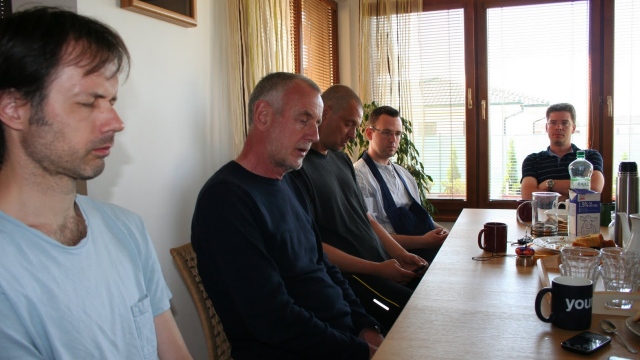
Michael Eido Luetchford
May 2012 — Nová Dedinka, Talk 2.
Venue: Nová Dedinka, Slovakia.
Michael Eido Luetchford · May 2012 — Nová Dedinka, Talk 2
Source: audio transcript.
From the day of zazenPhotosRecordings2Chronicle
Audio
20120526-den-zazenu-NovaDedinka-2.mp4 in the Google Drive folder
What the talk says (short overview) — About these overviews
Responding to Roman's question about why Dogen stresses in the chapter Raihai-tokuzui that we should prostrate ourselves to anyone who has got the marrow, while Mike himself never speaks like that, Mike explains that the marrow means the truth and gives his own sense of what prostrating to it means. He says that the word comes from the story of Bodhidharma telling three students that they had his skin, his bones and his marrow, an ancient way of describing how deep somebody's understanding is. In a simple understanding, he says, groups imagine a teacher who knows a special secret truth and treat that person as perfect, because they want somebody to tell them how to live their life, but Dogen's meaning is different because his understanding of the truth is different. For Mike, anything that has the truth, such as a mountain, a baby or a dog, can be revered because it can teach us something: we have to follow the truth of the mountain rather than the picture in our mind, a baby is truthful and honest, and a dog is always real. Yet we cannot always recognise the truth in others unless we recognise the same thing in ourselves, which is why a bad-tempered person, or someone who has got up in the night because a baby is crying, cannot see it in the dog or the baby.
Mike illustrates this with the tea ceremony, where Mono o daiji ni suru, jibun o daiji ni suru means that treating things with respect is treating yourself with respect, and he says that prostrating to someone or something that has got the marrow is recognising the marrow in yourself. Recognition works both ways, he says, and because it does, we feel oneness. Asked whether the chapter is about recognising true Buddhist teachers, he answers that it can be, but that recognising a true teacher is recognising the truth in yourself, which is intuitive. He tells how Gautama Buddha studied with yogins for maybe eight years, then left the forest, sat under a tree and recognised the truth in himself and in the whole universe, and he notes that Gautama Buddha did not have a Buddhist teacher, adding that when we recognise truth in somebody's teaching because we notice it in ourselves, we can make it our own. In the discussion Roman tells how a book by Brad Warner helped him, after 17 years of struggling with teachers, to give up the idea that he should be a certain kind of Buddhist, and Mike tells him that he had the freedom to be himself but did not recognise it. When a participant asks what Mike meant when he said that zazen does not change our lives, Mike answers that if we think zazen makes us better, our zazen becomes tainted, because to know ourselves we have to see the self we are, so in zazen we stop trying, and not trying to change changes us.
Asked whether zazen can change us for the worse, he says that it can, since an idea of zazen as balance or as no emotion leads us to push emotions down and use zazen as a prison, as he did himself and as he thinks many Japanese monks do. Asked about his teacher Nishijima, he describes a man who understood Dogen very deeply but pushed down painful feelings that Mike thinks may come from his youth and who, as he grew older, became very angry and suspicious while saying that he was not angry because Buddhist teachers are not. Mike gives the example of Nishijima shouting for many years at his secretary, who left the group and found her own confidence, and he says that he does not know whether that was teaching, although in a way everything is teaching, while he finds the idea that Zen masters always teach in a special secret way rubbish. He adds that Brad Warner writes about Zen masters in the States and that sometimes it is necessary to point out the situation, like the king who has no clothes, and when a participant says that Warner goes too far, Mike calls it obsession and says that Warner likes to be a fighter in his writing but is not like that in person. The recording ends as Roman asks whether the balance Mike speaks about includes being excited going downhill or exhausted going uphill, and Mike's answer is not recorded.
Complete English transcript — About transcripts
Editorial note: This transcript of a spoken talk has been lightly edited to read well as written text, keeping the speaker’s voice and meaning; the wording was adjusted with great care. We recommend listening to the original audio recording too.
[inaudible] that we could just have an informal talk. If you don't want to have a talk, we can have a chat. But Roman asked me to talk about something a couple of weeks ago, through Facebook. But I forgot exactly. But we have to wait. It's too early to say? No, we finish early. Okay, go.
Roman: The chapter Raihai-tokuzui.
Mike: Raihai-tokuzui.
Roman: Bowing to the marrow.
Boris: Prostrating to the marrow.
Mike: Yeah.
Boris: Yeah.
Mike: Explain it, and then tell me.
Roman: In Shobogenzo I have read a chapter which is called, in Czech, Poklony.
Boris: Prostrating to the attainment of the marrow.
Roman: So I explained why I found it interesting that Dogen stressed so much that we should recognise someone who attained the marrow, the truth, and we should revere such a person very much, even if it's a girl or a fox. And so it seemed interesting that he stressed that so much, to recognise a person who attains the marrow. And you never speak like that, like, ‘Look at that person, we should bow to him or to her because she…’ So if you could explain the meaning of the chapter and why he stressed that so much, and why you never talk like that.
Mike: Because I never talk like that.
Roman: I didn't notice that you would ever…
Mike: Yeah, okay.
Roman: You know.
Mike: It's an interesting chapter in Shobogenzo, and the marrow, prostration to the marrow, using the word marrow comes from another story. Hey, hey, hey.
Bodhidharma, who came from India to China in the ninth century, had three students. And when he was going to die, he called his three students to give them some kind of confirmation. And he said to his first student, You have got my skin. And he said to the second student, You have got my bones. And he said to the third student, You have got my marrow. It's a kind of ancient way of talking about how deep. So skin, flesh, bone, marrow. And marrow is inside the bone, so it's the very essence, the centre of something.
So the simile was used quite a lot to indicate how deep somebody's understanding is. And Dogen used the word in Raihai-tokuzui, prostration to the marrow.
Mike: And as Roman said, in the chapter Master Dogen said we should prostrate ourselves to anyone who has got the marrow. And then he tells stories about people who recognised other people who got the marrow. So the marrow means the truth. But what is the truth? And Roman's question is, how can we see if something or somebody got the truth? And then how do we revere them?
In the simple understanding, we might imagine that we find somebody who knows some secret, which is the truth. And if we can, we can see that they have this special secret truth. We can revere them and prostrate to them. And you can find this attitude in many Buddhist groups. People think that the teacher has some special secret truth. And they revere the person. I don't consider you a divine being. Or, in other words, they think the person is perfect. So they make the person into a kind of demigod.
And the reason that they do that is because they want very much to have somebody who is perfect to tell them how to live their life, tell them what to do, what to wear, what to speak, how to solve their problems, and so on. So lots of groups like to revere somebody who has got the truth. But Dogen's meaning is different to that, because his understanding of the truth is different. So this morning I told you about my experience in the mountains. So, if we can recognise that the mountains can teach us.
So, for instance, if we're walking in the mountains, and we have the picture in our mind according to the map, and we believe that picture is true, and we don't change our attitude according to the real situation, we might have to be rescued by helicopter. But if we recognise that the mountains themselves have a kind of truth, you have to follow the truth of the mountain, not the truth of your mind. So for that reason, we can revere the mountains, because they can teach you something.
Or, for example, if we have a new child in the family, a new baby, because a new baby is not contaminated by society. They are very pure. So if they feel upset, they cry. If they're happy, they laugh. So they're truthful, they're honest. They don't hide anything. And for that reason, we can learn something from a baby.
So if a baby comes into the room, and the mother or father brings a baby into the room, everybody's looking at the baby. The baby's very powerful. Everybody, because the baby has the truth. And everybody can recognise. Maybe there are some old-fashioned men who say, Oh, well… But they recognise too. Just they're embarrassed by the truth. And some people might go like this, look at this, they don't agree. I thought that if a real baby is in front of us, we can see something very simple. And if you have a dog as a pet, the dog is always real, unless the dog has been treated badly. The dog is very simple. If you take the dog for a walk, he says, Oh, my favourite walk. And you bring the dog back and he says, Oh, my favourite place. I can sleep. And you give him some food, and the dog says, Oh, my favourite food. So the dog is always in the moment. So we can see something in the dog. So the dog is… Or the baby is teaching us something. Or the mountains are teaching you something. Or anybody can teach you something. So we can revere them or respect them. So Dogen writes, anything which has the truth, we can revere. But we can't always recognise something that has the truth, unless we recognise the same thing in ourselves.
So if you come into the room and you have a dog, and you are very bad tempered, for some reason, you don't recognise the truth in the dog, because you can't recognise the truth in yourself. So you become annoyed with the dog. Or if you get up in the middle of the night because the baby is crying, you can't recognise the truth in the baby, because you can't recognise the truth in yourself. Sometimes we can recognise a simple fact in another animal or nature or something. And that recognition is also recognising ourselves. So if we revere the mountains, or we respect the mountains, we respect ourselves. In Japan there is an art called the tea ceremony. And the tea ceremony is a very special ceremony, using a special cup and green tea, and it's very ceremonial.
So the tea ceremony teacher, or the person who is doing the tea ceremony, is only one. And if you watch a tea ceremony, the person making the tea is doing everything very slowly. Putting water into the cup and so on. Placing the cup on the table. And so on. And in the tea ceremony they say in Japanese, Mono o daiji ni suru, jibun o daiji ni suru.
So, treating things with respect is treating yourself with respect. So in the tea ceremony, treating a cup very carefully is treating yourself very carefully. So they revere the way of putting the cup down, or the way of putting the tea into the cup. But in the tea ceremony, this means to revere yourself. So in Dogen's chapter Raihai-tokuzui, prostrating to someone or something that has got the marrow, tokuzui, is to recognise the marrow in yourself.
So when we can recognise the marrow in ourselves, we can recognise the marrow in a dog, or a baby, or a tree, or a mountain. So recognition is two ways. So because it's two ways, we feel oneness. I feel some connection. Let's see what we mean. If you have any other things. In Shobogenzo, Dogen again often…
Roman: …speaks about some true teachers of true Buddhism, and warns that person, non-Buddhist. That person didn't understand. And so you think in this chapter he's not talking about that, recognising true teachers of Buddhism?
Mike: Can be, but to recognise a true teacher of Buddhism is to recognise the truth in yourself. So if you go to see many different teachers, you are feeling, is this person okay, or is this person I can follow, and so on. But then if you find a teacher who you recognise something in yourself, then you feel, ah, okay. And if you find a teacher that you don't recognise anything, then you feel, hmm, maybe not. So it's kind of intuitive. So, in the story of Gautama Buddha's life, the story says he went into the forest to study with yoga practitioners, yogins. And the yogins said, the truth is, if you sit in the yoga position for a long time and very powerful concentration, you can become higher and higher level, and at the ninth level of consciousness, the creation of the world. So Gautama Buddha recognised in himself some desire, some intention to discover this. So he thought, I will study with these yogins.
So he studied with the yogins maybe for eight years. But after eight years, he couldn't find what they were telling him. So he left the forest and sat under a tree and recognised that the truth is in himself, and in the whole of the universe. So, for instance, Gautama Buddha didn't have a Buddhist teacher. But we might meet a teacher who says, The truth is to become very, very strong. Nothing can break you. So sitting like a rock in zazen. And even strong emotion doesn't have any effect. And so on. And we might feel, yes, yes, this is what I want. And then we might follow this teacher. And we might feel after some time, I don't know. I can't... Maybe there are people like that, but I can't do it. I tried, I tried, but I can't do it. This is what Gautama Buddha said.
Ah, I don't know. I tried for eight years, but it doesn't work. Something's not true. We feel. So we're searching for the truth outside, but we're also searching for the truth in ourselves. So if we find it outside, we recognise it inside. So this is the way we choose to study with, or find a teacher. But of course my story is too perfect, because often we're not sure one day, and we're sure the next day. And also there are no perfect teachers.
But I think one important thing is, when we recognise truth in somebody's teaching, because we notice in ourselves, ah yes. Then we can make it our own. So it belongs to us. Not to somebody else. Does that make sense?
Boris: Super.
Mike: Super, almost perfect.
Participant: Perfect. I was just thinking perfect all the time.
Roman: Can I give an example of what happened to me? It was before I met Mike.
Mike: I want to. He recognises the truth. He's hungry, he recognises. Sorry. Yes.
Robert: Cool.
Roman: I was browsing, because I wasn't very happy with my teacher. I was looking for something on the internet, of course, the internet has all kinds of links. And somebody said, Brad Warner, read his books. And I had no idea who Brad Warner was, and he wrote a book called Hardcore Zen. So they recommended the book, so I visited his website. There was a picture of quite a young guy wearing
Boris: Costume.
Roman: a costume, like acting like this, I'm a Zen master. So I thought he was either completely crazy or a true Buddhist teacher. So I read the Hardcore Zen book. And I was driving my car one day, as usual, and all of a sudden I realised that thanks to this, after 17 years of struggling with all kinds of teachers, I could at last give up the idea that I should be a certain kind of Buddhist. And I was driving the car, and it just felt, I'm just driving a car. I'm just what I am, nothing else. It's okay. That was a huge relief. So I think that was the kind of recognition of just I am myself, and thanks to this Brad Warner guy, he helped me to get rid of all this bullshit, all the Buddhist masks and stuff.
Mike: He's very good at that, yeah.
Roman: So I think good Buddhist teachers can give us wonderful freedom to be ourselves.
Mike: You have freedom to be yourself. We have freedom to be ourselves.
Roman: But I didn't have it before.
Mike: But you had it, but you didn't recognise it.
Boris: Yes, yeah.
Roman: And of course, if you study with teachers who try to make you into… you're not strong enough, or you're not wise enough, or you're not happy enough, then you always feel frustrated. Something's wrong with me, even if nothing's wrong.
Mike: I think especially difficult in Western, in European society, which has a Christian background. I guess for 2,000 years, Christianity said, We are born in sin. And we climb towards heaven. But Buddhism says we're born normal. And we can just accept our normal self. Which is very difficult.
Boris: I have another question that we had together with Robert and Vincent in the debate. Did you say to someone that zazen doesn't change our lives?
Mike: Yes.
Boris: How do you mean this? Because, for example, Robert says, It changes.
Mike: Yeah.
Boris: And I say, It doesn't change. But how do you mean this sentence?
Mike: I don't remember how I said it.
Boris: So, okay. It was very close. Zazen doesn't change. We believe, yes, we see that it changes. It will be better.
Mike: Yes, yes. If we think zazen makes us better, then our zazen becomes tainted.
Robert: You can even translate [inaudible].
Mike: If we want to know ourselves, we have to know the self which we are. Which is not beautiful, but beautiful, ugly, neither, and both. It's not kind, it's kind, cruel, and kind and cruel. And so on. So in order to know ourselves really, we can't think, I must be better, I must be better. Of course, we all think, I want to be better. I want to be better.
But zazen is not that situation.
Roman: No.
Mike: So in our normal lives, we often think, I want to be better. I want to change myself. But in zazen, we stop. And we say, I'm going to see myself as I am. In zazen, we don't try to be anything. In normal life, we're always trying, but in zazen, we can stop trying. And to practice, stop trying every day.
Changes us. So not trying to change changes us. I don't know why. Maybe human beings are very stubborn. So if we try to change ourselves, we say, No, no.
If we give up, then we say, maybe I change then. Okay. I don't know, but yes, of course, zazen [inaudible] us. What about that? Who says so? We have to ask everybody.
Robert: Perhaps you're right. Yeah.
Mike: Do you think I'm better? Do you think I'm better? Do you think I'm…
Robert: I don't know. You never know the another alternative, so you can compare.
Mike: No, you're right. No. You're right.
Boris: So when you said that zazen can help us see what we are, to see the truth maybe, to get rid of illusions, that can help us, or that can improve us, or improve our life?
Question: But if I asked the question differently: can zazen change us for the worse, is that real?
Boris: Does zazen make things worse? Is it also possible?
Mike: Yes. I think I realised that if we have some idea about zazen, for instance, zazen is balance, zazen is no emotion. If I practice zazen, everything will be solved. If we believe those kind of things, then when we practice zazen we tend to push down. For instance, emotion, sexual feeling. Anything which doesn't seem to be balanced. Push, push. Then we use zazen as a kind of prison. And I think many people who practice zazen do this. And I did it myself. At one time, my teacher said, Practice zazen and everything is okay. You don't need anything, only zazen. So I'm thinking, I don't need to solve my problems. I don't need to do anything in my life, just zazen. So, you know this feeling? Pushing, pushing. But I realised that that's not zazen, really. And you read in the books about zazen is wonderful, peaceful. And if we do that, it's not good. So now I cry in zazen. Or I feel angry in zazen. Or I feel sexy in zazen. Or I feel sleepy in zazen. That's me. It's all this. So it comes and goes, like this. So we can suppress ourselves in zazen, and I think many Japanese monks suppress themselves in zazen. Because they're taught, zazen should be like this. It should be peaceful, you know.
Robert: And do you have the same experience as your teacher, Nishijima?
Mike: I think my teacher taught me many, many things. And for 15 years, I was very close to him and worked together with him. And he taught me about Dogen's teachings, and he taught me how to practice zazen.
But then we had a bad relationship for 15 years. And of course, there's some problem with me, because two people. So it's difficult to talk about what was my problem. But his, I think his problem may be when he was young, the Second World War. Japan. He was in the army. His parents were killed in the war, in a fire. And I think when he discovered zazen, he found a way to be peaceful.
And he studied Dogen's works very, very, very deeply. And he understood Dogen's writing very, very well. Maybe better than any other man in Japan, or person in Japan. Any other person. But he told me he had a tendency to be intellectual. So although he understood the teachings, somewhere in his personality, he was pushing down. So as he became older, he couldn't control his… And because he'd been pushing them down, they started pushing up. So he starts to get very angry. But I get angry sometimes, as you know, but my teacher would get very angry. Or very suspicious. About different people. So thinking about it, I think that these were the feelings, maybe from his young childhood and his young life, which are very painful for him, and he pushed them down because he realised zazen can save him. But he wasn't completely like that. Part of him became very wild.
But because he believed in Buddhism very strongly, even he got very angry, he used to say, I'm not angry, I'm not angry. Because he was thinking, I'm not angry because I'm a Buddhist teacher, and Buddhist teachers aren't angry. And zazen is balance, you know? So he thought like this. But this is only part of him. So another part taught Pavel how to sit in zazen very kindly. Not angrily, not suspicious, but kind and generous. And Brad Warner, for example. He was always very kind to Brad Warner. But for instance, me, something in me, when Nishijima became older, something in me, he thought I'm trying to win him, trying to steal his things. I don't know why. Something, my character, I guess.
So he thought, I'm trying to steal his books, copyright. And the other students, he thought, you know, ah, they're trying to do this or trying to do that. So human being is very complicated. So something I just touched for him. So that's my understanding.
Vincent: It occurred to me, from what Mike was saying now, that it is often written in those Zen stories that the master got angry or hit some student, but that it was a kind of form of teaching. Whether perhaps he felt something like that about his teacher, even though basically… [inaudible] According to what he was saying here now, I think that it is more of a character trait of the master, that it showed itself somehow, but that [inaudible].
Roman: There's lots of stories, koans, where a teacher becomes angry and hits a student. So Vincent is asking maybe if Nishijima was doing something similar, like teaching people by becoming angry with them.
Mike: Maybe. But for instance, he was very, very angry for many years with his secretary, woman, [inaudible]. So he would shout out to her. And when another student, Gabriele, said to him, You shouldn't shout at [inaudible] like that, he said, Why not? It works in my home.
However, [inaudible] eventually left the group completely. And [inaudible] went to a separate place after being his secretary for many years. She quit and didn't want any conversation with him or anything. But she found her own confidence. So she found a way to live happily. So whether he's teaching her or not, I don't know. You know, parents are teaching us. We can say our parents are teaching us, because we learn from the bad part, or, I don't want to be like my father. No. So it's teaching. Thank you, Father. So yes, in a way, everything is teaching. But I think there's some kind of story that Zen masters always are teaching something special way, you know.
Wake up, Pavel. This is my teaching. My secret teaching.
Question: What is it?
Mike: I think that's rubbish. It may be a teaching. He might think, okay, I understand. I'm not going to be like [inaudible]. But I think the idea of some kind of Zen master is drunk. He's drunk because it's secret teaching. You know? They try to find secret teaching. Yes, they must be balanced even if they are drunk. Yeah, that's right. A Zen master is sleeping with a female student. It must be something special. Yes, special. There's lots of examples of this.
So Brad Warner is an excellent writer, and he writes many things about these Zen masters in the States. Sometimes it's necessary to point out the situation. You know the story, the king has no clothes. So somebody needs to say, No, the king has no clothes.
Robert: But he's especially upset with this Genpo, for example.
Mike: Yes, yes, he…
Robert: But maybe he's going too far with this. Too personal…
Mike: Yeah, maybe. I think obsession. Obsession.
Robert: Yes. Yes, yes.
Mike: Brad likes to be like, Oh, I'm fighting. In person he's not like that, but in his writings he likes to be, Oh, I'm fighting, I'm winning here. Maybe it's his character. Sometimes very amusing. I don't know Genpo, personally. I don't know him.
Robert: I only know what Brad writes about him, and yes, one time I read some articles.
Participant: [inaudible]
Robert: He's terribly against him, even a little bit too much.
Roman: I think Brad doesn't like that somebody sells enlightenment.
Participant: [inaudible]
Boris: Anyway, that is not the point.
Roman: Can I ask you something? I realised, like, a month ago, you always speak about balance, balance, okay. And then I realised, do you mean also, because balance normally I think like we're not feeling too excited or too sad, just balance. But then I realised when we, for example, go cycling, you can feel excited going downhill or feeling exhausted going up the hill. But are those also states of balance, or being sad in a balanced way, or being excited in a bal… you know what I mean?