Mike says we need only make an effort, not know its result, and that he is happy not making an organization
Talk digest
Michael Eido Luetchford
May 2014 — Banský Studenec, Talk 5.
Venue: Banský Studenec.
Michael Eido Luetchford · May 2014 — Banský Studenec, Talk 5
Source: video transcript.
Editorial note: A digest is a shorter way into the talk: the speaker’s main ideas in their own voice, gathered by theme. It suits a first acquaintance or a reminder; nothing in it is added. The full wording, with all examples and context, is in the full transcript, which remains the authority.
Nishijima’s four views
Nishijima Roshi hoped that Buddhism, based on the teachings of Master Dogen, could save the world. He seemed to believe that sometime in the future everybody would understand the truths that Dogen was teaching.[1]
He taught that Master Dogen had four views: an idealistic view, a materialistic view, a realistic view, and a view based on reality. It’s difficult to find a word for the last two. He discovered these viewpoints in Dogen’s writings, and when he studied world history, he saw these same four phases in the development of the world.[1]
From idealism to materialism
He thought that the early civilizations around the time of the Greeks were idealistic. The Greek belief was in the perfection of ideas, as in Plato’s philosophy about shadows on the back of a cave: there is a world of perfect form, and we are trying to be like that world. When these beliefs met Christianity, they fitted exactly: God is perfect, we try to be like God, and if we try very hard, after we die, we enter this perfect world. Actual living conditions were very miserable, but people could develop this perfect world in their minds. It was a very spiritual time, with wonderful soaring churches. So he saw that as the first phase, Dogen’s first viewpoint.[1][2]
Then a few people in Europe started to base their beliefs on what they could see and touch: the birth of scientific investigation. Very slowly, people realized that physical explanations were much easier to believe than spiritual ones, and the world became more materialistic. This is Dogen’s second viewpoint.[2][3]
Then Nishijima Roshi saw that the modern, very strong belief in the laws of science didn’t seem to be enough. Some people found that just believing in science has no heart; it’s too cold, too mechanical. He saw the last hundred years as a kind of battle between the spiritual view and the idealistic view and the materialistic view, especially between the Western world based on American idealism and the Soviet system based on the materialistic beliefs of Marx. He thought they would fight, and then somebody would win.[3][4]
A kind of dream
But when the communist system seemed to collapse in the 1980s, he thought it was a kind of synthesis between the two sides. So he felt very hopeful that the world would be entering a new phase, a realistic phase, where neither strong materialistic systems nor strong idealistic systems would dominate. And he thought that’s the same as Dogen’s third phase. His dream, or his hope, was that the world would enter a fourth phase where people entered reality. He believed this very strongly.[4]
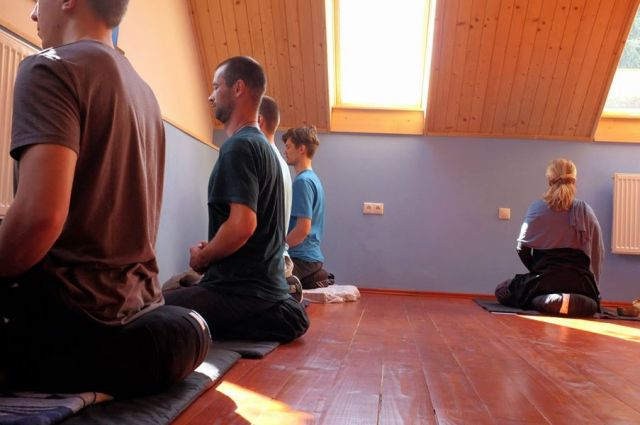
And his students found it quite difficult, because we’re just a small group of people practicing zazen. We used to ask him, Do you think everybody will practice zazen in the future? And he would say, Yes, I think so. So, a kind of dream.[4]
But at the same time, his analysis of the flow of world history is very interesting. He seemed to be saying that the truths that Buddhism teaches would become widely known, and because those truths become widely known, the world would move towards Buddhism. He was always very optimistic: although we’re having many conflicts and wars between different religious beliefs, he said the world is flowing towards reality. I don’t know whether his dream will happen or not. Some of his students are teaching, and our teaching is based on his understanding of Buddhism, which was based on Dogen’s teachings and his analysis of world history. We are a small group, and not many people come.[4][5]
Spreading without Buddhism
But what he says about Buddhism becoming widely known is true, isn’t it? I mean, things like mindfulness and all kinds of things from Buddhism creeping into general use and practice. So I reckon he’s not far off. In some ways, the teachings are spreading without Buddhism. Instead of the spread of different religions, we have the spread of football, which may be benefiting human beings more than some religions, because at the center, when you kick a ball, it’s better to be in a nice state of prajñā.[5]
Because of the many conflicts, we are beginning to understand that it’s better not to fight, that it’s possible to negotiate instead of fighting. Sometimes it works. So we are slowly learning. So in a strange way, without being so clear, the world appears to be moving towards Nishijima’s dream.[5]
Nishijima’s efforts
He never tried to make a big organization. Well, he did once, but that… Generally, he never tried to make a big or powerful organization. He did what he could, and people came and went to his seminars and sesshin from many countries. And it’s impossible to know the result of his efforts. I came back to the UK in 2000, and 14 years later, I’m in Slovakia, and I have no idea of the result of my efforts. And it’s not necessary to know the result of our efforts. But just to make an effort.[6]
A loose organization
So, in my opinion, we don’t need to build up a big group, a structure, a hierarchy; Nishijima was always the teacher, but he never made a hierarchy. I’ve been proceeding like that, and something has grown in 14 years, in the Czech Republic and here. Everybody has been making an effort. My feeling is that it’s better for something to grow naturally than to be constructed intentionally. That’s only my personal feeling. So, making an effort, maybe people come, maybe they don’t come. It’s okay. Sometimes at Nishijima’s retreats we only had five or six people, sometimes forty-five, forty-six: not getting bigger and bigger, but going up and down. I don’t know the reason.[6]
With this kind of very loose organization, it’s quite difficult for new people to feel enthusiastic. They want to know what kind of group they are joining. I don’t know how to solve this problem. I think it’s up to everybody to find the solution.[6]
But personally, I’m very happy not making an organization, because it’s easier for me, carrying on in a similar way to Nishijima. He never tried to attract people; some of the things he said made people leave. And now there are people all over the world who studied with him, and here and there there are groups like ours. If we had a structure and courses and charged bigger fees, we could get lots more people. But my idea is not like that. So my idea is rather lazy.[7]
So if you’d like to come to the group to practice together, it’s great. You can make your own effort, and something will happen. Susanna has started a group, so your group is going somewhere. But in my case, I never planned where I’m going, and I found it’s not so necessary. This is only my personal view.[7]
Coveting nothing
Question: I read a quote from Sawaki: To covet nothing is greatest gift you can give to universe. What does it mean?
Covet: to want to get. If you don’t want anything, it’s a nice situation. If you want to get something, there’s an imbalance, because wanting to get is a kind of feeling. So sometimes, if we want to get something strongly, it’s disturbing. I wanted to get a kayak last week, so I’m thinking about it all the time. So I wait until I stop wanting it, which is more comfortable.[8]
Pavel: I think these quotes are quite misleading, because sometimes people take them to mean that there’s nothing to do, just a kind of passive behavior. We need to find some kind of balance in understanding these.
Yes. The problem with words is that they never describe the situation. Kodo Sawaki was talking in Japan in a very materialistic time. Lots of people wanted to get things, and in Buddhism they wanted to get peace and happiness. So sometimes wanting to get something is disturbing to us. But there is no instruction not to do it. In his quote, he doesn’t say, Don’t covet. He just says, Not coveting is very nice.[9]
Question: It is fine to have an intention to do something. But desire is something else, where there is already some emotional attachment, a dependence on the result. The intention is fine.
Yes, we can’t avoid it.[9]
Buddhism is not a company
It’s very difficult talking about things. I don’t mean to suggest that we shouldn’t have any intention to do anything. But I would like to suggest that some things grow naturally. Part of that natural process is pulling something towards you, pushing something away from you, and finding your way. I don’t mean that you just hire a room and sit in it.[11]
Dogen Sangha started with Nishijima Roshi. He tried once: he tried to create Dogen Sangha International when he was very old, and it didn’t work. I only mean to suggest that with Buddhism, it’s not like selling biscuits. If you make biscuits which are very delicious, you can advertise them, people buy them, you make more, then you build a big factory, then a factory in another country. The teachings of Dogen are not like that. Dogen himself moved from a very busy city called Kyoto to a very remote place in the mountains.[11]
So in making our effort, with our practice, something happens. It’s not like building a company, an organization. Of course, organization is necessary, but it’s something different. We can’t live without intention. We can’t live without planning, without desire, without thinking, without making mistakes. That’s life.[11]
Changing the world
Pavel: I think it’s quite simple. With effort or with focus, it grows. If you stop making an effort, then it maybe survives or maybe not.
Yes. And making an effort for Buddhism is very great. Usually we think doing small things is not great, but it’s not true. Doing simple things sometimes is very great. We never know the result of doing something very simple with great effort. So when we do simple things to have Buddhist activity, we can think we are changing the world.[12]