Mike does not use Buddhism to solve his problems, and says zazen can become an escape rather than a refuge
Talk digest
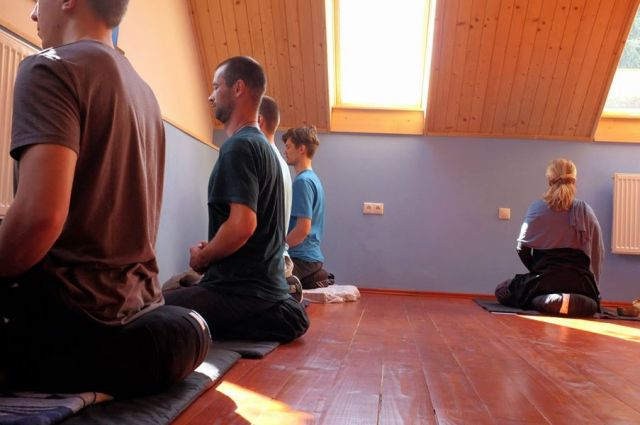
Michael Eido Luetchford
May 2014 — Banský Studenec, Talk 3.
Venue: Banský Studenec.
Michael Eido Luetchford · May 2014 — Banský Studenec, Talk 3
Source: video transcript.
Editorial note: A digest is a shorter way into the talk: the speaker’s main ideas in their own voice, gathered by theme. It suits a first acquaintance or a reminder; nothing in it is added. The full wording, with all examples and context, is in the full transcript, which remains the authority.
Has Buddhism helped me?
Roman asked me to talk about how Buddhism has helped me in difficult circumstances in my life. It’s a very interesting question, but the answer may also be interesting. I don’t think it’s helped me at all, and I’ll explain why. When I have a difficult circumstance, I forget all about Buddhism. I’m completely involved in the circumstances, and I have to deal with them from my own character.[1]
I lived in Japan for 25 years, and I noticed that Japanese people have Buddhist habits, but they’re not aware of the fact. In Buddhism there is a precept: don’t get angry. Of course, people get angry in Japan, but there is some shared understanding that if we get angry, it’s like releasing a poison into our blood, so they avoid it. I suppose that comes from the Buddhist teachings.[1]
Maybe I also have Buddhist habits without knowing about it. I guess I do. Certainly, I’m different now from when I was younger, but it’s difficult for me to know how different. Is the difference due to Buddhism? But I never make any attempt to use Buddhism to solve my problems. Maybe twenty years ago, Yoko and I had a big argument, and I thought, I’ll sit in zazen; that will solve the problem. So I sat in zazen, very sternly and angrily. But it didn’t solve anything. I think she threw something at me. Because it was an escape.[2]
We can use Buddhism and ideas of balance in zazen to escape from our lives, from our real problem. I think if you use zazen in that way, it’s possible to notice that it’s kind of escaping. Of course, if you’re angry and you feel disturbed afterward, sitting in zazen might help you to calm down. But to sit in zazen angrily doesn’t work.[2]
What my teacher meant
My teacher, Nishijima Roshi, said maybe thirty years ago that all we need in our life is zazen, and if we practice zazen, it will solve all our problems. I was about 35, and I believed it. I remember sitting in zazen with migraines, hoping they would go away, but usually I would have to go to bed. I also thought that if we practice zazen, we will never become ill. And then, in about 1985, Nishijima Roshi became very ill. So it doesn’t prevent you from becoming ill.[3]
His illness was a side effect of some medicine he had been taking for gout, and he had gout because he was drinking too much when he was younger. Then I began to think about what he said about zazen. And I realized that he didn’t mean that zazen had some kind of magical effect, but simply that if you practice zazen, you can keep healthy. In my life, that’s true. Practicing zazen every day, I think, seems to keep me fit.[3][4]
Boris: I have the same experience with Kaisen that you told about Nishijima: that zazen helps with maybe every problem, or also with health.
However, I think I misunderstood. I think there is a custom in Japan for teachers to be strong: Deshimaru, samurai. My teacher wasn’t like that, but when he said something, it was very direct: if you practice zazen, all your problems are solved. And I would understand exactly from his words, but he didn’t mean it like that. He didn’t live like that.[8]
Mike Cross, who translated the Shobogenzo with Nishijima Roshi, also had the same misunderstanding. Nishijima Roshi used to say, sit straight and pull your chin in. So Mike Cross thought, if I do it a lot, I will be better. He sat like this for some years, and of course it made him very tense. Then he studied Alexander technique, and they told him, relax. And he realised how tense and how idealistic his interpretation was. So my problem was I interpreted what Nishijima Roshi said idealistically. Practice zazen and you have no illness, no problems. It’s crazy. I think it’s a kind of process of studying Buddhism.[8]
Nishijima Roshi sat straight, but not rigid. And he is a man of his time, a Japanese man born in 1919. Although he used to say men and women are equal, sometimes he had the Japanese habit of treating women like a servant. Not always. So we are people of our time.[9]
Using zazen to escape
Whether practicing zazen solved my problems or not, I don’t know. Maybe it brought out my problems from inside me. I’d been teaching zazen in Bristol for nearly ten years when I met my present partner, Lisa. She’s an artist, with a very different character and lifestyle from mine, and in the first few years we had a very difficult relationship. One thing I realized and learned from her is that I was using zazen as an alternative to a fuller life.[4]
I based my life on a kind of routine. To some extent, I used that routine to escape from the possibility of…[4]
Participant: Changing.
If you teach Buddhism and you practice Buddhism, you keep reinforcing to yourself what you’re saying. So it can become kind of stiff. I think I was doing that. But Lisa’s life is more chaotic, which I wanted to refuse. Because my customary life based on my teaching became a kind of coat or cover, protection.[4]
So I realise that we can, and I have done, use Buddhism as an escape. I used zazen as an escape rather than a refuge. The difference between escape and refuge is a subtle one. So, to answer Roman’s original question, how did Buddhism help me with my problem? I think my problems help me with Buddhism more.[5]
Question: Could you give us an example of how you changed when you met Lisa?
Oh, I don’t know, really. When I was in Bristol in the early days, I was more strict. I wouldn’t say strict. I would say focused. But now I’m less focused.[6]
Question: Did you change your daily routine a little bit?
Of course, my daily routine changed, living with a different person. But I think relationships between couples, man and woman, or man and man, a woman and a woman, contain a male element and a female element. It doesn’t mean that woman is all female and man is all male. Characteristic male elements are conservative, resistance to change; female elements include skill to help others develop. We have both. But in most relationships, there’s polarity. Man doesn’t understand that woman is trying to change him for his benefit, so he resists. In my experience, that’s a common situation, and for me too. So now sometimes I do what I’m told. But sometimes now I can see the wisdom in the female. I don’t mean woman, I mean female. But the female wants to help you and to develop you.[6]
Truths that are everywhere
I realise that the teachings of Buddhism don’t belong to Buddhism. Very clearly. So groups who think they have some special teaching, some special position in society, some special moral advantage, I think that they are damaging Buddhism or damaging the truth.[5]
I think with all kinds of teaching, there is a tendency to keep the teachings belonging to me or to my group. If a teacher does that, they can climb up to the top of the group. But if they stop keeping it, they might fall down. So there’s a tendency for teachers to want to keep something: we are special. But it’s not true. It’s quite damaging.[6]
Robert: I think Dogen Sangha as a group is quite special among some other Buddhist groups.
Okay. But the truth we can see only between opposites. The truths that Buddhist teachers have taught since ancient times appear everywhere. So Buddhist teachers are trying to point out the truths that are everywhere, not to teach a truth that nobody knows but to point out a truth that we all have. We have already. We always had. We always will have. That’s my opinion.[6]
Why I keep practicing
Robert: Mike, you thought that Buddhism doesn’t help you in your problems? And if you could tell us why you practice Buddhism?
I don’t say that Buddhism didn’t help me with my problem. I don’t know if it helped me, because when I’m involved in a problem, I don’t think about Buddhism at all. But it may be there in me. Why do I continue with Buddhism? One reason is that I like practicing zazen. Zazen gives me a kind of base, or ground. And it keeps me healthy. I believe the essential ideas: cause and effect are absolute; the present time is only reality. I know that what the Buddhist precepts say is pretty well true. Although I don’t make a strong effort to follow the precepts, I think over some years, the precepts follow me. So I guess I changed. So I keep doing it. But not as focused as, say, ten years ago.[10]
From the other side
Roman: Could it also be the opposite? My life was very chaotic: I used to go to sleep at five, and I used to take drugs. In my experience, zazen helps me to return to some kind of order and some kind of simplicity. Do you admit it could be the other way too?
Yes, I’m telling you my experience. I didn’t take drugs and be untidy. I’ve always been quite tight, the opposite.[11]
Roman: So two different people can come to something similar.
If we think about it, you can say that. I think that, like any experience, when you do zazen, you learn something from it. In my case, I don’t shout at other drivers so much if I’m doing zazen regularly. But I think that’s purely because of learning, as you do in zazen, to let interruptions pass. It’s the same when I go to the dentist. I see him coming at me with that drill, I remember my zazen experiences, and that helps me let the pain and the fright go away.[12]
Sleepiness in zazen
Question: I’m very sleepy during zazen. Is it bad? Is it good? What to do with it?
It’s a fact. It’s not good or bad, but if we’re sleepy, usually there’s a reason. Often we need to go to sleep, and even if we try to sit in zazen, if we need to sleep, we can’t get rid of the sleepy feeling. So it may be better to sleep. On the other hand, sometimes we feel sleepy if we are pushing down some emotion. You can decide whether to continue sitting with your sleepiness or to get up and have a sleep.[12]
Sometimes I become very, very sleepy when I sit, almost like a drug. I don’t know why. But it’s easier for me. I guess my life is not so busy. But I think if we have very stressful, busy lives and then we come to sesshin, it takes some time for our stress, busyness and tiredness to come out. In Japanese they say that tiredness comes out, which is a nice expression. But the simple answer is, if you’re very, very, very sleepy, have a sleep.[13]
And the end of all our exploring will be to arrive where we started and know the place for the first time.[13]
I think that’s very nice.[13]