Mike says prajñā is neither a spiritual nor a physical force but the natural state before thinking, when mind and body are not separated
Talk digest
Michael Eido Luetchford
May 2014 — Banský Studenec, Talk 2.
Venue: Banský Studenec.
Michael Eido Luetchford · May 2014 — Banský Studenec, Talk 2
Source: video transcript.
Editorial note: A digest is a shorter way into the talk: the speaker’s main ideas in their own voice, gathered by theme. It suits a first acquaintance or a reminder; nothing in it is added. The full wording, with all examples and context, is in the full transcript, which remains the authority.
Before intellectual thinking
This afternoon I want to talk about the meaning of prajñā. What is prajñā? Where does it come from? Many Buddhist groups that I know of chant the Maha Prajñā Paramita Sutra, which is known in Japanese as Hannya Shingyo. It is in praise of prajñā. Maha means great. Paramita, practice, sutra: in English it means the practice of the great prajñā, which people often translate as wisdom. But I wonder what wisdom means.[1]
If we look at the Sanskrit word prajñā, it’s formed of the prefix pra and the participle jnana. Pra means before, and jnana means intellectual thinking. So prajñā means before intellectual thinking. It suggests something before we think, something like intuition. But what is intuition? Somebody wrote a sutra praising intuition: the Hannya Shingyo.[1]
But if you read that sutra, it’s actually talking about something to do with zazen. The sutra which we chant has the introduction and the ending missing. But the introduction describes a sesshin that Gautama Buddha held on Vulture Peak. The Buddha, Shariputra and Avalokiteshvara are at the sesshin, and they have just finished practicing something called the Prajñā Paramita, practice of wisdom. Avalokiteshvara asks Shariputra: How shall I explain the state in the practice of wisdom to young people who might want to practice it? And then Shariputra explains how he wants to describe the state. That’s where the sutra which we chant starts.[2]
The sutra seems to say that the state of prajñā paramita is without everything, a state in which eyes, ears, nose, mouth and so on all cease to exist. But actually, what he’s trying to describe is a peaceful state in zazen, when we stop thinking about the world. We stop discriminating. We stop using words and concepts in our brain to interpret the world. That state is called prajñā. So it seems that the practice of wisdom is the practice of zazen, or the practice of dhyana, meditation.[2]
A state without concepts
But what is it that we get from zazen which we can call prajñā, or wisdom, or intuition? Are we making contact with some higher power that gives us special knowledge? Or is it something in us? It’s quite difficult to describe. In the modern world we would normally think that a state without any concepts is a stupid state, because our societies and our civilization are founded on intellectual knowledge, ideas and concepts.[3]
Our societies value ideas which we call principles. Principles are ideas that are so strong that we believe in them. They’re worth dying for, worth living for. So we are taught to hold on to our principles. But a state before thinking doesn’t contain principles. That sounds very dangerous. What can a human being do, freed from ideas, concepts and principles? There would be no direction, no morals, no right and wrong, nothing to tell us which way to go.[3]
But this state is valued by Buddhism, praised by teachers of the past, and we don’t know what it is, or how it can be valuable.[4]
Mind and body
In order to understand the value of the state of prajñā, we have to imagine what it’s like not to have a mind separate from a body. We have to imagine it, because we can’t think about it. Normally we feel there’s me, my consciousness, sitting in my body, controlling it: come here, go there. My consciousness is like some kind of control center. Sounds good. Sometimes, though, our body does something we didn’t tell it to.[4]
In modern artificial intelligence research, some researchers are noticing that the model of the human brain as some kind of control center might not be true, because of some problems with how long it takes signals to travel in nerves. Now, from ancient times Buddhist teachers have insisted that there is no control center separate from the body. There’s one whole body-mind. It’s the central belief of Buddhist teaching. However, human beings have become very skilled at separating their mental faculties from their physical faculties, or rather, at believing that they are two different things.[4]
Instructions from God
Through the centuries there have been many theories about where the mind is. The great religions have suggested that there is some kind of non-physical power which we make contact with, usually called God. If we make contact with God, we can get nice instructions to control our body. It’s called prayer. Please, all-powerful, abstract God.[5]
Unfortunately, sometimes something goes wrong in the communication, and the people who are trying to receive instructions do very terrible things, killing people. So to me this belief doesn’t make any sense, that there is some spiritual force existing outside the world which will tell us what to do. This is called spiritualism or idealism. We base the way that we live on spiritual knowledge, or ideas or concepts or principles which are true. Instead, I learned from Buddhist teachers that if I stop separating my mental from my spiritual, if I allow myself to become whole, then I can just do what is natural.[5]
The natural state
This is quite difficult to understand, because of our strong belief that we have to think before we do something. So it’s difficult even to imagine a state where our thinking and our physical body are one. We’re not thinking and then doing, we’re thinking doing, or doing thinking, and what must that be like? The state of prajñā, before thinking, is just this state. It doesn’t come from anywhere. It already exists before we train ourselves to believe that we have to think about doing things and then do them.[6]
Maybe we can see it in babies, or in animals. Maybe when we are near them, we can sense it: naturalness, a freedom to live our lives without thinking before we act. This is the meaning of prajñā. It’s not a spiritual force. It’s not a physical force. It’s the natural state of living beings when they don’t separate their mental area from the physical area.[6]
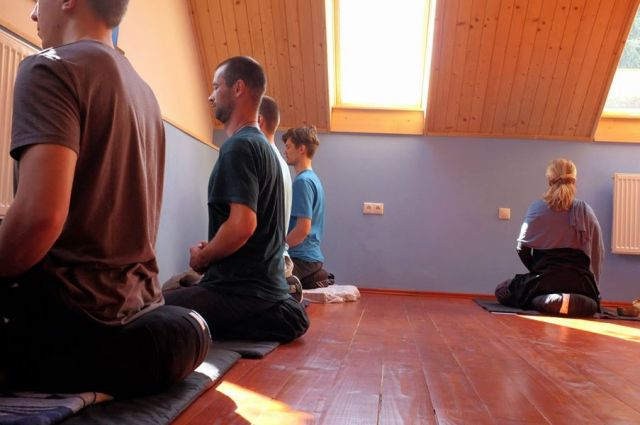
When we sit in zazen, dropping off our mental thoughts, focusing on our body, we are in the state of prajñā, sometimes not for long, because our thoughts come back. But from time to time in zazen we enter a state of wholeness, a state without concepts, ideas or principles, without right or wrong, without good or bad. Just the state of being. This is the state that Buddhism reveres, because it has its own wisdom.[6]
No I in control
But we find it so difficult to trust that our own actions can be right. We spend much of our lives thinking about whether our action was wrong or right. The ancient teachings of Buddhism say: return to the state of prajñā, return to the state before our parents were born. Which is a strange expression. And then we can do what we want. It’s very difficult to have confidence in that, very difficult.[6][7]
But sometimes, if a situation is very dangerous or very urgent, before we have time to think, we act. And then afterwards we often think: Oh, did I do that? Because we’re so used to having I in control. If I is not in control, we feel very, very vulnerable, but this may be an illusion. Prajñā has no I. It doesn’t mean the person disappears.[7]
The golf example
Roman: In dynamic sports like skiing or kayaking we don’t have time to think, and we are just natural. But golf is standing, having lots of time to think and then doing something. Most golfers, even the best, have a huge problem with the mind. We feel fear, we think a lot, and we separate mind and body.[8]
But isn’t it because golf is inherently competitive? You wouldn’t go and play golf on your own, would you?[9]
Roman: Yes, some people do. They compete with themselves. I play on my own most of the time.
I think kayaking or mountaineering, other more natural, normal sports, are something that you do naturally, whereas golf is a competitive sport.[9]
Roman: I’ll give you an example of the difference between not thinking before you do and thinking. When I try hard to swing well, I usually blow it. When I just want to move my balls back to where I started, I stop thinking about how to do it, and all the balls fly perfectly. It’s because I don’t try.
Golf is teaching you prajñā.[9]
Truths that are everywhere
So I’d like to repeat and insist that the truths of Buddhism don’t belong to Buddhists. This is very important. Most religions or teachings claim the teachings as their own, and this separates normal people from special people. But this is a mistake, or a delusion. The truths of Buddhism are everywhere. They can be discovered by somebody who never heard the word Buddha. They can be practiced by somebody who never heard about Buddhism. But Buddhist teachings have put forward these understandings to help us live. If you practice zazen too much, you get problems with your body. If you practice golf too much, you get problems with your elbows.[9]
Trust
Boris: If you know the state of prajñā, the space where you are moving is quite big sometimes. You said that you act before you think, but sometimes it’s very strange. Where are you going? And you are not afraid of this sometimes?
No, no.[10]
Roman: Do you trust?
Trust. Yes. So that trust develops over years. For instance, everybody’s character is different. When we’re young, we often feel our character should be the same as other people’s, so we need to change ourselves to fit in with other people. However, sometimes our character is too strong, and trying to fit in with society is very painful. So to find the confidence to be ourselves is quite difficult sometimes. Finding ourselves needs confidence that what we really like is okay. Usually we feel that what we really, secretly like is not so okay.[10]