Summer 2007 — Uji
Series digest
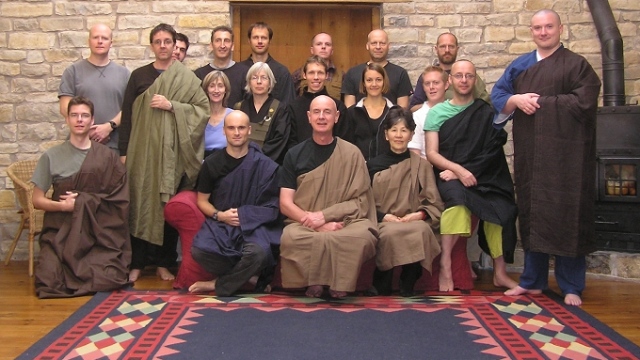
Michael Eido Luetchford
Summer 2007 — Uji.
Venue: Earth Spirit.
Michael Eido Luetchford · Summer 2007 — Uji
Editorial note: A digest is a shorter way into the talk: the speaker’s main ideas in their own voice, gathered by theme. It suits a first acquaintance or a reminder; nothing in it is added. The full wording, with all examples and context, is in the full transcript, which remains the authority.
The depth of now
At this retreat, I’d like to talk about the Buddhist theory of time. Two years ago, I think it was August 2005, I went to a conference in Oxford on ‘Consciousness Studies’, and I met a German woman there called Susannah Vrobel, who gave a paper on ‘The Nature of Now’. Her paper was quite mathematical, but the fact that she was trying to investigate the nature of now made me very happy, because no matter how we try and investigate something, the fact that we’re investigating it is the most important thing. She was interested in how “the now” can contain depth. We always think of now as being part of the line of time, just a point on that line. I sent her my modern interpretation of Master Dogen’s chapter ‘Uji’ and wrote a paper on it for her book about the now, so I thought it’d be a nice thing to talk about it too.[1.1][1.2][1.3]
I feel that her theory that time has a depth suggests some richness or depth in the present moment. I think a lot of the people doing research into consciousness will eventually have to look at their own experience to make sense of things. That’s my hope.[1.12][1.13]
Stcherbatsky’s Buddhist Logic has a chapter called ‘The Theory of Instantaneous Being’, and the two philosophers he concentrates on, Dignaga and Dharmakirti, lived in the sixth and seventh centuries; they are not in the line of transmission of Master Dogen. Their philosophy is very abstract, but as abstract philosophy, parts of it are quite good.[1.4]
… there is no other ultimate reality than separate, instantaneous bits of existence. … Ultimate reality is instantaneous. … The essence of reality is motion. The world is a cinema. … Thus it is that ultimate reality for the buddhist is timeless, spaceless and motionless.[1.5][1.6][1.7]
This suggests a picture of reality as frames in a film. Now, now, now, now. There’s quite a lot wrong with that view if we look at it. We can’t really believe that we’re living in a cinema, that our life is a projection of images. And, indeed, Master Dogen, while not rejecting that view, goes in a different direction in the end.[1.7]
Before then, in the second century, Nagarjuna, an ancestor in Master Dogen’s lineage, had already written about the present moment, in the chapter of his MMK entitled ‘An Examination of Time’; I translated the MMK into English in 2002. He’s saying that past, present and future are all dependent on each other, but it’s impossible to work out which comes first.[1.8][1.9]
The nature of time is instantaneous and so it cannot be grasped. Static time, which can be grasped, does not exist.[1.9]
By ‘static time’ he means the kind of time we envisage: ‘It’s ten to twelve.’ We can grasp it, but it does not exist. What we can understand is not the real nature of time, it’s a kind of construction. He says that constructed time depends on things: we only measure time by events, and events are always connected to things. But, in reality, the world is not composed of things, it’s composed of one whole. And when we practice zazen, after our minds have settled down, we’re not differentiating, we don’t have any concept of time, and time does not exist for us. So this is what he’s saying in this verse. It’s incomplete, but that’s what he says.[1.9]
Many years later, T. S. Eliot wrote verses in ‘Burnt Norton’ that are remarkably similar to Nagarjuna; whether he’d read Nagarjuna is not known. What they are all talking about is something to do with the fact that although, in our normal lives, we think we know what time is, in our very real experience we can’t find the nature of time. The moving-on-ness we invent in our brains and share it with each other. It’s no good me saying to the cat, ‘Hey, it’s twelve o’clock.’ But it is good me saying it to David, because David shares the same concepts as I do. So, time is a human concept. And what they are all saying is, ‘Well, besides that human concept, what is there?’ What they’re pointing to is: throw all that away, and the only thing we’ve got is the present moment, where we are now.[1.10][1.11]
Dignaga and Dharmakirti say that the present hasn’t got any duration. That doesn’t make any sense, or at least I certainly can’t make any sense of it. To me, something has duration, there’s a width to what we’re doing. Although what we’re doing is now, I can’t see now as a kind of point. Because we’re still here, aren’t we? Their theoretical analysis of the present moment leaves us wanting: if there’s a moment here, and then the next moment, there must be a gap in between! How wide is the gap?[1.11][1.16]
Investigating as participants
Zazen is a repeated experience of the now. We could say, on one point of view, that when we sit practicing zazen, we experience here and now. We’re often drifting off, we bring ourselves back – thinking to ourselves, ‘Oh, who said zazen was supposed to be peaceful!’ – and in that process we can see the nature of what’s drifting off, and where it comes back to. Something slowly clarifies. We’re actually investigating the same thing that Susannah Vrobel is, but from a much more participatory point of view. Although the scientist wants to be an observer, and has to be in order to be objective, they can’t help participating. Whereas we stupid buddhists can just participate freely, and maybe one day something might become a bit clear about it![1.15][2.13]
When I wake up after a disturbing dream and walk into the bathroom to wash my face, I suddenly realise, ‘Oh, this is the world I’m actually in, with water, hands,’ and I feel very happy, because I return to reality. So returning to reality is to participate in the world. We are participants.[1.16]
Science is a very powerful exploration of truth. And more and more people involved in scientific exploration are interested in practicing zazen. Maybe intuitively they realise that sometime in the distant future they’re going to have to jump out of all this. I don’t know. But I’m sure that if people pursue the truth with the most powerful tools that we have, they’ll get closer to it.[2.19][2.20]
Time-present
It’s quite a big problem, simply because we think about it. Master Dogen realised this and he wrote ‘Uji’, an essay full of images and metaphors. It’s not an ‘A, B, C, D, therefore E’ logical exposition. It’s more a whole kaleidoscope of images and concepts around the subject of ‘What is time? What is existence?’[1.17]
U means ‘existence’, or ‘being’, or ‘is’; ji means ‘time’. ‘Existence-time’, the title in our book, puts me in an abstract frame of mind, and ‘being-time’ sounds like a verb. It could be ‘time-being’. But I came up with ‘time-present’: for me, ‘to be present’ is ‘to be’, so ‘time-present’ says what I feel Uji says, better than any of the other ways. It may not do for you, so you can put your own title on it. ‘Time-present’ suggests a oneness of time and our existence in time. That is difficult for us to think about, but actually we’re always one with the time now.[1.18][1.19]
A buddha of old said:
Time-present is standing on the mountain heights. Time-present is sinking to the depths of the ocean. Time-present is an angry demon, time-present is a buddha. … time-present is pervading the whole Universe.[1.20]
What the writer of this poem, Master Yakusan Igen, wanted to convey was not a series but a collection of concrete happenings: not just time, but time happening, time-events. Another title for the chapter would be ‘The Now’. So he wants to say that time-presents are concrete, real. The pervading the whole universe, we can interpret, means sitting in zazen, when we stop dividing ourselves from the world.[1.20][2.1]
Master Dogen comments, Time present means that time is the present, and the present is time. The state of buddha is always made real at a time, and because of this, the state is illuminated by the light of the present.[2.1]
In Japanese, time present means time is the same, identified with, inseparable from present. So the state of Buddha is the state of being in the place where we are, being awake to the time and place where we are now. The light of the present doesn’t necessarily mean some kind of spiritual searchlight. It can also be interpreted to mean that when we are actually in the present, we can see things more clearly. In those moments in zazen where we’re just sitting and our eyes are just seeing naturally, everything is brighter.[2.1][2.2]
A process we share
Then Master Dogen puts another point of view. We shouldn’t reject the idea that there is a flow of time, 24 hours in a day. We feel time subjectively – the last zazen session went like a flash – and we measure it objectively with clocks, but in both cases we see time as moving. He would be silly to reject that, because without viewing time as a process, we can’t really function as a human society. We could probably function as a loose band of animals, but we couldn’t function as a civilization. So a civilization is based on us sharing the belief in time as a continuous process.[2.2][2.3][2.4]
He says that although we don’t doubt that there is something called time moving on, usually, we don’t really know exactly what it is. And then he brings us back and says that everything that’s happening actually is always now. We can only doubt now.[2.4]
Then Master Dogen creates a picture of linear time: events as a journey, like crossing a river or a mountain pass that we leave behind. We construct our journey and call it our life. When I talk about our holiday in the south of France in July, it’s as if it’s back there somewhere. I don’t know quite where, but it’s back there, and we’ve moved on.[2.12]
Our ability to conceptualize is so powerful that we can’t escape from our conceptualization. The thing is, to be trapped in one view makes it difficult for us to see reality: we can’t see that really the past has gone forever. We can do something now and call it putting the past right, but it’s not putting the past right; it’s putting the present right.[2.13][2.14]
So to find a crack in our linear view of time is a kind of liberation. It doesn’t mean we have to say there’s no such thing as time. It seems inevitable that we have to agree and accept and believe in a shared flow of process, because that’s what keeps us as a civilization going. But to be trapped in it means that we’re forever trapped in past, present, future, and that can sometimes create suffering for us.[2.14]
Seeing time simply as flowing away is not enough.[3.4]
In our ordinary life, especially when we’re working, with appointments and deadlines, we are immersed in the process view of our life, and we hardly have time to be where we are. Although we can’t appreciate where we are, we are always here. In a way, we all experience time present; but if in our mind we are carried away somewhere else, we don’t appreciate what’s around us.[3.4][3.5]
Pictures, not descriptions
We must also understand that all the people and things in the universe have their time present.[2.5]
The present moment belongs to each entity, each person and thing individually. I have my now. You have your now. But at the same time, all those individual time presents are inclusive: at this moment, everybody’s time present is one time present. So he’s pointing out that time present is both independent and inclusive, which are two opposite things. That’s contradictory, because he finds real experience contradictory, depending on how you look at it. He’s trying to describe the indescribable.[2.5][2.6]
We normally think that things happen at different nows, and those nows are a kind of journey, and we’re on that journey, so the past is back there and we’re heading over to the future. Then he changes to the opposite point of view.[2.15]
But this is not the only way to think about it. At the time when we are crossing the mountain pass or crossing the river, we are present there, and so time is present there. … The time when we are crossing the mountain pass is also a real time present.[2.15]
What he’s saying is that we sense some kind of depth or spread of time even in the present moment, and we’re grasping for images to satisfy our experience. Instead of going past, present, future, we can think of the present, and the past and future being out there, like a big range of mountains. Astronomers looking at distant stars are looking over a panorama of time. It’s a similar kind of image. Only an image. He was writing in the 13th century, without the vocabulary of psychology or astronomy, so he created poetic images to try and say similar things.[2.15][2.16][2.19]
He’s not saying that’s really how time is. He’s creating different viewpoints, and these viewpoints are models. And just as with scientific models, the model is not the reality. So even Master Dogen is not able to actually describe what time is, but he gives more than one viewpoint, and that’s the great importance of his work. He contradicts himself: it’s now, now, now; no, it’s a journey; no, it’s arrayed like this.[3.3]
In actual fact, all the things in the whole universe are time present, that are both continuous and separate.[3.5]
In this line, Master Dogen introduces a huge contradiction. He says that we think of time flowing like a river, but if we look at it more closely, in order to make sense of the present being now, there must be a gap between this present and the next present: moment, moment, moment, like frames in a film. He doesn’t say both are wrong. He says both are true views.[3.5][3.6]
Although time can be seen as a process like this, times arriving do not pile up on top of times past. Neither do they extend out in a continuous line.[3.7]
So he means that times don’t come on top of each other and make a pile of time, and they don’t come one after the other as a line. So he’s denying that our images are true.[3.7]
Our actual experience is rather more unusual than we normally notice. We’re always here. We never see the moment changing to the next moment, yet it’s always changing. We can’t make any sense of how I can see you without linear concepts of time, but that doesn’t mean it fits exactly the model that we make sense of. We’ve constructed our ship called civilisation, and we haven’t realised that there’s water out there. It doesn’t mean that when we notice we’re in a boat, we should jump out of the boat. Just we can notice where we are: that we’re always here, that everything is always changing, and that there are contradictions.[2.16][2.17]
We construct ourselves and our world
This person, who I think of as myself, is a person that I put together at one time present.[2.6]
To realize the truth means to realize what is real in each concrete now, and this is what it is to practice a Buddhist life. We construct ourselves. At this moment, I construct an image of myself, and I hold it; the next moment, I hold it. And the memory of all those held images of myself I think of as permanent Michael. Our conceptualization of the universe, too, is something we construct at every moment. In zazen we sometimes have moments where what’s happening just happens: we hear noises on the roof. Then we construct our world again, familiar to us and shared between us all. I can say, ‘It’s raining now,’ and we may all think, ‘If it’s raining tomorrow morning, we’ll have to work inside.’ So in constructing our world, we all construct a future. What Master Dogen is saying is that this is a construction which human beings make to interpret the world. But in the present moment, there is only what is happening to you, uninterpreted.[2.7]
The simple state of action
But the person who has clarified their real state sees only each thing, each thing, each thing, and lets go of understanding the nature of each thing.[2.8]
It sounds a kind of mindless way to live, a kind of superhuman state. But of course he doesn’t mean that there are people who live their whole lives like that; he’s not talking about something permanent. Within our lives, we’re doing it all the time. Those chopping down the brambles may have been just taking each thing, each thing: instead of thinking, ‘That’s a so-and-so. Shall I cut it here?’, in one fluid act, you catch hold of it and cut it. So it’s just the simple state of action which we all experience every day, sometimes more, sometimes less: hiking, swimming, music, painting. In action, we clarify our real state. In action, we are in the same state as buddha.[2.8][2.9][3.2]
In zazen, too, we have periods where we experience each thing, each thing, without interpreting. There is no part of the universe that’s not here. It doesn’t mean it’s all here, but it means we have no boundaries, because we haven’t divided ourselves off from it by thinking or by using language.[2.9]
Concepts and the world
Conceptualization causes confusion, but it can also be beneficial. So we shouldn’t think that conceptualization is bad, but we should notice what happens when we conceptualize. We can say we live three lives simultaneously: the conceptual world that we create, the physical world that we sense with our senses, and the world of action, where we’re just acting, like a baby. When we act, both those worlds disappear, and the world of instantaneous reality shows itself: the reality in which we are, here and now, always. Not through, but not without our senses. In zazen, there is a state where we don’t focus on either of those. It doesn’t exclude them; if you like, we’re defocusing, embracing everything. I always say it’s like walking on a tightrope: we wobble between the mental and the physical. But that’s only a picture, and all these words are very difficult.[2.9][4.16][4.17]
Western civilization is biased towards the conceptual: right back from the ancient Greeks, we value ideas about the world as much as or more than the world itself. Since Plato, we tend to prefer the conceptual and try and make our real world fit in with it. Everything abstract is important in a society which is based on constructions that we share. But we can’t make the world fit in exactly with our concepts, and we don’t know whether our ideas are realistic or not until we try them out.[2.9][2.10][2.11]
So what we try and do, at least, is to understand what it is that we construct and share, and what is basic, unconstructed and shared, and go backwards and forwards between them; and we get some feeling for who we are and what we’re doing. This is what we do in zazen in a very simple way. We lose ourselves in our thoughts, and then we come back to what we’re actually doing, again and again. Kind of mental aerobics.[2.11]
The present moment is complete
… They themselves are only reality presenting its results at this time present as causes and circumstances.[3.8]
That’s a completely unsatisfactory group of sentences, but it’s the best I can do to make it easier. We think who we are has been made by who we were in the past. But Master Dogen is presenting another view: what we’re like now is just what we’re like now. I’ve got a sore throat this morning because I talked too much last night, smoked twenty cigarettes and drank two pints of beer. But Master Dogen’s saying another view is just you have a sore throat this morning, and the sore throat, the cause of the sore throat, are all contained in now. It sounds kind of almost heresy, certainly as far as scientists are concerned.[3.8]
People say to me, ‘Why did you go to Japan?’ I trot out my little story, but in the end I went. Master Dogen is saying that the fact that you’re here contains all the causes and circumstances of you being here. In other words, he’s suggesting that the present moment is complete.[3.9]
Science is founded on the belief that cause and effect is absolute; otherwise we couldn’t have any science at all. And Master Dogen doesn’t deny that view, but he keeps putting a different view, and he puts it as though it is the only view. People mistake their view of reality, which they form from their past experience, for reality itself. But Master Dogen says that reality is not actually based on past experience. It’s just complete here and now.[3.9][3.10]
He might say the most important thing is not to cut yourself; the most critical thing is, don’t do it now. And he’s suggesting that not to do it now is in a way unrelated to anything other than now: it’s only related to me, my finger, the knife, and my action. Watching professional tennis on the television, it seems to me that on the baseline they’re trying to drop off everything that happened before and just be there. That’s the kind of view that Master Dogen put in. You can’t learn from the past. However, in another way, of course we can learn from the past.[3.10][3.11]
He’s saying that all the process markers of time that we use – two o’clock, six o’clock, yesterday, next year – are all time present, actual concrete time. We are concrete nows. At one moment of nowness, we are all in this room, and at that instant, reality is complete. We can’t move David off the sofa and keep the sofa here. He’s saying time present is the only reality, and it’s indivisible. The universe is created at this moment. We can’t escape from this moment.[3.14][3.15]
Where we already are
… they feel that the state of a buddha is not time present, but a state they must make efforts to attain. … But even the moment in which they make their efforts and reject the state of buddha because they cannot see that it is their state is also time present.[3.13]
That’s a very common situation in Buddhism. People think that the state of a buddha can’t be just being here and now. They think it’s something they haven’t got and therefore must get. So the place we are all trying to get to is the place we are already at – Wittgenstein, Culture and Value.[3.13]
Even the times when we seem to be blundering along heedlessly are at time present. … We should neither confuse it with not being present, nor force it into being present.[3.16]
He’s suggesting that we can never escape from reality. When we’re confused, feel a bit ill, feel well, whatever, they’re all reality as it is. And to be in our place in the universe is not to avoid being in the present moment, and neither is it trying to be in the present moment. So he’s suggesting a middle way between trying to do something, get something, or be something, and avoiding it.[3.17]
Participant: I was maybe wondering if I’m trying to be more present.
Try not to try.[3.18]
We suppose that time just passes away. And do not understand that time never arrives.[4.1]
We don’t have any feeling of this moment changing into this moment. We’re so used to our processed view of time that few people can see clearly this moment, here and now. He’s saying that even among those who live in the present, it’s very difficult to find somebody who can express what is here and now; he calls it the ineffable something, because it’s impossible to describe the content of the present moment. Whether he includes himself among those who cannot express it clearly or not, I don’t know. And among those who assert that they know what the Buddhist truth is, most of them, according to Master Dogen, are still groping around trying to find out who they already are.[4.1][4.2]
… time present is always made real without ridding ourselves of hindrances and delusions.[4.3]
That’s quite an interesting statement, because it suggests that trying to get rid of things that hinder us actually hinders us. If we hear what the Buddha’s state is, we immediately want to try and get it, and we imagine we have to get rid of our thinking, our busy mind, and so on. But he says none of that’s necessary, because in order to be fully in the present moment, it’s not a question of getting rid of things, but just leaving things as they are. He’s describing a situation where we come into the present moment quite naturally, and the reason is that to be fully present in the here and now is not a mental state, but a state of our body and mind.[4.3][4.4]
He suggests that there are benevolent forces helping us when we make a wholehearted effort. We don’t come into the present moment by getting rid of things that stop us coming into it; something brings us into the present moment. We can find more detailed explanations of what benevolent forces might be, but the fact is that the moment when we become fully present just appears. We can notice it in zazen: we may have a very busy mind, or achy legs, and then suddenly we’re sitting just where we are, for a second or half an hour.[4.3][4.9][4.10]
A person and the world meeting
… without our own moment-by-moment effort in time present, nothing could ever be made real or continue from one moment to the next.[4.4]
What he seems to be suggesting there is that our wholehearted effort in this moment is everything. We could say it creates the world. It makes everything real. We normally think that the world exists independent of us, but we can never ever test that situation out; our real experience is always that the real world in front of me and me are one inseparable whole. So me acting in the present moment, being fully here, to Dogen, is creating the world. A very strange statement, really. But Master Dogen doesn’t say, like solipsism, that the world only exists in my mind. He says reality is the joining between me and the world in this moment. It’s not that reality is inside me, or reality is outside me, but me and reality at this moment joining, inseparable. That’s reality.[4.4][4.5]
In wholehearted effort, we are not interpreting the world, we’re participating in the world; if we’re interpreting the world, we’re separating ourselves mentally from it. Much of the time we think that the effort we’re making is for an abstract goal, so we direct part of ourselves outside what we’re doing; when we don’t, it becomes more whole, or full, or something. That’s why sport has become so popular: running for the sake of running. And we practice zazen for its own sake. Wholehearted effort is Master Dogen’s phrase to describe the instant of our life existing, which is some kind of full dynamicness. And reality is a person and the world meeting in an instant. This is his image. This is his description of reality.[4.5][4.6][4.7]
Real for Master Dogen is a very simple, direct real, not the abstract real of what a film on the television is portraying, but the reality of sitting in front of the screen, watching it. It doesn’t mean that the film is not real. But it’s a different kind of real.[4.8]
We can’t escape from being here. Practicing zazen teaches us that our being here, sitting in zazen at this moment, is reality. He goes further: he says it makes reality, creates reality. Without making this moment, there can’t be another moment. I can’t do any better than that. It’s quite inadequate, really. We think that we’re separate from the world, but the momentary experience of me practicing zazen is the whole of the universe at one moment: me and the world meeting, you and the world meeting, me and you meeting. So we are making reality. That very, very simple, indescribable, ungraspable experience is Master Dogen’s reality. On top of it, we put our interpretation.[4.14][4.15]
About the universe making itself real, I can’t say anything. If it talked about the state of Buddha making the whole universe real, then there’s me in there, because I practice zazen. But that sentence is about something that’s beyond me.[3.18][3.19]
Nothing passes between moments
… An example of this momentary progression is spring. … But our practice teaches us that the passing of time from moment to moment involves no external object.[4.10]
He wants to say that moments continue moment after moment, but not like the wind or rain sweeping across the country; those moments are independent. That appears to deny that there’s any law of cause and effect, because the law of cause and effect links this moment to the next. But if we look at cause and effect in great detail, we find the same conclusion at its root. Scientists are always looking in more and more detail to link one action to the next action by a law. But however closely you go, you can never find out what’s in the gap between one action and the next action. So even science will never be able to fill up that gap.[4.10][4.11]
He comes back to the example of spring.[4.12]
But spring is made real at every time present in the process of spring.[4.13]
At this time it is spring. At this time it is spring. We construct a season we call spring by stringing all those together. We give a name to a container called spring, but our actual experience of spring is momentary.[4.13][4.14]
… if we think that there are only individual things that change on the outside, but there is some real unchanging entity that passes from moment to moment … we are becoming lax in studying Buddhism in our practice.[4.13]
We often put some unchanging entity behind the present moment in which we exist: a constructed self, our idea of who we are, our idea of our life, our concept of time – an unchanging, flowing entity moving behind this talk, which we call time.[4.13]
Our life is our action now
… what was Bodhidharma’s intention in coming from India to China? On hearing this question, Master Baso Doitsu replied, At one time present he was moved to raise his eyebrow and wink. At another time present he was not moved to raise his eyebrow and wink. At one time present to raise his eyebrow and wink was right, and at another time present to raise his eyebrow and wink was wrong.[5.1]
Master Dogen introduces this story here because it illustrates natural behaviour in time present. Usually we think that our life is a path: we decide where it is going to go, and then we follow it. So the question why Master Bodhidharma came to China is really a question about how we decide the course of our life. Master Baso’s reply illustrates the fundamental Buddhist view: our life is determined at each moment by our action in this moment, not by our plans, hopes, desires, wishes, dreams. In the present moment, there is no direction. We can think where we’re going, but our action doesn’t know where it’s going. We can see a path by looking backwards, and then we can plan the future. That’s one view. But the ultimate Buddhist view, in a very real sense, says actually our life is just created at this moment.[5.1][5.2][5.3]
That’s not to deny the value of making plans. We could never function in society without plans. But our plans are not our life itself. What we do in this moment is the footprint of our path. So beyond right and wrong even, whether we like it or not, our life is actually created moment by moment. But on top of that simple fact, we have our life in society.[5.3][5.4]
This story illustrates that our action in the present is our life, beyond right or wrong, beyond good or bad. But that doesn’t mean that therefore we should try to live a life that doesn’t care about good or bad, right or wrong, and doesn’t care about anything in the future. It’s simply pointing out a very, very simple fact. Master Bodhidharma acted naturally at each moment, following the circumstances of his life, and his actual life was not limited by ideas of right and wrong. I don’t know why he says raised his eyebrow and winked. The question is much more fundamental: how do we live our Buddhist life? Where are we going? And Master Baso’s answer is, here, here, here.[5.5][5.6]
… Being right has become part of him and pulls him in.[5.6]
That suggests that if we practice zazen, make our body and mind balance, then the balanced state pulls us into right action. In doing, we can’t see right or wrong; afterwards, of course, we can see it. But we can do right or wrong, and doing right or wrong is not only a function of our intention or our moral point of view, but of our whole state of body and mind. And when he says the mountains and the oceans are time present, he’s welding together circumstances and space-time, here and now. The circumstances we’re in at this moment cannot be separated.[5.6][5.7]
In normal life we can reflect: if I hadn’t got angry with that bloke last week, it would have gone much smoother. But we can’t actually make any final decision, and that’s why the only thing that’s important is what we do now.[5.15]
To describe is to restrict
Master Kisho’s poem about will and words is a very simple, realistic description of giving a talk. Sometimes he wants to say something but can’t find the words; at another time he’s got the words but not the will. Master Dogen’s comments create an image of just now, unrelated to before or after: just at this moment, I produce words. We don’t know consciously, one millisecond before we speak, what we’re going to say, but we do speak. Very often we just speak.[5.8][5.9]
The Buddhist view of time present is an instantaneous being: not an instantaneous occurrence, but an instantaneous existence. Everything happens now, independently of everything that happened at other times. But that doesn’t mean that Buddhism denies cause and effect.[5.9]
The word will describes will itself and depicts will as an object. …[5.10]
He’s talking about how we attach labels to something; because we attach a label to something, we make it into an object. Anger is a label for a fluctuating flow of something in our bloodstream; once we’ve labelled it, we can say, ‘I have to let my anger out.’ So words make reality into objects. In the original, Master Dogen uses the word which actually translates as restrict. And I thought about it for a very long time, and I realized that to describe something is to restrict it: to limit it, to define its boundary. Sylvia is the black thing over there that stops where the red sofa begins. I’m restricting you. So we create objects with our language.[5.10][5.11]
… a description of a thing is never the thing itself. When I meet a person, a person meets another person. When I meet myself, a manifestation meets a manifestation.[5.11]
I’m not sure of the meaning of those two statements, but I suppose when I meet a person, I can see a described, limited person; when I meet myself, I don’t know my boundaries, so what I’m meeting is unclear to me.[5.11]
In his own version of the poem, with will and words half present, he deconstructs the objects that the poem creates in our mind; and half of time present, or a quarter, or none of time present, is all in time present. So he wants to go beyond the images, suggesting that we can experience the world now, now, now, rather than through the process view that we are often trapped in. Or we could do both.[5.12][5.13]
To be human and to discuss things like time is to use containers; we can never get rid of them. So what Master Dogen’s trying to do is really impossible: to talk about what it would be like outside all the labels that we put on things, using labels.[4.14]
Although we are experiencing time present, right in front of us here and now, we might tend to be confused by somebody’s words about it, because we are trained to prefer those words to our own experience. We prefer the words to the state, and that’s the habit of our civilization. Fortunately, we then end the talk and we go and sit, and we realize that the words were just words. But the words are about something real: the reality that we’re in now.[3.17][3.19][3.20]
Natural in this moment
The chapter is very difficult to understand, because, without denying our normal view of time, it puts a point of view which is almost unacceptable: that we’re just living at this moment. What we do at this moment is our life itself. When we act, the world is here at this moment, so we can say the world is created at this moment – which, in a Christian culture, sounds as if we must be God. It’s describing what we notice when we practice zazen. That’s where his realization comes from. So because we practice the same practice, we can get a faint scent of what he’s talking about.[5.14][5.15]
People in Master Dogen’s time and people now who are involved in studying Buddhism in many different ways think that the state of Buddha is something to be attained, some special state, and they don’t realise that the state of buddha is the state of somebody who’s natural, naturally in this moment. We can’t find out who we are. But knowing that we can’t find out who we are is finding out. To know who you are is to forget who you are, he writes in Bendowa. To realize is to make real; we interpret realizing and knowing as some intellectual process, but it’s not that. To know who you are is to be comfortable in the present.[5.18][5.19]
Participant: It’s happening now, everybody’s a Buddha.
Everybody’s a Buddha when they’re a Buddha, and nobody’s a Buddha when they’re not a Buddha. When we’re acting in a natural state, sincerely, doing our best at this moment, we can say we’re a Buddha. We do it sometimes. Other times, we impose our views and cover our natural self up, and then we’re not a Buddha. But the state of Buddha is not static, and the words are limiting what we can say.[5.20]