Uji — Session 5
Talk digest
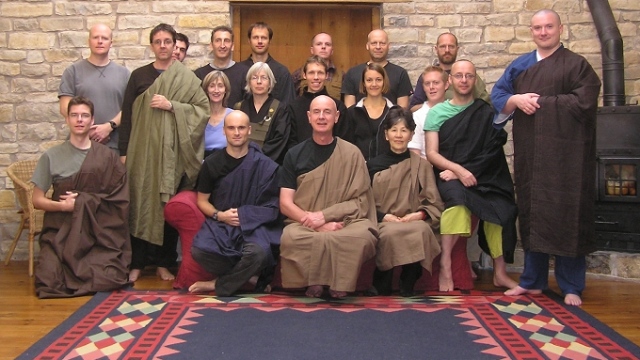
Michael Eido Luetchford
Summer 2007 — Uji, Session 5.
Venue: Earth Spirit.
Michael Eido Luetchford · Summer 2007 — Uji, Session 5
Source: audio transcript.
Editorial note: A digest is a shorter way into the talk: the speaker’s main ideas in their own voice, gathered by theme. It suits a first acquaintance or a reminder; nothing in it is added. The full wording, with all examples and context, is in the full transcript, which remains the authority.
A life made by action now
… what was Bodhidharma’s intention in coming from India to China? On hearing this question, Master Baso Doitsu replied, … At one time present to raise his eyebrow and wink was right, and at another time present to raise his eyebrow and wink was wrong.[1]
Master Dogen introduces this story because it illustrates natural behaviour in time present. The question why Master Bodhidharma came to China is really a question about how we decide the course of our life.[1][2]
Master Baso’s reply illustrates the fundamental Buddhist view: rather than our life being a planned course, which we then sail along, our life is determined at each moment by our action in this moment. Our action in this moment is our real life.[2]
In a very real sense, just what we do now creates a path. But in the present moment, there is no direction. Our action is directed into the here and now; it doesn’t know where it’s going. Looking backwards, we can see that we’re on some kind of path, and then we can even plan where we must be going. That’s one view. But the ultimate Buddhist view, in a very real sense, says actually our life is just created at this moment.[2][3]
Sometimes we make a plan and it influences our action; sometimes it doesn’t. That’s not to deny the value of making plans. We could never function in society without plans. But our plans are not our life itself. For instance, you can go and study how to make management plans and become an excellent theoretical manager, but be absolutely useless in practice, because you’re looking where you’re going, but you’re not looking where you are.[3][4]
Beyond right and wrong
So beyond right and wrong even, whether we like it or not, our life is actually created moment by moment.[4]
But that doesn’t mean we should try to live a life that doesn’t care about good or bad, right or wrong, and doesn’t care about anything in the future. Simply pointing out a very, very simple fact. Bodhidharma acted naturally at each moment, following the circumstances of his life.[5]
But the question is not whether he asked his master if he could go, or was planning to establish a temple in China. The question is much more fundamental than that: how do we live our Buddhist life? Where are we going? And Master Baso’s answer to where we’re going is: here, here, here.[5][6]
Balance and right action
… Being right has become part of him and pulls him in.[6]
That suggests that if we practice zazen, make our body and mind balance, then the balanced state pulls us into right action. ‘Wrong is not always done, and not doing is not always wrong.’ We’ve done the chapter Shoaku Makusa, and he’s commenting using those words, to point out that in doing, we can’t see right or wrong. Afterwards, of course, we can see it. But although we can’t see right or wrong, we can do right or wrong. But doing right or wrong is not only a function of our intention or our moral point of view, but of our whole state of body and mind.[6][7]
Time present and speech
… The mountains are time present, the oceans are time present. Without time present, the mountains and the oceans would not exist.[7]
He’s welding together circumstances and space-time, or here and now. The circumstances we’re in at this moment cannot be separated. He’s driving home the fact that time present, the here and now, is the only thing that’s real.[7]
He goes on to a poem by Master Kisho, a Chinese Zen master describing his experience of preaching. Sometimes he wants to say something but can’t find the words; at another time he’s got some words but hasn’t got the will to say it. It’s a very simple, realistic description of giving a talk.[7][8]
Master Dogen comments, Both will and words are time present. … Before the will has left, the words arrive.[9]
All these short sentences are creating an image of just now, unrelated to before or after. Just at this moment, I produce words: an instantaneous, completely independent act in the present. We don’t know consciously what we’re going to say one millisecond before we speak. Sometimes we might think what we want to say and then say it, but very, very often we just speak.[9]
The Buddhist view of time present is an instantaneous being, not an instantaneous occurrence, but an instantaneous existence. Everything happens now, independently of everything that happened at other times. But that doesn’t mean that Buddhism denies cause and effect.[9]
Words as labels
The word will describes will itself and depicts will as an object.[10]
Because we attach a label to something, we make it into an object. We use the word will to talk about something that is ineffable, that comes and goes inside us. Once we’ve labelled it, it becomes an object. Anger is a label for a fluctuating flow of something in our bloodstream, for example; once we’ve labelled anger, we can make it into an object and say, I have to let my anger out. So words make reality into objects. In the original, Master Dogen uses the word which actually translates as restrict.[10]
And I thought about it for a very long time, and I realized that to describe something is to restrict it. To describe something is to limit it, to define its boundary. So we create objects with our language, with our names.[11]
Dogen’s own poem
Then he goes on to finish the chapter, and he makes up his own version of the poem.[12]
Will and words being half present is also time present. … To experience arriving and leaving like this is to experience time present.[12]
He deconstructs the objects that the poem creates in our mind by saying half of time present instead of whole of time present. So he wants to go beyond the images that the poems create with his own poem. And he says that this is the way we should experience arriving and leaving, suggesting that we can experience the world now, now, now, rather than the process view that we are often trapped in. Or we could do both. And that’s the end of the chapter.[12][13]
An almost unacceptable view
It’s very difficult to understand, because it doesn’t deny our normal view of time, but it puts a point of view which is almost unacceptable: that we’re just living at this moment. When we’re here at this moment, the world is here at this moment. So we can say the world is created at this moment. In a Christian culture, with the backgrounds we have, that brings in all things about creation into our subconscious mind, doesn’t it? As if, well, we must be God then if we’re creating the world at every moment.[14]
It’s describing what we notice when we practice zazen. That’s where his realization comes from. Because we practice the same practice, we can get a faint scent of what he’s talking about.[15]
The state of Buddha
People in Master Dogen’s time and people now who are studying Buddhism think the state of Buddha is something to be attained. They don’t realise that the state of buddha is the state of somebody who’s natural, naturally in this moment.[18]
We can’t find out who we are. But knowing that we can’t find out who we are is finding out. When Master Dogen says they cannot see the person who has not realized who they are, he doesn’t mean literally we all know exactly who we are, but those people don’t. To know who you are is to forget who you are, he writes in Bendowa.[19]
To realize is to make real. But we interpret realize and to know as some intellectual process, but it’s not that. To know who you are is to be comfortable in the present. But even though they think a Buddha is something to be attained, it’s happening now.[19]
Participant: It’s happening now, everybody’s a Buddha.
Everybody’s a Buddha when they’re a Buddha, and nobody’s a Buddha when they’re not a Buddha. When we’re acting in a natural state, sincerely, doing our best at this moment, we can say we’re a Buddha. We do it sometimes. Other times, we cover our natural self up. We impose our views on it, and then we’re not a Buddha.[20]
The state of Buddha is not static. So the words are limiting what we can say.[20]