Uji — Session 1
Talk digest
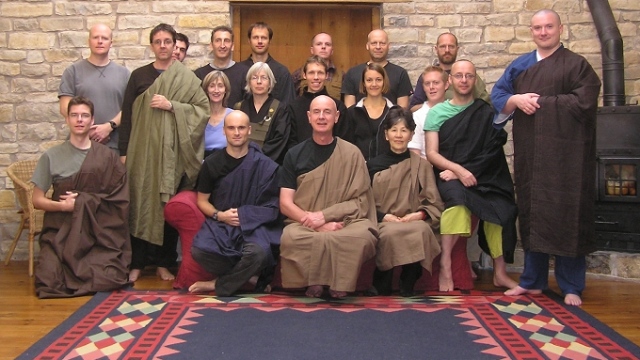
Michael Eido Luetchford
Summer 2007 — Uji, Session 1.
Venue: Earth Spirit.
Michael Eido Luetchford · Summer 2007 — Uji, Session 1
Editorial note: A digest is a shorter way into the talk: the speaker’s main ideas in their own voice, gathered by theme. It suits a first acquaintance or a reminder; nothing in it is added. The full wording, with all examples and context, is in the full transcript, which remains the authority.
The nature of now
At this retreat, I’d like to talk about the Buddhist theory of time. At a conference in Oxford on ‘Consciousness Studies’ I met Susannah Vrobel, who gave a paper on ‘The Nature of Now’. It was very theoretical and quite mathematical; but the fact that she was trying to investigate the nature of now made me very happy, because no matter how we try and investigate something, the fact that we’re investigating it is the most important thing. One never knows where one ends up.[1][2]
She was interested in how “the now” can contain depth. We always think that now is just a point on the line of time. So to meet somebody who thought that the present moment had some kind of depth in it, even from the theoretical perspective, is very interesting to me. From the theoretical point of view, what she was looking at has some kind of similarity to Master Dogen’s view in his chapter ‘Uji’. I wrote a paper on it for her book, with great difficulty.[3]
A world of instants
Those of us who have studied Master Dogen’s writings can feel quite familiar with some of the headings in Stcherbatsky’s Buddhist Logic, such as ‘The Theory of Instantaneous Being’ – they’re what we find Master Dogen talking about. The two buddhist philosophers Stcherbatsky concentrates on, Dignaga and Dharmakirti, lived in the sixth and seventh centuries; neither of them is in the line of transmission of Master Dogen. Their philosophy is very abstract, but as abstract philosophy parts of it are quite good.[4]
… there is no other ultimate reality than separate, instantaneous bits of existence. … The world is a cinema. … It is a mathematical point-instant.[5][6][7]
So this suggests a picture of reality as frames in a film. Now, now, now, now. There’s quite a lot wrong with that view. We can’t really believe that we’re living in a cinema. And Master Dogen, while not rejecting that view, goes in a different direction in the end.[7]
Time that cannot be grasped
Before them, in the second century, Nagarjuna, an ancestor in Master Dogen’s lineage, had already written about existence-time, about the present moment. His way of writing is not completely clear to us. But he’s saying that past, present and future are all dependent on each other, and it’s impossible to work out which comes first. This is my translation:[8][9]
The nature of time is instantaneous and so it cannot be grasped. Static time, which can be grasped, does not exist.[9]
By ‘static time’ he means the kind of time we envisage: ‘It’s ten to twelve.’ We can grasp it, but it does not exist. What we can understand is not the real nature of time, it’s a kind of construction. He says that constructed time depends on things. For instance, we only measure time by events, and events are always connected to things. But, in reality, the world is not composed of things, it’s composed of one whole. So, in the oneness where we don’t name things, how can there be time? But if we remember what we were just doing, practicing zazen: when we’ve stopped thinking, we’re not thinking of things, and time does not exist for us. So this is what he’s saying in this verse. It’s incomplete, but that’s what he says.[9]
A concept we share
Many years later, T. S. Eliot writes in ‘Burnt Norton’:[10]
Time past and time future What might have been and what has been Point to one end, which is always present.[10]
Those verses are remarkably similar to Nagarjuna. It’s known that T. S. Eliot had an interest in Buddhism. Whether he’d read Nagarjuna is not known. [inaudible comment] Is it? He must have pinched it then.[11]
What these Buddhist philosophers and Nagarjuna and T. S. Eliot are talking about is something to do with the fact that although, in our normal lives, we think we know what time is – ‘It’s about twenty past, it says on my watch’ – yet, in our very real experience, we can’t find the nature of time. The moving-on-ness we invent in our brains and share with each other. It’s no good me saying to the cat, ‘Hey, it’s twelve o’clock’, but it is good me saying it to David, because David shares the same concepts as I do. So, time is a human concept. And what they’re pointing to is, ‘Besides the concept of time – throw all that away and what have we got? The only thing we’ve got is the present moment, where we are now.’ And that’s common for all three.[11]
Dignaga and Dharmakirti say that the present hasn’t got any duration. That doesn’t make any sense, or at least I certainly can’t make any sense of it. To me, something has duration, there’s a width to what we’re doing. I can’t see now as a kind of point. Because we’re still here, aren’t we? Their theoretical analysis of the present moment leaves us wanting. We can say in theory, ‘The present moment is infinitely short – then the next moment starts.’ But that doesn’t actually explain anything: ‘There must be a gap in between! How wide is the gap?’[11][16]
Depth in the present moment
And I feel that just the fact that Susannah Vrobel is working on a theory that time has a depth suggests something different from our normal view of time: some richness or depth in the present moment. So, her theory is solving that problem. In other words, if we say we’re only existing now, it’s a very short time to be or do anything, isn’t it? (laughs) So, how can we just exist now but also feel a richness and depth to everything?[12][13]
I think that a lot of the people doing research into consciousness and artificial intelligence will have to, eventually, look at their own experience to make sense of things. That’s my hope. I felt at that conference that these people exploring the nature of consciousness – which is very much related to the now, which is very much the centre of Buddhism – because they’re looking at something that’s reality, eventually, if they keep going, will have to come round to looking at real reality, not abstract reality. Twenty years, fifty years, a hundred years, it doesn’t really matter. They’re studying the right thing.[13]
[inaudible comment about Susan Blackmore] Yes. Her book is about that: What is the nature of our actual experience now? We can tie ourselves up in tremendous knots, or, if we’re very clever, construct wonderful theories, and some of them have some kind of benefit to human beings, although they are theories. Myself personally, if I try to think about what my experience now is, it drives me up the wall. I’d much rather go and have a cup of tea and go out in the garden.[14]
Participating
We could say that when we sit practicing zazen, we experience here and now. We’re often drifting off, we bring ourselves back, thinking ‘Oh, who said zazen was supposed to be peaceful!’ In that process something slowly clarifies about what we’re doing. We’re actually investigating the same thing that Susannah Vrobel is, but from a much more participatory point of view. The scientist has to be an observer in order to be objective, but can’t help participating. Whereas we stupid buddhists can just participate freely. So, if we don’t mind being a bit stupid, we can participate in the experiencing of reality again and again, and maybe one day something might become a bit clear about it! (laughs)[15]
Sometimes I wake up after a disturbing dream and get out of bed feeling ‘Ughh’. But when I walk into the bathroom to wash my face I suddenly realise, ‘Oh, this is the world I’m actually in, with water, hands,’ and I feel very happy, because I return to reality. Returning to this place is to participate in the world. We are participants.[16]
Uji as time-present
It’s quite a big problem, simply because we think about it. Master Dogen realised this and he wrote ‘Uji’, an essay full of images and metaphors. It’s not a kind of ‘A, B, C, D, therefore E’ logical exposition. It’s more a whole kaleidoscope of images and concepts around ‘What is time? What is existence?’[17]
U means ‘existence’, but it also means ‘to be’, and ji means ‘time’. ‘Being’ is somehow warm and real; ‘existence’ is somehow abstract, but they’re referring to the same thing. The title in our translation, ‘Existence-time’, somehow, for me, puts me in an abstract frame of mind. So I wanted to find a phrase that is more concrete. The obvious choice would be ‘Being-time’. But ‘being-time’ sounds like a verb. So somehow it doesn’t grab me.[18]
How about ‘Time-being’?[19]
‘Time-being’, yes. That would do. But I came up with ‘Time-present’. For me, the word ‘present’ also suggests ‘existence’ – ‘to be present’ is ‘to be’. So ‘time-present’ says what I feel Uji says, better than any of the other ways. It may not do for you, so you can put your own title on it. ‘Time-present’ suggests a oneness of time and our existence in time. That is difficult for us to think about, but actually we’re always one with the time now.[19]
Yakusan’s poem
The chapter starts off with Master Dogen quoting a poem by Master Yakusan Igen:[20]
A buddha of old said:
Time-present is standing on the mountain heights. Time-present is sinking to the depths of the ocean. Time-present is an angry demon, time-present is a buddha. Time-present is a formal ceremony, time-present is the temple compound. Time-present is an everyday individual, time-present is pervading the whole Universe.[20]
What the writer wanted to convey was not a series but a collection of concrete happenings: not just time, but time happening, time-events. If you use ‘now’ in the very widest sense, we can make it embrace time and what’s happening in time. In the paper I wrote I used ‘the Now’ as a synonym for Uji. So, Master Yakusan says: ‘Now, standing on the top of a mountain. … Now, an ordinary person.’ So, he wants to say that time-presents are concrete, real. However, we have to be a bit abstract, because looking at my watch it’s twenty past twelve, and at twenty past twelve we stop the talk. So, ‘Time-present is stopping the talk.’ And we’ll continue this afternoon.[20]