Uji — Session 4
Talk digest
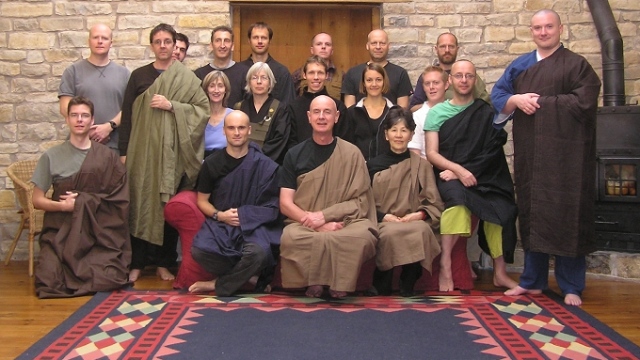
Michael Eido Luetchford
Summer 2007 — Uji, Session 4.
Venue: Earth Spirit.
Michael Eido Luetchford · Summer 2007 — Uji, Session 4
Source: audio transcript.
Editorial note: A digest is a shorter way into the talk: the speaker’s main ideas in their own voice, gathered by theme. It suits a first acquaintance or a reminder; nothing in it is added. The full wording, with all examples and context, is in the full transcript, which remains the authority.
Time never arrives
We suppose that time just passes away. And do not understand that time never arrives.[1]
Although we talk about the present passing into the past and the future coming, we don't have any feeling of time arriving.[1]
People see time as coming and going, and there are few people who can see it clearly as time present, here and now. … Then how can it be easy for them to get the time to attain the truth?[1]
Attaining the truth means to see what's real here and now, and what's created here and now. And seeing what's real here and now means being in time present. So it's difficult for people who see time only as coming and going to attain the truth.[1]
Even among those who see time as what is present now in the universe, who can express clearly what the ineffable something is that they have already got?[2]
Master Dogen is saying that even among people who live in the present, it's very difficult to find somebody who can express what is here and now. He describes it as the ineffable something, because it's impossible to describe the content of the present moment. Whether he includes himself among those who cannot express it clearly or not, I don't know.[2]
And even among those who have long been asserting that they have it already, none of them have stopped groping around trying to find out who they already are.[2]
If we realise what is true here and now, we don't need to grope around to find out who we are.[2]
But leaving these people to their time present, even attaining the truth and the balanced state is just time present that appears to come and go.[2]
Master Dogen's last paragraph describes the real situation. Everything is just time present. Reality is just this moment of the present. It's difficult to grasp the nature of the present moment intellectually, and it's even more difficult to express what is already here.[2]
Without getting rid of hindrances
… In short, time present is always made real without ridding ourselves of hindrances and delusions.[3]
Master Dogen is saying we can always come into the present without getting rid of things that hinder us. That's quite an interesting statement, because it suggests that trying to get rid of things that hinder us actually hinders us. If we hear what the Buddha's state is, we immediately want to try and get it, and we imagine we have to get rid of all things that are not the Buddha state: our thinking, our busy mind. But he says none of that's necessary, because in order to be fully in the present moment, it's not a question of getting rid of things, but just leaving things as they are.[3]
The benevolent forces that appear to the right and left of us are the time present of our wholehearted efforts in this moment.[3]
So he suggests that there are benevolent forces to the right and left of us. When we make a wholehearted effort, these benevolent forces are helping us.[3]
He's describing a situation where we come into the present moment quite naturally, not as a result of trying to be here rather than somewhere else. And the reason is that to be fully present in the here and now is not a mental state, but a state of our body and mind.[4]
Something brings us into the present moment. We might say that our physiological state changes, and we feel more at peace, or something like that. So we can find more detailed explanations of what benevolent forces might be. But the fact is that the moment when we become fully present just appears. We can notice it in zazen. We may have a very busy mind, or achy legs, and then suddenly we're sitting just where we are for a second or half an hour.[9][10]
Effort that makes the world real
… All the beings in this world and other worlds are also the time present of our moment-by-moment wholehearted effort. Our practice teaches us that without our own moment-by-moment effort in time present, nothing could ever be made real or continue from one moment to the next.[4]
What he seems to be suggesting there is that our wholehearted effort in this moment is all. Not only is it being in this moment, but it's everything. We could say it creates the world. It makes everything real. We normally think that the world exists independent of us, but we can never ever test that situation out. Our real experience is always that the real world in front of me and me are one inseparable whole. So me acting in the present moment, being fully here, to Dogen, is creating the world. A very strange statement, really.[4]
The difference between Master Dogen's view and solipsism is that Master Dogen doesn't say the world only exists in my mind. He says reality is the joining between me and the world in this moment. It's not that reality is inside me, or reality is outside me, but me and reality at this moment joining, inseparable.[5]
Participating in the world
Master Dogen talks about wholehearted effort in the sense that when we make a wholehearted effort, we are not interpreting the world, we're participating in the world. If we're interpreting the world, we're separating ourselves mentally from the world, splitting something in our perception between me and things. When we make wholehearted effort, we stop doing that.[5]
Participant: In the modern world, we can turn on a television and you can see images from another side of the planet… I think we're impeded in the modern world in that respect…
In one respect we might be, but in another respect, human civilization has thought about what it's all about for much longer, so we all practice some kind of activity, not because we're apt to plant carrots, but just for its own sake. All those things were probably denied to people in the 13th century. To practice something for its own sake is very difficult. But we practice zazen for its own sake. But if you've got to work from dawn to dusk to make enough food to live, then you can never realize that you're doing things for their own sake.[6]
We can say at the level of our ordinary lives, we're always making a wholehearted effort, but much of the time we think that the effort we're making is for an abstract goal. So in a strange way, we direct part of ourselves outside what we're doing. When we don't, it becomes more whole, or full, or something. This is why the sporting activities of the modern world have become so popular. Unconsciously, people notice what it is to make wholehearted effort, not because they have to finish a deadline, but just because they're on the running treadmill: they're running for the sake of running. And then some people find that too simple, so they put earphones on and watch television, and take themselves out of the moment that they're in. So we have a choice.[7]
Wholehearted effort is Master Dogen's phrase to describe the instant of our life existing, some kind of full dynamicness. And reality is a person and the world meeting in an instant. This is his description of reality.[7]
A simple, direct real
Real for Master Dogen is a very simple, direct real. It's not an abstract real. One abstract real might be watching a film on the television, and knowing the film is portraying something that was real, or may be real somewhere. He's talking about the reality of sitting in front of a television screen, watching film. That itself is reality. It doesn't mean that the film is not real. But it's a different kind of real.[8]
Nothing external between moments
… We should not understand that this momentary continuance is like the wind or rain sweeping from east to west.[10]
… our practice teaches us that the passing of time from moment to moment involves no external object.[10]
So again, he's saying that there's some kind of process or progress from moment to moment, but those moments are independent. There's nothing external that changes the world from this moment to the next moment. That appears to deny that there's any law of cause and effect, because the law of cause and effect links this moment to the next moment. But if we look at the law of cause and effect in great detail, we find the same conclusion at its root as Master Dogen says here.[10]
Scientists are always looking in more and more detail to link one action to the next action by a law. Atomic physicists smash particles of matter into ever smaller particles, and then they have to build a bigger accelerator. There is no end to that process. But however closely you go, you can never find out what's in the gap between one action and the next action. So even science will never be able to fill up that gap.[11][12]
Spring and the unchanging entity
… momentary spring passes through a process that we call spring. But the passing is not spring itself.[12]
He's deconstructing the words we use to describe the passing of the seasons. We give a name to a container called spring, but our actual experience of spring is momentary.[12][14]
But spring is made real at every time present in the process of spring.[13]
At this time it is spring. At this time it is spring. But we construct a season we call spring by stringing all those together.[13]
… if we think that there are only individual things that change on the outside, but there is some real unchanging entity that passes from moment to moment, … we are becoming lax in studying Buddhism in our practice.[13]
We often put some unchanging entity behind the present moment in which we exist: a constructed self, our idea of who we are, our idea of our life, our concept of time. But he says that way of thinking is becoming lax in studying Buddhism.[13]
What zazen teaches
We can't escape from being here. When we practice zazen, practicing zazen teaches us that our being here, sitting in zazen at this moment, is reality. The very simple experience. So he goes further than is reality. He says makes reality, creates reality.[14]
Without making the effort to practice zazen, we can never see that actually being here in this moment is this moment, makes this moment. And without making this moment, there can't be another moment. I can't do any better than that. It's quite inadequate, really.[14]
We think that we're separate from the world. But the momentary experience of me practicing zazen is the whole of the universe at one moment. So he says we create it. Reality is me and the world meeting at this moment, you and the world meeting, me and you meeting. So we are making reality. We notice that we're just sitting here, and there is something, again and again: not time passing, but just this, just here, just now. That very, very simple, indescribable, ungraspable experience is Master Dogen's reality. On top of it, we put our interpretation.[15]
Three worlds
So we can say there's three worlds: the reality in which we are, here and now, always; the world of our ideas and thoughts and interpretations, in which we think that we exist; and the physical world of our senses, which we think is real. When we think about the world, we can never get out of the world of thinking. When we experience the world through the senses, we can never get out of the world of sensual perception.[16]
But when we act, both those worlds disappear, and the world of instantaneous reality shows itself. Not through, but not without our senses. Sitting in zazen, we can focus on the pain in the knee, or a bird outside, and then we're in the physical world. Or we can focus our consciousness on our idea, and we're in the world of ideas. But in zazen, there is a state where we don't focus on either of those. It doesn't exclude them. If you like, we're defocusing. So we're embracing everything. Or another way is we're getting rid of those other two worlds and entering a world of reality. It's not that our senses disappear, but we don't focus our consciousness in one direction. But all these words are very difficult, aren't they?[16]
I always say it's like walking on a tightrope. To keep our balance, we need to wobble between the world of thinking and the world of our senses. But that's only a picture.[17]
Putting it into words
What Master Dogen's trying to do is really impossible. He's trying to talk about what it would be like outside all the labels that we put on things, using labels. We can never get rid of them, because to be human and to discuss things like time is to use containers.[14]
Our ability to describe our real experience is so limited. We're never in the situation where we're only listening to the rain; our consciousness is darting around all over the place, all the time. So to try and pin it down is always to miss the point. But that's the best we can do.[18]
My words are only my attempt to make Master Dogen's words easier. But we can only try.[19]