Uji — Session 2
Talk digest
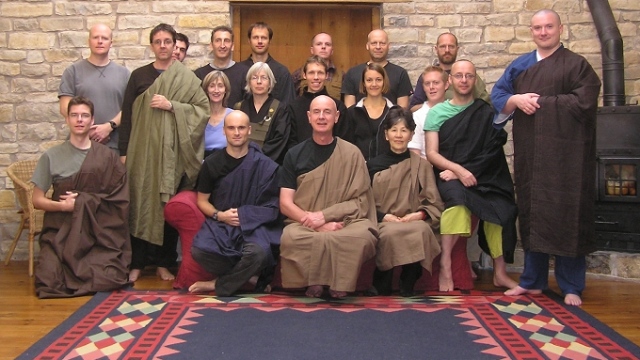
Michael Eido Luetchford
Summer 2007 — Uji, Session 2.
Venue: Earth Spirit.
Michael Eido Luetchford · Summer 2007 — Uji, Session 2
Source: audio transcript.
Editorial note: A digest is a shorter way into the talk: the speaker’s main ideas in their own voice, gathered by theme. It suits a first acquaintance or a reminder; nothing in it is added. The full wording, with all examples and context, is in the full transcript, which remains the authority.
Time is the present
… Zen Master Yakusan Igen's poem, … Time present, an angry demon. Time present, a buddha. …[1]
So the poem identifies time present, or the now, with actual concrete circumstances.[1]
Master Dogen comments, Time present means that time is the present, and the present is time. The state of buddha is always made real at a time, and because of this, the state is illuminated by the light of the present.[1]
In Japanese, time present means time is the same, identified with, inseparable from present. The light of the present doesn't necessarily mean some kind of spiritual searchlight, in a metaphorical sense. It can also be interpreted to mean that when we are actually in the present, we can see things more clearly. In zazen, there are moments where we're just sitting and our eyes are just seeing naturally, and everything is brighter.[1][2]
Time as a measured process
Then Master Dogen puts another point of view: ‘But we must also study time as 24-hour time this day.’ We shouldn't reject the idea that there is a flow of time.[2]
The last zazen session just went like a flash, but I know that it took one hour, because I can measure it. So we have these subjective and objective views of time flowing as a process. He would be silly to reject that, because without viewing time as a process, we can't really function as a human society. We could probably function as a loose band of animals, but not as a civilization. So a civilization is based on us sharing the belief in time as a continuous process.[3][4]
My now and our now
Master Dogen says that every separate person, thing, has their own present moment. I have my now. You have your now. But at this moment, everybody's time present is one time present. So he's pointing out that time present is both independent and inclusive, which are two opposite things. Contradictory. That's because he finds real experience contradictory, depending on how you look at it.[5][6]
Constructing ourselves and our world
This person, who I think of as myself, is a person that I put together at one time present. …[6]
The phrase to realize the truth, which comes up so much, means to realize what is real in each concrete now. And this is what it is to practice a Buddhist life. We construct ourselves at each moment, and the memory of all those held images of myself I think of as permanent Michael. In the same way, our interpretation of the universe is something we construct at every moment, and the world we construct is shared between us all. In constructing our world, we all construct a future. What Master Dogen is saying is that is a construction which human beings make to interpret the world. But in the present moment, there is only what is happening to you, uninterpreted.[7]
But the person who has clarified their real state sees only each thing, each thing, each thing, and lets go of understanding the nature of each thing. …[8]
He doesn't mean that there are people around who live their whole lives like that. Within our lives, we're doing it all the time. Those who were chopping down the brambles may have been just taking each thing, each thing: in one fluid act, you catch hold of a plant and cut it. So what he's describing is not some kind of superhuman person, but just the simple state of action which we all experience every day, sometimes more, sometimes less. In zazen, although we have lots of thoughts coming and going, we also have a period where we experience each thing without interpreting. We are part of one huge whole because we haven't divided ourselves off from it by thinking or by using language.[8][9]
Three lives
It causes confusion, but it can also be beneficial. So we shouldn't think that conceptualization is bad, but we should notice what happens when we conceptualize. We can say we're living three lives simultaneously: the conceptual world that we create, the physical world that we sense, and the world of action, where we lose both and we're just acting, like a baby. But Western civilization is biased towards the conceptual. Right back from the ancient Greeks, we value ideas about the world as much as or more than the world itself. Plato said that there is a real life, which is the conceptual, and the physical world follows it. From that time, we tend to prefer the conceptual and try and make our real world fit in with it.[9][10]
But we can't make the world fit in exactly with our concepts. If we believe our concepts are of paramount importance and try and make the world fit in, we usually have big problems. But the difficulty for human beings is we don't know whether our ideas are realistic until we try them out. So how do we find our way through that maze? What we try and do, at least, is to understand what we construct and share, and what is basic, unconstructed and shared, and go backwards and forwards between them. This is what we do in zazen in a very simple way. We lose ourselves in our thoughts, and then we come back to what we're actually doing, again and again. And slowly, slowly, we get some feeling for what we're doing.[11]
The journey and the crack
Until we study the Buddhist view, it is normal to think … we imagine events as part of a journey, as though we were crossing a river or walking over a mountain pass. …[12]
Here Master Dogen's creating a picture of linear time. We construct our journey and call it our life, and we somehow think that the past is back there somewhere. Zazen is a repeated experience of the now. And human beings are so intellectual that we can't escape from our conceptualization.[12][13]
To be trapped in one view makes it difficult for us to see reality. Whatever happened in the past, we can't put it right now. We can do something now and call it putting the past right, but it's not putting the past right; it's putting the present right. So to find a crack in our linear view of time is a kind of liberation. It doesn't mean we have to say there's no such thing as time. It seems inevitable: we have to agree and accept and believe in a shared flow of process, because that's what keeps us as a civilization going. But to be trapped in it means that we're forever trapped in past, present, future, and that can sometimes create suffering for us.[14]
Peaks and a panorama of time
… At the time when we are crossing the mountain pass or crossing the river, we are present there, and so time is present there. Time cannot elude the present. …[15]
What he's saying in that paragraph is similar to what Stuart is trying to express, and that is, we sense some kind of depth or spread of time even in the present moment. So he says instead of thinking of time as a journey, we can think of time spread out. Astronomers looking out at stars are looking over a panorama of time; they're seeing in the past. This is a similar kind of image that Dogen is trying to create. Only an image. It's only creating ways to look at our experience, because our actual experience is rather more unusual than we normally notice. We're always here. We never see the moment changing to the next moment, yet it's always changing.[15][16]
… we can also think of time as if going up into the mountains and looking out over thousands of peaks, rather than seeing time as passing us by. …[18]
He was writing in the 13th century. He didn't have the vocabulary of psychology, astronomy, or the benefit of Einstein's theory of relativity. So he created poetic images to try and say similar things.[19]
The ship of civilisation
We can't make any sense of how I can see you without linear concepts of time. But that doesn't mean it fits exactly the model that we make sense of. We've constructed our ship called civilisation, and we haven't realised that there's water out there. It doesn't mean that when we notice we're in a boat, we should jump out of the boat. Just we can notice where we are: that we're always here, that everything is always changing, and that there are contradictions.[17]
From the discussion
Because we're searching for the truth, if we carry on searching, we'll find it. Of course, if we search for the truth in the wrong direction, we may never find it. We can crystal gaze from now until we die, but we won't get any nearer the truth. But we have something more excellent than crystal gazing called science. And science says, look at what's outside, and then say, Huh, that's probably not true. Let me find out if it is or not, and then thoroughly pull the thing apart to see whether it's true or not. And if you can't prove that it's false, then you say, Okay, for the time being, that's true, and then you move on. So if science continues in that way, it must move closer to the truth.[19]
Question: That is a non-conceptual experience, rather than a conceptual?
Yes.[20]
Participant: You might get closer to it, but you're always going to miss it until you drop that concept.
Yes. So it's quite interesting that more and more people involved in scientific exploration are interested in practicing zazen. These scientists exploring all these conceptual ideas are sitting like this. They must be doing that for some valid reason. Maybe intuitively they realise, sometime in the distant future I'm going to have to jump out of all this. Or maybe they already know, and they're trying to find the link between outside and inside. I don't know. But I'm sure that if people pursue the truth with the most powerful tools that we have, they'll get closer to it.[20]